
My Employer Accused Me of Stealing Her Mother’s Brooch and Emptied My Bag in Front of Everyone. What Fell Out Made Her Go Silent.
PART 1: Empty the Bag
The woman who accused me of stealing her mother-in-law's brooch made one mistake: she emptied my bag in front of my daughter.
If Aimee had stayed in the car as usual, I might have swallowed what happened. I had swallowed worse things in nineteen years of cooking for the Whitmore family.
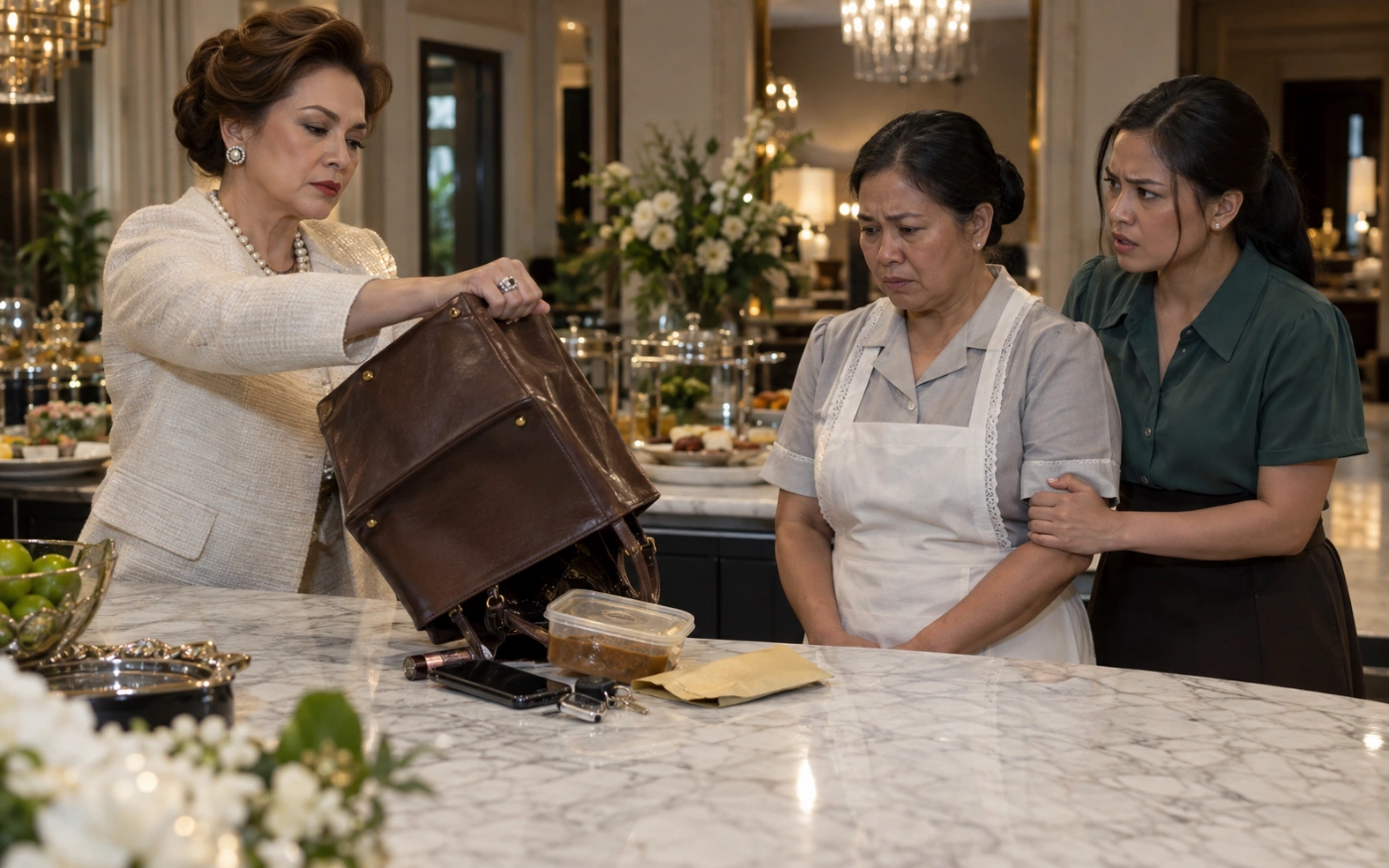
But that afternoon, my daughter walked into the kitchen just as Camille Whitmore held my old brown bag over the marble island and shook.
My phone fell out. My keys. A plastic container of hot stew.
Then a folded envelope landed between us.
And the whole house changed.
That morning, I had arrived at seven to find three caterers arranging silver trays in my kitchen.
I say my kitchen only because I knew every stubborn burner and every floorboard that complained. The house belonged to Mrs. Eleanor Whitmore. I was only the cook.
Not the maid. Not the nurse. Not family.
The cook.
For nineteen years, I had known that Eleanor wanted no vinegar before noon. I knew arroz caldo calmed her on sleepless nights. I knew Friday meant fish, even if she forgot the day, because she had grown up in Tanay in a house where Friday meant fish.
Yet I heard Camille tell the head caterer, “No fish appetizers. Mother has never cared for fish.”
I was trimming green papaya six feet away.
“Understood,” the caterer said.
My knife paused once, then continued.
Camille noticed neither the knife nor me. She checked the flower delivery on her tablet, smiling the small, correct smile she used whenever she was about to make somebody feel unnecessary.
“Marilou, the kitchen must be cleared by four. We have the signing at five.”
“Yes, ma'am.”
It was Thursday, so pork and green papaya simmered on my back burner. Eleanor had described the dish to me in 2006: ginger, broth, pepper leaves, meat soft enough to press apart with a spoon. No recipe. Just a taste remembered from childhood.
Every Thursday, she took one mouthful and said, “Closer.”
Never right.
Lately, there were days she called me Maribel, her sister who died in 1998. Then there were days she could tell from the hallway that I had toasted the garlic ten seconds too long.
She was eighty-four. She was not gone.
But everyone around her had begun speaking as if she were already a framed photograph.
The “party” was really a house sale. Camille and Eleanor's son, Robert, had invited a lawyer and two prospective buyers. Their plan was to move Eleanor into memory care and sell the property, including the little cottage behind the garden.
At three, Camille rushed into the kitchen, pale but perfectly composed.
“Mother's brooch is missing.”
It was an old gold sampaguita brooch, the only jewelry Eleanor still asked for by name.
“She wore it to Mass last Thursday,” I said. “Check the green coat. She put it in the pocket when the pin scratched her neck.”
Camille's expression tightened. “We've already checked her closet.”
Then she asked the florist to open her supply boxes.
Soon everyone was searching—the caterers, the florist, even the lawyer, Mr. Levin, who stood beside a thick folder at the island. Robert checked drawers as though his mother's memories might be filed under cutlery.
Then my phone buzzed.
I'm outside, Aimee had written.
She had come to drive me home, as she did on party days. At thirty-one, she still hated this house. Since she was nineteen, she had been saying, “Ma, quit na. They don't deserve you.”
And I always answered, “Trabaho lang ito.”
Work was easier to defend than affection.
I packed a small container of stew because Eleanor ate better at four than at six, and because I suspected there would be no dinner after the signing. Then I put it in my bag and washed my hands.
“Before you leave,” Camille said, “we need to check everyone's belongings.”
The room became still.
“Everyone?” I asked.
Nobody else's bag was on the island.
“It's nothing personal, Marilou.”
She meant it. That was worse. To her, humiliation was simply the next efficient step.
“Ask me where it is,” I said quietly.
Camille blinked. “Excuse me?”
“You did not ask me.”
At that moment, the kitchen door opened.
Aimee stood there with her car keys in one hand. She looked at my bag, then at the ring of people around me.
“Ma, anong nangyayari?”
“Nothing, anak.”
Camille reached for the bag.
Aimee moved forward. “Don't touch her things.”
I caught my daughter's wrist. “Hayaan mo na.”
For nineteen years, I had protected my place in that kitchen by never making a scene.
So I placed my bag on the marble myself.
Camille unzipped it and turned it upside down.
The stew hit first, then my phone and keys. Last came the envelope, yellowed at the folds and soft at the edges from two years of being carried everywhere I went.
The brooch was not there.
Aimee exhaled sharply. “Satisfied?”
But Camille was staring at the handwriting on the envelope.
She knew it.
We all did.
For Marilou. Open when they try to send me away.
Camille slid one finger beneath the seal.
“Ma'am,” I whispered, “huwag po.”
She opened it anyway.
PART 2: What Eleanor Had Planned
The first page was a letter in Eleanor's narrow blue handwriting.
Camille began reading silently, but her face changed so quickly that Robert took the paper from her.
“What is this?” he asked.
I knew only part of the answer.
Two years earlier, on a clear October morning, Eleanor had called me into the breakfast room. She was fully herself that day—lipstick even, and annoyed that her coffee had cooled.
She handed me the sealed envelope.
“Keep this in your bag.”
“Ano po ito?”
“Something I arranged.”
“For what?”
“For when my children become practical.”
I tried to return it. “I don't want money.”
“Good. Then you won't spend it.”
That was Eleanor: even her jokes sounded like orders.
“Promise me, Marilou. Open it only if they try to move me.”
So I promised. I carried it for two years through grocery runs, bus rides, rain, and every Thursday stew. I never opened it because saying anything would make me something besides the cook, and the cook was allowed to stay.
Now Robert unfolded the second page.
“The cottage?” His voice cracked. “You gave her the cottage?”
Every head turned toward me.
“No,” I said. “Hindi ko alam.”
Mr. Levin finally moved. “May I see that?”
Robert held the papers away. “My mother was already declining.”
The lawyer looked at the date. “This transfer was executed in 2019.”
Five years before the diagnosis.
He read the attached copy, then opened the folder he had brought for the sale. His calm expression tightened.
“The cottage was deeded to Ms. Marilou Santos, recorded and paid in full. It is not part of this transaction.”
Camille's polished voice sharpened. “She manipulated an old woman.”
Aimee lifted her phone.
I saw the red recording light.
“Aimee, ibaba mo 'yan.”
“No, Ma.” Her hand trembled, but her voice did not. “Not this time.”
Mr. Levin kept reading. “There are also two medical competency letters from the date of execution.”
Camille stared at him. “Two?”
“Mrs. Whitmore appears to have anticipated a challenge.”
Of course she had. Eleanor could forget where she left her glasses, but five years earlier she had seen this room exactly as it was now: her son, his efficient wife, a sale folder, and me trying to disappear beside the stove.
Robert turned to me. His voice became quiet, the way people speak when canceling a delivery.
“Marilou, you've worked here a long time, and we appreciate that. But after today, we'll be making other arrangements.”
Nineteen years ended in one breath.
I took off my apron.
Aimee stepped beside me. “Sige, Ma. Let's go.”
“One moment,” Mr. Levin said.
He was not defending me. He did not look angry or heroic. He merely found a third document and answered the fact in front of him.
“You cannot simply dismiss her and sell the property as though none of this exists.”
Robert gave a short laugh. “She's an employee.”
“She also owns the cottage.” Mr. Levin tapped the page. “And your mother's recorded instructions allow Ms. Santos to remain there and continue working for her as long as Mrs. Whitmore lives in this house.”
Nobody spoke.
The refrigerator hummed. Behind me, the stew gave one soft bubble.
Camille reached for the paper. “That can't prevent us from selling.”
“Your buyer was promised the cottage and an empty house,” Mr. Levin said. “Neither is available under these documents.”
“Then change the terms.”
“I cannot.”
“You're our lawyer.”
“And that is my factual answer.”
He closed the folder.
The caterers looked down, suddenly fascinated by their trays. The florist held a bundle of white roses against her chest. But they had all heard. Camille knew they had heard.
Her eyes found me.
“You carried this for two years and said nothing?”
“I didn't know what was inside.”
“You expect us to believe that?”
Before I could answer, a faint voice came from the hallway.
“Believe her.”
We turned.
Eleanor stood at the kitchen entrance in her blue cardigan, one hand gripping the doorframe. Her white hair was uncombed. In the other hand, she held a green wool coat.
The missing brooch gleamed from its open pocket.
PART 3: Why She Chose Me
For one terrible second, nobody helped her.
They were too busy staring at the brooch.
I crossed the kitchen and took her arm. “Dahan-dahan po.”
Eleanor let me guide her to the island. She looked at the papers spread among my keys and the overturned container. She looked at Robert, then Camille, then Aimee's raised phone.
Nobody knew how much she understood.
“Mother,” Robert began, “we were only—”
Eleanor raised one finger.
Her eyes were clear.
“I knew you would stop asking me,” she said. “That is why I asked Marilou to stay.”
Then she turned to me.
“Is dinner ready?”
The room released its breath.
Camille placed the letter on the island. She did not apologize. I did not need her to. Around her stood a caterer, a florist, a lawyer, and my daughter, all silent, all knowing.
Camille picked up her tablet and walked out.
Robert followed.
The buyers never arrived. Mr. Levin packed his folder. The caterers covered their silver trays and carried them back to the van. The florist took the roses. One by one, the rooms emptied until the house sounded like itself again.
Aimee stopped recording.
She looked at my apron on the floor, then at me. “Ma, grabe. Nineteen years.”
I waited for the old argument—for her to tell me I should have left, that loyalty had made me small.
Instead, she picked up my apron, shook it once, and tied it around my waist.
“Mainit pa ba?” she asked, nodding toward the stove.
“It needs reheating.”
“Ako na sa kalat.”
She swept flower clippings and crumbs while I washed the spilled container, skimmed the broth, and added fresh pepper leaves. Eleanor sat at her usual place by the window, the green coat folded over the next chair, the brooch safe in my palm until I pinned it back onto her cardigan.
It was Thursday.
So I served the pork and green papaya stew.
Eleanor leaned over the bowl. Steam touched her face, carrying ginger, garlic, and the green bite of the leaves. Something in her expression loosened.
For the first time that day, she was not an estate, a diagnosis, or a problem to be arranged.
She was simply hungry.
She tasted one spoonful.
Then another.
“My mother made this,” she said.
In nineteen years, she had never told me that.
Aimee stopped sweeping.
Eleanor kept her eyes on the bowl. “Tanay, 1962. Dirt floor. Mountains in the window. I was nineteen.”
Her spoon hovered in the steam.
“I had not met Walter yet. I thought I would live there forever.”
I sat across from her without asking permission.
“Was hers better?” I asked.
Eleanor's mouth curved.
“Of course.”
Aimee laughed softly behind me.
Outside, the last van rolled away. Inside, evening light settled over the island, the opened letter, and three bowls I had filled instead of two.
Eleanor tasted the stew again.
For a moment, she looked past the expensive windows toward a kitchen only she could see.
Then she reached across the table and closed her warm hand over mine.
“Not right yet,” she said. “But closer than last week.”