
A Famous Pampanga Chef Crashed Her Daughter's Wedding Reception and Ruined the ₱500,000 Catering — Then the Groom Did This! 😭🔥
PART 1: Fifty Kilos in the Trash
Ten minutes before my wedding buffet opened, my mother threw fifty kilos of caldereta into the garbage.
Not one tray. Not one serving.
The whole pot.
Three hundred guests were inside a ballroom in San Fernando. I sat at the bridal table in a beaded gown that took four months to make, holding my new husband Nonoy’s hand.
For eight seconds, I thought my wedding was perfect.
Then somebody screamed in the kitchen.
“HOY! BITAWAN MO ’YAN!”
A waiter came backward through the swinging doors. Then another. Then Chef Bogart Villanueva burst out after them with both hands on his head.
“SHE DUMPED IT!” he yelled. “SHE DUMPED THE CALDERETA!”
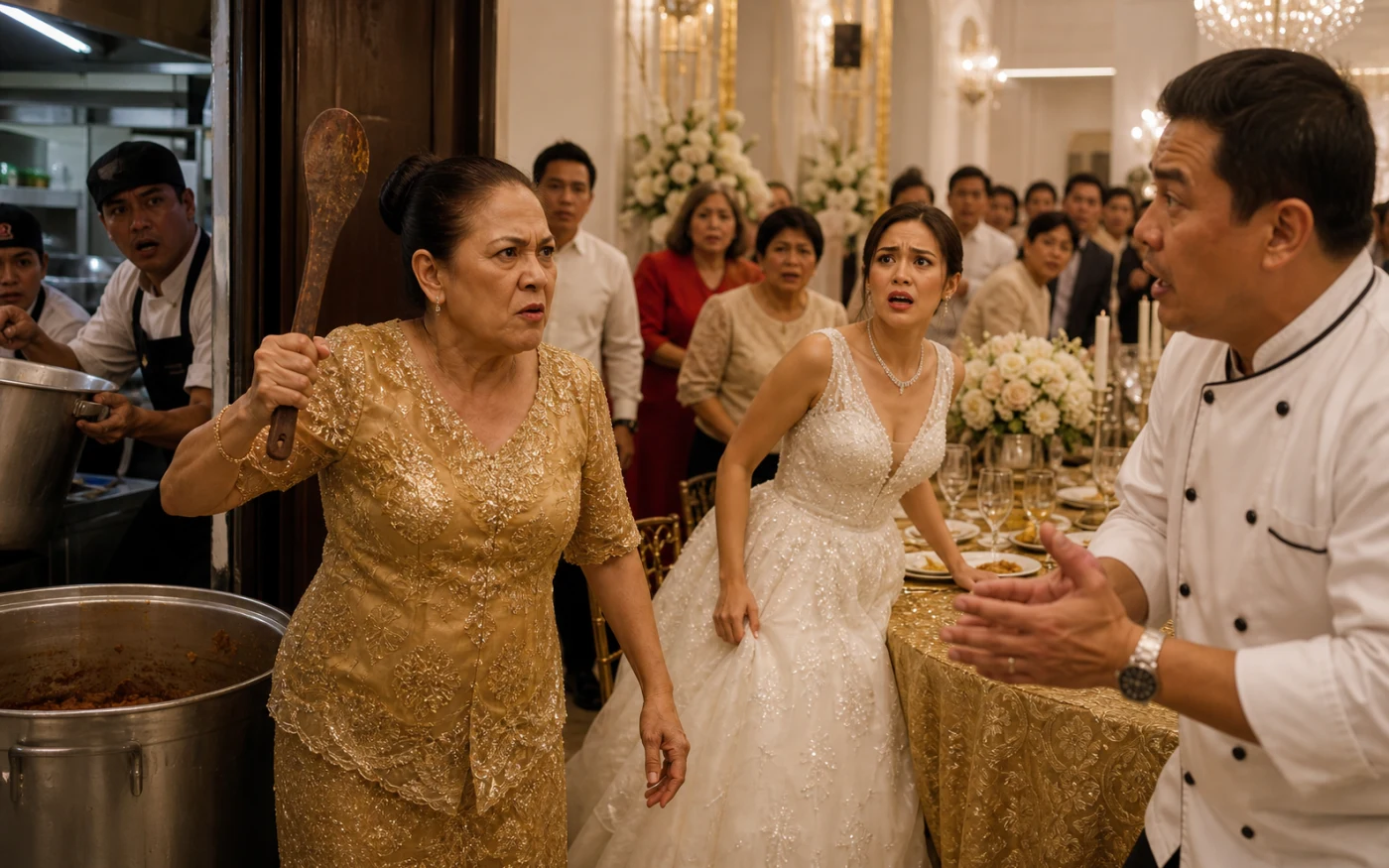
And behind him came my mother.
Rosa Salazar. Fifty-eight. Four-foot-eleven. Hair in the same tight bun she has worn forever. In Pampanga, people know her cooking. She has fed mayors, priests, actors, and one governor who sent his driver back for more kare-kare.
She was also holding Bruha.
Bruha is her wooden spoon. It is older than me. It has burn marks, dents, and one black spot from a Christmas Eve incident nobody is allowed to discuss.
My mother marched into my reception holding that spoon like a weapon.
“Ma,” I said. “Ano’ng ginawa mo?”
She looked straight at me.
“Binuhos ko. Lahat.”
My knees actually went weak.
The caldereta was Chef Bogart’s signature dish. My mother-in-law, Marissa Buenaflor, had paid half a million pesos for the catering because, according to her, our wedding needed to look “elevated.”
That word had been bothering me for six months.
“Nothing too provincial,” she had told the coordinator while my mother was standing right there.
Mama had smiled.
I had pretended not to hear.
That was my problem during the engagement. I kept pretending not to hear things.
Two months earlier, Mama had asked to cook the wedding. She brought a handwritten menu on the back of an old wall calendar. Kare-kare. Mechado. Bringhe. Sisig. Tibok-tibok.
She even circled one line twice.
DIVINE’S FAVORITE CALDERETA.
“Ma,” I told her, “the Buenaflors are already paying for catering.”
“So?”
“So just enjoy the wedding. Guest ka. Relax ka naman.”
She stared at me. “Ayaw mo ng luto ko?”
“Of course I do.”
“Then bakit parang ikinahihiya mo?”
That hit because it was true.
Before I met Nonoy, Mama and I planned a second branch of her little restaurant. I would handle the books. She would cook. We had even looked at a corner space near the highway.
Then I got engaged to a Buenaflor and started learning how to smile when people called my mother’s food “rustic.”
I hated it. I did it anyway.
So when Mama offered to cook my wedding, I told her no.
She folded the calendar once. Then again.
“Sige,” she said. “Basta masaya ka.”
After that, she barely cooked at home for three weeks.
I told myself she was sulking.
Now she had just destroyed the most expensive dish at my reception.
The ballroom went quiet table by table. Even the violin stopped.
Tita Marissa stood up.
She wore pearls, silver silk, and the expression of a woman watching someone drag a goat through her living room.
“Rosa,” she said. “Is this some kind of Pampanga wedding tradition?”
A few Buenaflor relatives laughed.
My face burned.
And then I made it worse.
“Ma, please. Sit down. Nakakahiya na.”
Mama froze.
That was it. Two words. I watched them land.
Her mouth tightened. Her eyes changed. She did not yell at me.
I almost wished she had.
Chef Bogart pointed toward the kitchen. “Half a million pesos! Do you understand? She destroyed my food in front of my staff. I will sue. I will make sure this woman never caters another event—”
“Bogart,” Mama said.
He kept going.
“—and this ridiculous tindera cannot just walk into my kitchen and—”
“BOGART.”
Mama rolled up her sleeve.
Something white covered her forearm.
Not flour.
Not bandages.
Labels.
A whole row of them.
And the second Chef Bogart saw them, he stopped talking.
PART 2: What Was Under the Sticker
Mama peeled one label off her arm and slapped it onto the bridal table. Then another. Then another.
Expiry stickers.
Fifteen of them.
“Galing sa mga kahon mo,” she told Chef Bogart.
He laughed too quickly. “So? Packaging labels. That proves nothing.”
Mama picked up one sticker with her fingernail. “Talaga?”
Then she peeled it apart.
There was another date underneath.
The room went, “OHHHH.” Even Ninang Puring stood up.
Mama held both labels over her head. “Magkapatong.”
Chef Bogart went pale.
Nonoy stood beside me with his jaw tight. He is not a shouting person. His whole family can argue around him while he looks like he is waiting for an elevator.
“Ma,” he asked my mother, “what did you taste?”
Mama pointed Bruha toward the kitchen. “I went in because your mechado had no bay leaf.”
I stared at her. “You crashed the kitchen over bay leaf?”
She looked offended. “Anak, may standards tayo.”
A few people laughed. I almost did too.
Then her face went hard again. She said she tasted one spoonful. The sauce smelled sharp, and the beef tasted wrong, like somebody had washed it in something strong and buried it under spices.
So she checked the boxes.
Fresh labels on top. Old labels underneath.
“Labing-isang araw,” Mama said. “Eleven days past the date.”
Tita Marissa gripped the back of her chair.
Chef Bogart threw up both hands. “This is insane. Those dates are supplier dates. You people don’t understand commercial kitchens.”
You people.
That did it.
Mang Celso at table six leaned toward his wife and said loudly, “Commercial kitchen daw. Amoy Zonrox naman.”
Half the room laughed.
Chef Bogart snapped, “Stay out of this.”
Then Jomar appeared in the kitchen doorway. Nineteen, maybe twenty. Hairnet crooked. Apron stained red. He looked terrified.
“Chef,” he said.
Bogart turned. “Go back inside.”
Jomar stayed where he was. “Chef, ayoko na.”
He raised his phone, and my stomach dropped. Bogart moved toward him, but Nonoy stepped between them first.
Not dramatically. He just stood there.
That was enough.
“Give me the phone,” Nonoy said.
Jomar handed it over. A message was already open on the screen.
Bogart started talking fast. “That can be edited. Anybody can type anything. Emmanuel, your mother paid me to handle this event professionally, and I am not going to be humiliated by—”
Nonoy walked away from him and went straight to Tita Marissa.
“Ma.”
She looked at the phone, then at him. “No.”
“Basahin mo.”
“Emmanuel, not here.”
“You hired him here.”
That shut her up.
Nonoy held out the phone. “Read it.”
Three hundred people waited.
Tita Marissa took the phone. Her voice was strong for the first line.
“Rinse and re-ice.”
The second came out softer.
“New stickers after delivery.”
Then almost nothing.
“Walang makakaalam. They’re provincial. Hindi nila matitikman.”
Silence.
My face burned again, but not from embarrassment this time. I had spent months trying to impress people who thought we were too stupid to taste rotten beef.
Mama looked at Tita Marissa.
Tita Marissa could not look back.
Bogart tried one last time. “It was still edible.”
My mother turned so fast Bruha almost whistled.
“TATLONG DAANG TAO ’YAN.”
Nobody moved.
“May matatanda. May buntis. May mga bata. Tapos sasabihin mong edible?”
Bogart opened his mouth, but Mama pointed toward the lobby.
“Lumayas ka.”
He blinked. “Excuse me?”
“Lumayas ka sa kusina ko.”
It was not her kitchen.
Nobody corrected her.
The venue manager opened the service door. Bogart’s staff started taking off their gloves, and two cooks walked out before he did. Jomar stayed beside Mama.
A few minutes later, fourteen white jackets rolled equipment through my balloon arch.
Then I remembered the obvious problem.
We had no dinner.
Three hundred guests. No caldereta. No trays. No caterer. The bread baskets were already empty.
Somebody’s stomach growled near table ten.
Ninang Puring raised one hand. “Ako ’yon. Sorry.”
I sat down and started crying. Not pretty bridal tears. Full ugly crying. Mascara. Snot. Everything.
“Ma, I’m sorry,” I said. “I chose them. I let them talk down to you. Tapos sinabi ko pang nakakahiya ka.”
Mama’s face softened. “Anak—”
“And now nobody has food.”
That was when Nonoy grabbed the microphone. He looked toward the ballroom doors and smiled.
Not a nervous smile.
A dangerous one.
“Actually,” he said, “we have food.”
He pointed toward the lobby. “Mga kuya. Aga natin nang konti.”
The ballroom doors opened.
And I heard wheels.
PART 3: What Was Waiting Outside
Eleven food carts rolled into my wedding.
Eleven.
Carinderia carts.
Mang Delfin pushed the first one. He had sold sisig near our old school since I was nine. Behind him came Ate Baby, Kuya Nestor, Aling Cora, and half Mama’s street in aprons.
The first pan hit the burner.
TSSSSSSS.
Sisig.
The smell of onions, calamansi, chili, and hot pork rolled through the ballroom. Then came kare-kare, mechado, bringhe, tibok-tibok in little cups, and rice wrapped in banana leaves.
Taped to the front of every cart was a piece of cardboard in thick black marker.
RECIPE NI ALING ROSA
Mama covered her mouth.
For once in her life, Rosa Salazar had nothing to say.
I grabbed Nonoy’s sleeve. “Ano ’to?”
He suddenly looked shy, which made me more suspicious.
“Remember your mom’s calendar menu?” he said.
Mama slowly lowered her hands.
Nonoy nodded toward the carts. “I asked her if we could serve her food later tonight. After the formal dinner. Pang-midnight. Surprise sana.”
I stared at him.
For three weeks, Nonoy had been disappearing after work, supposedly fixing wedding problems. He kept coming home smelling like charcoal. Once he had a burn on his wrist and blamed the car.
“The car burned you?” I said.
He shrugged. “Bad lie.”
Mama smacked his arm. “Sabi ko sa ’yo mahuhuli ka.”
Then she looked at me, and I finally understood why her kitchen at home had been quiet.
She had not been sulking. She had been teaching eleven neighbors my wedding menu so her food could be the late-night surprise. She never expected Chef Bogart to destroy dinner.
She just wanted her daughter to eat her cooking on her wedding day, even after I told her no.
That hurt worse than the shouting.
I walked straight to her and wrapped both arms around her. “I’m sorry, Ma.”
She hugged me for about two seconds, then pushed me toward the carts.
“Okay na. Mainit ang kare-kare.”
That is my mother’s version of forgiveness.
Behind us, the seating chart was already dead. Mang Celso got in line first. Ninang Puring cut in front of him and denied it while standing directly in front of him. Somebody found paper plates, and the violinist stopped pretending this was still a formal program and asked for sisig.
Then I saw Tita Marissa.
She was still beside the bridal table while everybody else moved around her. Mama saw her too, and for one second I thought they might finally fight.
Honestly, part of me wanted it.
Instead, Tita Marissa took off her expensive silk scarf, folded it onto her chair, and walked to the end of the food line.
No assistant. No special plate. No cutting.
Just Marissa Buenaflor standing behind Ninang Puring while sisig smoke curled into her hair.
When she reached Mama, she held out her plate.
“Rosa.”
Mama stared at her.
Tita Marissa swallowed. “I was rude to you. Worse than rude.”
Mama said nothing.
Marissa looked at the kare-kare, then back at her. “Pwede ba akong humingi?”
Mama lifted the ladle. “One scoop?”
Tita Marissa nodded.
Mama gave her two.
That was all. No speech. No hugging. Nobody became best friends.
Marissa carried the paper plate back to her table and ate every bite. Ten minutes later, she quietly got in line again.
Mama noticed.
Of course she noticed.
She pretended not to.
By then my formal reception had become a barangay feast under a chandelier. People ate standing, my cousins carried pots, and Mang Delfin stole the microphone until the violinist took it back.
I laughed so hard my veil came loose.
Then Mama appeared beside me with an apron.
“No.”
“Yes.”
“Ma, this dress cost—”
“Hindi nakakain ang beads.”
She tied the apron right over my wedding gown and put Bruha in my hand.
“Your turn.”
So I served kare-kare at my own wedding. Nonoy carried rice beside me, Mama barked instructions, and Marissa eventually came through the line again like everybody else.
For the first time all day, I stopped worrying whether I looked like a Buenaflor.
I looked like Rosa Salazar’s daughter.
That felt better.
Near the end of the night, Mama pulled something folded from her apron pocket.
The old calendar page.
She had kept it.
On the back were our notes for the second branch. Rent. Tables. Freezer. Signboard.
I looked at her. “Ma. Yung pwesto near the highway. Available pa kaya?”
Mama raised one eyebrow, but she was already trying not to smile.
“Bakit?”
I held up Bruha. “May business partner ka na.”
She snatched the spoon back.
“Partner, oo. Pero akin pa rin ’to.”
Then Nonoy took a picture of us.
Me in my wedding gown with kare-kare on the apron. Mama beside me holding Bruha. Eleven food carts behind us.
And in the background, Tita Marissa was waiting for her third scoop.
That is the wedding photo I framed.