
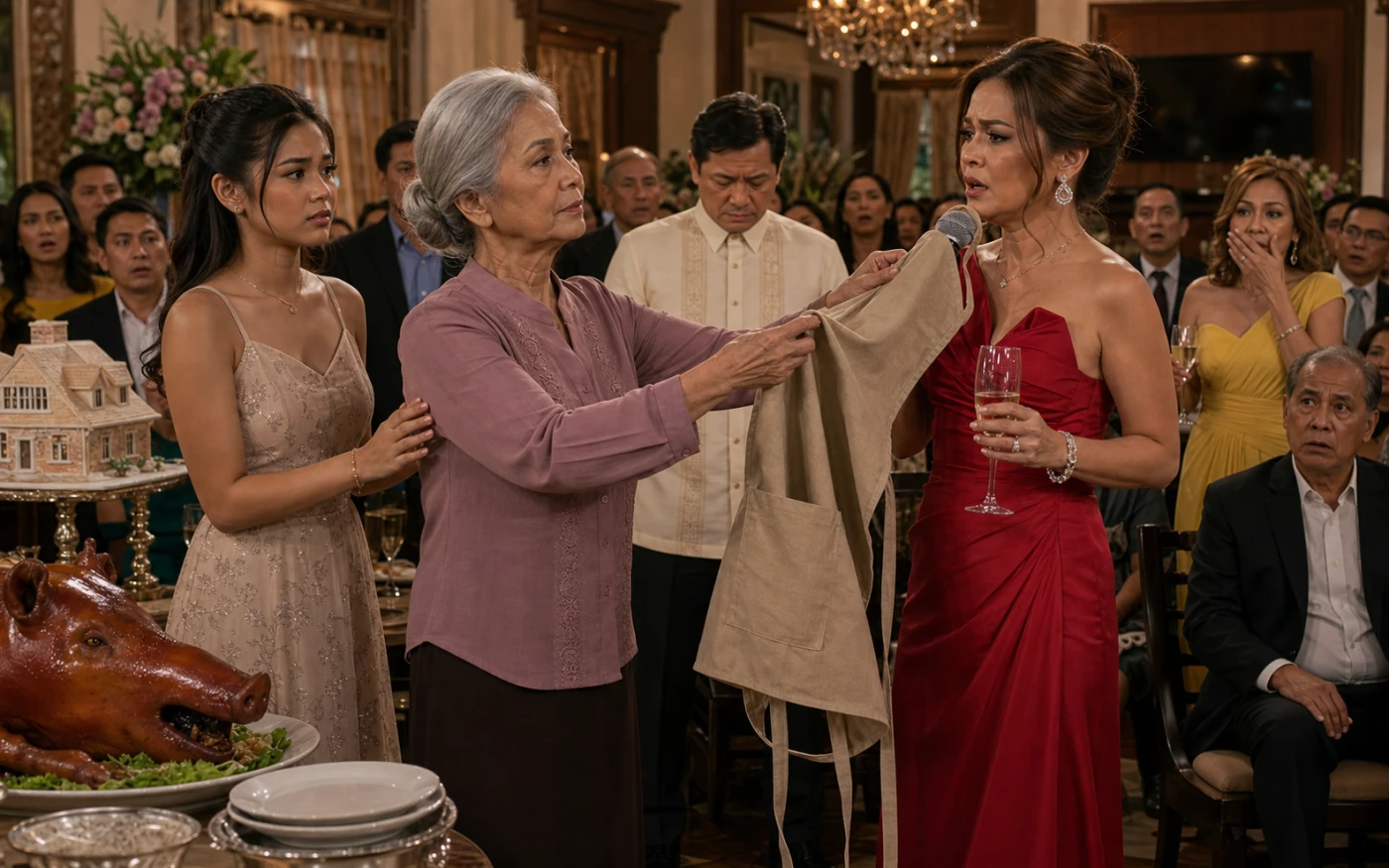
At My Daughter-in-Law’s Birthday, She Called Me “Just the Helper” and Toasted the Sale of My House. Then I Folded My Apron Over Her Microphone...
PART 1: The House She Sold
The woman in the yellow dress smiled at me and asked, “How long have you worked for this family?”
I was holding a tray of lumpia.
In my own living room.
Before I could answer, my daughter-in-law Divina swept between us in a red designer gown.
“Oh, her?” she said. “She’s just the helper.”
Then she pushed an empty champagne glass onto my tray.
“Mama, the kitchen needs more ice. And please use the back hallway. You are wandering into the photographs.”
The woman in yellow looked embarrassed for me.
Divina did not.
At seventy-nine, I had paid for every wall around us.
For thirty-one years, I worked night shifts as a nurse in New Jersey. I missed Christmas mornings, graduations, and my own mother’s funeral. Every month, I sent money home so my husband could build that house in Quezon City one careful room at a time.
When he died, the title remained in my name.
When I retired, I came home believing I would spend my last years surrounded by family.
Instead, my son Boyet and his wife moved in “for six months.”
That was seven years earlier.
First, Divina asked me to stop using the formal dining room because her friends found my medicine bottles depressing.
Then she moved me from the master bedroom to the little room beside the laundry.
Then Boyet started calling my pension “the family budget.”
And somehow, on Divina’s fiftieth birthday, I was wearing an apron while sixty guests drank champagne under the chandelier my nursing shifts had bought.
There was a string quartet beside the television.
A whole lechon occupied the dining table.
In the center of the room stood a sugar replica of my house with gold icing across the roof:
OUR NEXT CHAPTER.
My granddaughter Isay found me refilling the ice bucket.
She was twenty-two, still in nursing school, and the only person who came to my room every morning to take my hand and say, “Mano po, Lola.”
“Why are you wearing that?” she asked.
“Your tita said the caterer was short-staffed.”
Isay pulled the apron over my head.
“The caterer has fourteen employees.”
Divina appeared behind her.
“Put that back on.”
“She is not your servant.”
“She likes helping.”
“Then why did you tell that woman she was the helper?”
The quartet stopped between songs.
The nearest guests turned toward us.
Divina laughed the laugh she used when she wanted cruelty to sound sophisticated.
“Isay, don’t create drama at my birthday. Mama gets confused. Giving her little tasks makes her feel useful.”
I looked at my son.
Boyet heard every word.
He lowered his eyes.
That hurt more than Divina’s lie.
I had held him through asthma attacks. I had worked double shifts to pay his university fees. I had eaten crackers for dinner so he could have a new school uniform.
And when his wife erased me in my own home, he studied the floor.
Divina clapped her hands.
“Everyone, it is time for our announcement!”
The lights dimmed.
A video began showing aerial views of my neighborhood, architectural drawings, and a shining new condominium tower.
Then a rendering appeared of my house being demolished.
In its place stood twelve luxury townhouses.
I stopped breathing.
Divina lifted a microphone.
“Tonight, Boyet and I are celebrating more than my birthday. After years of sacrifice, we have sold our family property to Solara Development!”
The guests applauded.
Boyet did not.
“The deposit has been paid,” Divina continued, “and next month we move into our beautiful new penthouse.”
Isay grabbed my hand.
“Lola, did you know?”
“I knew they were trying. I didn’t know they’d already taken money for it.”
Divina pretended not to hear.
“And because Mama needs professional supervision now, we have reserved her a lovely room at St. Agnes Senior Residence.”
People stopped clapping.
The room they had chosen was smaller than my laundry room.
They planned to pay for it with my pension.
“You sold my house?” I asked.
Divina smiled for the guests.
“Our house, Mama. Boyet has special power of attorney. Everything is handled.”
“And when were you planning to tell me?”
“We are telling you now.”
She raised her glass.
“To family, sacrifice, and our next chapter.”
I placed the tray of lumpia on the table.
Then I removed my apron and folded it over the microphone in Divina’s hand.
“Before we toast,” I said, “perhaps Attorney Reyes should explain how you sold a house that belongs entirely to me.”
Every head turned toward the lechon.
My lawyer put down his fork, wiped his mouth, and opened the briefcase at his feet.
Inside was my owner’s duplicate certificate of title.
PART 2: The Forged Signature
Divina stared at Attorney Reyes.
“Why are you at my party?”
“Mrs. Villanueva invited me,” he said.
For the first time all evening, Divina looked at me as if I were not furniture.
Attorney Reyes raised the certificate.
“This property has been registered solely to Remedios Villanueva since 1987. There is no mortgage and no co-owner.”
A man near the champagne table stepped forward.
“That cannot be correct,” he said. “Solara Development received a notarized special power of attorney authorizing Mr. Villanueva to sell.”
He introduced himself as Solara’s acquisitions director.
Divina recovered quickly.
“Exactly. Mama signed it because she cannot manage complicated decisions anymore.”
“May I see it?” I asked.
The director opened a folder.
There was my name beneath a trembling signature.
REMEdios Villanueva.
The person who forged it had even added a little shake, as if old age were a font.
“That is not my signature,” I said.
Divina sighed into the microphone.
“This is what we deal with. She signs something, then forgets. Last week she left the stove on.”
“I have not used that stove in three years. You banned me from your renovated kitchen.”
Somebody laughed.
Divina’s cheeks reddened.
Boyet finally spoke.
“Mama, maybe we should discuss this privately.”
“You announced my removal publicly. We will discuss it publicly.”
Isay squeezed my hand.
She was the reason Attorney Reyes was there.
Two weeks earlier, Isay found a brochure for St. Agnes under the printer. My name was written across the cheapest room. Beside it lay practice pages covered in crooked versions of my signature.
She photographed everything.
When she showed me, I wanted to believe there was an innocent explanation.
Then I called Attorney Reyes. A title check showed that someone had already submitted sale documents for my home.
Attorney Reyes displayed Isay’s photographs on the television.
The guests saw twenty-seven attempts to copy my name.
At the bottom of one page, Divina had written:
Make the R shakier. She is almost eighty.
The woman in the yellow dress whispered, “Grabe.”
Divina pointed at Isay.
“She planted those! She wants the house!”
“I wanted my lola to know you were evicting her,” Isay said.
“After everything we gave you?”
“You paid one semester of my tuition with money from Lola’s account.”
Boyet flinched.
I turned toward him.
“Is that true?”
He said nothing.
Attorney Reyes opened a second folder.
It contained seven years of bank statements.
“Mrs. Villanueva’s pension paid the property taxes, electricity, water, renovations, household staff, and tonight’s caterer,” he said. “Mr. and Mrs. Villanueva transferred a total of 3.8 million pesos from her accounts.”
The guest beside Divina looked down at her champagne.
“Boyet gives Mama an allowance,” Divina said desperately.
“Two thousand pesos a month,” I replied. “From the account where my own pension is deposited.”
The acquisitions director turned to Divina.
“Where is Solara’s five-million-peso deposit?”
Divina clutched the microphone.
“Safe.”
The woman in yellow stepped forward.
“It is not.”
She introduced herself as Elena Valdez, chief compliance officer for the bank handling the sale.
She was the woman Divina had told I was the helper.
“Mrs. Villanueva’s complaint triggered a fraud review this morning,” Elena said. “The remaining funds are frozen, but more than one million pesos has already been withdrawn.”
Everyone looked at the party.
At the quartet.
At the lechon.
At Divina’s red gown, diamond earrings, and enormous sugar house.
“You spent a stolen deposit on your birthday?” Isay asked.
“It was not stolen!” Divina screamed. “This family owed me something!”
“For what?” I asked.
“For living with an old woman for seven years!”
The silence after that was enormous.
Even Divina seemed shocked by her own mouth.
I looked at Boyet.
“Did you know she forged my signature?”
His eyes filled.
Divina grabbed his arm.
“Think before you answer.”
“Did you know?” I repeated.
My son walked to the center of the room, past the guests who had spent years hearing how generously he supported his poor mother.
Then he lowered himself to his knees.
“I did not just know,” he said.
He looked up at me.
“Mama, I signed your name.”
PART 3: Thirty Days to Leave
Divina slapped the microphone against her dress.
“Get up, Boyet.”
He stayed on his knees.
“She said Mama would never understand the papers,” he told the room. “I signed the special power of attorney. I transferred the pension money. I told myself the house would belong to me eventually.”
“You are her only son,” Divina snapped. “It should belong to you.”
“I am still alive,” I said. “None of you inherit me before I am finished living.”
Attorney Reyes almost smiled.
Divina rushed toward the title.
“Give me that!”
She caught one heel in the rug.
Her shoulder struck the dessert table.
The sugar replica of my house slid forward, tipped off its silver stand, and collapsed across the floor.
Its gold roof split in two.
The words OUR NEXT CHAPTER landed upside down in buttercream.
No one helped her pick it up.
Elena Valdez announced that the bank was freezing the accounts connected to the fraudulent sale. Solara canceled the purchase and demanded the missing deposit be returned.
Then Attorney Reyes handed Isay a document.
“This was registered this morning,” he said.
I had placed the house in a family trust, with my lifetime right to live there protected and every compulsory heir’s lawful share preserved. Isay would serve as trustee if I could no longer manage it myself.
Isay began crying.
“Lola, I did not warn you because I wanted the house.”
“I know.”
“I would rather have you.”
“That is why I trust you with it.”
Divina stood with frosting on her red gown.
“You cannot throw us out. We are family.”
“You called me the helper.”
“That was one joke.”
“You forged my name, emptied my accounts, sold my home, and reserved me a room without asking.”
I picked up the apron.
“A joke is supposed to be funny.”
Boyet bowed his head.
I gave them thirty days to leave.
Divina called me heartless in front of sixty witnesses.
The woman in yellow answered before I could.
“Heartless would have been moving a seventy-nine-year-old woman out tonight. Thirty days is generous.”
That ended the discussion.
The next morning, photographs of Divina standing over the collapsed sugar house reached every social circle she had tried to impress.
But public embarrassment was only the decoration on her karma.
She sold the diamond earrings, returned the penthouse deposit, and repaid what she could. Boyet signed a formal confession that cleared Isay and me of any role in the fraud. Their attorney negotiated repayment of the remaining money.
They moved into a small rented condominium.
Divina complained that the kitchen had no island.
I heard this and survived.
Boyet came to my gate six Sundays later.
He was alone.
“I have no excuse,” he said. “I thought being your son meant I had already earned everything you built.”
“And now?”
“Now I understand I had not even earned the right to enter.”
He bent toward my hand.
I let him mano.
But I did not give him a key.
Love can leave a door open without moving the thief back into the bedroom.
Isay graduated from nursing school the following year.
At her pinning ceremony, she asked me to stand. In front of the whole auditorium, she said, “My lola worked thirty-one years of night shifts so our family could have a home. I became a nurse because she taught me that care is not what you claim. It is what you do when nobody is applauding.”
That time, everyone applauded.
Today, I am writing this from my sala with my feet up.
The master bedroom is mine again.
My pension goes into an account only I control.
The apron is framed inside the pantry beside a copy of the forged signature.
Underneath, Isay added a little brass plaque:
SHE KEPT THE RECEIPTS.
Sometimes guests still ask whether I am the lady of the house.
I tell them no.
I am the woman who built it.
There is a difference.