
Someone Kept Winning the Office Potluck with My Lola's Pancit. So I Left a Sabotaged “New Recipe” on My Desk and Waited.
PART 1: The Yellow Card
I want to say the trap worked perfectly.
It did.
That was the problem.
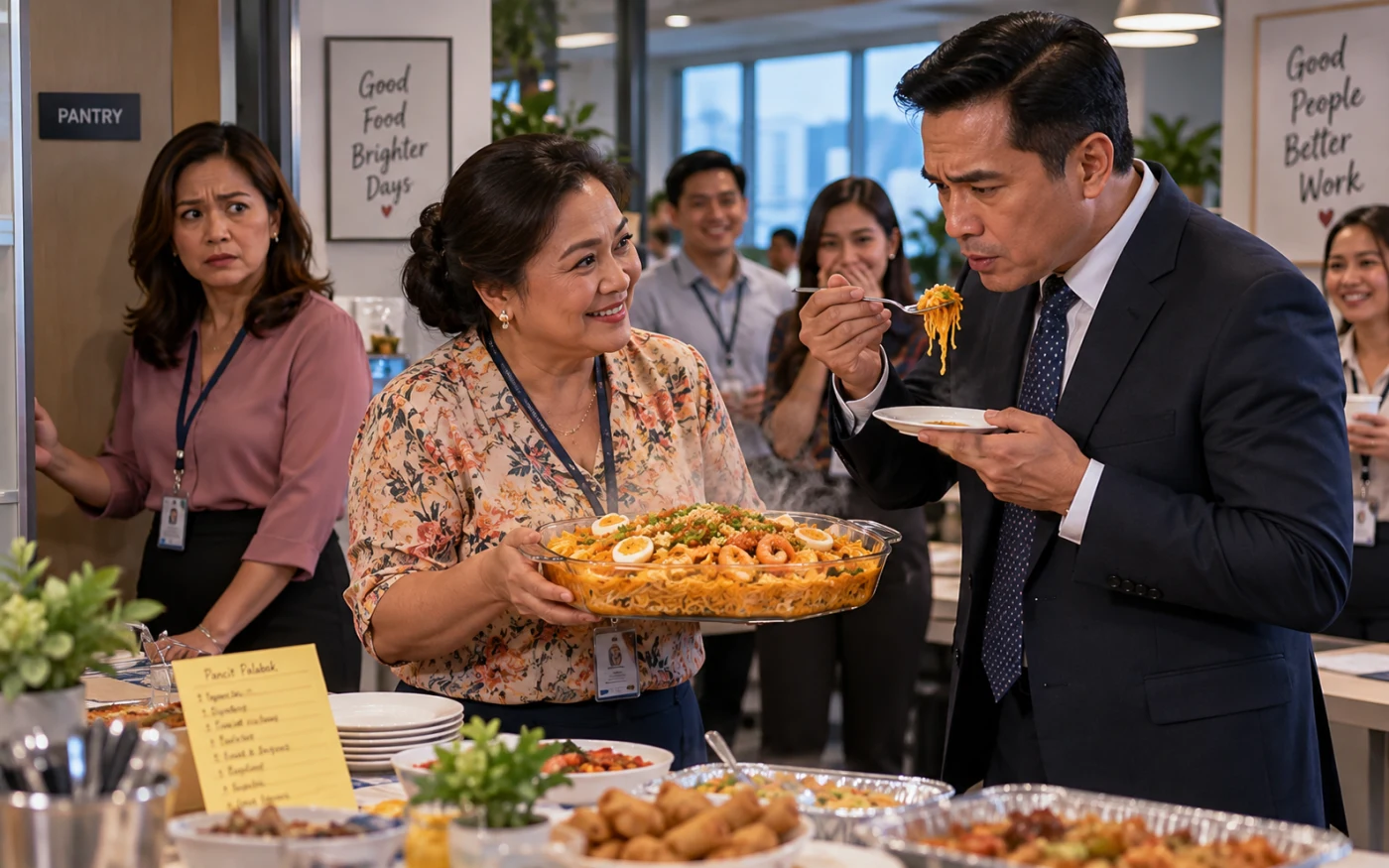
The moment our regional vice president spit Marilyn's pancit palabok into his napkin, I knew I had caught her. I stood by the pantry door holding my paper plate, feeling like a detective in a movie.
That feeling lasted a few seconds.
Then everything went wrong, and it was my fault. But let me start with the pancit.
I process insurance claims in an office in Quezon City. It is quiet work. Nobody fights.
Except once a year, at the potluck.
Our potluck has trophies. Gold plastic trophies, the kind you can buy for less than a jeepney fare.
People treat them like Olympic medals. I have seen a grown man from underwriting go home early after his kare-kare lost.
And for three years in a row, Marilyn from accounting won Best Dish with pancit palabok.
Every year I ate it. Every year I thought the same thing.
That is my Lola Celing's palabok.
Not similar. Not "inspired by." Hers.
Lola toasted the shrimp shells almost too dark. She used just enough tinapa for smoke. And she put exactly one teaspoon of bagoong in the sauce. Not two. Not "to taste." One.
She wrote it all down in blue ink, in a notebook she kept wrapped in an old dish towel. When she died, the notebook came to me.
I never married. I don't have children. Some nights I would take the notebook down, unwrap it, and wonder where it would go after me.
Then I would wrap it back up and put it away, because that is not a question you can answer on a weeknight.
Years ago, I copied the palabok recipe onto a card for an office Christmas party. After the party, I kept the card in my desk drawer, next to my stapler.
As far as I knew, there were only two copies of Lola's recipe in the world. One in my kitchen. One beside my stapler.
Then Marilyn started winning trophies.
The first year, I told myself I was imagining it.
The second year, I asked her, "Uy, Marilyn, where did you get your recipe?"
She hugged her trophy. "Family secret."
"Your family?"
"Oo naman."
The third year, our branch manager asked her to share the recipe in the group chat.
"Secret nga," she said, and posed for pictures.
Every bite tasted like Sunday lunch in Lola's kitchen. And there was Marilyn, smiling for the camera with my grandmother in her tray.
By the fourth potluck, I had solved the case. Marilyn had been snooping in my desk. There was no other explanation.
So I made a trap.
I copied Lola's recipe onto a bright yellow card. At the top, in big letters, I wrote:
LOLA CELING'S UPDATED PALABOK. NEW VERSION.
Everything below was correct.
Almost.
Where Lola said one teaspoon of bagoong, I wrote:
6 HEAVY TABLESPOONS BAGOONG. DO NOT REDUCE.
Six tablespoons of bagoong could season a swimming pool. My hand hurt writing it. Lola would have hit me with a ladle.
I left the card sticking out from under a folder and went to lunch.
When I came back, it looked untouched. By the next day, I was starting to wonder if I had become a middle-aged woman setting shrimp paste traps for an innocent accountant.
Then potluck Friday came.
Marilyn walked into the pantry carrying a giant foil tray.
She looked delighted.
"New version this year!" she announced.
My whole body went cold. Then hot. Then cold again.
The regional VP was visiting from Makati, so of course everyone made him take the first serving.
I would like to say I tried to stop him.
I did not. I was busy being right.
He took one big bite. His eyes filled with tears. He coughed into his napkin, grabbed his water, then grabbed somebody else's water.
"Very..." he gasped. "Very flavorful."
Our branch manager took a tiny bite and squeezed a whole handful of calamansi over his plate, like citrus could perform an exorcism.
I waited for my victory to feel good.
It didn't. Because Marilyn looked confused.
Not guilty. Confused.
She took a bite herself. Her whole face collapsed.
"Ano ba 'to?"
Then she pulled out her phone and called someone.
"Jomar," she snapped. "What did you do to the palabok?"
A teenage voice came through the speaker. "Nothing, Ma! I followed it exactly!"
"Followed what?"
"The new one. The yellow card on Tita Nora's desk."
Everyone near the table turned and looked at me.
I looked at Marilyn.
Marilyn looked at me.
"It said Lola Celing's updated recipe," Jomar added helpfully. "It said do not reduce."
Marilyn lowered the phone slowly.
"Nora," she whispered. "Who is Lola Celing?"
And that was when I understood.
Marilyn had never been in my desk.
Her son had.
For three years, I had hated the wrong person. And I had just fed our vice president six tablespoons of revenge.
PART 2: What Fell Out of the Delivery Bag
"Put him on speaker," I said.
Marilyn looked at me like I had asked for one of her kidneys.
"Nora..."
"Speaker."
She pressed the button.
"Jomar," I said. "Updated from what?"
Silence. Not bad-signal silence. Guilty-teenager silence. It has a very specific sound.
"Tita Nora," he said finally. "I can explain."
"Good. Come explain."
He was already nearby, so he came straight to the office.
He walked through the glass doors carrying two insulated delivery bags and a shoebox held together with rubber bands.
He was still wearing his school ID. He looked like a boy walking into his own trial.
Marilyn marched him into the pantry. "Tell her."
He set everything down on the table. Then he opened his phone and showed me a photo.
My desk. My stapler. My handwriting.
Lola's recipe. The real one. The photo was years old.
I sat down.
"I used to wait at your desk after school when Ma worked late," he said quickly. "I saw the card. I was trying to sell food at school. I thought maybe I could make palabok."
"You took a picture of it."
"Yes."
"You knew it wasn't yours."
"Yes."
"And this week you photographed the yellow one too."
He looked miserable. "I was dropping off lunch orders while you were out. It said new version. I thought you improved it."
Marilyn spun on him. "You stole Nora's recipe?"
"You told me the potluck wins would help!"
That stopped everyone.
I looked from one to the other. "Help what?"
The story came out in pieces.
Jomar had always loved business. In grade school, he sold pens. Then snacks. Then he charged boys to print their love letters on "premium paper."
Then he decided lunch boxes were the future.
There was one problem. Jomar could not cook.
His fried rice got no repeat customers. His adobo got complaints.
Then he found my card.
His first batch of palabok sold out. The second batch had orders before he even made it. Soon the teachers were buying too.
"So I had an idea," he said, looking at the floor. "If Ma entered it in the potluck and won, I could say it was award-winning palabok."
I turned slowly to Marilyn.
Her face was bright red.
"You knew he cooked it?"
She nodded.
"And you let everybody think you did?"
Another nod.
"For three years?"
"Nora, I thought it was his recipe!"
"But you took the trophies."
"I know."
"You posed with them."
"I know."
"You told me 'family secret.'"
Marilyn covered her face.
"Technically, I am family," Jomar said quietly.
"Not helping," said Marilyn.
I wanted to stay furious. I had earned it. I had three years of fury saved up.
Then his phone started buzzing.
Orders. One after another.
Two palabok Friday please.
Add one for Sir Allan.
Can you deliver before lunch?
He opened the shoebox to write them down.
Inside, everything was labeled. An envelope for each delivery route. An envelope for change. A list of regular customers. Little notes in careful handwriting.
Clinic: no onions for Ma'am Tess.
Guard station: deliver first, they eat early.
I stared at it. "You made all this?"
He nodded.
I should have told him to delete the photo and go home.
Instead, I heard myself say, "What else do you sell?"
He brightened a little. "Adobo. Lumpia. Spaghetti. Pork steak. Buko pandan."
"Let me taste."
His face fell. "Tita..."
"All of it."
He had it in the delivery bags already. Of course he did.
Within minutes, I understood why stolen palabok was carrying his entire business.
The adobo was dry. The lumpia was soft and oily at the same time, which I did not know was possible.
I took one bite of the spaghetti and put down my fork.
Jomar waited. "So?"
I looked at him.
"You can sell," I said.
He smiled weakly.
"You cannot cook."
The smile disappeared.
Marilyn made a small choking sound that was definitely a laugh.
"I know," Jomar said to the table.
He started packing up. He closed the shoebox. He picked up a delivery bag.
A sticker fell out onto the floor.
I picked it up. It was one of his box labels, hand-printed, with a little drawing of a cooking pot.
It said: LOLA'S PALABOK.
"Why Lola?" I asked.
Jomar shrugged, embarrassed. "The card said Lola Celing's. I didn't know who she was. It didn't feel right to take her off."
I looked at the sticker in my hand for a long time.
"People call it that now," he added. "At school. They ask, 'Is there Lola's today?'"
All those nights I had wrapped the notebook back up and put it away, wondering where it would go after me.
And all that time, Lola's name had been going out the door every Friday in a boy's delivery bag. To people who asked for her by name.
A thief had been keeping my grandmother alive.
Marilyn saw my face and went quiet.
"Come to my house tonight," I said. "Both of you."
That evening, Jomar arrived holding the shoebox like it was evidence. Marilyn arrived holding her plastic trophies like they were evidence too.
I ignored both.
I went to my kitchen cabinet, took down the dish towel, and unwrapped Lola's notebook on the table.
Jomar's eyes went wide.
I opened it.
Palabok. Kare-kare. Chicken pastel. Pancit bihon. Menudo. Arroz caldo. Page after page of blue ink.
"You stole one recipe from me," I said.
He lowered his head. "I know."
I turned the notebook around so it faced him.
"How would you like the rest?"
PART 3: What Happened to the Trophies
Jomar did not answer for a long moment.
Then he said, "Legally?"
I almost laughed.
"With permission," I said.
"Yes."
"With conditions."
"Yes."
"You never take a picture of anything again without asking me."
"Yes."
"You do not change my measurements."
He looked wounded. "I learned that."
"I cook. You sell. You watch me cook, and you learn."
"Yes, Tita."
"And you stop telling people it's award-winning when the award belongs to your mother."
Marilyn pushed the trophies across my table.
"Actually," she said. "About that."
On Monday morning, she carried them into the office herself. She stood by the pantry table while half the floor pretended to work.
"I owe everyone an apology," she said.
She looked miserable, holding the ridiculous gold plastic trophies against her chest.
"My son cooked the palabok I entered. I let you all think I made it because I liked winning."
Somebody in underwriting whispered, "Grabe."
Marilyn kept going. "I didn't know the recipe was stolen from Nora. But these were never mine."
She put the trophies on my desk.
I looked at them. Then at her.
"You can keep the middle one," I said.
Her eyes widened. "Why?"
"It has a crack."
She stared at me. Then she laughed so hard she had to sit down in a swivel chair, which rolled away with her.
That was how the war ended.
The work started that Saturday.
Jomar arrived at my house before sunrise with the order sheets already printed. I cooked. He watched every step like it was an exam.
When I toasted the shrimp shells almost too dark, he reached for the pan.
I slapped his hand.
"It's burning, Tita!"
"It's supposed to."
He wrote that down. "Supposed to burn," he said to his notebook, very seriously.
Later that morning, Marilyn stopped by to drop off his jacket and found us buried in receipts.
"You're losing track of money," she said.
Jomar lifted the shoebox. "I have a system."
"This is footwear," said Marilyn.
The next week, she came back with a proper ledger. She joined us.
We called the business Celing & Jomar. I insisted Lola's name come first. Jomar did not argue. He said it was better branding anyway.
The chicken pastel sold out the first day. Then the arroz caldo. Then Lola's cassava cake, which made a grown security guard call me "Nanay."
Offices started calling. Then more offices. Then offices we had never heard of.
One day I looked up from the stove and realized I had not thought about insurance claims all week.
So I left the company. They gave me a cake at my goodbye party. It was store-bought. I said nothing. I am a professional.
A year later, my old branch manager called.
"The anniversary lunch," he said. "No potluck this year."
"No?"
"We're hiring a caterer."
I waited.
"You," he said.
The morning of the anniversary, I stood in a rented kitchen looking at rows and rows of packed lunches. Palabok. Chicken pastel. Lumpia. Cassava cake.
Every box had the same small label Jomar had designed.
CELING & JOMAR
And underneath, in smaller letters:
Family recipes. Properly shared.
I told him that line was cheeky. He said it was branding.
By lunchtime, he was standing beside me with a phone in each hand, taking orders faster than I could understand them.
"Tita, do we still have sauce?"
"We have sauce."
"Good. Ma, stop touching the delivery list."
"I am fixing your math," said Marilyn.
Then the regional VP appeared at the kitchen door.
The same man I had nearly ruined with six tablespoons of bagoong.
He looked at the trays. Then at me.
"Safe?" he asked.
"One teaspoon," I said.
He nodded solemnly. "Excellent."
He took the first box. Later, he came back for seconds.
Near the end of lunch, I carried an empty tray to the loading door and stopped.
Boxes were going out in stacks. Riders were carrying them down the stairs.
People I had never met were reading my lola's name before they opened their lunch.
For years, I had kept her wrapped in a dish towel, wondering where she would go after me.
Now I knew. She was going everywhere.
"Tita."
Jomar was beside me, holding up his phone.
On the counter was a new recipe card I had written that morning. Lola's kare-kare.
"Can I take a picture?" he asked.
I looked at him. Handed him the card.
He took the photo and held the card out to give it back.
"Keep it," I said.