
The Bank Manager Accused Me of Passing Counterfeit Bills and Locked the Doors — Then I Asked a Question He Didn’t Want Answered...
PART 1: The Number Underneath
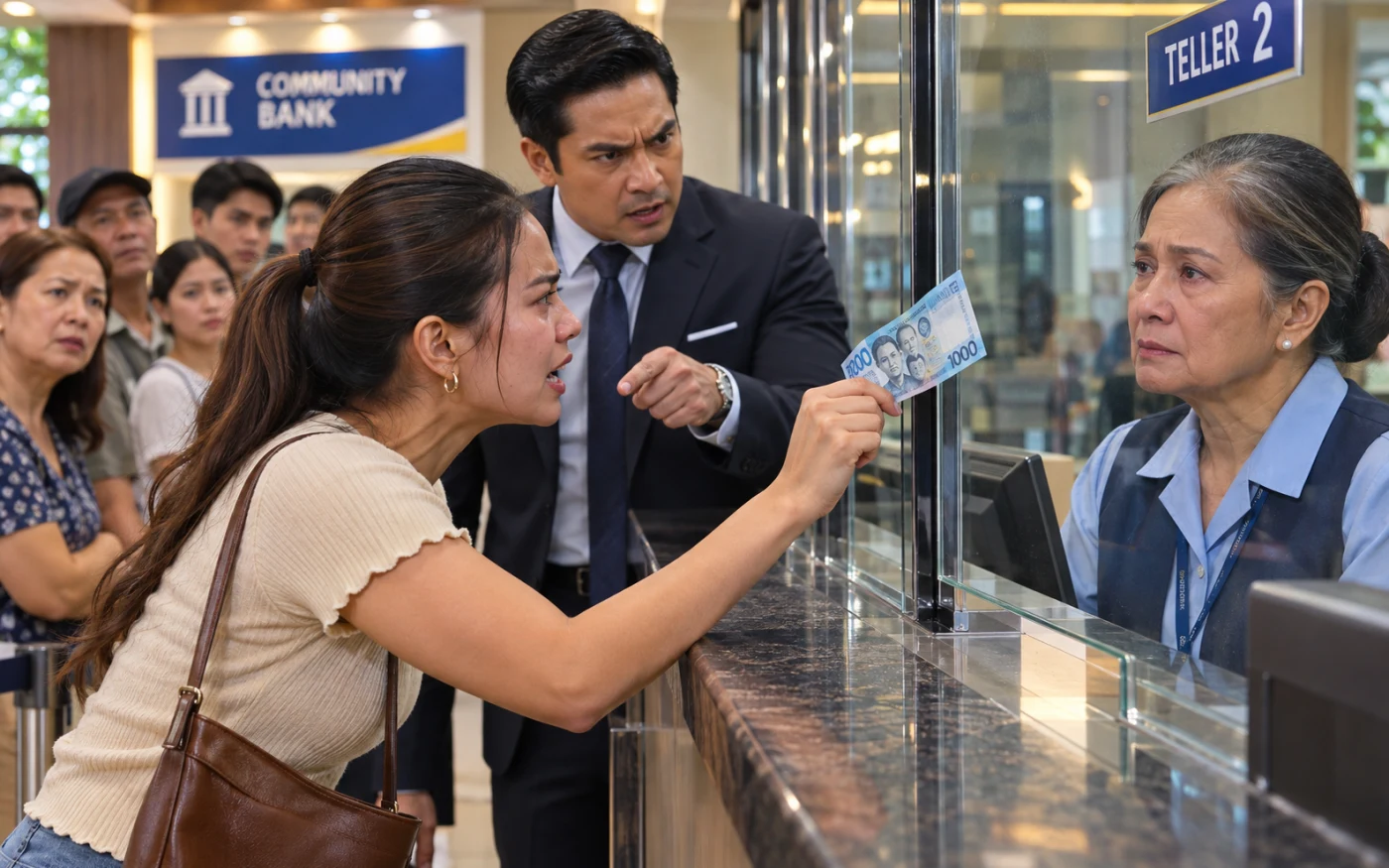
The counterfeit bill was already in the customer’s hand when she screamed.
“This is fake!”
Every head in the bank turned toward my window.
It was Friday afternoon. Payday. The lobby was packed with nurses, teachers, factory workers, and one crying toddler who had been trying to eat a deposit slip.
The young woman slapped the thousand-peso bill against my glass.
“You gave me counterfeit money!”
I had worked at San Felipe Community Bank for forty years. I had survived two robberies, three floods, six computer systems, and managers who used the word “innovation” before removing something useful.
I had never passed a false bill.
“May I see it?” I asked.
She pushed it through the slot.
The paper felt wrong.
Too smooth. Too soft. Like a lie that had been ironed.
A faint purple smear marked one corner.
I checked the security thread, the watermark, and the raised print.
Nothing.
Before I could speak, our branch manager, Victor Salcedo, came running from his office.
Victor was thirty-eight, polished, ambitious, and so fond of tight suits that every button on his body seemed to be negotiating for freedom.
He examined the bill for three seconds.
Then he looked at me.
“Pilar, step away from your drawer.”
He did not lower his voice.
That was deliberate.
“Sir, we should verify the rest of the bundle.”
“Step away.”
I stood.
Victor called security. Kuya Ben locked the front doors under counterfeit protocol. Metal bolts slid into place with two heavy clacks.
The customers began murmuring.
Nobody could leave.
Nobody could enter.
Victor pulled my drawer onto the counter and counted every bill beneath the bright inspection lamp. The first counterfeit was near the top.
Then he found another.
And another.
And another.
By the time he finished, twenty-four false thousand-peso bills lay in a neat pile between us.
Twenty-four little funerals for my reputation.
Victor’s face became solemn, but his eyes were shining.
He had been waiting for something like this.
For months, he had suggested that I retire. He called my handwritten records “clutter.” He asked younger tellers whether I had forgotten transactions. If I paused to check a total twice, he appeared beside me like a vulture wearing cologne.
Now he turned toward the crowded lobby.
“We have discovered counterfeit currency in Mrs. Pilar Dizon’s cash drawer.”
My coworkers stared at me.
One customer whispered, “Ay, Diyos ko.”
Victor continued, “Security has contacted the police.”
“You called them already?” I asked.
“Of course.”
“Before checking where the money came from?”
His jaw tightened.
“It came from your drawer.”
“That is where it ended up. I asked where it came from.”
“Cash does not carry a family tree, Pilar.”
“Mine does.”
I reached for the paper strap around the bundle.
Victor slapped his hand over it.
“Do not touch the evidence.”
“Then lift the edge of the strap yourself.”
The room went quiet.
Victor did not move.
“Lift it,” I repeated.
Kuya Ben stepped closer. “Sir, she is only asking you to look.”
Victor slowly raised the paper band.
Underneath, in tiny blue numbers, I had written:
4831 / JUL 22 / VS
Victor stared.
For forty years, I had insisted that every strapped bundle entering our vault be marked with its source. Source account. Date received. Initials of the employee who accepted or transferred it.
We wrote beneath the strap so the ink would not smear and customers would not see private information.
Victor hated that habit.
He had also forgotten it.
“Account ending 4831,” I said. “Which customer owns it?”
“I do not know every account number.”
“Then look.”
The assistant manager, Celia, opened the customer database.
Her face changed.
Victor took one step toward her.
“Do not read that aloud.”
Too late.
Celia swallowed.
“The account belongs to Sinners & Saints Entertainment Corporation.”
Everyone in town knew Sinners & Saints. It was a nightclub with purple lights, watered drinks, and a neon angel whose left wing had not worked since Christmas.
Victor’s older brother, Ramon Salcedo, owned it.
And Ramon was standing inside our locked bank at that exact moment, beside the VIP desk, with a black cash bag between his shoes.
PART 2: Follow the Deposits
Ramon had come early with another cash deposit. He bent and grabbed the handles of his bag.
“I have another appointment.”
Kuya Ben blocked the locked doors.
“Nobody leaves until the police arrive.”
Ramon looked at Victor.
Victor looked at me.
That look contained no surprise.
Only calculation.
“Pilar wrote those numbers herself,” Victor announced. “She could have added my brother’s account after planting the bills.”
I almost smiled.
“Then let us check the vault-transfer ledger.”
Victor’s nostrils flared.
“She didn’t,” Celia said. “We all use Pilar’s system.”
Banks remember everything. Machines remember logins. Doors remember key cards. Vaults remember every bundle that enters and leaves.
And old tellers remember where the machines make mistakes.
Celia brought the morning transfer sheet. At 7:51 a.m., Bundle 17B had moved from the vault into my drawer.
The false notes were in Bundle 17B.
The transfer carried Victor’s electronic approval.
“That proves nothing,” he said. “I approve dozens.”
“Turn the page.”
Bundle 17B had entered the vault two days earlier as part of a cash deposit to account 4831.
The deposit was made at 7:42 p.m., forty-two minutes after the branch closed.
It had been accepted using Victor’s manager override.
Celia whispered, “Why was the cash detector bypassed?”
Victor pointed at me. “Do not let her control this conversation.”
“I am not controlling it,” I said. “The timestamps are.”
A few customers laughed.
Victor’s face darkened.
I asked Celia to search for other after-hours deposits to Sinners & Saints.
There were fourteen in six months.
Every deposit contained bundles accepted after closing.
Every one used Victor’s override.
Every time, his notes claimed the automatic cash detector had malfunctioned.
“Fourteen malfunctions?” I asked. “Only when your brother arrived?”
“The machine is unreliable.”
From the back office, our youngest teller, Marites, spoke.
“No, sir.”
Victor turned.
She held up the maintenance folder with both hands.
“The detector has passed every weekly test. I keep the service reports.”
Marites was usually frightened of Victor. At that moment, her voice shook, but it did not break.
Magaling.
I asked Celia to check what happened after each nightclub deposit.
The pattern appeared immediately.
The club deposited fake cash at night.
The bank credited its account as if the money were real.
By morning, most of the credited funds had been transferred electronically to liquor suppliers, performers, rent, and overdue loans.
Victor then broke the counterfeit bundles apart and scattered the bills among teller drawers. A few false notes in one drawer. A few in another. Enough to pass them back into the community without creating a large shortage in the vault.
But the scheme had started collapsing.
Three customers had returned counterfeit bills that week. Head office had scheduled a surprise cash inspection for Monday.
Victor needed someone to blame before then.
Someone quiet.
Someone old.
Someone whose memory he had been publicly questioning for months.
Me.
“This is absurd,” Victor said. “You are inventing a crime novel.”
“Then explain why twenty-four counterfeits were placed in the one drawer belonging to the teller you have been trying to remove.”
“Your memory has become unreliable.”
I had started keeping the notebook when Victor’s complaints stopped matching what had actually happened.
I opened my handbag and removed the small black notebook.
Victor laughed.
“That proves my point. More of your little notes.”
“Yes,” I said. “Little notes are dangerous when they have dates.”
I read his own words back to him.
March 9: Mrs. Dizon forgot to record a cash delivery.
Attached to that entry was the delivery receipt with my signature and the correct time.
April 18: Mrs. Dizon left her drawer unlocked.
Attached was the security log showing Victor had ordered me away from the counter during a fire drill, then used his manager key to open it.
June 2: Mrs. Dizon confused two customer accounts.
Attached were the corrected forms proving Victor had transposed the numbers before handing them to me.
He had not been documenting my failing memory.
He had been building a costume for me to wear when he committed his crime.
Ramon suddenly kicked the black cash bag beneath the VIP desk.
The zipper split.
Bundles of thousand-peso bills spilled across the floor.
One slid to my shoe.
I lifted the edge of its strap.
Nothing was written there.
But across the top bill ran the same faint purple thumbprint found on all twenty-four counterfeits in my drawer.
Sinners & Saints stamped guests’ wrists with purple ink. Its cashiers counted the door money beside the open stamp pad, and I had seen that stain on the club’s deposits for years.
Ramon whispered, “Victor, do something.”
Victor rushed toward the security desk.
He reached for the monitor controls.
Kuya Ben caught his wrist.
On the screen behind them, the morning corridor footage was already playing.
At 7:51 a.m., before any teller arrived, Victor entered my station carrying Bundle 17B.
PART 3: Forty Years of Proof
The lobby became so quiet I could hear the counting machine humming in the back room.
On the monitor, Victor unlocked my drawer.
He removed a bundle of real bills.
Then he placed Bundle 17B inside.
He relocked the drawer and walked away.
Victor stared at the screen as if betrayal had come from the camera instead of his own hands.
“Ramon lied to me,” he said.
His brother’s mouth fell open.
“You told me the detector could not recognize them!”
There it was.
Not remorse. Not loyalty.
Just two guilty men fighting over who had carried the heavier end of the crime.
Victor shouted, “I was trying to save the club!”
Ramon shouted back, “You were trying to save your investment!”
Celia opened the full ledger for account 4831.
Over the past year, Victor had transferred Ramon nearly four million pesos from his personal account. He had mortgaged his condominium and poured the money into Sinners & Saints, hoping a new dance floor and famous DJs would rescue it.
The nightclub kept failing.
When head office announced its inspection, Victor gathered the remaining counterfeits and planted them in my drawer.
He expected my age to do the rest.
He expected people to hear “sixty-four-year-old teller” and imagine shaking hands, missing memories, and a woman too frightened to defend herself.
He forgot that I had balanced more money than he had ever seen.
He forgot that I checked twice.
He forgot that I wrote things down.
Sirens sounded outside.
Blue light flashed across the locked glass doors.
Victor straightened his jacket.
Even then, the man adjusted his tie. Vanity is a stubborn little cockroach.
“Pilar,” he said softly, “tell them this was an internal misunderstanding.”
I looked at the twenty-four fake bills.
I looked at the customers trapped inside the bank.
I remembered every time he had spoken slowly to me in front of younger employees, as if age had turned my mind into cold soup.
“No,” I said. “I will tell them the exact account, date, time, bundle, and override code.”
Kuya Ben opened the doors for the police.
Before they could ask their first question, I had arranged the evidence across the consultation table.
Bundle 17B.
The marked strap.
The vault ledger.
The fourteen after-hours deposits.
The detector service reports.
My notebook of fabricated performance complaints.
The corridor footage.
And Ramon’s black bag, still bleeding purple-smeared bills across the tile.
I walked the officers through the scheme from beginning to end.
Calmly.
Slowly.
Completely.
When I finished, the lead investigator looked at Victor.
“She reconstructed six months of transactions in twenty minutes.”
Celia folded her arms. “She has had forty years of practice.”
The police took Victor and Ramon through the same doors Victor had ordered locked against me.
Ramon tried to cover his face with his jacket.
Victor had no jacket left because an officer was using it to wrap the evidence box.
The customers applauded.
I wish I could say I bowed. I did not. I sat down because my knees had finally remembered they were sixty-four.
The young woman who had received the first fake bill came to my window.
“Mrs. Dizon, I am sorry I shouted.”
“You were right to shout,” I told her. “You just shouted at the wrong person.”
Head office sent investigators that evening. By Monday, they had identified hundreds of counterfeit notes connected to the nightclub deposits.
Victor was dismissed and charged with fraud, counterfeiting offenses, and falsifying bank records. Ramon lost Sinners & Saints, including the broken neon angel. The club was seized before its grand reopening, which saved the public from both financial crime and its new twelve-minute laser show.
The bank issued a public apology.
They offered me a promotion to branch operations supervisor.
I declined.
Instead, I accepted a six-month assignment teaching fraud controls to younger tellers across the region. Head office adopted a formal source-tracking system for strapped cash bundles across every branch, based on my handwritten method.
No more tiny blue numbers beneath paper bands.
Now the information is printed in barcodes, recorded in the system, and impossible for a manager to pretend he never saw.
On my final day at the branch, Marites gave me a new black notebook.
On the first page, she had written:
Quiet women are still keeping records.
I laughed so hard I had to remove my glasses.
Then I added the date beneath her sentence.
Some habits earn the right to survive.