
My Cousins Fought Over My Aunt’s Safe Before Her Funeral Flowers Had Wilted. When They Opened It, They Found Plastic Jewelry and a Note Addressed to Me...
PART 1: The Safe at the Wake
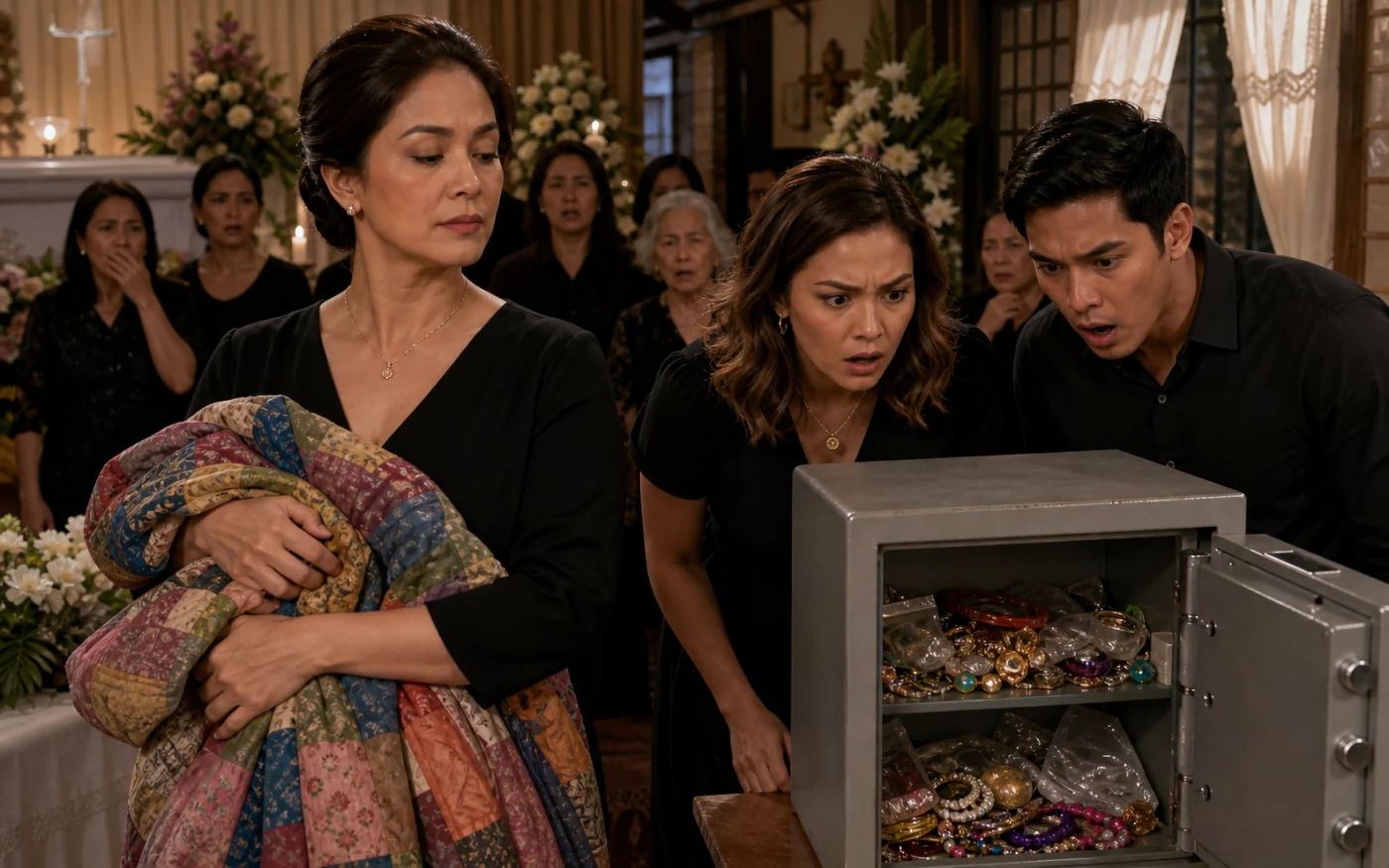
My Aunt Celia’s funeral flowers had not even begun to wilt when my cousin Vanessa tried to drag her safe out of the bedroom.
I heard metal scraping across the floor while I was downstairs pouring coffee for mourners.
At first, I thought someone had knocked over a table.
Then my cousin Ramon shouted, “Lift your side! Do you want to split the money or break my back?”
I ran upstairs.
Vanessa was wearing the black dress she had bought for the funeral. Ramon still had a white condolence ribbon pinned to his shirt. Between them sat Aunt Celia’s old steel safe, half pulled from the closet.
“What are you doing?” I asked.
Vanessa did not even look ashamed.
“Protecting the family inheritance,” she said. “People are walking in and out of this house.”
“Those people are praying beside her coffin.”
Ramon wiped sweat from his forehead. “Exactly. Strangers.”
They were not strangers.
They were seamstresses, nurses, market vendors, teachers, and old women who had traveled from three provinces to say goodbye. Some were crying so hard they could barely speak.
Vanessa had looked at them downstairs and whispered, “Why did Tita invite every poor person in Luzon?”
I wanted to slap her.
Instead, I pushed the safe back against the wall.
“The lawyer is reading the will tomorrow. Leave it alone.”
Vanessa’s mouth tightened. “Easy for you to say, Mara. You have no claim.”
That was how she had spoken to me my whole life.
Aunt Celia was my mother’s older sister. After my mother died, she raised me from age fourteen. She paid my school fees by sewing uniforms late into the night. When her hands became stiff, I took her to every appointment. I worked weekdays as a school guidance counselor. On Sundays, I repaired hems in her little shop and cooked enough food to last her through the week.
Vanessa and Ramon visited on Christmas.
Sometimes.
Usually when they needed money.
But because their late mother had been Aunt Celia’s youngest sister, they had decided blood flowed more strongly through their veins than mine.
The next afternoon, Attorney Santos opened the will in Aunt Celia’s living room.
Vanessa sat forward before he finished clearing his throat.
“The house?” she asked.
He adjusted his glasses. “I will read the document in order.”
“And the safe,” Ramon added. “Please be specific about the safe.”
Attorney Santos looked at them for a long moment.
Then he read.
Aunt Celia left her clothes to the parish charity, her sewing machines to the women who worked in her shop, and the contents of her kitchen to our longtime neighbor, Aling Rosa.
Vanessa began tapping her heel.
Finally, Attorney Santos said, “To Vanessa and Ramon Cruz, I leave the contents of the steel safe in my bedroom, to divide equally.”
Vanessa grabbed Ramon’s hand.
He whispered, “I told you.”
Then Attorney Santos continued.
“To my niece Mara Reyes, who understood that keeping someone warm is more important than looking rich, I leave my patchwork quilt.”
Silence.
Then Vanessa laughed.
She laughed in front of Aunt Celia’s photograph.
“The old blanket?” she said. “The one with the ugly yellow squares?”
Ramon leaned toward me. “Do not worry, cousin. Maybe you can sell it online as vintage.”
My face burned, but not because I had received less.
That quilt had covered me the first night I came to Aunt Celia’s house, when I cried for my mother until sunrise. Every square came from discarded fabric: school uniforms, curtains, christening gowns, even the blue skirt Aunt Celia wore in her only studio portrait.
I held it against my chest.
“It is enough,” I said.
That made Vanessa laugh harder.
By sunset, she had invited a locksmith and a jewelry appraiser to the house. She also started a livestream on her phone.
“Our aunt was very private,” she told her followers, standing beside the safe. “But she believed in preserving family wealth.”
Attorney Santos warned her. “Ms. Cruz, perhaps this should remain a private matter.”
“Why?” Vanessa asked. “The safe belongs to us.”
She angled the camera toward me.
“Mara got a quilt,” she said brightly. “But sentimental things are valuable too.”
Ramon snorted.
The locksmith drilled through the final lock while mourners gathered in the doorway. I noticed several of Aunt Celia’s old friends watching without surprise.
They looked almost as if they were waiting for a joke whose ending they already knew.
The lock snapped.
Vanessa pushed past the locksmith, seized the handle, and pulled.
The steel door swung open.
And my cousins screamed.
PART 2: Inside the Quilt
The shelves were filled with jewels.
Red stones. Blue stones. Long ropes of pearls. Gold bracelets. A sparkling tiara.
For three full seconds, Vanessa could not breathe.
Then she plunged both hands into the safe.
“Oh my God,” she whispered. “Tita was rich.”
Ramon lifted a thick gold chain and kissed it for the livestream.
The appraiser reached into the safe, picked up one ruby necklace, and bent it between two fingers.
It folded.
He picked up a pearl and scratched it with his thumbnail. White paint flaked off.
“These are plastic,” he said.
Vanessa froze. “Some of them, perhaps.”
“All of them.”
He emptied the safe onto the table. There were children’s bangles, costume rings, fake pearls, and a tiara with three missing stones.
At the bottom sat an envelope.
The appraiser finished counting and checked prices on his tablet.
“Total resale value,” he announced, “approximately thirty-four dollars and sixty cents.”
Someone at the back of the room coughed to hide a laugh.
Vanessa ended her livestream so quickly she nearly dropped the phone.
Ramon tore open the envelope.
“It is addressed to Mara,” Attorney Santos said sharply.
Ramon ignored him and unfolded the note.
His face changed as he read.
“Give that to me,” I said.
He held it above my head. “Maybe your aunt left you instructions for washing your blanket.”
Aling Rosa stepped forward. She was seventy-two, tiny, and usually gentle.
That day, she looked ready to bite through steel.
“Give her the letter,” she said.
Around her, the women from the funeral moved closer.
Ramon finally let go.
The note was written in Aunt Celia’s careful hand.
Mara,
If Vanessa and Ramon opened this safe before the flowers wilted, then they have answered the last question I had about them.
They spent years asking what I kept locked away. They never asked whom I kept safe.
Take the quilt to my sewing room. Begin with the yellow square you always called ugly. Attorney Santos has the key to everything else.
Love is not what I hid from you. Love is what I taught you to recognize.
My hands began shaking.
Vanessa read over my shoulder.
“This is manipulation,” she said. “There is something in the quilt.”
She grabbed one corner and pulled.
I pulled back.
“Let go.”
“If Tita concealed assets, they belong to the estate!”
The quilt tore with a sound like paper.
Something slid from inside the yellow square and struck the floor.
It was a photograph.
In it, Aunt Celia stood outside her old sewing shop thirty years earlier. Beside her were six young women. One had a bruised cheek. Another held a baby. All of them wore cheap plastic necklaces.
On the back, Aunt Celia had written:
Costumes for the fiesta. Bus tickets hidden under the beads. Six women left safely that night.
The room went quiet.
Aling Rosa began to cry.
“I am the one holding the baby,” she said.
I stared at her.
She touched the plastic pearls on the table.
“Her husband counted every peso she spent,” she told me. “Celia bought these necklaces and pretended we were preparing for a fiesta. Inside the clasps, she hid money and addresses. We left while the men were drunk.”
Vanessa scoffed. “One photograph does not make the quilt valuable.”
Attorney Santos took a small seam ripper from Aunt Celia’s sewing box.
We opened the yellow square properly.
Inside were more photographs, letters, property maps, and deposit slips wrapped in waxed cloth.
Every patch held part of a story.
A piece of green school uniform concealed the teaching certificate of a woman Aunt Celia helped escape a violent home.
A square of white curtain held the deed to a small apartment.
The blue fabric from Aunt Celia’s portrait contained a list of names and dates going back thirty-eight years.
Some women had stayed one night.
Some had stayed a year.
Some had returned later with money to help the next woman.
“How many?” I whispered.
Aling Rosa looked around the room.
“At least one hundred and twelve.”
Vanessa reached for the property deed.
Attorney Santos caught her wrist.
“That does not belong to you.”
“It belonged to my aunt!”
“No,” he said. “It belongs to the Celia House Trust.”
He opened his briefcase and removed a blue folder.
Inside were documents for twelve properties: apartments, boarding houses, two shops, a small farm, and Aunt Celia’s home.
Vanessa’s eyes widened.
“Twelve?”
Attorney Santos nodded. “Purchased over decades by women who rebuilt their lives and contributed what they could. Your aunt managed the network. She did not own it personally.”
Ramon pointed at me. “Then why give her the quilt?”
Attorney Santos turned to me.
“Because the trustees voted unanimously to name Mara as Aunt Celia’s successor, if she accepts.”
Before I could answer, the front gate opened.
Three vans pulled up outside.
Women began stepping out, one after another, carrying folders, house keys, and the truth my cousins had spent their whole lives failing to see.
PART 3: The Women She Kept Safe
They filled the house: a judge, a restaurant owner, a nurse, and a gray-haired principal.
Each woman carried a piece of fabric matching a square in Aunt Celia’s quilt.
The judge held up cloth from the dress she wore when Celia accompanied her to court. The restaurant owner showed me a piece of her first tablecloth.
Then a woman named Liza walked to the front.
She was Vanessa and Ramon’s mother’s closest childhood friend.
My cousins stopped smiling.
Liza placed a faded pink ribbon beside the quilt.
“Your mother was the first woman Celia rescued,” she told them.
Vanessa went pale. “Our father died when we were children.”
“Before that, your mother tried to leave him three times. Celia hid her here. When he found her, Celia moved her to the first apartment owned by the trust.”
Ramon shook his head. “She never told us.”
“She wanted you to remember your father without fear,” Liza said. “Celia paid for your mother’s nursing course. Your mother’s first salary bought the lock on the safe you just opened.”
That silenced them.
For one second, I thought shame might reach where love had failed.
Then Vanessa looked at the folder of property documents.
“Our mother contributed,” she said. “That means we have a share.”
The entire room seemed to exhale at once.
Attorney Santos answered calmly. “The trust has no private shareholders. Every property is permanently dedicated to shelter, training, and legal assistance.”
“Then sell one,” Ramon demanded. “There are twelve!”
The judge stepped between him and the table.
“You are demanding that abused women lose a safe home so you can inherit money that was never yours.”
Vanessa noticed her phone was still receiving notifications from the livestream she thought she had ended. The signal had frozen when she tapped the screen, but it had resumed.
Thousands of people had watched everything.
The appraiser announcing $34.60.
The letter.
The quilt.
And Vanessa demanding that a shelter be sold.
“Turn it off!”
Ramon snatched the phone, but the restaurant owner’s youngest employee was already reading the comments aloud.
“Here is one,” she said. “‘They wanted treasure and found their own character appraisal.’”
Even Attorney Santos smiled at that.
Vanessa lunged for the blue folder.
Her heel caught on her handbag. She grabbed Ramon for balance and pulled him backward into the table.
Plastic pearls flew through the air.
The fake tiara landed perfectly on Ramon’s head.
Nobody planned it.
That was what made it beautiful.
The room erupted in laughter while he stood there wearing exactly what he had inherited.
Attorney Santos placed the costume jewelry back into two grocery bags.
“One equal share each,” he said. “As the will requires.”
He handed them their inheritance in front of everyone.
Vanessa received seventeen dollars and thirty cents’ worth of plastic treasure.
Ramon received the same, including the tiara.
Their public humiliation was not the end of the consequences. Ramon had promised a business partner that his inheritance would secure a loan. The partner withdrew by sunset. Vanessa had posted photographs of the condominium she planned to buy. For weeks, strangers left plastic rings at the gate.
I did not join the teasing.
I was too busy learning what my aunt had built.
The trust did not make me rich. It gave me work.
I left my position as a school guidance counselor and became the network’s full-time coordinator. Aling Rosa reminded me how many frightened mothers I had already referred to Aunt Celia.
“You were already doing the work,” she said. “You simply did not know how large the house was.”
We turned Aunt Celia’s sewing room into an intake office. Women from the shelters used her machines to make uniforms and quilts, helping fund emergency transportation.
We mounted the empty steel safe in the lobby with its door permanently open. Inside it, we placed the plastic jewelry and a small sign:
Some people ask what is valuable. Better people ask who needs safety.
Six months later, Vanessa came to see me.
She carried the torn yellow square, repaired by hand.
“I am not asking for money,” she said quickly.
“Good.”
She swallowed. “I want to know about my mother.”
That question should have come years earlier.
But it had finally come.
I showed her the pink ribbon, the nursing certificate, and her mother’s first receipt for the trust.
Vanessa cried until her mascara disappeared.
She never became a trustee. Trust is not inherited just because regret arrives wearing a humble face. But she began volunteering twice a month.
Ramon never returned. He mailed his half of the plastic jewelry back without a note.
I kept the tiara.
It hangs above Aunt Celia’s sewing machine, crooked and ridiculous, exactly where she would have wanted it.
As for the quilt, we repaired every torn seam but left the yellow square visible. It now covers the bed in the trust’s newest safe room.
When a frightened woman arrives with nothing, we wrap it around her shoulders.
Then I tell her what Aunt Celia taught me.
The treasure was never hidden in the quilt.
The quilt was a map to all the people who had become treasure to one another.