
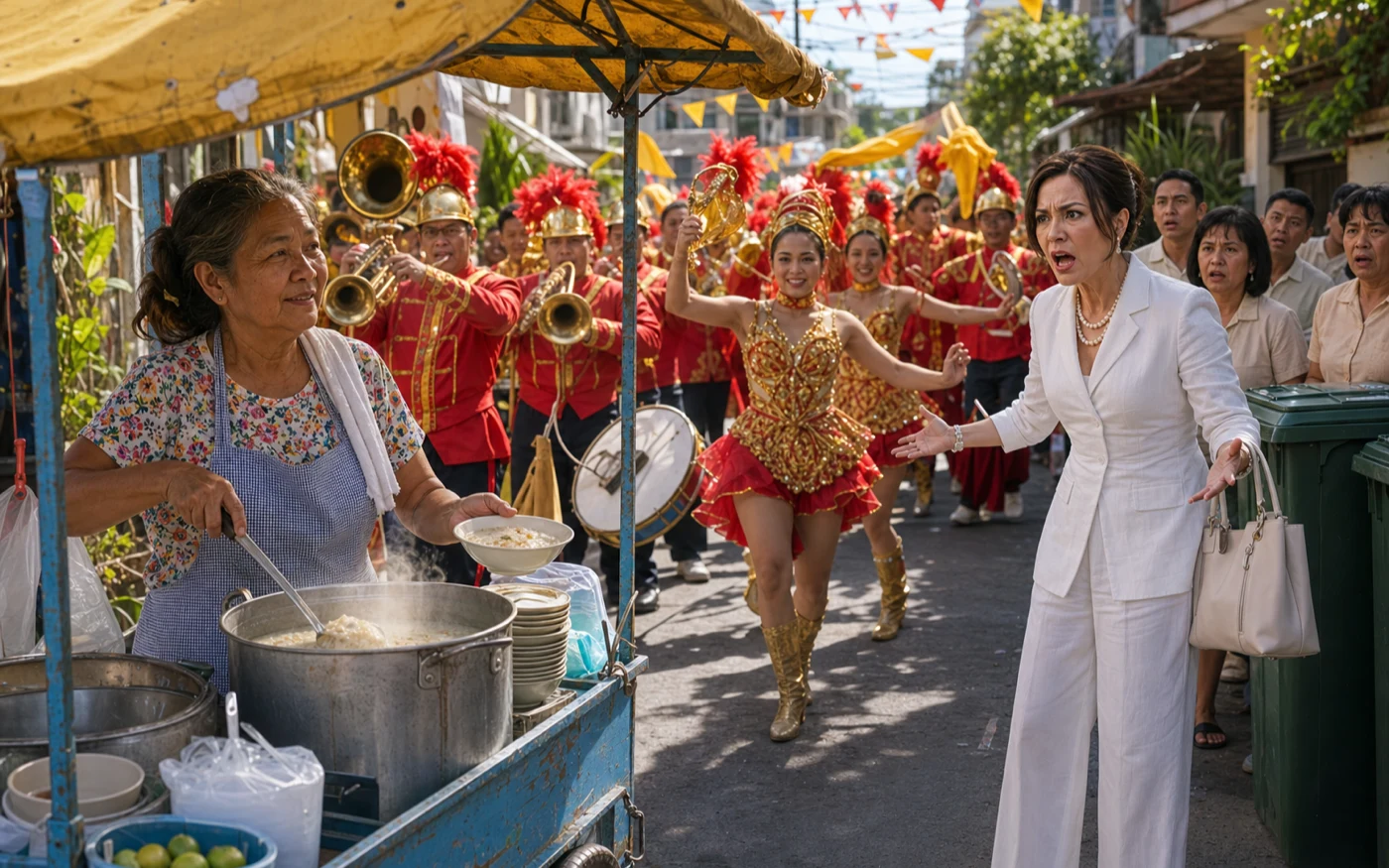
The Festival Committee Hid My Mother’s “Ugly” Food Cart Behind Dumpsters — By Noon, the Entire Parade Had Turned Around
PART 1: Behind the Dumpsters
The woman who hid my mother’s food cart behind the municipal dumpsters wore white linen to a street festival.
That should tell you everything.
At six in the morning, while Mama was lifting a pot of chicken arroz caldo heavy enough to anchor a fishing boat, Festival Chairwoman Celeste Alvarado walked toward us without stepping in a single puddle.
Behind her came two security guards and a young man carrying a clipboard as if it contained the Ten Commandments.
Celeste stopped in front of Mama’s cart.
She looked at the faded blue paint. She looked at the patched yellow canopy. She looked at the dent beside the wheel where a delivery motorcycle had hit us in 2019.
Then she pinched her lips.
“This cannot be here.”
Mama kept tying bundles of plastic spoons. “Good morning to you, too.”
Celeste pointed toward the plaza. Overnight, our usual row of local vendors had vanished. In its place stood six identical white booths with gold trim, flower walls, ring lights, and smiling employees in matching aprons.
One booth sold bottled calamansi juice for more than Mama charged for a full meal. At the center waited a huge VIP tent bearing the logo of BuenSabor Foods, the festival’s new corporate sponsor.
“We have upgraded the vendor experience,” Celeste said. “The parade will be filmed by drones. We need visual consistency.”
I stared at her. “Visual consistency?”
She tapped Mama’s cart with one polished fingernail.
“This is too ugly.”
The words landed harder than a slap because Mama did not answer.
For twenty-three years, she had parked at that corner during the San Aurelio Festival. She had fed drummers, dancers, drivers, traffic officers, and children whose coins never quite added up.
Her cart was not pretty.
It was better than pretty.
It had history stuck to it in layers of steam, scratches, stickers, and spilled soy sauce.
I stepped between Mama and Celeste.
“She paid her permit.”
The clipboard man checked a page. “Her permit remains valid in the alternate vending zone.”
“Where?”
Celeste pointed down a service lane.
Behind the municipal hall.
Behind the portable toilets.
Behind two green dumpsters already breathing hot garbage into the morning air.
“You want my mother serving food beside trash?”
“I want her somewhere the cameras cannot see her.”
There are sentences so cruel they make the whole world go quiet.
I heard oil snapping in Mama’s frying pan. I heard a broom scraping the pavement twenty meters away. I heard Celeste’s bracelet click against her watch.
Mama touched my arm.
“Mara, anak. Help me push.”
“No.”
“The rice is already cooked.”
That was my mother. Insult her pride, and she would worry about wasting breakfast.
We pushed the cart down the service lane.
One wheel squealed every third turn.
Squeak. Squeak. Squeak.
It sounded like a small animal protesting on Mama’s behalf.
At the dumpsters, Celeste’s assistants hung a gray curtain between the cart and the road. Not for shade. To hide us.
Mama arranged her eggs, scallions, fried garlic, and bottled sauces as carefully as always.
Then she taped her handwritten sign to the cart.
ARROZ CALDO 35 PESOS. EXTRA EGG 10. PAY TOMORROW IF HUNGRY TODAY.
I nearly cried when I saw that last line.
“Take it down,” I whispered. “Not today.”
Mama frowned. “People do not stop being hungry because a rich woman has drones.”
By nine, drums warmed up near the school. Dancers in red-and-gold skirts gathered by the fountain.
But no customers came behind the dumpsters.
At nine thirty, Mama stirred a pot meant for two hundred people and pretended not to count the untouched bowls.
Then a boy in a white marching-band uniform appeared at the mouth of the lane.
“Tita Rosa?”
It was Jun Mercado, the drum major. Mama had fed him through four festival seasons, including the year his father lost his job.
He saw the dumpsters.
He saw the gray curtain.
His face changed.
“Who put you here?”
“The new arrangement,” Mama said lightly.
Jun read her sign. Then he looked at me.
I told him exactly what Celeste had said.
Too ugly.
No cameras.
Hide her.
Jun did not shout. He did something much more dangerous.
He took out his phone.
At nine forty-five, three majorettes came running.
At nine fifty, two float drivers arrived.
At nine fifty-five, the leader of the senior citizens’ dance troupe marched behind the dumpsters wearing silver boots and an expression that could frighten concrete.
At ten o’clock, the parade announcer raised his microphone in front of the BuenSabor VIP tent.
Celeste smiled for the drone.
The mayor lifted one hand.
Jun raised his baton.
But instead of bringing it down, he turned his back on the official route.
Behind him, every drummer turned with him.
And the whole street went silent.
PART 2: Why the Drums Stopped
At first, Celeste kept smiling.
It was a brave little smile. Thin. Shiny. Doomed.
The announcer tried again.
“Ladies and gentlemen, the San Aurelio Festival Parade!”
Nothing moved.
No drums.
No dancers.
No engines.
Even the papier-mâché carabao on the agriculture float seemed offended.
Celeste hurried toward Jun.
“Start the parade.”
Jun held his baton against his chest. “We are waiting for Tita Rosa.”
“She is a food vendor.”
“She is our food vendor.”
One of the majorettes stepped forward.
“Last month, six of us rehearsed until eleven at night. Tita Rosa waited because she knew we had not eaten.”
A jeepney driver leaned out of his decorated vehicle.
“When my wife was in the hospital, she fed my children for twelve days.”
“She gave my grandson breakfast before every drum practice,” called Lola Mercy, leader of the senior dancers. “And she never once announced it through a microphone.”
That last sentence hit Celeste directly between the eyebrows.
People began lifting their phones.
The drone hovered above us, recording everything it had been hired not to see.
Celeste pointed at the bands. “You signed participation forms. Follow the approved route.”
The drivers switched off their engines.
One by one.
Click.
Click.
Click.
A silence rolled down the line longer than the parade itself.
I ran back to Mama.
She was packing lids onto her pots.
“What are you doing?”
“We are leaving.”
“Mama, the parade stopped for you.”
“Exactly. Thousands of people are waiting. Children are standing in the sun.”
Her hands shook as she tied a plastic bag around the eggs.
“I will not ruin the fiesta because Celeste embarrassed me.”
There it was.
Not weakness. Not surrender.
Mama was still protecting the very people who had let Celeste hide her beside garbage.
I took the bag from her hand.
“You did not ruin anything. They moved the heart of the festival behind the dumpsters.”
She looked at me, and for one second I saw how much the insult had hurt.
Mama could survive hard work. She could survive debt, heat, rain, and customers who promised to pay Friday and returned three Fridays later.
What hurt was being told that twenty-three years of feeding people had made her something shameful to look at.
I untied the gray curtain.
Then I rolled it into the largest dumpster.
Celeste arrived just in time to see it fall.
“Put that back.”
“No.”
“If this disruption continues, I will cancel your mother’s permit.”
Mama went pale.
The cart was not a hobby. It paid her electric bill. It paid for her medicine. It helped put me through nursing school one bowl at a time.
Celeste knew exactly where to press the knife.
So I pulled Mama’s permit from the plastic envelope beneath the cash tin.
“Cancel it in writing,” I said. “On camera.”
The phones around us rose higher.
Celeste glanced at them.
Her confidence flickered.
Then the young man from BuenSabor pushed through the crowd. His name tag said PAOLO SANTOS, REGIONAL COMMUNITY DIRECTOR.
“Chairwoman,” he said, “why are local vendors behind a dumpster?”
Celeste recovered quickly.
“Brand standards. As we agreed.”
Paolo’s forehead folded. “We agreed to sponsor a local-vendor showcase.”
“And we selected vendors who present the community professionally.”
He looked at the six gold-trimmed booths.
“Those are franchise partners from Manila.”
The crowd made one sound.
Not a gasp.
A growl.
Celeste’s clipboard man began walking backward.
I saw it.
“Sir,” I asked Paolo, “did BuenSabor require the committee to remove our town’s vendors?”
“Absolutely not.”
“Did BuenSabor require my mother to be hidden from your cameras?”
His face hardened. “No.”
Celeste reached for his arm, but he stepped away.
That tiny step was the moment her whole morning began to crack.
At the starting line, Jun whistled.
The band members lifted their instruments.
Celeste spun around in triumph. “Finally.”
But the first drumbeat came from the wrong direction.
Boom.
Then another.
Boom.
The band marched away from the VIP tent.
The dancers followed.
The senior citizens followed.
The floats turned one after another, flower petals shaking as drivers swung into the service road.
“Stop them!” Celeste shouted.
No one did.
By ten twenty, the entire parade had turned around.
And every bright, noisy, beautiful piece of it was coming straight toward Mama’s cart.
PART 3: Where the Parade Went
Mama stood beside her pot with both hands over her mouth.
Jun led the band into the service lane.
The first drummer struck a rolling rhythm that bounced between the municipal walls. Trumpets answered. Cymbals crashed.
The ugly little lane exploded with music.
Dancers lifted their red-and-gold skirts and spun past the dumpsters as if they were performing before a palace.
The senior ladies stomped in their silver boots.
Lola Mercy pointed both hands at Mama and shouted, “This one is for the woman who gives extra egg!”
The crowd roared.
I laughed so hard I cried.
The parade did not merely pass Mama’s cart.
It circled it.
The marching band formed a ring. The dancers formed another. The flower trucks rolled around the block and came back, spilling petals along the service lane until the dirty pavement looked like a wedding aisle.
Every camera turned with them.
The official VIP tent sat empty beside the original route.
Its white chairs faced nothing.
Its catered rice cakes sweated beneath their glass domes.
Its giant BuenSabor banner flapped for an audience of six franchise employees and one very confused balloon arch.
Celeste pushed through the crowd.
“This is unauthorized! This is humiliating!”
I wiped my eyes.
“Yes,” I said. “It is.”
For once, she understood the sentence exactly as I meant it.
Paolo asked for the microphone.
The announcer handed it over.
“BuenSabor sponsored this festival,” he said, “because Chairwoman Alvarado submitted a proposal promising that local cooks and vendors would be featured at the center of the celebration.”
He raised his phone.
“This morning, I learned that the six featured booths were charged premium placement fees and that longtime local vendors were removed.”
Celeste’s face drained so quickly even her lipstick looked nervous.
“That is an internal committee decision.”
“Made using our name,” Paolo replied. “We are withdrawing from the VIP program and redirecting today’s sponsorship funds to reimburse every displaced local vendor.”
The crowd cheered.
Then the mayor took the microphone.
I had always considered Mayor Villanueva a pleasant man with the spine of warm gelatin.
That morning, perhaps the drums shook it solid.
“The permit authority belongs to the municipal office,” he said. “Not to one festival chairwoman. Aling Rosa’s permit will not be canceled.”
Celeste opened her mouth.
He was not finished.
“And until the committee reviews the false statements in the sponsor proposal, Chairwoman Alvarado is suspended from all festival duties.”
The cheer that followed frightened birds from three rooftops.
Celeste stood in her white linen suit while a flower truck rolled past and sprayed her with yellow petals.
One petal landed in her hair.
Another stuck to her lip gloss.
Lola Mercy looked at me and whispered, “Now she has visual consistency.”
I nearly fell against the cart.
Mama did not gloat.
Of course she did not.
She lifted the lid from her arroz caldo, and a cloud of ginger-scented steam rose into the sunlight.
“The food is getting cold,” she announced.
That was all it took.
Drummers lined up with dancers. Drivers climbed down from their floats. Traffic officers brought folding tables. The franchise workers abandoned their polished booths and came too.
Mama served until both pots were empty.
Some people paid.
Some paid double.
Some handed her old debts folded into tiny squares.
Jun placed thirty-five pesos on the counter.
Mama pushed it back.
“Your father is working again?”
“Yes.”
“Then use it for lunch tomorrow.”
He stared at her. “This is lunch.”
Mama sighed and added an extra egg.
That afternoon, the parade completed its route, but the announcer changed the program.
Every group passed Mama’s corner first.
The corner behind the dumpsters was no longer hidden. It was covered in petals, surrounded by folding chairs, and louder than the plaza.
The next morning, I helped Mama push the cart back to its usual spot.
No gold trim appeared. No flower wall. No ring light.
The dent was still there.
The yellow canopy was still patched.
The wheel still squeaked every third turn.
Squeak. Squeak. Squeak.
But someone had tied a fresh ribbon to the handle.
Someone else had taped up a photograph of the entire parade circling the cart.
Beneath it, Jun had written:
THE CORNER EVERYONE TURNED AROUND FOR.
Mama read it twice.
Then she pretended to be very busy chopping scallions.
I pretended not to see her crying.
By seven, the first customer arrived.
By seven ten, there was a line around the block.
And in the middle of all that noise, steam, laughter, and squeaking, Mama finally looked at her old cart the way the rest of us always had.
Not ugly.
Never ugly.
Loved.