
My Mother-in-Law Pinned a Volunteer Badge on My Mother at Her Charity Gala and Said, "Now Everyone Knows Why She's Here." My Husband Laughed — Then the Anonymous Donor Was Named.
PART 1: The Badge She Chose
My mother wore her good cardigan to my mother-in-law's charity gala.
Gray, pearl buttons, bought sometime during the Bush administration and treated like a Vatican relic.
"Too plain?" she asked me in the hotel lobby.
"Ma, you look beautiful."
"Beautiful or appropriate?"
"Both. Stop fishing."
She grinned. "Sige. One compliment only. Mahal ang parking dito."
That was Lourdes. She could turn a valet fee into a federal investigation. I loved her for it.
Which is why, twenty minutes later, I wanted to launch my mother-in-law into the chocolate fountain.
Bitsy Chalmers had chaired the Houston Literacy Ball for nine years and spent my two-year marriage to her son, Preston, insulting my family without using a single technically insulting word.
"Lourdes has such simple tastes."
My favorite was, "Her people really know the value of hard work."
Every sentence came gift-wrapped. Every sentence had a razor inside.
Preston always told me I was reading too much into it.
"Mom's from another generation," he'd say.
Bitsy was sixty-one, not a surviving passenger from the Mayflower.
That night, the first problem was the seating chart.
Preston and I were at table four.
My mother was at table thirty-one.
Table thirty-one was beside the service door, with a glamorous view of stainless-steel racks.
"There must be a mistake," I said.
Bitsy appeared beside us with a smile so bright it should have required a permit.
"No mistake! Lourdes, I thought you'd be more comfortable there. Less noisy."
"It's beside the kitchen," I said.
"Exactly. Easy access."
My mother touched my wrist.
"Anak. Hayaan mo na."
I had spent two years hayaan-mo-na-ing Bitsy while Preston whispered, "Not tonight," every time his mother shaved off another little slice of my dignity.
Then Bitsy looked at my mother's cardigan.
"Oh! Wait."
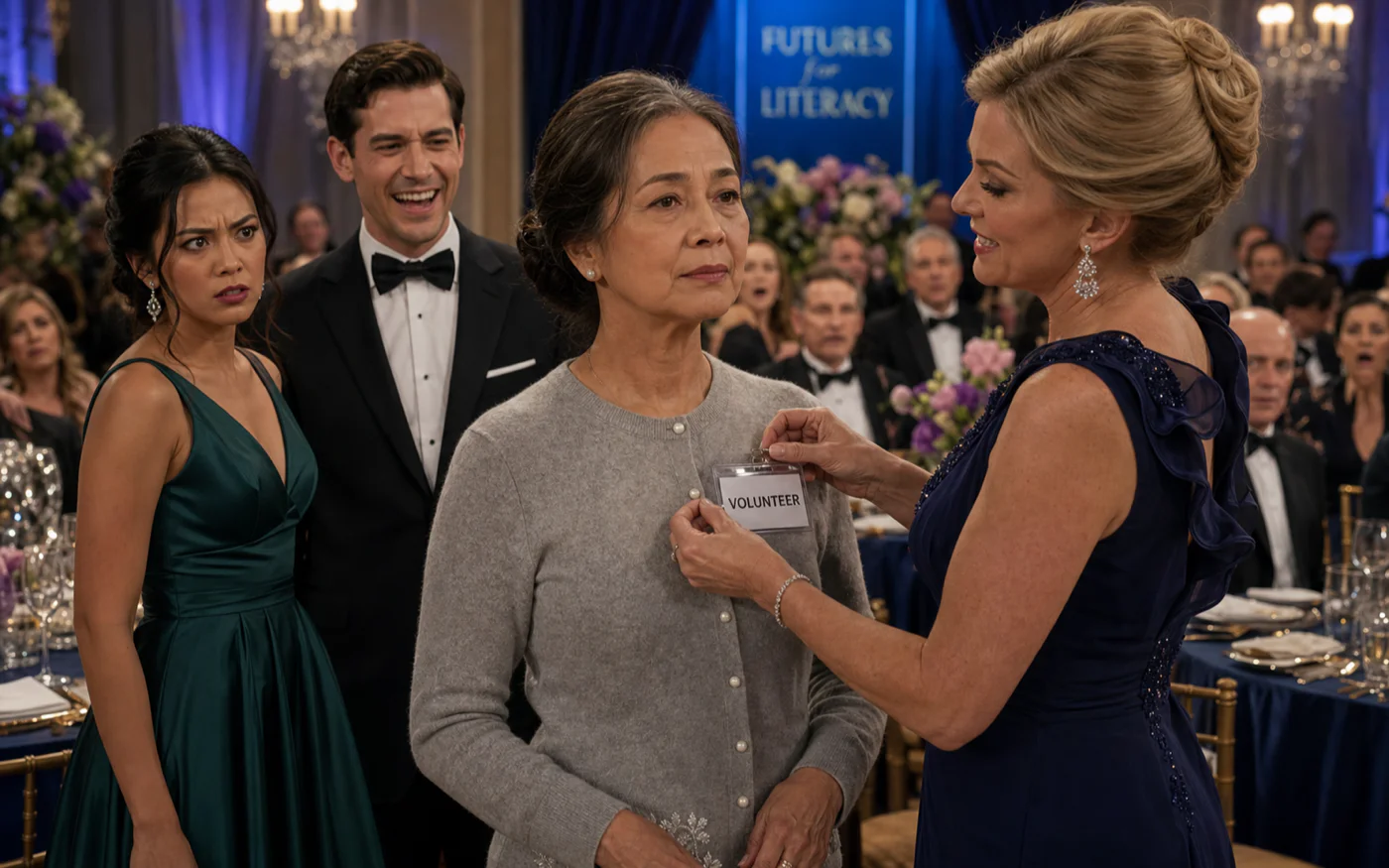
She reached toward the registration table and picked up a laminated badge on a blue ribbon.
VOLUNTEER.
Before I understood what she was doing, she pinned it straight through my mother's cardigan.
Right beside the pearl buttons.
"There," Bitsy said. "Now everyone knows why she's here."
My mother stared down at the badge.
I stared at Bitsy.
Then I looked at my husband.
Preston had heard every word.
He gave one uncomfortable little laugh.
"Mom. You're terrible."
Terrible.
Like she'd stolen a canapé.
Bitsy laughed, snapped a picture, and said, "For the committee chat."
My mother lifted her chin. "Maganda ba ako? If you're taking my picture, I hope I look good."
I almost kissed her.
Bitsy walked away.
Preston leaned toward me. "Please don't make this a whole thing."
I said, "Your mother just labeled mine like borrowed furniture."
"She was joking."
"Did my mother laugh?"
He looked toward table thirty-one.
My mother was already sitting down, chatting with a young busser named Emilio. Two minutes later she had learned he was from Pasig, his mother was a teacher, and he was taking night classes.
That was Lourdes. Put her beside a service door and ten minutes later she had cousins.
I sat at table four because my mother texted me under the table.
Sit down. Eat. Huwag kang gumawa ng eksena dahil sa akin.
So I sat.
I did not eat.
And I hated myself a little for obeying.
Because lately, that was what I did.
I used to spend Sundays at my mother's house on Cook Road: adobo, gossip, my sister Ana stealing containers.
After Preston, Sundays became his family's brunches and Bitsy's "quick appearances." My mother never complained. She just started packing my adobo in the freezer.
At 8:40, the emcee walked onto the stage and thanked the sponsors.
Then his voice changed.
"Before tonight's auction, we have a special announcement."
The ballroom settled.
"For nine years, this literacy program has been supported by one anonymous benefactor, known to all of us as the Tuesday Fund."
That name was everywhere. On the backdrop. On the programs. Printed in gold on napkins people were using to blot lipstick.
Bitsy leaned toward me, vibrating with excitement.
"I've heard the donor is somebody enormous."
Then the emcee smiled.
"Tonight, for the first time, that donor has agreed to be named."
I looked toward table thirty-one.
My mother had stopped talking to Emilio.
Her hand was resting on the volunteer badge.
And she had gone completely still.
PART 2: What Tuesdays Were For
I knew that look.
Not surprise. Decision.
Then Bitsy stood up.
She wasn't headed for the stage.
She was headed for my mother.
I followed.
Bitsy reached table thirty-one first and bent down with that syrupy public smile.
"Lourdes, the program is starting. Volunteers really should be outside during the donor recognition."
My mother said, "I'm a guest."
Bitsy tapped the badge she herself had pinned on her.
"Well, now you're helping."
I actually saw red.
"Bitsy."
She ignored me and lifted one finger toward hotel security.
A security man came over. Bitsy told him, "She's gotten confused about where volunteers are supposed to sit."
My mother's face changed just a little. That hurt more than if she'd cried.
I turned to Preston.
He was ten feet away.
"Say something," I told him.
"Cris, not now."
"Now is exactly when."
The emcee began, "The Tuesday Fund was created in honor of—"
Preston glanced toward the stage.
My mother stood.
"Come on, Ma," I said. "We're leaving."
She squeezed my hand. "No. Ikaw, come with me."
We walked through the service door.
Preston stayed in the ballroom.
I looked back once. He was sitting down.
In the corridor, I exploded.
"Ma, bakit mo ako pinigilan? I should've said something the second she touched you. I should've—"
"Cris."
"And Preston just sat there! Diyos ko, I am married to decorative furniture."
My mother almost laughed.
Almost.
Then Marguerite Fontenot, the foundation's usually glacial executive director, came running around the corner looking terrified.
"Mrs. Alcaraz. Thank God. We need you inside. They're about to say your name."
I stopped breathing.
My mother closed her eyes.
"Marguerite," she said, "I asked you not to make a production."
"This wasn't supposed to be a production."
Marguerite looked at the VOLUNTEER badge.
Then she looked toward the ballroom.
"Oh, my God."
I said, very slowly, "Whose name?"
My mother sighed.
"Mine."
And that was how I found out my coupon-clipping mother had quietly put more into literacy than Preston's family had spent nine years taking credit for.
She told it fast because the emcee was talking through the wall.
When she came to Houston in 1979, she could read English, but official American forms might as well have been ancient curses.
Lease applications. Licensing papers. Tax forms.
"I knew the words," she told me. "But I didn't know what they wanted from me. Nakakahiya. I felt stupid all the time."
A librarian named Ruth Guillory noticed.
Every Tuesday after closing, Ruth sat with my mother and taught her how to understand the papers that controlled her life.
No speeches. No pity.
Just Tuesdays.
"I tried to pay her," my mother said. "She got mad. Sabi niya, 'Lulu, do it for somebody else.'"
So my mother did.
After years of night shifts, she and my father bought a little fourplex, then another. The buildings grew in value. After he died, she sold them gradually and put most of the money into the Tuesday Fund.
"Why buy a bigger kitchen?" she said. "Same rice cooker."
She meant it. She liked the house on Cook Road. She liked Sundays with too much food and not enough chairs and Ana stealing containers on her way out the door.
The money was never meant to change any of that. In her head, it had already belonged to Ruth's Tuesdays.
"Eleven million?" I whispered.
My mother winced. "Don't say it like that. Parang malas."
"Ma!"
"What? It's only a number."
"It is eleven million numbers!"
Marguerite made a strangled sound that might have been a laugh.
Then I asked the question that suddenly hurt more than the amount shocked me.
"Why didn't you tell me?"
My mother looked at me like I'd asked why she'd never announced she had elbows.
"Anak, you knew my life. You knew your father worked until his knees hurt. You knew I kept every Mother's Day card, even the ugly macaroni one."
"I was six."
"Very ugly."
I laughed, and then I started crying.
She took my face in both hands.
"Anak. Kung sinabi ko sa'yo, you would have been proud of me." A small shrug. "And then you would have been careful with me. And I liked how you were before."
I cried harder. Two years of letting Bitsy decide what my mother was worth, and my mother had never once asked me to prove anything.
Through the wall, the emcee said, "The sole founder and benefactor of the Tuesday Fund is Mrs. Lourdes Alcaraz."
Then three hundred people began applauding for a woman who was standing in a service hallway wearing a badge that said VOLUNTEER.
Marguerite opened the ballroom door.
My mother looked down at the badge.
I reached to remove it.
She caught my hand.
"No," she said.
Then she smiled.
"Leave it."
PART 3: Who Walked Back In
The ballroom doors opened, and my mother walked in first.
Lourdes Alcaraz, five-foot-two in low heels, gray cardigan, pearl buttons, VOLUNTEER badge bouncing against her chest.
The applause died in pieces. People saw the badge, then Bitsy, then suddenly nobody wanted to make a sound.
My mother walked past table thirty-one.
Emilio stood there holding a tray.
He whispered, "Go, Tita."
She winked at him.
That almost killed me.
At table four, Preston stood up at last.
Too late is such an ugly little phrase.
He mouthed, "Cris."
I kept walking.
Bitsy's phone was face-up beside her plate. Her photo of my mother was still there.
Found an extra helper 😂
My mother saw it and kept walking.
She climbed the steps to the podium and adjusted the microphone down.
Then she tapped the badge.
"Good evening. Apparently I am volunteering tonight."
The room laughed once.
Nervously.
Bitsy looked like she'd swallowed a decorative lemon.
My mother smiled.
"Mrs. Chalmers gave me this badge so everyone would know why I'm here. I think that's useful. So I'll keep it on."
Silence.
Pure, expensive silence.
Then my mother told them about Ruth first: the librarian who stayed late on Tuesdays, taught a scared young immigrant not to feel stupid, and asked for kindness to keep moving.
Her voice shook once when she said Ruth died in 2004.
Then she looked at the room.
"For nine years, many of you have helped this work. Salamat. Truly. But the gala was never the work. The work happens Tuesday night when somebody walks into a library embarrassed to ask for help, and somebody stays."
Bitsy was still frozen.
Then my mother did something I didn't expect.
She beckoned to Emilio.
"Ikaw. Come here."
He came to the stage looking horrified.
"You're studying accounting at night?" she asked.
He nodded.
She took off the volunteer badge.
For one second, I thought she was finally done with it.
Instead, she pinned it onto Emilio's jacket.
"This is what a volunteer looks like," she said. "Someone working, studying, helping, trying. Walang nakakahiya diyan. Nothing small about it."
This time people stood. Emilio covered his face. Marguerite cried. Bitsy stood too, because even a bully understands when the camera is on.
Then Sunny Boudreaux, who had sat on Bitsy's committee since the beginning, turned her chair around to face her.
"Bitsy." Normal speaking voice. No performance in it at all. "What do you say about me when I leave the room?"
Bitsy opened her mouth.
Nothing came out.
Sunny picked up her purse and went to go find my mother.
Before we left, Emilio pressed the badge back into my mother's hand. "Para sa susunod, Tita," he said.
Afterward, Preston found me near coat check.
"Cris, can we talk?"
"You had a chance to talk."
"I didn't know who your mother was."
There it was.
The sentence that finished the job.
I stared at him.
"You knew exactly who she was. She was my mother."
Then, because apparently God wanted to make sure I didn't weaken, he said, "My mom is humiliated. Maybe your mother can say something to smooth this over."
I laughed. I couldn't help it.
"Preston, your mother put a volunteer badge on mine to humiliate her, had security walk her out, and you're asking the woman she insulted to fix her feelings?"
"That's not what I meant."
"It's exactly what you meant."
I handed him my wedding-ring hand and pulled the ring off myself.
No dramatic throw. Rings are expensive.
I put it in his palm.
"Tell Bitsy I finally made it a whole thing."
Then I went home with my mother.
Cook Road.
The Camry blew warm air at us, and Ma refused to let me cry dramatically because mascara was "very hard to remove from beige upholstery."
At eleven-thirty we sat at her kitchen table in formal dresses eating reheated adobo and rice.
I opened her freezer.
Inside were six plastic containers with my name written on masking tape.
CRIS.
CRIS - SPICY.
CRIS DON'T GIVE ANA.
I stood there staring at them.
My mother came up beside me.
"You kept making these?"
"Of course."
"I barely came on Sundays anymore."
She shrugged.
"Sunday comes every week. I knew eventually you would remember where I live."
No lecture. No victory speech. Just food in the freezer like she'd saved me a seat in my own life.
The next Sunday, I came back.
So did Ana. She stole the spicy container anyway.
My mother complained for twenty full minutes and then packed her another one.
On the kitchen counter, beside my father's old watch, was the volunteer badge.
Not framed. Just there.