
I Pretended to Be a Michelin-Star Chef to Save My Diner. The Reclusive Billionaire Only Wanted Mac & Cheese...
PART 1: The Biggest Lie I Served
I had exactly twelve days to save my diner.
So I told a billionaire I was a Michelin-star chef.
I was not.
I was a forty-eight-year-old widow whose fanciest dish was chicken adobo with extra garlic, and even that sometimes came out too salty when I was angry.
But the eviction notice was taped to the glass door of Marina's Diner, right beside the faded sticker that said WE SERVE BREAKFAST ALL DAY.
My landlord wanted three months of back rent plus new “market-rate adjustments.”
Twenty-eight thousand dollars.
I had eight hundred and sixteen in the bank.
“Naku, maybe close before you lose everything,” my sister Sheila said over the phone.
I looked around the empty diner.
Mang Tony's favorite stool had a crack in the red vinyl.
The ceiling fan squeaked.
A tray of untouched pandesal sat under glass.
This place had fed nurses after night shifts, drivers before sunrise, and lonely old men who ordered one coffee and stayed for three hours.
My husband, Daniel, had built the counter himself before cancer took him.
Close?
I would rather fight a carabao in slippers.
That night, while searching for catering jobs, I saw a strange posting.
PRIVATE CHEF REQUIRED. LIVE-OUT. DISCRETION ESSENTIAL. COMPENSATION: $10,000 WEEKLY DURING TRIAL.
Under qualifications, it said: “Michelin-level experience preferred.”
Preferred, I told myself, was not required.
Then the application asked, “Have you worked in a Michelin-starred restaurant?”
My fingers froze over the keyboard.
I should have clicked no.
Instead, I clicked YES.
A second box appeared: “Describe your fine-dining background.”
I typed, “Extensive private experience creating elevated international cuisine.”
That was not completely false.
I had cooked pancit for a city councilman's retirement party, and he ate three plates.
Then I attached a photo of my prettiest beef caldereta, cropped so nobody could see Mang Tony's elbow in the corner.
At nine the next morning, a woman named Cheryl called.
“Mr. Calderon would like you at the estate tonight.”
“Tonight?”
“He dismissed the last chef during the soup course.”
I swallowed. “What was wrong with the soup?”
“It had foam.”
That should have warned me.
The Calderon estate sat behind black iron gates and hedges taller than my diner.
The driveway was so long I thought the guard had accidentally sent me toward another country.
Cheryl met me at the door.
She was in her sixties, straight-backed, silver-haired, and terrifying enough to make me confess unpaid parking tickets from 2009.
“Your knives?” she asked.
I lifted Daniel's old canvas knife roll.
“Menu?”
I handed her a page full of dishes I had copied from expensive restaurant websites.
Truffle consommé. Lobster thermidor. Duck confit with cherry gastrique.
I could not pronounce gastrique with confidence, much less cook it.
Cheryl scanned the page. “Mr. Calderon has barely eaten in two weeks. If you upset him, you leave immediately.”
No pressure.
The kitchen was larger than my whole diner.
There were three ovens, two marble islands, and a refrigerator with its own computer screen.
I spent ten minutes trying to turn on a faucet.
Then I met my ingredients.
A live lobster stared at me from a crate.
I stared back.
“Pare,” I whispered, “we are both in trouble.”
I burned the butter. Dropped a spoon into the sauce. Nearly set a towel on fire.
When Cheryl entered, I was chasing the lobster across the floor with an oven mitt.
She shut her eyes.
“Is this part of your technique?”
“Very modern technique, po.”
Somehow, I put food on a plate.
The lobster was rubber. The sauce was purple.
I added parsley because parsley had rescued many ugly plates at the diner.
Mr. Augusto Calderon sat alone at one end of a dining table built for twenty.
He was eighty-one, painfully thin, wearing a navy robe over pajamas.
His famous face had once been in business magazines.
In person, he looked less like a tycoon and more like somebody's exhausted lolo.
He poked the lobster.
It bounced.
“Which Michelin restaurant employed you?” he asked.
My mouth went dry.
I thought of the notice on my door.
I thought of Daniel sanding the counter at midnight.
I thought of every lie I had typed.
Then Mr. Calderon pushed the plate away with a shaking hand.
“Please,” he said. “No more performances.”
That broke me.
“Sir, I have to tell you the truth.”
Cheryl stiffened behind him.
“I have never worked in a Michelin restaurant. I own a struggling diner. I lied because I'm being evicted, and I was desperate. I can cook, but not this.” I pointed at the purple sauce. “Honestly, I don't know what that is anymore.”
He stared at me.
I kept going because humiliation has no brakes.
“I know arroz caldo. Meatloaf. Chicken soup. Grilled cheese. Boxed macaroni with too much butter. Food people eat when they are tired or sick or heartbroken.”
Mr. Calderon's face crumpled.
Then the reclusive billionaire began to cry.
PART 2: Why He Started Crying
Not elegant tears.
Big, gasping sobs.
I looked at Cheryl in panic. “Did I kill him?”
“Not yet,” she said.
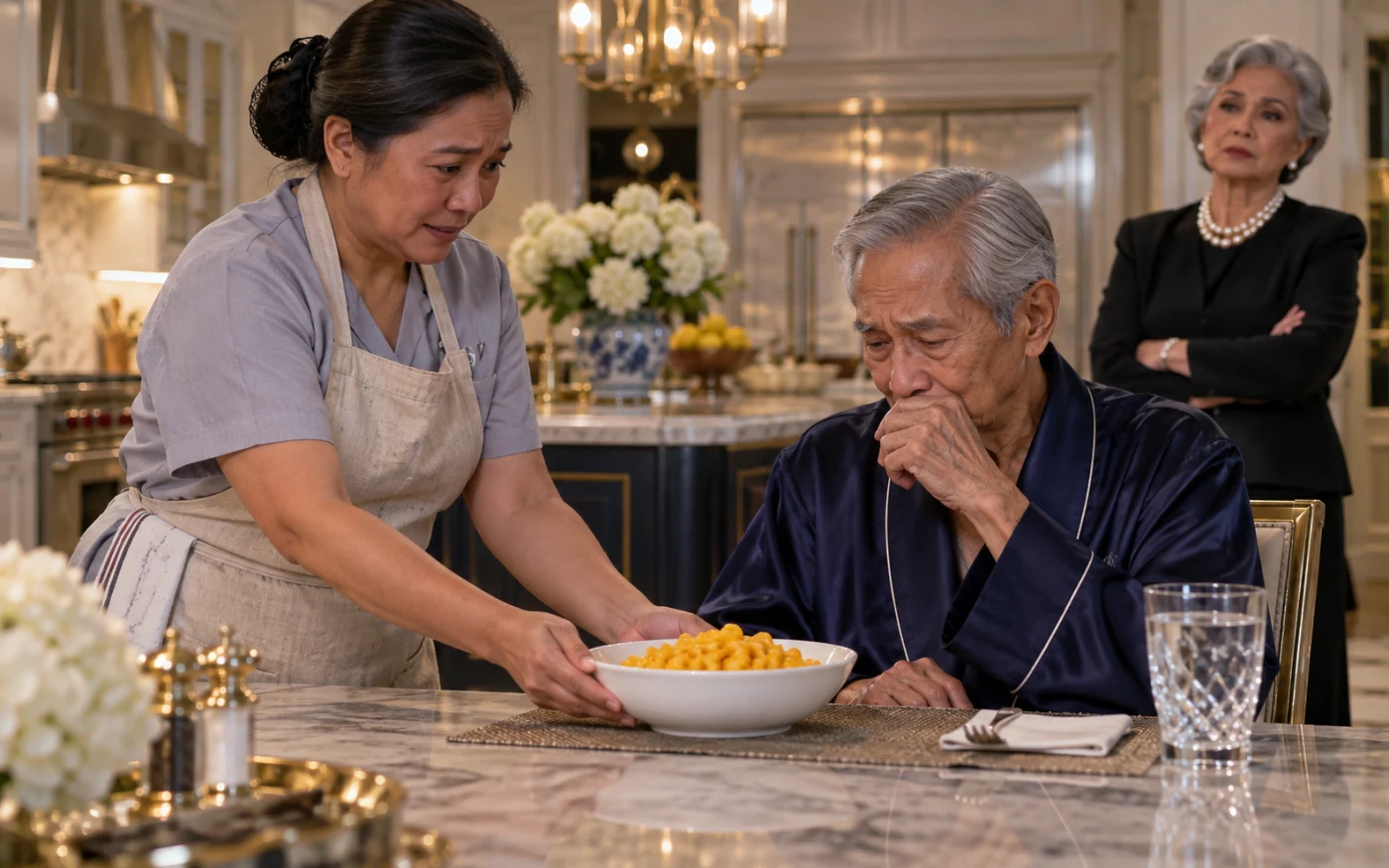
Mr. Calderon wiped his face with a linen napkin. “You said boxed macaroni?”
“Yes, sir.”
“The orange kind?”
“Very orange.”
He gripped the edge of the table. “Can you make it now?”
There was no boxed macaroni in that palace kitchen, but there were elbow noodles, cheddar, milk, and butter.
I made the closest version I could, with a little evaporated milk because that was how Daniel liked it.
Then I placed the bowl in front of a man worth billions.
He took one bite.
His eyes closed.
“My wife, Marian, made this every Friday when we were young,” he whispered.
“After I became successful, chefs kept improving it. Gruyère. Truffles. Breadcrumbs flown in from France. Every improvement took it farther away from her.”
He ate another spoonful.
“She died eighteen months ago. Since then, everyone treats my meals like a board presentation.”
I sat down without being invited. “Then tomorrow I'll make chicken soup.”
He looked at me. “With foam?”
“If my soup has foam, call an ambulance.”
He laughed so suddenly that macaroni nearly came out of his nose.
The next morning, Cheryl handed me an envelope.
Inside was a contract and a check for fifty thousand dollars.
“Five-week retainer,” she said.
My knees weakened. “For macaroni lang?”
From the breakfast room, Mr. Calderon shouted, “And no lobster!”
I paid the overdue rent that afternoon.
I didn't tell my landlord where the money came from.
I only watched his eyebrows jump when the payment cleared.
For the next three weeks, I opened Marina's at six, left my cook Patrick in charge after lunch, then drove to the estate.
I made tinola with green papaya. Beef stew. Mashed potatoes with gravy. Fried rice from leftovers.
On Fridays, we had orange macaroni in plain white bowls.
Mr. Calderon began waiting in the kitchen instead of the dining room.
At first, he only watched. Then he peeled carrots. Badly. He removed half the carrot with the skin.
“Naku, at this rate,” I told him, “one carrot will feed nobody.”
“I used to negotiate international acquisitions.”
“The carrot is winning.”
He laughed more. He ate more. He started wearing real clothes.
Sometimes he asked about my diner.
I told him about Mang Tony pretending not to flirt with Sheila.
Nurse Joy sleeping over her tapsilog after night duty.
And, Daniel's cracked red stool that nobody else was allowed to use.
Then his family arrived.
His son Victor wore a suit that looked more expensive than my car.
His daughter-in-law Bianca carried a handbag large enough to contain my car.
Their daughter Sofia followed behind them, staring at her phone.
They entered the kitchen while Mr. Calderon and I were arguing over whether raisins belonged in macaroni salad.
“Ay, absolutely not,” he said.
“Then make your own salad.”
Victor's face turned red. “Who speaks to my father like that?”
Mr. Calderon raised one finger. “A woman who understands raisins are a serious matter.”
Bianca opened a folder on the island.
Inside were printouts from my diner's social media page, the eviction notice, and my original fake application.
“You lied about your credentials,” she said. “Then took fifty thousand dollars from a grieving old man.”
The warmth drained from the room.
“I confessed on the first night,” I said.
“After gaining access to the estate.” Victor turned to his father. “Dad, she is exploiting your condition.”
Mr. Calderon's spoon hit the bowl.
“My condition?”
“You haven't been yourself since Mom died.”
That hurt him. I saw it.
So I stepped between them. “Your father is right here. Talk to him, not around him.”
Victor pointed toward the door. “You're fired.”
“You cannot fire my cook,” Mr. Calderon snapped.
“We can protect you from undue influence.” Bianca pushed the folder toward him.
“Sign this. It suspends all payments while we review her contract.”
My stomach dropped.
Without that income, the diner would collapse again.
But what frightened me more was Mr. Calderon's face.
He looked small. Cornered.
I untied my apron.
“Maybe I should go,” I said quietly.
“Marina—”
“I won't let your family use me to hurt you. But I also won't stand here and be called a thief.” I looked straight at Victor.
“Check every payment. Check every meal. Then apologize to your father for speaking as if grief made him stupid.”
I walked out shaking.
The next four days were terrible.
Business at the diner was slow. Every time the bell over the door rang, I expected a lawyer.
On Sunday morning, it rang at seven sharp.
Cheryl entered with a short woman in a white coat and Victor behind her.
“This is Dr. Velasco,” Cheryl said. “Mr. Calderon's physician.”
Dr. Velasco placed a chart on my counter. She pointed to two simple lines.
“His weight is up six pounds. His blood pressure has stabilized. His blood work is better, and he's walking every morning. These changes began after you started cooking for him.”
Victor frowned. “That doesn't prove she wasn't taking advantage of him.”
“No,” Dr. Velasco said. “I'm telling you what I can prove. Your father is eating, walking, and participating in his life again.”
Victor looked at the chart.
“Healthy meals helped,” Dr. Velasco continued. “But so did company. Your father wasn't refusing luxury. He was lonely.”
Victor's eyes filled.
“I thought giving him the best meant hiring the best,” he said. “I didn't ask what he wanted.”
I was still angry, but I moved Daniel's old stool toward him. “Sit. You look like you need coffee.”
He gave me a weak smile. “My father said you'd say that.”
Then Cheryl handed me a folded note.
Marina,
Please come to the estate at noon. Bring your landlord's number.
Also, wear something suitable for a short trip.
Below that, Mr. Calderon had added one more line.
Do not bring raisins.
PART 3: Where He Took Me
At noon, a black car carried Mr. Calderon and me through town.
“Where are we going?” I asked for the fifth time.
“You talk too much when nervous.”
“I talk too much when awake.”
The car turned onto my street.
Then it stopped in front of Marina's Diner.
My landlord stood outside with Victor, Cheryl, and a contractor holding blueprints.
Sheila, Patrick, Mang Tony, and half my regular customers were pressed against the windows.
I faced Mr. Calderon. “What did you do?”
“I made an acquisition.”
My landlord held out a document. “Mr. Calderon purchased the building this morning.”
The sidewalk tilted under my feet.
“You bought my diner?”
“The building,” Mr. Calderon corrected. “The diner is yours.”
He took the eviction notice from the window, tore it in half, and handed the pieces to my landlord.
Everyone inside cheered.
I did not.
Not yet.
“Hindi,” I said.
The cheering stopped.
Mr. Calderon's smile faded. “No?”
“You already paid me too much. People will say your family was right. They'll say I fed a lonely man macaroni and walked away with his building.”
“Let them talk.”
“I have to live with myself after they stop.”
He studied me for a long moment. Then he nodded toward the door.
“Show me what needs fixing.”
We walked through the diner together.
I showed him the leaking pipe, the broken freezer seal, the burner that only worked if Patrick kicked it, and the ceiling fan that squeaked like a mouse arguing with God.
At Daniel's red stool, I stopped.
“My husband built this place,” I said. “I won't turn his work into charity.”
Mr. Calderon ran his hand along the counter.
“Marian loaned me the money to start my first company,” he said.
“She made me sign a contract on a grocery receipt. One dollar repayment every year, plus dinner on our anniversary.”
He pulled a pen from his pocket.
“So give me fair terms.”
Right there on a paper placemat, we made our agreement.
I would keep the business.
He would own the building and renovate the kitchen.
My rent would stay affordable for ten years.
In exchange, he received one meal every Sunday and the right to complain about the macaroni.
“That's not fair,” I said.
“Fine. Unlimited coffee.”
“Now you're robbing me.”
We shook hands.
Three weeks later, the diner reopened.
The old sign stayed.
So did Daniel's counter and every cracked red stool.
But the kitchen had safe wiring, working burners, a new freezer, and a faucet that turned on without requiring an engineering degree.
On opening morning, people lined up around the corner.
Sofia posted a video of her grandfather fighting a carrot, and somehow it had spread everywhere.
But by Sunday, the curious crowd was gone, and my real customers came home.
Nurse Joy took her usual booth.
Mang Tony ordered coffee and denied he was waiting for Sheila.
Patrick shouted from the kitchen that nobody was allowed to kick the new stove.
At exactly eleven, the bell over the door rang.
Mr. Calderon entered wearing a blue jacket and carrying a small framed photograph of Marian.
Victor came behind him with Bianca and Sofia. They looked nervous.
I pointed to four empty stools at the counter.
“Sit. Family eats together.”
Victor met my eyes. “Marina, I owe you an apology.”
“Yes, you do.”
He blinked.
“You can give it while peeling carrots.”
Mr. Calderon laughed so hard he had to hold the counter.
I placed a bowl of bright orange macaroni in front of him.
Nothing fancy. No truffles. No foam.
Just butter, cheddar, evaporated milk, and the taste he had been asking for when nobody was listening.
He set Marian's photograph beside the bowl.
Then he looked around my noisy little diner.
The nurses, the drivers, the widows, the children stealing fries.
His family squeezed beside strangers and his eyes grew wet.
“This table is too small,” he said.
I looked at the counter Daniel had built.
“No,” I told him. “We just make room.”
So Mang Tony moved one stool, Sheila moved another, and the billionaire sat shoulder to shoulder with the rest of us.
Every Sunday after that, he came back.
And every Sunday, I served him the one dish no Michelin star had ever managed to improve.