
For Two Years I Fed the Men Building the Tower Across the Street. On My Last Day, One of Them Came Back in a Suit.
PART 1: My Last Friday
On the morning I thought I was losing everything, Mr. Quiet handed me his empty plate and said, “Cora, don’t pack away the Friday afritada yet.”
Then he disappeared into the finished tower across the street.
I stood behind my food cart with one hand on my aching knee, wondering why he cared what stayed warm. By sunset, I would have nowhere to cook it again.
My name is Cora de Guzman. I was fifty-four years old, eleven years into running Cora’s Lutong Bahay from a stainless-steel cart on a busy Quezon City corner, and behind on my apartment rent, my electric bill, and the payment for the cart itself.
Still, I cooked.
I always cooked.
I woke before the alarm, rubbed liniment into both knees, tied my apron, and started the rice. Then came pork adobo, giniling, pancit, fried eggs, and champorado for the men who arrived before sunrise.
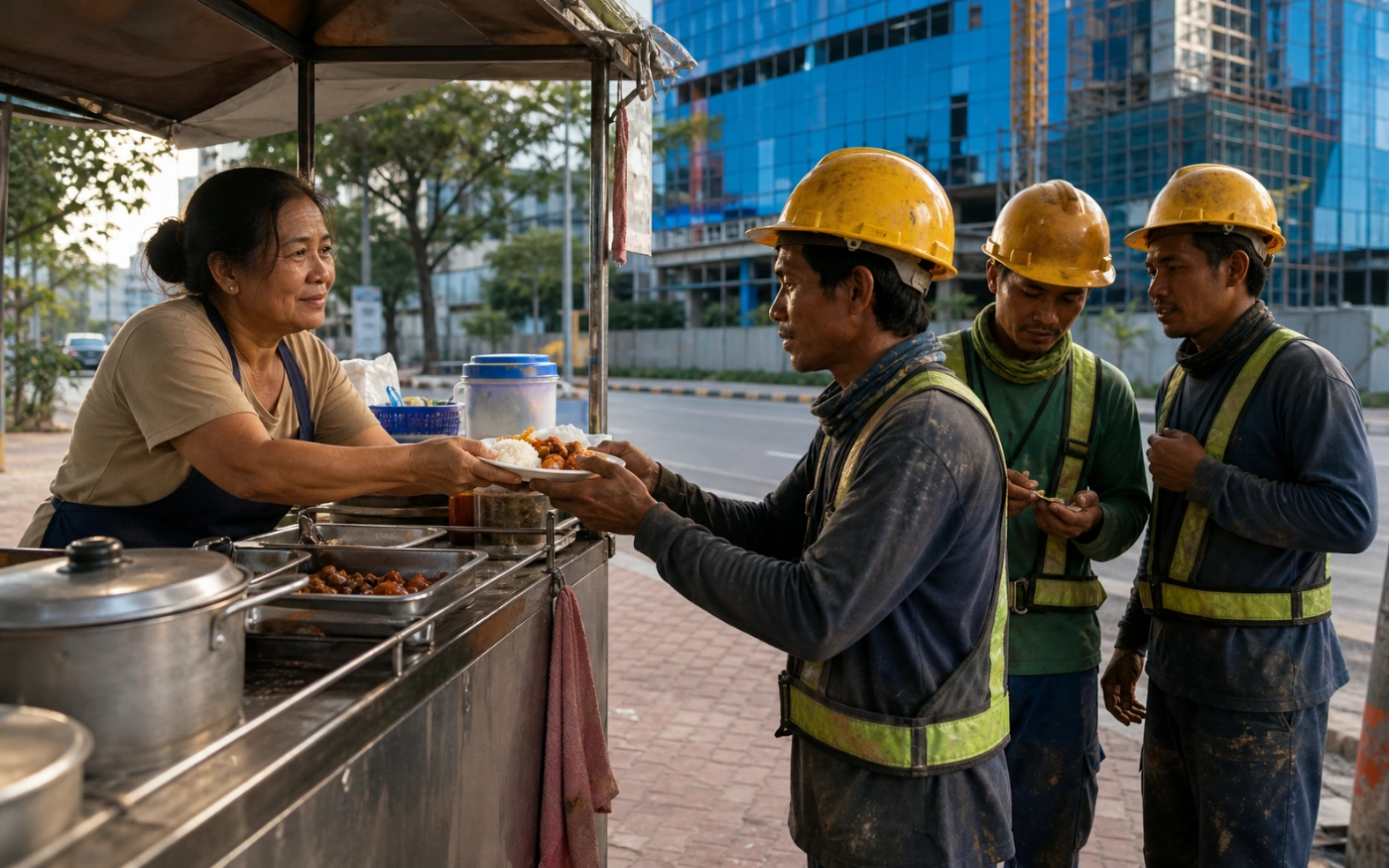
For two years, the empty lot across from me had been noise, dust, cranes, and men in hard hats. By six every morning, my cart had a line.
Those men became mine.
“Tita Cora, dagdag kanin,” Bebot would say, holding out his plate before he had swallowed his first bite.
“You already have a mountain.”
“Maliit lang, Tita.”
I gave him more.
Marlon could not eat sili because his stomach fought back. Jun, the youngest, was from Bicol and missed his lola, so I saved him the sweet turon with extra langka. Reynaldo sent most of his pay to Baras and pretended he was never hungry on Thursdays, the day before payday.
I knew who needed credit. I knew who had a sick child. I knew who wanted the burnt edge of the tocino and who was lying when he said, “Busog pa ako.”
I fed the ones who were short and never wrote it down where they could see.
And almost every day, there was Mr. Quiet.
I did not know his real name. He wore faded jeans, dusty brown boots, and usually a gray work jacket. He ate standing beside the orange construction fence, slowly, as if every bite deserved attention.
The first time he came, he pointed at the giniling.
“Spicy?”
“Only enough to wake you up.”
He smiled and bought one plate.
After that, he kept returning.
He never asked for credit. He never complained. When the line was long, he waited. When rain blew under my umbrella, he held one side of the tarp without being asked.
Most strange of all, he always asked about my knees.
“Masakit today?”
“They are fifty years older than the rest of me.”
“You’re fifty-four.”
“Exactly. My knees are one hundred four.”
He would nod seriously, as if this made perfect sense.
One Friday, almost two years earlier, I had served chicken afritada. He took one bite and stopped.
I thought something was wrong.
Then he said softly, “My mother put green peas in hers. Every Friday. Kahit mahal.”
The next Friday, I put green peas in the afritada.
After that, every Friday, I saved him a portion.
I never asked what he did at the site. Some men carried tools. Some checked plans. Some disappeared into trailers. A person has a right to eat without giving his whole buhay.
Then the tower was finished.
Thirty stories of blue glass rose where the empty lot had been. The construction fence came down. New trees arrived in square concrete boxes. Men polished windows that already looked clean.
And taped to my cart one Tuesday morning was a city notice.
SIDEWALK RECONSTRUCTION. ALL VENDORS MUST VACATE BY FRIDAY, 7:00 P.M.
I read it three times.
The new sidewalk plan had benches, planters, bicycle racks, and no space for me.
“Saan ka lilipat?” Bebot asked.
“I’m looking.”
That was a lie.
Every nearby corner required permits I did not have money for.
A small kitchen wanted six months’ rent in advance.
My sister Liza in Pililla told me to come home, but what would I do there?
At fifty-four, with bad knees and unpaid bills, I could not arrive carrying only two stockpots and hiya.
So Friday became my last day.
The men knew. Nobody said much. They simply came in larger numbers.
By ten, Bebot was eating his second breakfast. Jun had red eyes. Marlon handed me an envelope collected by the crew.
“No,” I said.
“Tita—”
“No. May mga anak kayo. Keep it.”
“Ang tigas ng ulo mo.”
“That is why my neck hurts too.”
But my voice broke.
At noon, Mr. Quiet came for his Friday afritada.
I gave him the plate I had saved, with green peas, carrots cut evenly, and sauce thick but not oily.
He ate slowly, asked about my knees, and handed me the empty plate.
“Cora, don’t pack away the Friday afritada yet.”
“Why?”
“May babalik para diyan.”
Before I could ask who, he crossed the street and disappeared into the tower.
At five, I began packing what was left.
The crew gathered near the cart, pretending they had nowhere else to be.
The finished tower reflected the sunset above us. It looked rich and cold and impossible.
Then a black car stopped beside the curb.
A man in a navy suit stepped out and opened the back door.
Mr. Quiet emerged.
But he was not wearing his dusty boots.
He wore a dark charcoal suit, and the building manager was hurrying across the sidewalk toward him.
“Mr. Villanueva,” the manager called. “Sir, we have the lease documents.”
Every construction worker around my cart went silent.
Mr. Quiet looked at me.
Then he looked at the pot of Friday afritada I had not packed away.
PART 2: Who Was Mr. Quiet
I stared at him so long that Bebot whispered, “Tita, huminga ka.”
Mr. Quiet came closer. His hair was combed back. His jacket probably cost more than my cart. But his face was the same face that had eaten beside the fence through heat, rain, and construction dust.
I pointed at the tower.
“Why is he calling you sir?”
He took a breath.
“My name is Gabriel Villanueva. My company owns the building.”
My hand landed on the edge of the cart.
“You own that?”
“Yes.”
I looked at his clean shoes, then at the tower, then back at him.
“For two years you let me call you Mr. Quiet?”
“You never asked my name.”
“You never offered!”
“You called me Mr. Quiet on the second day. It seemed final.”
Behind him, someone made a choking sound. Bebot covered his mouth.
I was not laughing.
My face burned. I remembered every time I had told this man not to block the napkins. Every time I had complained about “whoever designed that monster.” Every time I had given him an extra spoonful because I thought he looked tired.
“Were you inspecting me?” I asked.
His expression changed.
“No.”
“Was this some rich-man game? Kumain sa cart, see how ordinary people live?”
“No, Cora.”
I pulled off my apron. “Then bakit?”
He looked unsure for the first time in two years.
“My mother died three months before we broke ground,” he said. “She ran a small canteen when I was a boy. Construction workers, jeepney drivers, office clerks. She remembered everybody’s food. No sili. Extra sabaw. Utang muna.”
He glanced at the afritada.
“I used to tell her she gave too much away. Then at her funeral, men I had never met came from jobs she had fed them through twenty years earlier. One told me my mother kept him eating during the month his daughter was in the hospital.”
The crew had gone completely still.
Gabriel looked at me.
“Then I found your cart.”
My anger loosened, but it did not disappear.
“You could have told me.”
“I could have. But here, nobody wanted a meeting from me. Nobody wanted approval. I could eat, listen to Bebot complain about rice portions, and let you insult my building.”
“Often.”
“Often with excellent points.”
Daniel, the building manager, cleared his throat.
“Sir, the contractor still needs the sidewalk cleared by seven.”
There it was again. The real world.
I folded my apron and put it inside a plastic bin.
“Fine. I’m almost done.”
Gabriel shook his head. “That isn’t what he means.”
Daniel opened a leather folder.
“Mr. Villanueva has selected the tenant for the ground-floor corner unit.”
I looked through the tower’s glass doors. On the corner was a space with tall windows and enough room for twelve tables. For weeks, real estate agents had shown it to coffee chains, restaurants, and expensive shops.
“Good for them,” I said.
Gabriel pointed to me.
“It’s you.”
I laughed once because the sentence was absurd.
Nobody else laughed.
“Ano?”
“I want Cora’s Lutong Bahay there.”
My stomach dropped.
“I cannot afford even the doorknob.”
Daniel showed me the first page.
The rent was lower than what I paid for my apartment.
I looked at Gabriel.
“No. You feel sorry because I gave you peas.”
His voice became firm.
“I am not rewarding you, Cora.”
He walked to the side of my cart and lifted the small notebook I kept beneath the cash tin.
“May I?”
Before I could answer, he opened it.
Inside were my shopping totals, daily sales, and lists of names with amounts beside them. Some had been crossed out when the men paid. Some I had quietly crossed out myself.
Gabriel looked toward the workers.
“I watched this line become the one place where laborers, engineers, delivery drivers, and executives stood in the same order. I watched you know who was hungry before he spoke. I watched men choose this cart over catered meals inside.”
He tapped the notebook.
“You think you were only selling lunch. You built the first place in this whole project where people knew each other’s names.”
My eyes filled.
He continued.
“I can rent that corner to a coffee chain for more money. But I have spent two years deciding what belongs there. I had my answer almost from the beginning.”
Nobody spoke.
Then Bebot held up his plate.
“Tita Cora fed me when I had twelve pesos.”
Marlon nodded. “She fed me three days before payday and pretended she forgot.”
Reynaldo looked embarrassed. “Five days.”
“You said three,” I told him.
“I was protecting my dignity.”
The men laughed.
Jun wiped his face with the back of his hand.
“You saved turon for me when I wanted to go home.”
I looked at all of them.
The men I had fed under one leaking tarp.
The men who had fixed my wheel, carried my gas tank, and pretended not to notice when I crossed out what they owed.
For the first time, the tower did not look like the thing that had pushed me away.
It looked like a place full of people I already knew.
Gabriel held out a brass key.
My fingers closed around it.
“What if I fail?” I whispered.
“Then you fail after somebody finally gives you a fair place to try.”
Bebot immediately picked up the rice cooker.
“Good. Tapos na.”
“Hoy! Where are you taking that?”
“Across.”
Marlon grabbed a stockpot.
Jun took the stack of paper plates.
Nobody asked permission.
And all the men I had fed began carrying my kitchen into the tower.
PART 3: What Waited Inside
“Put that down!” I shouted.
Nobody listened.
Reynaldo pushed the cart after the city inspector confirmed it could cross. Even Daniel removed his suit jacket and took one end of a folding table.
Gabriel offered me his arm.
“My knees work,” I snapped.
“I know. You tell me every day.”
I crossed without him, crying so hard that the traffic lights became red and green stars.
Gabriel unlocked the glass door.
Inside, the unit was not empty.
There was a long stainless-steel counter. Behind it stood a stove, refrigerator, sinks, shelves, and a rice cooker so large Bebot whispered, “Ay, mahal na mahal ako ni Lord.”
Along the windows were simple wooden tables and chairs.
On the wall hung one unfinished sign.
CORA’S LUTONG BAHAY.
Below it, in smaller letters, was FOOD THAT KNOWS YOUR NAME.
I pressed both hands over my mouth.
“The kitchen equipment stays with the unit,” Gabriel said. “The rent is fixed for five years. You get three months to open without rent, and if after a year this does not work, you can leave.”
Daniel handed me the papers.
“Take them to your own lawyer,” he said.
I looked at Gabriel.
“No tricks?”
“No tricks.”
Then Marlon placed the crew’s envelope on the new counter.
“Now you take it.”
I started to shake my head.
“Tita,” Jun said, “advance payment.”
Bebot pulled out folded bills and put them beside the envelope.
“One month lunch.”
Reynaldo added his money.
“Two weeks breakfast.”
Marlon put down his share.
“No sili.”
I laughed through my tears.
“I know.”
One by one, the men paid for meals I had not cooked yet.
Not donations.
Breakfast.
Lunch.
Extra rice.
Gabriel pushed nothing toward me. He simply stood back and let me see it.
For eleven years, I had cooked with rain hitting my back and buses breathing exhaust into my face.
I had hidden overdue notices under sacks of rice.
I had gone home every night smelling of oil, telling myself that surviving one more day was enough.
Now my dented pots sat on a shining counter, and the men around them were arguing over how many lunches they were allowed to buy in advance.
I put both hands on the counter.
“All right,” I said.
The room went quiet.
“My lawyer checks everything first.”
Gabriel smiled. “Absolutely.”
“And if she says it is clean, I sign.”
Bebot raised both arms.
“May pagkain!”
Everyone shouted.
I laughed so hard I had to sit down.
Three weeks later, at five fifty in the morning, I stood behind the new counter wearing a clean red apron.
Liza had come from Pililla after declaring over video call that I could not open a carinderia without someone who knew how to criticize my chopping.
She was arranging pandesal when she looked through the window.
“Ate,” she said. “May pila na.”
The line curved past the glass doors.
Hard hats. Office shirts. Delivery uniforms. Building staff. Men who had eaten at my cart and people I had never seen.
My knees hurt. My hands were trembling.
“Hindi ko kaya,” I whispered.
Liza tied my apron tighter.
“Late ka na magsabi.”
At exactly six, I unlocked the door.
The men cheered.
They filled the tables instead of sitting on the curb. Bebot claimed the chair nearest the rice station. Marlon inspected the giniling for sili. Jun touched the wooden tabletop as if checking that it was real.
Then Gabriel entered wearing jeans and dusty brown boots.
He took his old place at the end of the line.
“You own the building,” Daniel told him. “You don’t have to queue.”
Gabriel shook his head.
“Everybody waits here.”
When he reached the counter, I gave him chicken afritada with green peas.
He took one bite and closed his eyes.
“Like hers?” I asked.
He opened his eyes. They were wet.
“No,” he said softly. “Like yours.”
Behind him, Bebot called, “Tita Cora, dagdag kanin!”
I lifted the rice spoon.
“You already have a mountain.”
He held out his plate.
And this time, with all my people warm and seated around me, I gave him more.