
My Son's Fiancée's Mother Asked Me to Take Her Coat at the Rehearsal Dinner. Then a Famous Designer Walked in and Called Me "Maestra."
PART 1: The Woman in the Garage
The moment the most famous man in the room took both my hands and called me “Maestra,” I had just finished carrying another woman’s coat and fetching her wine.
But let me start with the sentence that put me there.
“It is a six-figure gown, Lorna,” Celeste Beaumont told me. “And you work out of a garage.”
She said it four months before our children’s wedding, in the bridal salon, while her daughter Ava stood barefoot on a little white platform.
My son Nico stared at the floor.
Ava whispered, “Mom.”
I smiled because when I am hurt, my face behaves as if a camera has appeared.
“Of course,” I said. “Naiintindihan ko.”
I had only offered to make Ava’s veil.
Not the gown. I knew the gown had already been ordered from a designer whose name everyone said slowly, like a prayer: Matteo Vale.
I had never heard of him.
What I knew was silk. What I knew was how to make a French seam disappear between two fingers.
What I knew was how a bride’s shoulders change when a dress finally stops fighting her body.
I had sewn in my Daly City garage for thirty-one years.
Prom dresses, baptism gowns, barongs, funeral blouses, choir robes, pageant costumes, and one silver anniversary dress made from a woman’s original wedding train.
I had sewn through fog, heat, brownouts, Nico’s chicken pox, and the year my husband Ramon died.
There was a couch beside my cutting table where Nico used to sleep under bundles of muslin.
There were oil marks on the concrete and chalk dust in every crack.
It was still a garage.
That was the part I could not stop turning over.
Was Celeste cruel, or was she simply right?
For four months, I heard her sentence whenever I raised the metal door.
You work out of a garage.
I heard it when my old Juki purred beneath my hands.
I heard it when Mrs. Ramos cried because I made her late mother’s ternos fit her daughters.
I heard it when I swept loose thread into my palm at midnight.
Nico tried to apologize the next day.
“Ma, I should have said something.”
“Then why didn’t you?”
He was quiet.
My son is thirty-two, but when he feels ashamed, he becomes nine again.
“I didn’t want Ava caught in the middle.”
“And where did you put me, anak?”
His eyes filled. Mine did too, so I turned toward the kettle.
“Ayoko ng drama,” I said, although drama was already sitting at my kitchen table, breathing into both hands.
I told him I would attend every dinner and smile in every photograph. I told him I loved Ava. Both things were true.
But I did not make the veil.
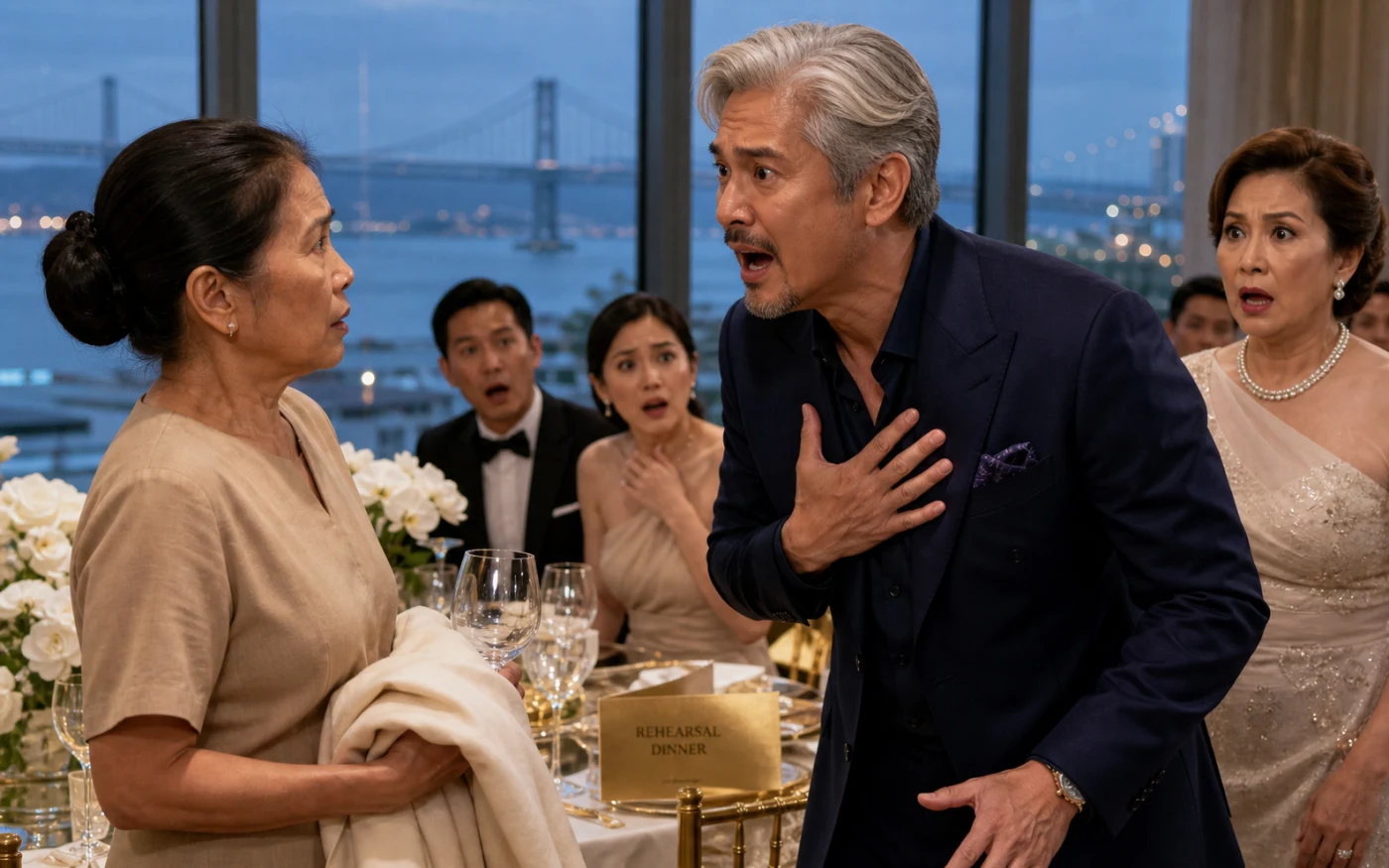
The night of the rehearsal dinner, Celeste rented the glass dining room of a hotel overlooking the bay.
There were white orchids hanging above the tables and little gold cards telling each person where to sit.
My card was beside the service door.
Maybe that was coincidence.
I had met Celeste eleven times. She still called me Laura.
“Lorna,” Ava corrected softly.
“Yes, of course.” Celeste slipped a cream cashmere coat from her shoulders and held it toward me without looking. “Would you take this, please?”
I took it.
Then she handed me her empty glass.
“And perhaps a refill? Sauvignon blanc.”
For one hot second, I saw myself set both things on the floor.
Instead I said, “Sige.”
Across the room, Nico saw me.
His whole face changed.
He started toward us, but Ava caught his sleeve.
She had been crying in the ladies’ room ten minutes earlier because the gown fitting upstairs had gone badly.
I knew because I had found her washing mascara from beneath her eyes.
“It pinches here,” she had whispered, touching the front of her shoulder. “They keep saying beauty needs sacrifice.”
“Beauty needs room to breathe,” I said.
She had looked at me in the mirror as if I had opened a window.
Now she held Nico because she needed him, and I could not make him choose between us in front of ninety people.
So I carried Celeste’s coat to the checkroom.
I brought her wine back.
“Thank you, Laura,” she said.
“Lorna,” said Nico.
The room went still around our little circle.
He took the glass from my hand and placed it on the table.
“My mother is not staff.”
Celeste blinked. “I never said she was.”
“You didn’t have to.”
Ava’s hand slipped from his arm.
“Nico, please,” she whispered.
Then the dining-room doors opened.
Three hotel managers entered first. Behind them came a slim man in a midnight-blue suit, silver at his temples, with two assistants hurrying after him.
Celeste gasped.
“Matteo.”
Everyone began saying that name.
Matteo Vale. Matteo Vale. Matteo Vale.
He crossed the room toward us.
Then he looked at me.
His leather folder fell from his hand.
“Maestra?” he said.
PART 2: Who Called Me Maestra?
I knew his face before I knew his name.
Not the sharp cheekbones or the silver hair. I knew the frightened eyes.
“Jun?” I said.
He made one broken sound, then took both my hands and pressed them to his forehead.
“Maestra Lorna. Diyos ko. Ikaw nga.”
The famous designer was crying.
Celeste was still holding the wine my son had put down. Her mouth had opened, but nothing came out.
“You are Matteo Vale?” I asked.
He laughed through his tears. “Now, yes. Dati, Jun Valencia, very stubborn, very hungry.”
That was when I remembered 2001.
Jun had been nineteen.
He had dropped out of college and was sleeping in his cousin’s laundry room.
One rainy afternoon, he came to my garage holding a ruined red jacket he had promised to finish for a singer.
He had set both sleeves backward.
“Can you fix it?” he asked.
“Hindi.”
His face fell.
“But you can,” I said. “Tanggalin mo.”
He stayed eleven months.
He swept the floor, watched Nico after school, and learned that cloth cut on the bias remembers every careless hand.
He called me Maestra because Tita made him too comfortable, he said.
Then one morning he left a note beside my scissors. New York. A chance. Salamat po.
For years, there were Christmas cards. Then my Ramon got sick, we moved twice, and the cards stopped.
Now Jun—Matteo—held my shoulders in a hotel dining room as if I were the person who had been lost.
“You taught him?” Ava asked.
“Everything important,” he said.
“Naku, not everything.”
“How to set a sleeve. How to cut silk. How to feed a child while finishing a hem.” He looked at Nico. “You slept beneath her table.”
Nico nodded slowly. “I remember red thread in your hair.”
Jun touched his hair and smiled.
Celeste found her voice.
“This is extraordinary. Lorna, why did you never tell us you trained Matteo Vale?”
I looked at her.
“You never asked what I did in the garage.”
Her face changed then. Not enough. But something moved.
Jun bent to retrieve his folder. “Where is the bride? I came because my atelier sent fitting photographs, and something is wrong.”
Ava went pale.
Celeste said quickly, “Only a minor comfort issue.”
“She cannot lift her arms,” I said.
Jun looked at me. “You saw?”
“Only how she holds her shoulders.”
He turned to Ava. “Show me the gown.”
Upstairs, six of us crowded into the bridal suite: Ava, Nico, Celeste, Jun, his assistant Mara, and me.
The gown stood on a mannequin by the window.
It was beautiful. Ivory silk faille, a low square neck, hand-beaded vines, and long fitted sleeves. It was also wrong.
I could see the problem from the doorway.
“Who altered the armscye?” Jun asked.
Mara checked her tablet. “The local salon. They took in three centimeters.”
“Three?” His voice became very soft.
Celeste twisted her ring. “They said Ava’s upper arms looked heavy in the photographs.”
Ava stared at her.
“You told them to do that?”
“I wanted the line to be perfect, darling.”
“You told me it was how the designer made it.”
“Put it on,” Jun said gently.
When Ava emerged, she looked like a princess trapped inside a glass bottle.
The gown pulled beneath both arms. The neckline bowed. Her fingers had already begun to tremble.
“Raise your hands,” Jun told her.
She could barely lift them past her waist.
“Tomorrow my father is supposed to dance with me,” she said. “How can I even hold him?”
Celeste moved forward. “We can skip the dance.”
“No,” Ava said.
It was not loud. It stopped everyone.
Jun walked around her, studying the seams. “The extra allowance was cut away.”
“Can you replace the sleeves?” Nico asked.
“In New York, with three weeks, yes.”
“The wedding is tomorrow.”
No one moved.
Then Jun looked at me.
Not at the celebrated designer in the mirror. At the woman reflected behind him, still wearing drugstore lipstick, with Celeste’s coat-check ticket in her purse.
“Maestra,” he said, “what do you see?”
I stepped closer and put two fingers beneath Ava’s left sleeve.
There was no room. But under the beaded overskirt, hidden in the back pleats, there was cloth.
Enough, perhaps.
“I see someone must be brave,” I said.
Then I picked up Jun’s scissors and cut into the six-figure gown.
PART 3: What Did I Cut Away?
Celeste screamed my name correctly for the first time.
“Lorna!”
Ava did not move.
I had cut a clean line beneath the left sleeve, opening the seam from underarm to elbow.
She lifted her arm.
Not far, but farther.
“Again on the right,” she said.
“Anak, once I cut, walang balik.”
She looked straight at herself in the mirror.
“I want to dance with my father.”
So I cut the other sleeve.
Jun was already removing his jacket.
“Mara, sewing kit. Nico, clear the table. Celeste—” He glanced at the woman standing white-faced beside the champagne bucket. “Bring Maestra a chair.”
Celeste brought me the chair.
For the next two hours, the rehearsal dinner happened without us.
Hotel staff carried plates upstairs. Nobody ate except Nico, who held half a dinner roll near my mouth until I took a bite.
I opened the back pleats and removed two narrow panels no guest would ever miss.
Jun sat cross-legged at my feet, pulling beadwork away stitch by stitch so I could shape the silk into underarm gussets.
“Too narrow,” I told him.
“I followed your old formula.”
“Mali ang angle.”
He looked at the piece, frowned, and recut it.
Thirty years disappeared. He was Jun again, eager and offended by every correction.
Celeste stood in the corner holding pins.
Once, she tried to say something to Ava.
“Darling, I only thought—”
“Please don’t,” Ava said.
Celeste closed her mouth.
At eleven forty, I basted the final gusset into place.
“Try,” I said.
Ava lifted both arms.
The silk settled instead of pulling. The neckline lay smooth. She raised her hands higher, over her head, and gave a startled little breath.
Then she turned to Nico.
He understood.
He took out his phone and played the song she had chosen for the father-daughter dance.
“Your father isn’t here,” he said. “Ako muna.”
Ava placed one hand on his shoulder. He took her waist carefully, and they began to move between the bed and the room-service cart.
At first she watched the sleeves.
Then she forgot them.
Nico spun her once.
The skirt opened around them like a white flower. Ava laughed and lifted both arms as high as she could.
Nothing tore.
Jun gripped my hand.
Celeste made a small sound behind us.
Her face had folded. She walked toward her daughter, stopped, and seemed to understand that words would not carry her across the room.
So she bent down.
The gown’s long train had caught beneath the wheel of the room-service cart.
Celeste freed it carefully, spread the silk with both hands, and stayed kneeling until Ava finished dancing.
When the song ended, Ava looked down at her mother.
Celeste said, “I’m sorry. Anak, I’m so sorry.”
Ava’s eyes filled.
“Stand up, Mom.”
Celeste stood. Ava put her arms around her.
Those new seams held too.
The next morning, someone knocked on my garage door at seven.
I raised it expecting Nico.
Jun stood outside in yesterday’s midnight-blue suit, holding two coffees and a paper bag of warm pandesal.
“My flight leaves at noon,” he said. “May oras pa.”
“For what?”
He turned around.
The back hem of his famous suit trousers had come loose and was hanging over his shoe.
“Emergency,” he said solemnly.
I let him in.
He sat on the old wooden stool beneath the shelves of thread while morning fog pressed against the open door.
I threaded a needle and folded his hem into place.
“Your blind stitch is too tight,” I told him.
“That was my assistant.”
“Sinungaling.”
He lowered his head, smiling like the nineteen-year-old boy who had once sewn two sleeves on backward.
I tapped his ankle.
“Sit still, Jun. And listen. Mali pa rin ang stitching mo.”