
My Cousins Entered Lola in the Karaoke Contest as a Joke and Told Her, "Go On, Superstar." Halfway Through the First Verse, a Judge Stood Up...
PART 1: The Registration Slip
The registration slip cost twenty pesos.
Paolo paid with a fifty and told the lady at the table to keep the change, because that is the kind of thing you do when you are twenty-four and the joke is going well.
"Lola Belen de la Cruz," he said, spelling it out. "Seventy-eight."
The lady wrote it down without looking up.
Lola Belen raised me in a house where there was music in every room and nobody ever mentioned it.
She hummed while sweeping.
She sang harmony with the radio, always the harmony, never the melody.
When the electricity went out she knew every verse of every song the neighbors asked for, and the neighbors asked for a lot of them.
But if you ever said she had a beautiful voice, she would wave one hand at you like she was chasing a fly.
"Naku, dati pa iyon."
"Finish your food."
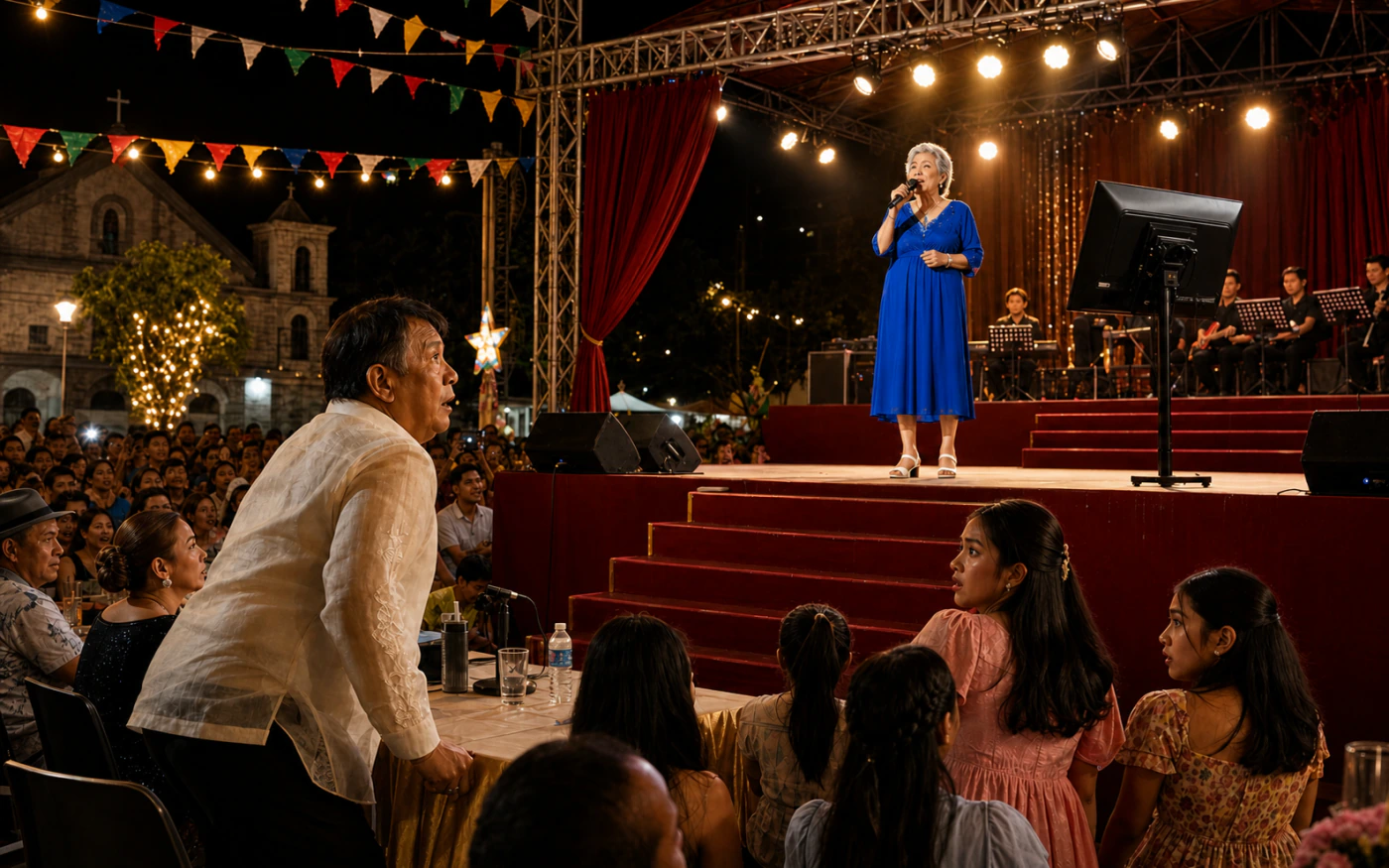
The plaza was strung with colored lights that year. The good ones, the big bulbs, because the barangay captain's daughter had gotten married in June and there was money left.
Children ran around the bandstand.
The judges sat under a tarp with two electric fans pointed at their faces.
Lola wore the blue dress she has owned since my college graduation and the white sandals with the tiny buckle.
She was holding a plate of pancit she had not touched.
"They put you between the power ballad and the dance remix," I said.
"Mm."
"Lola, we can go home. You do not have to prove anything to them."
She looked at me for a second longer than I expected.
"Prove?"
"Anak, I am seventy-eight. At my age you stop proving and you start collecting stories."
Paolo came over with the printed song list, laughing before he even arrived.
"Lola, we picked for you already."
He put his finger on it.
Number forty-one. A kundiman from before any of us were born, sitting there in the list like a typo, three lines above the teenagers doing the dance remix.
"Nobody under forty even knows this one," he said. "It is perfect."
My cousins were laughing behind him. Not cruelly. That is the thing I want to be fair about. They were laughing the way you laugh at your grandmother's flip phone.
I was watching Lola's face.
Because Lola's face did something.
It was very small and it lasted maybe half a second. Her chin came up. Her eyes went to the paper and stayed there a beat too long, the way you look at a name you were not expecting to read.
Then she set down the pancit.
"Sige," she said. "Number forty-one."
Paolo whooped.
"Go on, Superstar!"
Behind the bandstand is the barangay music room. It has been there my whole life. The roof leaks over the corner where the guitars are, two of those guitars have missing strings, and the keyboard only works if somebody presses down on the battery cover while you play.
Lola looked at that roof for a long moment.
Then she looked at the sign taped to the judges' table.
FIRST PRIZE ₱20,000
"Nina," she said.
"Po?"
"Hold my plate."
PART 2: Number Forty-One
The emcee called her name and half the plaza did not stop talking.
Lola climbed the steps slowly, one hand on the rail. Somebody's lola always climbs the steps slowly. Nobody looks up.
The emcee leaned in with the microphone, doing his job.
"First time joining, Lola?"
"No."
He blinked.
That was not the answer he had.
"Ah, you have joined before po?"
Lola took the microphone out of his hand.
Not rudely. The way you take a pan off a stove.
She turned to face the plaza, and she said it into the speakers, flat, like she was reading a grocery list.
"I sang this song every Saturday night for two years."
"DZRB Iloilo."
"Nineteen sixty-seven."
The plaza did not gasp. I want to be honest about that. Most of them were not listening and the ones who were did not know what DZRB was.
But under the tarp, one of the judges put down his ballpoint.
He was an old man in a cream barong. He took off his glasses.
He did not stand up yet.
The music started.
Her first note was so soft that the halo-halo stall kept blending.
Then she lifted her head, and the second note came out, and I did not recognize it.
I am going to try to say this correctly.
The sound that came out of my grandmother did not belong to the small woman who carries the grocery bags against her hip and washes out plastic containers because they are still good.
It was low. It was clear. It was warm at the edges and completely certain, and it went out across the plaza and everything else got out of its way.
The children stopped running.
The blender clicked off.
The man selling balloons lowered his arm.
Paolo was standing near the halo-halo stall with his mouth slightly open and his phone still up, filming a joke that had stopped being one.
Lola did not look at any of us.
She sang to the back of the plaza. Past the tricycles. Past the church.
Her hands stayed at her sides the entire time.
Only her voice moved.
Halfway through the first verse the old man in the barong stood up.
He did not applaud. He just stood, the way people stand in church, and he stayed standing.
The woman beside him tugged his sleeve and he did not notice.
When the song ended nobody did anything for one full second.
Then the plaza came up.
I have heard loud before. This was not loud. This sounded like a room full of people trying to give something back that they had not known was missing.
The old man came onto the stage before the emcee could recover.
His voice was not steady.
"Ma'am. Are you Belen de la Cruz?"
Lola looked at him the way she looks at a salesman.
"That depends who is asking."
He laughed and put his hand over his mouth like a boy.
"Celso Manalo po. I carried the sheet music at the station. I was fourteen."
And my grandmother, who has never once in my life looked surprised, said:
"Ay."
"Celsito."
PART 3: What Was in the Shoebox
Here is what she told the plaza, and she told it herself, and it took her about ninety seconds.
In 1967 she won a regional radio contest. A recording company in Manila asked her to come and audition. She was nineteen. The bus ticket was already bought.
Two days before the trip her father died.
She was the oldest of seven.
The ticket money became rice money, and then it became school uniforms, and then it became somebody's tuition, and then it was 1974 and nobody was asking anymore.
"My brothers became teachers," Lola said. "My sisters became nurses."
"That was also a good song."
There was no self-pity anywhere in her voice. That is what made me cry, standing there holding a paper plate of pancit.
Mang Celso was wiping his face with his sleeve, not even hiding it.
They gave her first prize. She argued about it. She said the teenager with the dance remix had better stage presence, which was true, and the judges ignored her, which was also correct.
Twenty thousand pesos and a trophy shaped like a microphone.
The emcee asked what she would do with the money.
She pointed behind the stage.
"Fix that roof."
"Children should not have to wait until they are seventy-eight to find out they are allowed to sing."
Paolo did not apologize that night. I want that on the record, because I think it matters.
He apologized four days later, at the house, standing in the kitchen doorway while she was washing dishes, and he had clearly been carrying it around the whole time.
"Lola. We did not know."
She kept washing.
"You knew I was your grandmother."
"That should have been enough."
He said opo and looked at the floor and she let him stand there for a while before she handed him a towel.
Mang Celso came to the house the following Sunday.
He brought a shoebox.
Inside it were letters. Not many. Maybe forty. Ruled paper, some of them, and a few on the back of receipts, addressed to the station, asking when the girl who sang on Saturday nights was coming back.
He kept them for fifty-nine years.
"I always thought you would come and get them," he said.
Lola read them at the kitchen table with her glasses down her nose, one at a time, all afternoon, not saying anything.
Then she put them back in the box and closed it and said, "Sinong gusto ng merienda?"
The recording happened a month later, at a community radio station in town, in a room with egg cartons on the walls.
She sang the song she never took to Manila.
She made all seven grandchildren sing the last chorus with her. Including Paolo, who has the voice of a distressed carabao and who participated with humility.
It did not make anybody rich. They played it twice on a Sunday program and that was that.
What it did was this.
Neighbors started coming to the house with old songs they half remembered from their parents. Lola would work out the rest. Children from the music room came with the repaired guitars and the keyboard that now closes properly.
Sunday afternoons at our house got very loud.
At the next fiesta the organizers asked her to judge the karaoke contest.
She wore the blue dress. She put the microphone trophy on the table beside her.
Before the first contestant she leaned toward the crowd.
"No laughing unless it is funny, ha?"
Paolo clapped first.
She still sings while she washes the dishes.
She just does not stop anymore when somebody walks in.