
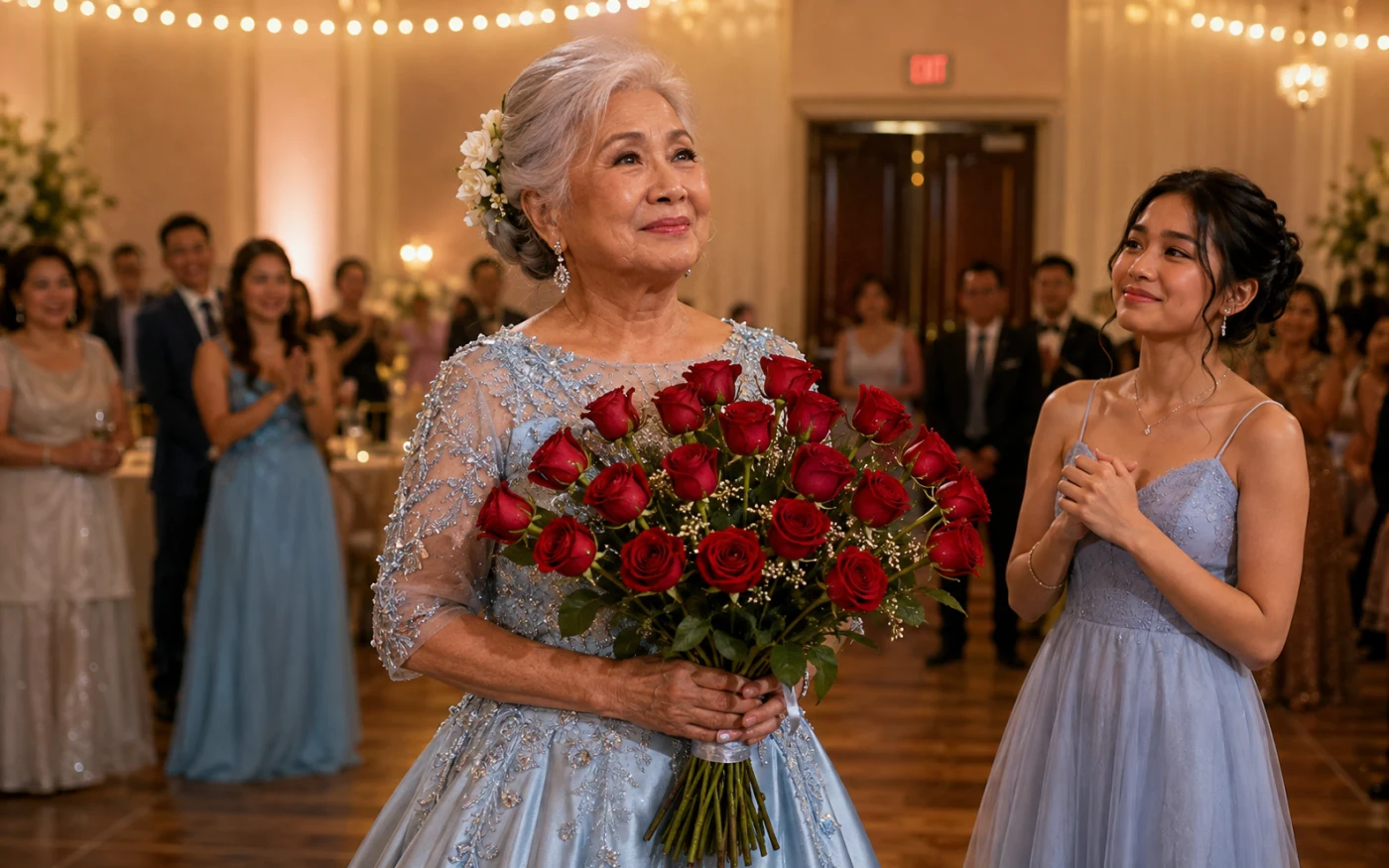
Lola Ising Is Turning 76 and Demanded a Debut — Eighteen Roses, Eighteen Candles, a Gown, the Whole Thing. Her Sons Called a Doctor.
PART 1: Lola's Impossible Party
My grandmother announced she was having a debut for her seventy-sixth birthday.
Before the plates were cleared, my father was whispering that she needed a doctor.
Not a gown fitting.
Not a caterer.
A doctor.
We were eating Sunday lunch at Tito Joel's house in Houston.
There was pancit on the table, a tray of lumpia between my elbows, and twelve relatives talking over one another when Lola Ising tapped her water glass with a spoon.
“I have an announcement,” she said.
She was five feet tall in her house slippers, with silver hair sprayed so firmly that Houston humidity had surrendered.
Everybody quieted.
“For my seventy-sixth birthday, I will have my debut.”
My father, Anthony, blinked.
Tito Joel laughed once because he thought she was teasing.
Lola did not laugh.
“I need a ballroom, a cotillion, eighteen roses, eighteen candles, and eighteen treasures,” she continued. “My gown will be blue. Not navy. Navy is for meetings. I want the blue of the sky before sunset.”
My cousin dropped a fork.
“Ma,” my father said carefully, “a debut is for an eighteen-year-old.”
“I am aware. I have attended many.”
“You are turning seventy-six.”
“Also aware.”
She opened her purse and took out a little spiral notebook.
“The hall deposit is paid. Invitations go out Tuesday. I have six roses confirmed.”
That was when everyone stopped smiling.
My father and his brothers exchanged the look they used when a roof leaked or a hospital called.
Lola watched them, put one spoonful of leche flan on her plate, and ate it calmly.
I knew exactly why she was doing it.
Three weeks earlier, I had asked my parents if I could have a debut when I turned eighteen the next spring.
I did not ask for a hotel ballroom or a horse-drawn carriage.
I had shown them a church hall, a borrowed dress, and a budget I had made myself.
My mother looked interested.
My father did not even look at the numbers.
“We're not that kind of family, Chato,” he said. “That's showing off.”
Lola had been in the next room folding towels.
I remembered the silence after his words. I remembered a towel slipping from her hands.
Later that night, she sat beside me on the back steps while mosquitoes attacked our ankles.
“You wanted it very much?” she asked.
I shrugged because I was seventeen and humiliation had made me pretend I wanted nothing.
“It's fine, Lola.”
“That is not what I asked.”
I stared at the dark yard.
“Yes,” I said. “I wanted it.”
She pressed my hand once. Then she went inside.
At Sunday lunch, my father leaned toward me while Lola described her preferred centerpiece height.
“Did she say anything to you?” he whispered.
I looked at her notebook. Every page had names, prices, phone numbers, and tiny boxes checked in red ink.
“She said she wanted a party.”
“This isn't a party. This is…” He lowered his voice. “This isn't like her.”
But it was exactly like her.
They just had not been listening for years.
Lola had come to live with us after Lolo died.
She paid for her own medicine, bought groceries when my parents were short, and slipped twenty-dollar bills into birthday cards.
She wore the same good dress to every wedding.
She never ordered the expensive fish. She said, “Anything is fine,” so often that my father believed it.
Now she wanted something, and the whole family treated desire like a symptom.
By Wednesday, Dad and Tito Joel had scheduled a cognitive assessment.
They called it a “regular checkup.”
Lola found the appointment reminder on the refrigerator.
She read it twice, then looked at my father.
“You think I have lost my mind.”
“Nobody said that, Ma.”
“You booked me with a memory specialist.”
“Because this party is costing thousands.”
“My thousands.”
“And you are asking strangers to dance with you.”
Lola lifted her chin. “Dr. Patel is not a stranger. He has seen the inside of my heart.”
That was how we learned her cardiologist was Rose Number Three.
Rose Number Four was her Uber driver, Luis, who had driven her to church during the month Dad's car was being repaired.
Number Five was Father Francis.
Numbers Six and Seven were two widowers from Zumba named Eddie and Boyet.
“This proves my point,” Dad said.
“It proves I can count to seven,” Lola answered.
The appointment was Friday.
I went with them.
Lola answered every question.
She knew the date, the president, our address, and the names of all nine grandchildren in birth order.
She drew the clock perfectly.
She remembered three words after ten minutes and also reminded the doctor that my father had parked in a thirty-minute space.
Then the doctor asked why she wanted a debut.
Lola turned toward Dad.
For one second, her face changed. She looked tired, almost frightened.
Then she buttoned it up again.
“Because,” she said, “this family needs one.”
The doctor said there was no sign of cognitive impairment.
Dad apologized in the parking lot, but he also asked Lola to cancel.
She refused.
That night, my uncles announced they would not attend.
Dad said he would not help turn his mother's birthday into a spectacle.
Lola listened without begging any of them.
Then she handed me a stack of gold envelopes.
“Chato,” she said, “tomorrow we mail the invitations.”
I looked at the stack.
There were two hundred of them.
PART 2: Why Two Hundred Said Yes
Within four days, Lola's debut had a waiting list.
People called from California, New Jersey, and Manila.
Her former coworkers from the hospital laundry wanted a whole table.
Women from church requested two.
The Zumba group demanded seats near the dance floor.
Our mailbox filled with gold reply cards.
Yes. Yes. Yes.
Lola had spent forty-two years remembering people.
She attended baptisms, brought arroz caldo when someone was sick, sat through funerals, mailed graduation cards, and called widows on the first anniversary everyone else forgot.
Now two hundred people remembered her back.
Dad stood at the kitchen counter counting RSVPs.
“The hall only holds two hundred.”
“Correct,” Lola said.
“There are thirty-one more asking to come.”
“Oo. Waiting list.”
“Ma, who has a waiting list for a birthday?”
She looked at him over her glasses. “Apparently, your mother.”
Still, Dad and my uncles held their boycott.
They said she was wasting money.
They said people were encouraging her because nobody wanted to tell an old woman no.
They said the eighteen roses would be embarrassing.
Each time, Lola added another name to her notebook.
The tailor came to our house with fabric samples.
Lola chose a pale blue satin that glowed against her brown skin.
When she stepped out for her first fitting, the room went silent.
The gown had a fitted bodice, tiny hand-sewn beads, and a skirt that moved like water.
She stared at herself in the mirror but did not smile.
“Too much?” the tailor asked.
Lola touched one bead.
“For seventy-six years,” she said, “maybe not enough.”
That was the first time I asked her what had happened on her eighteenth birthday.
She tried to wave me away.
I asked again.
Finally, she sat on the edge of my bed while the blue gown hung from my closet door.
“In 1968, my father was sick,” she said. “There was no money. Not for a gown. Not even for cake.”
She had worked that day.
When she came home, her mother fried one egg and put it over rice.
Her younger brothers sang to her.
Before she finished eating, the power went out.
“I was not angry,” she told me quickly. “We had what we had.”
But at school, she had watched other girls carry photographs from their debuts.
She had congratulated them. She had admired their dresses and kept her own empty birthday private.
“Then I married. Then babies. Then America. Then your grandfather got sick. There was always a better use for money.”
“Why now?” I asked, though I already knew part of it.
She looked at the gown.
“Because your father said we are not that kind of family.”
Her voice did not shake. Mine did.
“He didn't mean—”
“I know what he meant. He is afraid of spending. He remembers when one broken car could ruin a month. But he made being careful sound like a family inheritance. As if wanting one beautiful day makes you foolish.”
She took my face between her hands.
“If he tells you no, he must tell the truth. He may say he is afraid. He may say he cannot afford it. He may say he does not understand. But he cannot say you do not come from people who celebrate their daughters.”
I started crying.
Lola wiped my cheeks with her thumbs.
“Ay, do not begin. Your mascara is expensive.”
The next Sunday, Dad found us practicing the waltz in the garage.
I told him everything.
I told him about 1968, the egg over rice, and the power going out.
I told him why Lola had paid the hall deposit the morning after he rejected my debut.
His face went pale.
“She told you that?”
“She heard you, Dad.”
He sat on a folding chair and watched his mother dance alone.
For a moment I thought he would cross the garage and take her hand.
Instead, he stood.
“Two parties won't fix what happened fifty-eight years ago,” he said.
Lola stopped moving.
“No,” she said. “But one could have changed what happens next.”
Dad walked inside.
On the morning of her debut, all three sons still said they were not coming.
Lola did not mention them while the makeup artist pinned white flowers into her silver hair.
She did not mention them in the limousine.
She did not mention them when we reached the hall and found two hundred guests standing beneath strings of warm lights.
But when the music began, she squeezed my fingers.
Her list had only seventeen roses.
PART 3: Who Held the Last Rose
Lola entered the ballroom on my arm.
Every person stood.
The cotillion opened the program, followed by eighteen treasures from friends and family.
She had worried the skirt would make her look short. Instead, that blue gown made her look ten feet tall.
The first rose came from her oldest surviving cousin.
The second came from a retired nurse who had worked beside her for twenty-three years.
Then Dr. Patel bowed and danced carefully because Lola had warned him not to monitor her pulse during the waltz.
Luis the Uber driver wore a new suit.
Father Francis stumbled on the turn and apologized.
Eddie and Boyet from Zumba each tried to outdo the other until Lola ordered them both to behave.
One by one, seventeen men placed roses in her arms.
Between dances, seventeen women lit candles and told stories about her.
A former coworker said Lola once worked her double shift so she could sit with her dying mother.
A neighbor said Lola had fed her children for three weeks without ever calling it charity.
I lit the eighteenth candle.
“My Lola taught me that wanting joy is not the same as showing off,” I said.
“And she taught me that our family is whatever kind of family we have the courage to become.”
The room blurred through my tears.
Lola's face did not. She looked directly at me, holding seventeen roses against her blue dress.
Then the emcee announced the final dance.
There was no name on the card.
The ballroom doors stayed closed.
The music waited.
Whispers moved from table to table.
Lola stood alone at the center of the floor. Her smile remained, but I saw her fingers tighten around the stems.
I was about to walk to her when the doors opened.
My father stepped inside holding one red rose.
Behind him were Tito Joel and Tito Manny, both in dark suits, both crying openly.
Dad crossed the ballroom by himself.
Nobody clapped. Not yet.
He stopped in front of his mother.
“Ma,” he said into the terrible silence, “may I have this dance?”
Lola looked at the rose.
“Anak, you are late.”
“I know.”
“Fifty-eight years late.”
His mouth twisted. “I know that too.”
She let him wait one more second.
Then she placed her roses in my arms and gave him her hand.
The applause hit so hard that Dad flinched.
They began to dance.
He had practiced. I could tell immediately.
My father, who claimed parties were foolish and dancing was worse, guided Lola through a slow waltz without missing a step.
Halfway around the floor, he bent his head and said something in her ear.
She stopped.
The music kept playing, but Lola stood perfectly still.
“Say it properly,” she told him.
Dad looked toward me.
Then he signaled to the emcee and took the microphone.
“I owe my mother an apology,” he said.
“I thought I was protecting her. The truth is, I was embarrassed by something I didn't understand. I called this showing off because it was easier than admitting I was afraid—afraid of the cost, afraid of looking foolish, afraid that I could not give my daughter what she wanted.”
My mother reached for my hand.
Dad swallowed.
“My mother gave us everything quietly, so quietly that her sons began to think quiet was all she deserved.”
Tito Joel covered his face.
“Ma, I'm sorry.”
Lola held out her hand for the microphone.
“Apology accepted,” she said. “Continue dancing.”
Everyone laughed through their tears, and Dad obeyed.
When the song ended, he did not let go of her. Instead, he turned her gently so they both faced me.
“I also have an announcement,” he said.
My heart started pounding.
“Next spring, we will be back in this hall for Chato's debut.”
For one stunned second, I could not move.
Then the whole ballroom erupted.
My cousins screamed. My mother hugged me from behind.
Tito Manny began telling people he had always supported the idea until Lola stared at him and he fell silent.
I ran onto the dance floor.
“Dad, are you serious?”
He nodded, crying now.
“We'll make a budget,” he said. “A real one. And if you still want it—”
“I want it.”
He pulled me into his arms.
Lola stood beside us, holding all eighteen roses at last.
The band began another song. Dad offered his hand to her again, but she shook her head.
“No,” Lola said. “This one is for my granddaughter.”
She put my hand in his.
Then she lifted her satin skirt, stepped between her three sons, and led them onto the dance floor.