
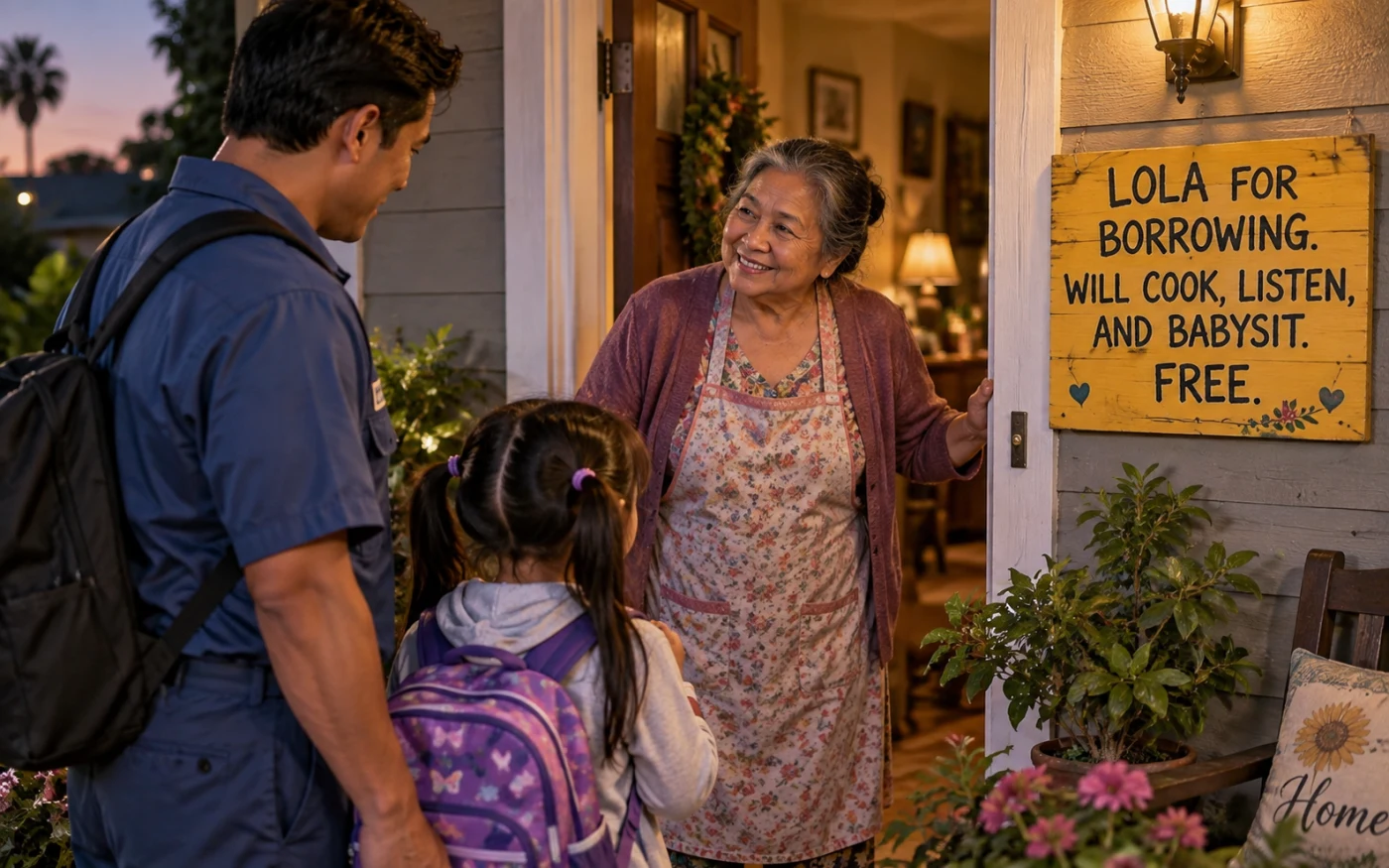
After My Kids Moved Abroad, I Put a Sign on My Porch: “Lola for Borrowing. Free.” When It Went Viral, My Children Were Mortified.
PART 1: The Sign on My Porch
My children found out I was lending myself to strangers from a video with three million views.
By then, the sign had been on my porch for six weeks.
It said:
LOLA FOR BORROWING.
WILL COOK, LISTEN, AND BABYSIT.
FREE.
My eldest daughter, Carina, called from Toronto at four in the morning.
“Mama, ano ba?” she said. “Please tell me you are not standing outside your house advertising yourself.”
I looked through my bedroom curtains.
There were two folding chairs on my lawn, a stroller by the roses, and a nurse asleep on my sofa.
“Not right now,” I said. “It is four in the morning.”
That was not the answer she wanted.
But let me tell you how it began.
My son Daniel had moved to Dubai.
Carina had married and settled in Toronto.
My youngest, Audrey, had gone to Sydney for what she called a two-year adventure. Seven years later, she was still having it.
They called me every Sunday.
Three little faces in three little boxes.
They asked if I was eating, sleeping, walking, checking my blood pressure, and locking the back door.
Then one of them always said, “We wish we were there.”
I always said, “I am fine.”
And I was.
But after each call, my Bakersfield house became so quiet that I could hear the refrigerator turn itself off.
I still cooked like people were coming home.
That was my problem.
I would make arroz caldo and reach for five bowls.
I would see mangoes at the market and buy too many because Audrey loved them.
Once, I made an entire tray of pancit before remembering there was nobody to complain that I had put too much celery in it.
I gave half to my neighbor, Mrs. Ruiz.
She stood at my kitchen counter eating from the container.
“Adel,” she said, “you need a hobby.”
“I have hobbies.”
“Watching your children’s flight paths is not a hobby.”
The next morning, I found an old wooden board in the garage.
I painted it yellow because yellow is difficult to ignore.
I wrote the words in black.
Then I tied the sign to my porch railing.
Mrs. Ruiz came running across the street in her slippers.
“Are you opening a daycare?”
“No.”
“Then what is this?”
“Exactly what it says.”
“People will think you have lost your mind.”
“Then they do not have to borrow me.”
For two days, nobody knocked.
Cars slowed down.
Teenagers took pictures.
One man asked whether “free” meant there was a membership fee later.
On the third evening, someone finally came.
His name was Rafael Soriano.
He stood on my porch in blue work clothes, holding the hand of a six-year-old girl with two crooked pigtails.
“Ma’am,” he said, “I know this sounds bad.”
“Most true things do at first.”
He explained that he repaired machinery at a packing plant.
His night sitter had quit without warning.
His daughter, Sofi, was quiet beside him, gripping a purple backpack.
“Only tonight,” he said. “I can pay you Friday.”
I pointed at the word FREE.
“Do I need to make the letters bigger?”
Sofi looked up at me.
“Do you have macaroni?”
“I have pancit.”
She considered this.
“Does it have macaroni in it?”
That child stayed until sunrise.
She drew cats at my kitchen table while I packed Rafael a meal for his break.
At bedtime, she admitted she was afraid of sleeping in a strange house.
So I sat beside her and told her about Audrey’s first night away at college.
Audrey had called me crying from under her blanket because she did not want her roommate to hear.
“Was she still brave?” Sofi asked.
“She was afraid and did it anyway.”
Sofi nodded.
Then she moved over and let me share the pillow.
After that, Rafael came twice a week.
Then came Eric, a college freshman from Fresno who had seen the sign from the bus.
He knocked and said, “Do you really cook?”
I said, “Do you really wash dishes?”
He became my Thursday dinner visitor.
He missed his mother, but he was too proud to tell her.
So he ate my sinigang, washed every pot, and listened while I told him pride was expensive when airplane tickets were already expensive enough.
That night, he called her from my porch.
Then Iris came.
She was a young nurse who lived two streets away.
She had lost a patient during her shift and could not bring herself to enter her empty apartment.
She saw my sign and knocked.
I did not ask her to explain.
I put tea in front of her.
She cried so hard she could not drink it.
I sat beside her until morning.
Soon, my quiet house was quiet no longer.
There were crayons under the sofa, shoes by the door, and containers in my refrigerator with other people’s names.
Somebody was always borrowing a chair, an onion, an hour, or me.
Then one Saturday, a teenager filmed my yellow sign while I was teaching Sofi to roll lumpia.
The video showed Eric carrying groceries inside.
It showed Iris asleep in a lawn chair after a shift.
It showed me at the door saying, “If you are hungry, come in. If you are only nosy, bring rice.”
By Monday, the whole internet knew my address.
By Tuesday, all three of my children were calling at once.
And by Friday, they had made a decision about my life without me.
“We’re coming home for your birthday,” Carina said.
I smiled.
Then she added, “And we’re moving you somewhere safe.”
PART 2: What My Children Packed
“Safe from what?” I asked.
“Strangers,” Daniel said from Dubai.
“You are giving strangers access to you and your house,” Carina said.
“They are not strangers after they introduce themselves.”
Nobody appreciated that answer.
Audrey leaned close to her camera.
“Mama, this sign is a cry for help.”
“No. A cry for help is louder.”
They told me they had found a beautiful assisted-living community fifteen minutes away.
It had gardens, exercise classes, and what Daniel called “people at the same stage of life.”
“What stage is that?” I asked.
Nobody answered clearly.
I told them I was not moving.
They told me we would discuss it in person.
For the next two weeks, they called every day.
They sent me photographs of sunny hallways and smiling gray-haired women holding paintbrushes.
I sent them photographs of Sofi’s spelling test, Eric’s empty soup bowl, and Iris asleep with her mouth open.
They thought I was proving their point.
I thought they were proving mine.
Then, three days before my birthday, a package arrived from Carina.
Inside were flattened moving boxes.
I stood in my hallway staring at them until Rafael arrived to collect Sofi.
He saw my face.
“What happened?”
I showed him the boxes.
“They are coming to pack my house.”
He became very still.
“Do you want to go?”
“No.”
“Then don’t.”
“They are my children.”
“And you are their mother.”
That sounded powerful, but it did not stop my hands from shaking.
My children loved me.
That was what hurt.
They were not trying to punish me.
They were trying to carry me from three different countries because they believed I had fallen down.
I had told them I was fine so many times that the words no longer meant anything.
I had never told them the truth.
I had been lonely.
Some afternoons, I had sat at the kitchen table until the sunlight disappeared because there was no reason to move.
But the sign had changed that.
I was needed again.
Not because anyone owed me a Sunday call.
Not because my name was Mama.
People came because I had something they needed, and they gave something back without even knowing it.
They filled my chairs.
They opened the curtains.
They made me buy the large bag of rice again.
I folded the moving boxes and put them in the garage.
The next morning, my phone began ringing before breakfast.
People wanted interviews.
A morning television show wanted to put me on a plane.
Someone offered to sell shirts with my face on them.
I said no to everyone.
Then a woman from across town arrived with twin babies and asked whether I could watch them while she attended a job interview.
I said yes.
By lunchtime, twelve people were on my porch.
Some needed help.
Most wanted photographs.
That part frightened me.
So Eric made a second sign.
NO VIDEOS.
NO MONEY.
KNOCK ONLY IF YOU NEED A LOLA.
The crowd thinned.
The right people stayed.
On the night before my birthday, Iris came over in clean clothes instead of scrubs.
She opened my refrigerator, frowned at how empty it was, and asked what I wanted for dinner.
“Nothing heavy,” I said. “My children land tomorrow.”
She shut the refrigerator.
“Are they really packing you?”
“They will try.”
“What are you going to say?”
I looked around my kitchen.
Sofi’s latest cat drawing was on the refrigerator.
Eric’s textbooks were stacked by the fruit bowl.
Iris’s spare key hung beside mine.
“I will tell them this is still my home.”
She hugged me so suddenly that my cheek hit her shoulder.
Then she left without making dinner.
I thought I had upset her.
After that, everyone behaved strangely.
Rafael canceled childcare for the next day.
Eric claimed he had an exam on a Sunday.
Mrs. Ruiz would not look at me over her fence.
On my birthday morning, I woke to silence.
No knocks.
No messages.
Even the yellow sign was gone from my porch.
For the first time in weeks, my house felt empty again.
Then a car door slammed outside.
Carina had arrived with a roll of packing tape in her hand.
PART 3: Why the Street Was Full
All three of my children came through the front door at once.
Carina hugged me so tightly the packing tape pressed into my back.
Daniel kissed my forehead and immediately checked the locks.
Audrey cried before she even put down her suitcase.
For one beautiful minute, I forgot they had come to remove me from my own house.
Then Daniel opened the coat closet and said, “We should start with things you don’t use.”
“Isara mo ’yan.”
He closed it.
They sat on the sofa in a row, just as they had when they were children caught breaking something.
Carina held my hands.
“Mama, we know this is hard.”
“For you, maybe.”
“You admitted you were lonely.”
“I was.”
Audrey’s face crumpled.
“Why didn’t you tell us?”
“Because what could you do? Leave your lives? Feel guilty every morning?”
“Yes,” Daniel said. “At least give us the chance.”
That stopped me.
He looked angry, but his eyes were wet.
“I saw that video,” he said, “and some college boy knew what medicine you take. A little girl knew where you keep the extra blankets. A nurse had a key. We knew nothing.”
Carina wiped her cheek.
“We thought strangers had replaced us.”
There it was.
They were not only afraid for me.
They were afraid I no longer needed them.
I sat between them.
“Nobody replaced you.”
“Then come with us,” Audrey whispered.
“No.”
She pulled away.
I took her hand again.
“You gave me wings when you left,” I said. “I did not want wings. I wanted all of you at my table. But you went, and I survived it.”
Nobody spoke.
“Now you want to put me somewhere because I learned how to live without waiting at the window.”
Daniel stared at the floor.
Then Carina noticed the moving boxes were missing.
“Where are they?”
“Garage.”
She stood up.
“Fine. We can bring them in.”
“Subukan mo.”
She marched to the front door.
Daniel and Audrey followed.
I followed them because it was my garage and because, if necessary, I was prepared to sit on the boxes.
Carina opened the door.
Then she stopped so suddenly that Audrey walked into her back.
There was nowhere to park on my street.
Cars lined both curbs.
A folding table stretched across my driveway.
Blue, yellow, and pink balloons covered the fence.
My missing sign hung above the garage with fresh paint beneath the old words.
LOLA ADEL’S BIRTHDAY.
TODAY, WE TAKE CARE OF HER.
The whole yard erupted.
“Surprise!”
Sofi ran toward me wearing a paper crown.
Rafael carried a tray of enchiladas.
Eric stood behind three pots of sinigang, each one labeled because he had apparently asked three aunties to make it.
Iris was in charge of a cake so large it needed its own table.
Mrs. Ruiz rang a little brass bell and shouted, “The birthday girl has arrived!”
There were dozens of people.
The twins slept under a canopy.
The woman who had gone to the job interview was there wearing her new work badge.
An elderly man I had driven to the pharmacy held a bowl of pancit.
A teenage boy whose parents worked late had hung lights between my porch posts.
People filled every chair, every patch of shade, and every inch of my lawn.
My children stood behind me without moving.
Sofi put the crown on my head.
Then she looked at them.
“Are you the kids from the phone?”
Daniel made a sound that was almost a laugh and almost a sob.
“Yes,” he said. “We’re the kids from the phone.”
Sofi took his hand.
“Come on. We saved you seats.”
She led them to my old dining chairs, which someone had carried onto the lawn.
Their names were taped to the backs.
CARINA.
DANIEL.
AUDREY.
And beside them was my chair.
Nobody had taken their places.
Their places had been waiting.
Iris brought each of them a plate.
Rafael told Daniel how I had saved his job by watching Sofi.
Eric told Carina that I had made him call his mother.
The woman with the twins showed Audrey her new badge and said, “Your mama gave me the two hours that changed my life.”
My children listened.
Then Carina slowly put the packing tape on the table.
Mrs. Ruiz picked it up.
“Good,” she said. “We need this for the decorations.”
She tore off a long strip and used it to fix a balloon to the fence.
Everyone cheered.
Carina covered her face, laughing and crying.
Daniel went into the garage and brought out every flattened box.
For one terrible second, I thought he still meant to use them.
Instead, he laid them across the driveway so the children could draw on them.
Audrey found a marker and wrote in huge letters:
LOLA STAYS.
Sofi drew twenty purple hearts around it.
That afternoon, my children canceled the assisted-living appointment.
Not later.
Not after another discussion.
They called from the lawn while everybody listened.
Then the music started, and Daniel danced with me beneath the yellow sign.
Every year since, all three of them have flown home for my birthday.
They sleep in their old rooms.
They complain about the celery in my pancit.
And on the morning after the party, they sit together on my porch beneath the sign.
“Excuse us,” Carina always says. “We traveled very far.”
Then all three hold out their arms.
“Can we borrow our Mama now?”