
My Retired Bus Driver Uncle Lived in a Dilapidated Shack in Baras. After His Death, 300 College Graduates Showed Up in Black Suits.
PART 1: The Empty Funeral
I was lowering my uncle's coffin into the ground when the first bus arrived.
Then another came.
Then another.
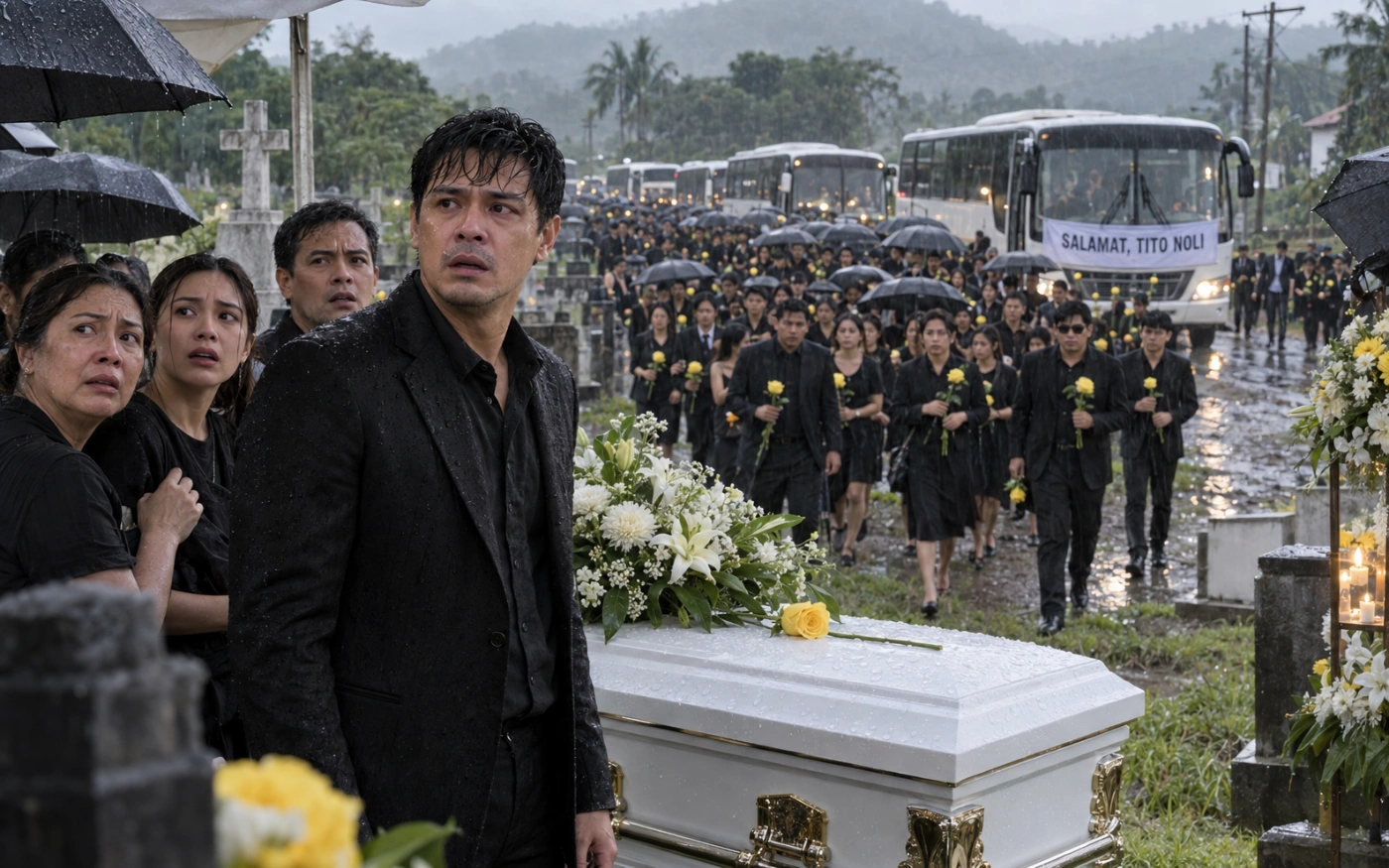
By the time the seventh bus stopped beside the cemetery in Baras, more than three hundred strangers in black suits were walking toward us, each carrying one yellow rose.
I thought they had come to the wrong funeral.
I was wrong about that.
I had been wrong about Tito Noli for most of my life.
He was my father's older brother, a retired public bus driver who had spent forty years traveling between Rizal and Manila. My father had died six years earlier.
He lived alone in a shack with unpainted plywood walls, a rusted roof, and a front door that only closed if you tied it with blue nylon rope.
When rain came, he placed five plastic basins beneath the leaks.
I once asked why he had five basins but only two plates.
"The roof has more mouths than I do," he said.
That was Tito Noli. Thin, sun-browned, and always smiling as if he knew a joke he had no intention of sharing.
He owned no television. No refrigerator. Not even an electric fan. On hot nights, he slept beside the window with a folded newspaper on his chest.
Our relatives called him Kuripot King.
At reunions, they laughed at his faded shirts and repaired sandals.
"Kuya Noli," my Aunt Soling once said. "You drove overtime every week. Where did your money go? Cards? Cockfighting? A secret girlfriend?"
Everyone laughed.
Tito Noli just stirred his coffee.
"Naku. If I had a girlfriend," he said, "do you think I would still look like this?"
They laughed harder.
So did I.
That memory burned after he died.
He passed quietly at seventy-two, sitting on his wooden chair after sweeping the yard.
His neighbor, Aling Mercy, found him holding an old bus conductor's puncher in one hand. His eyes were closed.
Beside him was a cup of coffee he had not finished.
I was the closest relative, so the funeral became my responsibility.
There was almost no money in his house.
Just four hundred eighty pesos in a biscuit tin, three neatly folded uniforms, and a wooden box locked with a tiny brass padlock.
I searched for the key but found nothing.
"Probably gambling debts inside," Aunt Soling muttered.
I snapped at her.
"He's dead, Tita. Tama na. Can we stop insulting him for one day?"
She went quiet, but I could see the old belief in everyone's faces.
Poor Noli. Strange Noli. Stingy Noli, who worked his whole life and had nothing to show for it.
Because heavy rain had damaged the road near his shack, I arranged a simple two-night wake at a small chapel.
We borrowed chairs. Aling Mercy cooked arroz caldo. I ordered the cheapest white coffin I could afford.
Only twelve people came the first night.
Most were elderly neighbors and two retired drivers who remembered Tito Noli from the old Rizal-Manila route.
One of them, Mang Bert, placed a yellow rose on the coffin.
"He never left a passenger behind," he whispered.
I thought he meant Tito never skipped stops.
The second night, a young woman arrived just before midnight.
She wore hospital scrubs under a black jacket, and her hair was wet from the rain.
She stared through the glass at Tito's face and began sobbing so hard that I caught her elbow.
"I'm Mark," I said. "His nephew. How did you know him?"
She pressed a yellow rose against her chest.
"He paid for my nursing degree. Please don't bury him before nine tomorrow. The others are coming."
I thought grief had confused her.
"What others?"
She looked at me as if I had asked how many stars were in the sky.
"All of us."
Then she rushed back into the rain.
The next morning, nobody came by nine.
At nine fifteen, the priest checked his watch. Aunt Soling sighed loudly. The cemetery workers waited beside the open grave.
I felt foolish for believing a stranger.
At nine thirty, I gave the signal to lower Tito's coffin.
That was when we heard the first bus horn.
PART 2: Who Filled the Buses?
The bus was old, blue, and freshly washed. A white cloth was tied across its windshield.
SALAMAT, TITO NOLI.
Its door folded open.
Men and women stepped down in black suits and dresses.
Some wore stethoscopes around their necks.
One man still had an engineer's hard hat tucked under his arm.
A teacher carried a bundle of yellow roses.
Then the second bus arrived.
Then five more.
The narrow cemetery road disappeared beneath people.
I stood beside the grave with my mouth open. Aunt Soling actually dropped her umbrella.
The young nurse from the night before hurried toward me.
"I'm Joanna," she said, breathless. "Pasensya na. We waited for the group from Quezon City. Traffic was terrible."
"Who are these people?"
Her face crumpled.
"His children. Not by blood. By chance."
A gray-haired man in a black suit stepped forward. He introduced himself as Attorney Castelo, but his voice shook like a boy's.
"May we carry him?"
The coffin was already suspended above the grave. I nodded, still too stunned to speak.
The cemetery workers raised it again. Six graduates took the handles. Behind them, hundreds formed a line, yellow roses glowing beneath black umbrellas.
The priest restarted the prayers.
But before the final blessing, Attorney Castelo asked for one minute.
He faced us and held up a small rectangle of faded cardboard.
It was an old bus ticket.
"I met Mang Noli in 1987," he said.
"I was seventeen. Every morning, I rode his bus from Antipolo carrying a plastic envelope full of school papers. One day, he found me crying in the back seat. My father had died, and I was quitting school to work."
Attorney Castelo wiped his eyes.
"Mang Noli asked how much my enrollment cost. I lied because I was ashamed. The next morning, he handed me an envelope and said, 'If you waste this, I will personally drive the bus into your classroom.'"
Soft laughter moved through the crowd.
"He paid every semester until I finished law school. He never asked me for repayment. Only my grades."
Joanna stepped beside him.
She held up her own ticket.
"Mine was in 2004. I sold boiled eggs at the terminal after class. He saw my chemistry book and asked why the pages were wet. I told him our roof leaked. The next week, my tuition was paid."
One by one, people raised old tickets.
Some were yellow. Some pink. Some so faded they looked blank.
An engineer said Tito noticed him solving math problems while standing in the aisle.
A teacher said Tito caught her hiding in the bus because she could not pay the fare.
Instead of throwing her out, he gave her bread and asked to meet her mother.
A doctor said Tito drove him straight to an entrance exam after a landslide blocked their usual route.
"He shouted at every passenger, 'Emergency! Future doctor!'" the man said, laughing through tears. "Nobody complained. We arrived with three minutes left."
Story after story.
Forty years of them.
My shame grew heavier with every yellow rose placed on the coffin.
I remembered mocking his patched sandals.
I remembered refusing to stay overnight at his shack because there was no television.
I remembered telling my cousins that Tito probably buried his money in the backyard because old men became weird.
He had buried nothing.
He had planted everything.
But one question would not leave me.
"How?" I asked Joanna. "He was a bus driver. How could he pay for hundreds of degrees?"
"Not hundreds at once," she said.
"One student, then two. Some received full tuition. Some needed books, uniforms, rent, or exam fees. He took every overtime shift he could."
"And none of us knew?"
Her eyes hardened.
"He didn't want people praising him. He also didn't want his students feeling like charity cases. We knew there were others, but he never told us how many."
Attorney Castelo reached into his coat and handed me a tiny brass key.
"He gave this to me two months ago. He said that after his funeral, his nephew Mark would find a wooden box."
My breath stopped.
"He knew I would handle the funeral?"
"He said you were the one who kept repairing his roof even when he complained that you were wasting money."
That was true. Every monsoon, I climbed onto that rusted roof. Every monsoon, he shouted that one more basin was cheaper than new roofing.
Attorney Castelo gripped my shoulder.
"He trusted you. He wanted you to hear his voice."
Before I could ask anything else, he looked toward the road.
An eighth bus had arrived.
But no graduates stepped out.
Instead, twelve children in worn school uniforms climbed down, each holding an unopened enrollment form.
PART 3: What Was in the Box?
After the burial, I drove straight to Tito Noli's shack with Joanna, Attorney Castelo, and the twelve students.
Rain tapped through the rusted roof.
Plink. Plink. Plink.
The children squeezed together on the floor while I pulled the wooden box from beneath Tito's bed. My hands trembled so badly that I missed the lock twice.
The key turned.
Inside were no gambling slips. No secret debts. No money.
There were hundreds of report cards, graduation photos, thank-you letters, and old bus tickets tied into bundles with rubber bands.
On top sat a cheap cassette recorder and an envelope with my name.
MARK, PLAY THIS FIRST.
The recorder groaned when I pressed the button. Then Tito's scratchy voice filled the shack.
"Mark, if you are hearing this, I finally escaped your roof repairs."
Everyone laughed.
I couldn't. I covered my mouth and cried.
"I saved for my coffin," the recording continued. "But a girl named Jenny needed heart surgery. A coffin cannot complain. A heart can stop."
One of the schoolchildren gasped. The smallest girl, perhaps twelve, began crying silently.
Joanna knelt beside her.
Tito's voice went on.
"People thought I hated spending money. That is not true. I loved spending it. I only wanted to spend it on things that grew."
I bowed my head.
"Every day, students rode my bus. I learned to recognize the ones who counted coins before climbing aboard. The ones who pretended not to be hungry. The ones who slept because they studied under streetlights. I could not help them all. That is the wound I carried."
The tape clicked, then continued.
"Mark, thank you for climbing onto my roof every monsoon even when I told you to stop. You always saw one thing worth fixing. I was proud of you for that."
The recording ended.
Nobody moved.
Then Aunt Soling's voice came from the doorway.
"He really was kuripot," she said.
I turned, ready to throw her out.
But she walked in carrying her jewelry box.
She removed two gold bracelets and placed them beside Tito's cassette recorder.
"He was stingy with comfort," she said, crying. "Not with love. Sell these. I laughed the loudest, so I will give first."
Behind her stood my cousins, the old bus drivers, Aling Mercy, and dozens of graduates who had followed us from the cemetery.
The shack could not hold them. They crowded the yard in the rain.
Attorney Castelo pulled a thick envelope from inside his coat.
"We brought these twelve," he said. "Tito had already been helping them. We thought they should meet the people who came before them."
He opened the envelope and read the twelve names. Beside each was a school, a course, and a painfully small amount that stood between a child and a future.
"I will take Ethan," the engineer said from outside. "All four years."
"Jenny is mine," Joanna said. The little girl beside her burst into tears.
"Uniforms and books, ako na," said the teacher.
Voices rose from the yard.
"One semester for Dante!"
"Boarding expenses for Ana!"
"I can handle the exam fees!"
Within minutes, every child had a sponsor.
I stared at the leaking roof. At the two plates. At Tito's folded uniforms hanging from a nail. At forty years of photographs packed inside one box.
I had spent my life measuring his wealth by what he owned.
Now three hundred living answers stood in his yard.
"Then let's give them somewhere dry to study," I said. "This house can keep helping."
Attorney Castelo smiled.
"Good. Because we didn't come only to bury him."
He raised one hand.
The graduates moved at once.
From the buses came sacks of cement, plywood, roofing sheets, desks, books, computers, and a painted wooden sign.
Doctors carried chairs. Lawyers hauled hollow blocks.
Two engineers argued over a measuring tape while a teacher yelled that they were holding it backward.
I laughed so hard I nearly fell into one of Tito's rain basins.
The sign was placed against the shack.
MANG NOLI'S LAST STOP
FREE STUDY CENTER AND SCHOLARSHIP HOME
"He made us promise not to touch his house while he was alive," Joanna said. "He said construction noise ruined his afternoon nap."
So that afternoon, still wearing black, we began.
Every graduate placed one yellow rose into an empty bus-fare box before picking up a hammer, broom, or paintbrush. We pulled down the worst sheets of rusted roofing and saved the chair where Tito died.
Over the next three weeks, people came back in shifts. We replaced the roof, turned his tiny bedroom into a reading room, and built a larger classroom behind it.
Even Aunt Soling painted.
She got yellow paint in her hair and blamed Tito.
On opening day, nearly all three hundred graduates came back. The twelve students sat at new desks beneath a roof that did not leak. For the first time in my life, there wasn't a single basin under Tito's ceiling.
I placed Tito's old conductor's puncher beside the door.
Then little Jenny tugged my sleeve.
"Kuya Mark," she asked, "was Mang Noli rich?"
I looked outside.
Doctors were sharing pandesal with drivers. Lawyers were sweeping mud. Teachers were sorting books.
Three hundred graduates filled the road, laughing beneath a sky washed clean by rain.
"He was the wealthiest man in the province," I said.
Jenny nodded as if this were obvious.
Then she dropped a coin into the old fare box, took her seat, and opened her first book.