
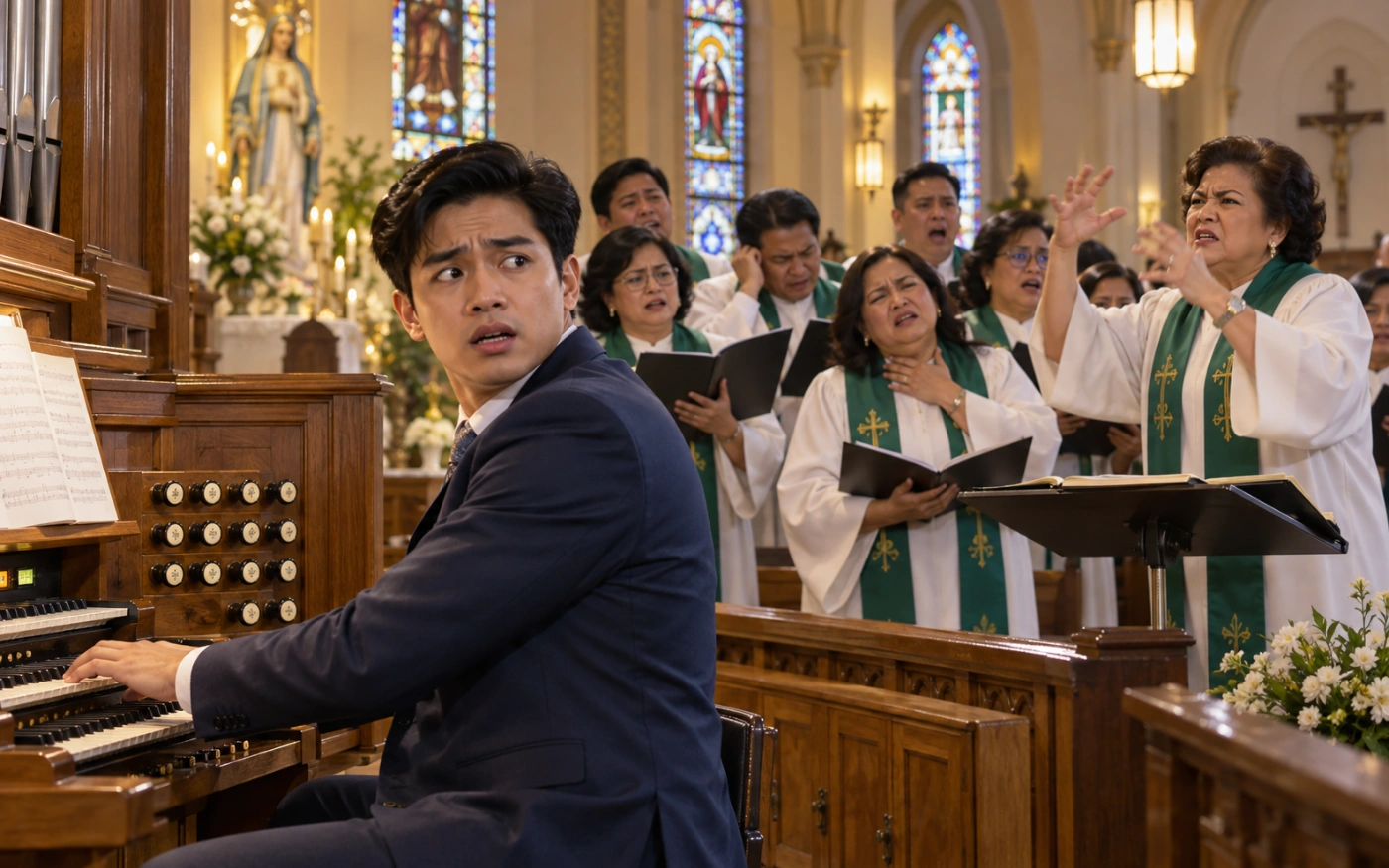
The Whole Choir Begged the Priest to Fire the Terrible Organist. Then They Heard Themselves Without Him.
PART 1: The Petition
I helped fire our church organist.
Three Sundays later, I was begging him to come back with a tray of pancit on my lap.
He took the pancit.
He did not take the job.
But I am getting ahead of myself.
For twenty-six years, Manong Pete played the organ at St. Columba's in Daly City.
And for twenty-six years, everyone in the choir complained about him.
He played every hymn too low.
He played every hymn too slowly.
Sometimes he played a chord that made all of us turn our heads like confused chickens.
Our choir director, Tita Vicky, would wave both arms faster, but Manong Pete never followed.
He just squinted through his thick glasses and continued at the speed of a funeral procession.
Even during Easter.
Especially during Easter.
One year, “Jesus Christ Is Risen Today” sounded as if Jesus had risen, looked around, and decided to lie down again.
After Mass, we surrounded Manong Pete near the sacristy.
“Manong, it needs more joy,” I told him.
He smiled. “You reached the last note, Myrna.”
“That is not the point.”
“But you reached it.”
That was how he answered everything.
If Tita Vicky said the music was too low, he said, “But everyone finished.”
If our tenor, Romy, said the tempo dragged, Pete said, “But nobody got left behind.”
If someone said he had played a wrong note, he tapped his ear and said, “Did I?”
He always brought a small pencil, a roll of mint candies, and a screwdriver in his shirt pocket.
Before Mass, he would test the organ, listen to us warm up, then scribble mysterious marks all over his music.
We thought the marks were proof that he could no longer read properly.
I was president of the choir council, which sounds important but mostly meant I collected money for birthday cakes and stopped people from fighting over solo parts.
Then Romy found a video online of a cathedral choir singing one of our favorite hymns.
Their organ thundered. Their sopranos soared. Their ending gave me goose bumps.
Romy played it in the parish hall after rehearsal.
“See?” he cried. “That is how it should sound!”
Everyone began talking at once.
“We could sing like that.”
“Of course we could.”
“We only need a real organist.”
That last sentence came from me.
I wish I could pull it back into my mouth even now.
We made a petition. Seventeen choir members signed it. Tita Vicky signed first. I signed second, in large, confident letters.
We carried it to Father Daniel after the Wednesday novena.
He read the whole page, took off his glasses, and looked at us.
“Have you spoken honestly with Pete?” he asked.
“Many times,” I said.
“Have you listened honestly to him?”
Nobody answered that.
Father Daniel rubbed his forehead. “He has served this parish since before some of you were married.”
“That does not make the notes correct, Father,” Romy said.
We stood firm. We used words like quality, growth, and excellence.
I even said younger families deserved beautiful music.
Father Daniel finally sighed.
“All right,” he said. “His last Mass will be at the end of the month.”
Manong Pete did not argue when Father told him.
On his final Sunday, he arrived early, fixed the loose pedal with his screwdriver, and placed his mint candies beside the hymnal.
I could hardly look at him.
After the last hymn, we gave him an envelope and a cake that said THANK YOU, MANONG PETE in blue icing.
He shook everyone's hand.
When he reached me, he held my fingers for one extra second.
“Sing gently, Myrna,” he said. “You push when you get nervous.”
I felt my face burn.
“I don't get nervous.”
He smiled, tucked his pencil into his pocket, and left carrying half the cake.
The next Sunday, our new organist arrived.
Jaime Valencia was twenty-eight, handsome, and fresh from a music conservatory in San Francisco.
He wore a fitted black shirt. He had perfect hair.
He could play with both hands and both feet while turning pages without stopping.
At rehearsal, his fingers flew over the keys.
The organ did not wheeze anymore. It roared.
We stared at one another, thrilled.
“The correct key,” Jaime announced, pointing to the score. “Exactly as written.”
Tita Vicky lifted her chin. Romy winked at me.
This was what we had wanted.
Sunday came. The church filled. Jaime wore a suit.
Father Daniel gave me a strange look before the entrance hymn, but I ignored it.
Jaime raised his hands.
He struck the first glorious chord.
And seventeen confident choir members opened their mouths.
What came out made a baby in the third pew start crying.
PART 2: Why Did We Sound Terrible
The sopranos missed the first note completely.
The altos came in somewhere underneath them.
Romy attacked a high note, made a sound like a jeepney braking downhill, and grabbed his throat.
I pushed because I was nervous.
Just as Manong Pete had warned me.
Jaime looked over his shoulder, horrified, but his hands kept playing.
The correct notes kept coming. High, bright, merciless notes.
We chased them and failed.
By the second verse, half the choir had stopped singing.
Tita Vicky was waving her arms so wildly that one sleeve struck Sister Agnes in the face.
The congregation tried to help. That made it worse.
Father Daniel closed his eyes.
The hymn ended with Jaime playing a magnificent final chord alone while we stood behind him, red-faced and gasping.
That should have been the worst moment.
It was not.
The responsorial psalm went higher.
My voice cracked on “Lord.” Romy coughed through an entire line.
Sister Agnes whispered, “Jesus, take me now,” directly into the microphone.
At Communion, Jaime finally lowered the music by one key.
We still could not reach it.
He lowered it again.
Three people managed.
Then he lowered it a third time, stared at the pencil marks left in Manong Pete's old hymnal, and suddenly stopped playing.
His mouth fell open.
After Mass, the choir room exploded.
“Grabe naman, you played too high!” Tita Vicky shouted.
“I played what is printed!” Jaime shot back. “That is the melody!”
“We have sung those hymns for years.”
“Not in those keys, you haven't.”
He grabbed Pete's battered hymnal from the organ bench and opened it on the table.
Almost every page had pencil notes: minus two, minus three, Myrna tired, Romy sick, Agnes lead today.
Some hymns had whole sections rewritten by hand.
Jaime turned pages faster.
“He was transposing everything,” he said.
We stared at him.
“What does that mean?” Sister Agnes asked.
Jaime pointed to the printed notes. “The song is supposed to be here. Pete moved it down here. Sometimes four whole steps.”
“Why?” I asked, though a cold feeling had already reached my stomach.
Jaime looked around at all of us.
“Because you can't sing it.”
Silence.
Pure, holy silence.
He softened his voice. “Not comfortably, anyway. He must have listened during warm-up and changed the key depending on who was struggling that day.”
I remembered Pete testing one chord, then another.
I remembered him asking whether Romy's cold was better.
I remembered those mysterious pencil marks.
I remembered every time he had said, But everyone finished.
Father Daniel was standing in the doorway.
“Pete never told us,” I whispered.
“He told me once,” Father said. “He made me promise not to tell you. He said a choir sings better with confidence than shame.”
That sentence hit harder than any scolding.
We had called him terrible for protecting us.
Worse, we had put it in writing.
By Monday, we learned Pete had accepted a job at Serenity Gardens Funeral Home across town.
On Tuesday, we formed what Romy called Operation Bring Back Manong.
We knew Pete loved food, so we attacked him with food.
Tita Vicky made lumpia. Sister Agnes brought bibingka. Romy bought two trays of barbecue.
I cooked pancit bihon using my mother's recipe and added extra calamansi.
We found Pete in a quiet chapel playing “Be Not Afraid” for a funeral rehearsal.
It was low.
It was slow.
And it was exactly what the crying family needed.
An elderly widow held her daughter's hand while Pete played.
When he finished, she walked to the organ and touched his shoulder.
“Salamat talaga,” she said. “My husband could sing along with you, even when his lungs became weak. You remembered his key.”
Pete nodded. “He liked to finish the song.”
I nearly dropped the pancit.
Outside the chapel, we apologized all at once.
Pete accepted every tray.
Then he declined the job.
“Dito kasi, they listen to me,” he said simply.
No one had an answer.
Two weeks later, St. Columba's biggest wedding of the year was three days away.
The bride, Marisol, was the mayor's niece.
There were four hundred guests, eight bridesmaids, a string quartet, and enough white roses to decorate heaven.
Her mother arrived at rehearsal in pearls and asked to hear the entrance music.
Jaime played beautifully.
She stopped him after six measures.
“Hindi,” she said. “I asked for the old organist.”
My heart jumped.
Father Daniel explained that Pete no longer worked for us.
The woman opened her handbag, removed an old cassette tape, and set it on the organ.
“Sige. Then get him,” she said. “Because only Pete knows why this wedding song must be played wrong.”
PART 3: Would Pete Come Back
The cassette was from Marisol's parents' wedding, twenty-five years earlier.
We found an old player in the parish office. The tape hissed, crackled, and then a younger Manong Pete began playing “The Wedding Song.”
He missed a note in the first verse.
Then he missed the same note in the second verse.
Marisol's mother pressed both hands to her mouth.
“My husband sang from the front pew that day,” she said.
“He was so nervous, he came in early. Pete changed the music instantly and followed him. That wrong note became our family joke.”
Her voice shook.
“My husband died last year. Marisol chose that song so it would feel like her father was walking with her. I don't want perfection. I want the way Pete played it.”
This time, nobody brought up excellence.
I drove to Serenity Gardens alone.
Pete was locking the chapel when I arrived. I did not carry pancit. I carried our petition.
The original one.
I had asked Father Daniel for it.
“I came to tell you the truth,” I said. “I wrote most of this.”
Pete glanced at the signatures. “I know your handwriting.”
“We were proud. And cruel. You protected every weak voice in that choir, including mine, while we blamed you for the sound that saved us.”
He looked away.
I tore the petition down the middle.
Then again.
“Marisol's mother wants you for the wedding,” I said. “But I am not asking you to rescue us for free. Name your terms.”
He gave a small laugh. “You think I can be bought with pancit?”
“No. We already proved you can only be fed with pancit.”
That finally made him smile.
Then he became serious.
“A proper raise,” he said. “Not another envelope at Christmas.”
“Yes.”
“A new bench. That old one pinches a nerve in my leg.”
“Yes.”
“And Jaime stays.”
I blinked. “You want him to stay?”
“He has beautiful hands. But he listens to paper before people.” Pete slipped his keys into his pocket. “He can learn.”
Father Daniel approved everything that night.
The choir members added money from our own pockets until the parish council could make the raise official.
But Jaime was the hardest part.
When we told him Pete wanted him as an apprentice, his ears turned red.
“I graduated with honors,” he said.
“Congratulations,” Pete replied. “Now play that hymn badly.”
At the wedding rehearsal, Jaime played the opening exactly as written.
Pete stopped him.
“Ayan. Watch the bride's mother,” he said.
They started again.
This time, Pete sat beside Jaime on the new padded bench.
When Marisol's mother quietly began humming, Pete tapped Jaime's wrist.
“Diyan,” he whispered. “Follow her breath.”
Jaime changed the key.
The notes settled lower. Warmer. The mother's shoulders relaxed.
Then Pete showed him where to place the famous wrong note.
Jaime frowned as if asked to put ketchup on a diploma.
But he did it.
On the wedding day, every pew was full. White roses climbed the pillars.
Marisol stood at the church doors with tears already shining on her face.
Pete and Jaime sat together at the organ.
The entrance music began.
It was lovely. Not flashy. Not thunderous. Lovely.
When the wrong note came, Marisol's mother gasped and laughed through her tears.
Marisol heard it too.
She looked toward the empty space where her father should have been, pressed one hand to her heart, and took her first step down the aisle.
Pete did not look at the music.
He watched the family.
Jaime watched Pete.
And I watched both of them while trying not to ruin my mascara.
The following Sunday, Pete returned to St. Columba's officially.
His new bench had thick brown padding and a little brass plate that Romy secretly ordered: MANONG PETE — PLEASE PLAY IT WRONG.
Before Mass, we warmed up.
Sister Agnes's voice was tired. Romy was fighting another cold. I was nervous because the church was packed.
Pete listened. He made three pencil marks.
Jaime leaned close as Pete shifted the first hymn down.
“That low?” Jaime whispered.
Pete nodded toward me. “Myrna pushes.”
“I can hear you,” I said.
“Good,” Pete replied. “Then don't push.”
The organ began low, slow, and slightly wrong.
We opened our mouths.
Every voice came out together.
We sounded exactly as we had for twenty-six years.
Only now, when Manong Pete turned around and smiled, the whole choir finally knew who had been carrying the song.