
I Donated a Kidney to an Anonymous Stranger. He Turned Out to Be the Man Suing Me for Everything I Own.
PART 1: The Man in Room 812
The first thing the man who got my kidney said was, “You.”
Not thank you.
Not hello.
Just one angry, frightened word.
“You.”
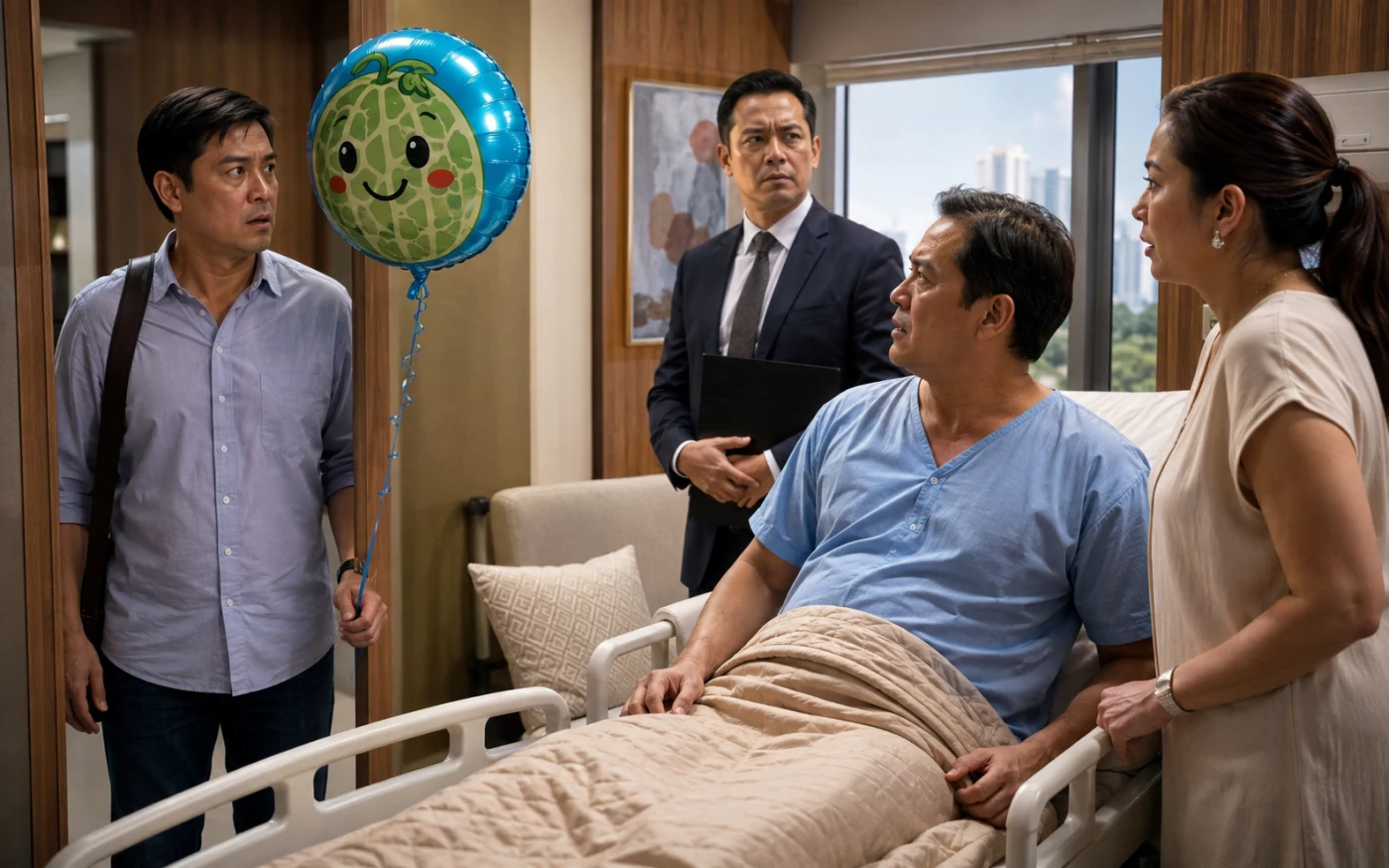
I stood frozen in the doorway of Room 812, holding a ridiculous blue balloon that said YOU’RE ONE IN A MELON.
The man in the bed was Victor Lim.
The man suing me for my house, my truck, my tools, and every peso I had saved since I was twenty-two.
And somewhere under his hospital gown, my kidney was keeping him alive.
But let me go back three months.
My name is Ramon Navarro. Most people call me Mon.
I own a small construction company in Quezon City.
Small means I have six regular workers, one truck that complains every morning, and an office where the printer only works if you kick the bottom tray.
I was not rich.
But after nineteen years of building kitchens, repairing roofs, and arguing about bathroom tiles, I had a decent life.
Then Victor hired me to renovate his family’s old house.
The project began with smiles and pancit. It ended with water pouring through his dining-room ceiling.
A pipe coupling failed while Victor and his wife, Grace, were away.
It ruined cabinets, flooring, appliances, and an antique narra table that had belonged to Grace’s grandmother.
Victor said my crew installed the wrong coupling.
I said Victor had rushed us, changed the plans twice, and ordered us to close the wall before the pressure test because his relatives were arriving from Davao.
The ugly truth? We were both partly wrong.
I should have refused to close that wall. I should have put everything in writing.
Instead, I was proud and tired and afraid of losing a big client.
So I said, “Sige, we’ll manage.”
We did not manage.
Victor’s insurance refused part of the claim.
His lawyer then demanded an amount so large I laughed when I first saw it.
Then I realized it was not a joke.
If I lost, my company was finished.
My family home could be sold. My workers would lose their jobs.
Victor would not even look at me during mediation.
His lawyer did all the talking.
“Mr. Lim intends to recover everything the law allows.”
One month later, while I was learning how terrifying the word deposition could be, my younger sister Ana called.
She had kidney failure. Her condition was getting worse. I offered to donate before she finished asking.
I was healthy.
We were compatible enough to enter a paired-exchange program, but not a direct match.
I would donate to a stranger. Another stranger would donate to Ana.
“Kuya, you don’t have to,” she whispered.
“Of course I do.”
“What about the case?”
“A lawyer cannot repossess an organ.”
That made her laugh. I needed that laugh.
The program protected everyone’s identity.
I knew only that my recipient was a man in his fifties who had been waiting a long time.
He knew only my blood type and that I was alive and willing.
The surgeries happened on the same morning.
Before they rolled me away, Ana reached across the space between our beds and grabbed my fingers.
“When this is over,” she said, “I’m cooking for you.”
“That is not comforting. You burn rice.”
“Then I’ll order food.”
I woke feeling as if a carabao had sat on my side. But the first news I heard was good.
Ana’s new kidney was working.
Mine was working inside the anonymous man too.
For four days, pain and joy shared the same hospital room with me.
I walked bent like an old question mark. Ana shuffled beside me, hugging her IV pole.
We raced to the nurses’ station and both claimed victory.
On the fifth day, a transplant coordinator named Dr. Torres came in smiling.
“Your recipient asked if you would like to meet,” she said. “Only if you are comfortable.”
I imagined a quiet grandfather.
Maybe his children had been waiting outside an operating room, praying the way I had prayed for Ana.
I said yes.
Ana insisted I bring something, so she bought the melon balloon from the hospital gift shop.
“It was this or a teddy bear,” she said.
“I am meeting a grown man.”
“Then give him the bear next time.”
A nurse walked me down the corridor. I was nervous. My palms were damp.
I kept thinking, What do you say to someone carrying a piece of you?
Then the door opened.
Victor was in the bed.
Grace sat beside him.
His lawyer, Attorney Salcedo, stood by the window with a folder under one arm.
Victor’s face went gray when he saw me. Grace looked from him to me, confused.
Attorney Salcedo recognized me next.
“Mr. Navarro,” he said sharply. “Why are you here?”
I stared at Victor.
“Apparently,” I said, “to visit my kidney.”
The balloon slipped from my hand and floated to the ceiling.
Grace slowly stood.
“Wait,” she said. “Mon is the donor?”
Nobody answered.
She turned to her husband. “The contractor?”
Victor’s monitor began beeping faster.
Attorney Salcedo closed the folder against his chest. “This meeting is over.”
But Grace stepped between him and the door.
“No,” she said. “I waited two years for someone to save my husband’s life. I’m not letting you throw him out now.”
Then she pointed at the lawyer’s folder.
“And you came here today to make Victor sign what?”
PART 2: What Was in the Folder
Attorney Salcedo’s grip tightened.
“Mrs. Lim, this is privileged.”
“I am your client too,” Grace said. “That house is in both our names.”
Victor tried to sit higher, winced, and pressed a hand over his incision.
“Grace, calm down.”
That was the wrong thing to say.
For two years, Grace had watched her husband fade.
She had taken him to dialysis before sunrise.
She had measured his water. She had slept in plastic chairs.
There was a permanent dent on her nose from wearing a mask in hospital corridors.
She did not calm down.
She snatched the folder.
Inside was a proposed order freezing my business accounts before trial.
I read my company name upside down. Navarro Homeworks.
Under it was a list: equipment, vehicle, residence, receivables.
Everything.
My knees went soft, and not because of surgery.
“You brought this to his hospital bed?” Grace asked.
Salcedo lowered his voice. “The hearing is in twelve days. Mr. Lim’s health has delayed this case repeatedly. We need his signature.”
Victor looked at me, then at the blanket covering the kidney I had given him.
“Did you know?” he asked.
I almost shouted.
Instead, I lifted my hospital bracelet. “They told me you were an anonymous man in his fifties. If I knew, do you think I would walk in carrying a melon?”
Ana appeared behind me in the doorway, pushing her IV pole.
She had followed because she was nosy. For once, I thanked God for it.
“Kuya?” she said.
Grace looked at Ana’s bracelet, then at me. “She received a kidney too?”
“That is why I joined the exchange.”
Victor’s anger changed. Just for a second, I saw shame.
Then Salcedo spoke.
“A medical coincidence does not change legal liability.”
He was right, which made me hate him more.
I faced Victor. “My kidney does not buy your forgiveness. I did not give it to you. I gave it to a stranger because somebody gave one to my sister.”
“Then what do you want?” he snapped.
“Right now? My balloon.”
Ana made a choking sound that might have been a laugh.
I pulled a chair closer but did not sit. My side hurt. My pride hurt worse.
“I should have put the pressure-test delay in writing,” I said. “I should have refused to close the wall. I made a mistake.”
Victor stared at me. During eleven months of legal letters, neither of us had said those words.
So I kept going.
“But I did not cause all the damage you claimed. Your second contractor tore out rooms the water never touched. Your lawyer added lost rental income even though you never rented that house. And you still owe my workers for the final month.”
Salcedo stepped forward. “Do not discuss the case without counsel.”
“Then leave,” Grace said.
“Excuse me?”
“Leave. My husband just received an organ. You are making his monitor scream.”
A nurse rushed in, took one look at us, and ordered everyone except Grace out.
In the corridor, Attorney Salcedo cornered me.
“You will not use this donation to manipulate my client.”
“I don’t need to,” I said. “You brought the freezing order yourself.”
He walked away, furious.
Ana leaned against my shoulder. “That was the man suing you?”
“Yes.”
“You gave him a kidney?”
“Apparently I make poor business decisions even under anesthesia.”
She laughed, then cried, then held her side because both hurt.
The next morning, Grace came to our room alone.
She carried the melon balloon.
She tied it to the foot of my bed and placed something else on my tray: a plastic envelope, warped and stained along one edge.
Inside were photographs of her ruined dining room.
The narra table stood under a collapsed ceiling, covered in wet plaster.
“My grandmother hid under that table during the war,” she said. “It was the only thing of hers I had.”
My throat tightened.
“I’m sorry.”
“Victor thought you did not care. Then every letter from your insurance company sounded cold. Every letter from our lawyer made him angrier.”
“I did care. I was terrified. My lawyer told me not to call you.”
She nodded. “Ours told us the same.”
Then she pulled out one last photograph.
It showed the wall before it had been closed.
My foreman, Carlo, was holding the correct heavy-duty coupling in one hand.
Beside him, Victor was pointing at the open wall while a party decorator waited with rolls of fabric.
I remembered that afternoon exactly.
“Where did you get this?” I asked.
“My niece took it. Look at the time stamp.”
It proved Victor had ordered us to close the wall before testing.
It did not erase my responsibility, but it destroyed the claim that he had never known.
“Victor told Salcedo about this photo,” Grace said. “Salcedo said it would only confuse things.”
I looked toward the corridor.
“Why are you giving it to me?”
“Because saving Victor’s life does not make you innocent.” Her eyes filled.
“But damaging my table does not make you a monster.”
She took a breath.
“At noon, Attorney Salcedo is coming back with that order. Victor says he will sign it.”
My stomach dropped.
Grace closed her hand over the photograph.
“Unless you come with me and both of you finally tell the truth.”
PART 3: Who Owed Whom
At noon, I shuffled into Victor’s room wearing a robe, slippers, and the expression of a man who had recently lost both an organ and his patience.
Ana came too.
So did Dr. Torres, because she said no one was turning her transplant floor into a courtroom without medical supervision.
Attorney Salcedo laid the freezing order on Victor’s tray.
“Sign here,” he said.
Grace placed the photograph directly over the signature line.
Victor went still.
Salcedo’s face changed. “Where did you find that?”
“In our family album,” Grace said. “Where you told us to leave it.”
Victor looked at his wife. “You gave it to him?”
“I showed it to him. Now you will say what happened.”
For a long moment, all we heard was the soft pump of an IV machine.
Then Victor spoke.
“I told Mon to close the wall.”
Attorney Salcedo cut in. “You were relying on his professional judgment.”
“Stop putting clean words on my dirty decisions,” Victor said.
The room became very quiet.
He looked at me. “My relatives were coming for my mother’s seventieth birthday. I wanted the room finished. You warned me about the test.”
“I still agreed,” I said. “I was the contractor. I should have said no.”
“Yes, you should have.”
“Yes.”
That one word did more than eleven months of legal papers.
Victor touched the blanket over his new kidney.
“When the pipe failed, Grace cried over that table. I needed someone to blame. Then dialysis got worse. The bills grew. The case became the only fight I thought I could still win.”
Grace sat beside him. “You won the fight that mattered yesterday.”
He looked at me. “Because of him.”
“Because he chose to help a stranger,” she said. “Do not turn that into a debt. But do not pretend you still know what kind of man he is.”
Attorney Salcedo reached for the photograph. Grace slapped his hand away.
“We should discuss settlement privately,” he said.
“We have been private for eleven months,” she answered. “Look what it did.”
Then she turned to me.
“What can you actually repair?”
I swallowed. This was my choice. Not my lawyer’s. Not my insurer’s.
“The dining room. The cabinets. The flooring. All of it. At cost. No markup, no profit for me. My crew gets paid normally. But not yet, because I currently cannot lift anything heavier than this balloon.”
Ana raised one finger. “And he will use the correct coupling.”
Even Victor laughed at that.
It hurt him, so he groaned while laughing, which made Ana laugh harder, which made her groan too.
Dr. Torres shook her head. “My healthiest patients are somehow my biggest problem.”
Victor wiped his eyes.
“The antique table cannot be replaced,” he said.
“No,” I said. “But my father restored old furniture before he died. I learned from him. If the wood is not rotten, I can try.”
Grace’s hand flew to her mouth.
I pointed at the order. “In return, withdraw the demand for punitive damages and the freeze. Let the insurers settle the water damage they can prove. Pay what you still owe from the old job, and I’ll finish the repairs at cost.”
Salcedo said, “Absolutely not.”
Victor picked up the freezing order.
He tore it in half.
Then he tore it again.
“You heard my donor,” he said.
“I am not your donor,” I replied. “I am your contractor.”
He held out his hand.
“Then, Mr. Navarro, please fix my wife’s table.”
I took it.
“After you settle the old balance.”
“Makunat ka talaga.”
“You sued the correct man.”
Four months later, Victor walked into his dining room without a cane.
My crew had rebuilt the ceiling and cabinets.
Victor settled the old balance, including the overtime.
The insurers handled the covered damage, and we rebuilt the rest at cost. The lawsuit was dismissed.
But everyone was staring at the center of the room.
Grace’s narra table stood there, dark and shining.
The water stains were gone.
The cracked corner had been joined with a small butterfly-shaped piece of lighter wood, the way my father taught me.
Grace ran her fingers over it.
“You saved it,” she whispered.
“Most strong things can survive one bad break,” I said.
Victor came beside me. He was healthier now. So was Ana, who had brought an enormous tray of pancit and, wisely, ordered it from a restaurant.
Grace called everyone to eat.
Before I sat down, Victor handed me a familiar blue balloon.
YOU’RE ONE IN A MELON.
It was wrinkled and nearly empty.
“This belongs to you,” he said.
I tied it to the repaired corner of the table.
“No,” I said. “It belongs here.”