
I Have Been Sending Money to My Brother in the Province for Nine Years. Last Month I Visited Without Telling Him.
PART 1: Eleven People Knew Me
By the time the eleventh stranger pressed my hand to his forehead, I was sure my brother had done something terrible with my money.
Maybe he had stolen it.
Maybe he had joined a religious group and made me their saint.
Or maybe, as my friend Tetchie whispered through my phone from Dubai, I had been mistaken for a dead woman.
“Do not let number twelve touch you,” she said. “Rosalie, listen. Baka ritual na iyan.”
I stood beside a dusty road in Nueva Ecija at six forty in the morning, holding my suitcase with one hand and protecting the other against my chest.
“What ritual?”
“How would I know? Ikaw ang nandoon.”
This had started twenty minutes earlier, when the jeepney driver from the bus terminal refused my fare.
I had just come from Dubai after eleven years of working hotel accounts, sharing a flat with four women, and learning exactly how many flavors of instant noodles a person could hate.
For nine of those years, I had sent my younger brother Boyet twenty thousand pesos every month.
The money was supposed to keep Papa’s little hardware store alive.
Every month, Boyet messaged, Received, Ate. Salamat.
Every few months, I asked, “How is the store?”
He answered, “Okay lang. How are your knees?”
I had received nine years of photographs from exactly one corner of that store. The same shelf. The same three sacks of cement. The same crooked fluorescent tube. Sometimes the sacks changed order, but I was not convinced they were different sacks.
Tetchie had theories.
At first, the theories involved gambling. Then a second family. Then an underground cockfighting empire. By the time I booked my surprise flight, she had already searched how to file a criminal case against a sibling.
But I did not truly believe Boyet had stolen from me.
That would have been easier.
I believed he had let the money leak away through bad decisions, utang, repairs, favors, and the soft heart that made him give away his own slippers if somebody said the road was hot.
I believed I was about to discover that my thirties had disappeared with it.
So I came home without telling him.
I had rehearsed my speech on the plane.
Boyet, mahal kita, but love does not excuse nine years without proper records.
Then the jeepney driver took my suitcase down, looked hard at my face, and pushed my money back.
“Hindi po, Ate Rosalie.”
Before I could ask how he knew my name, he took my hand, touched it to his forehead, and said, “Mano po. Salamat.”
Then he drove away.
I was still staring after him when a woman opening a sari-sari store saw me.
Her mouth fell open.
“Si Ate Rosalie?”
She hurried across the road in house slippers, took my hand, and bowed over it.
“Salamat talaga.”
“For what?” I asked.
But she was already calling into the store, “Nandito siya!”
I walked faster.
A man carrying rebar spotted me next. He put the rebar down carefully, wiped both hands on his shorts, and came over.
“Mano po.”
“Kuya, bakit?”
He only smiled. “God bless you, Ate.”
Number four was an old woman holding pechay.
Number five was a teenage boy on a bicycle.
Number six came out of a bakery with flour on both cheeks.
By number seven, Tetchie had moved from second family to identity theft.
By number nine, she was certain Boyet had used my photograph to run for barangay office.
Number ten was a girl around fifteen who bowed so quickly she nearly struck her forehead against my knuckles.
“Ingat!” I cried, grabbing her shoulder.
She looked more worried about frightening me. “Sorry po. Thank you, Ate Rosalie.”
Then she ran off, smiling.
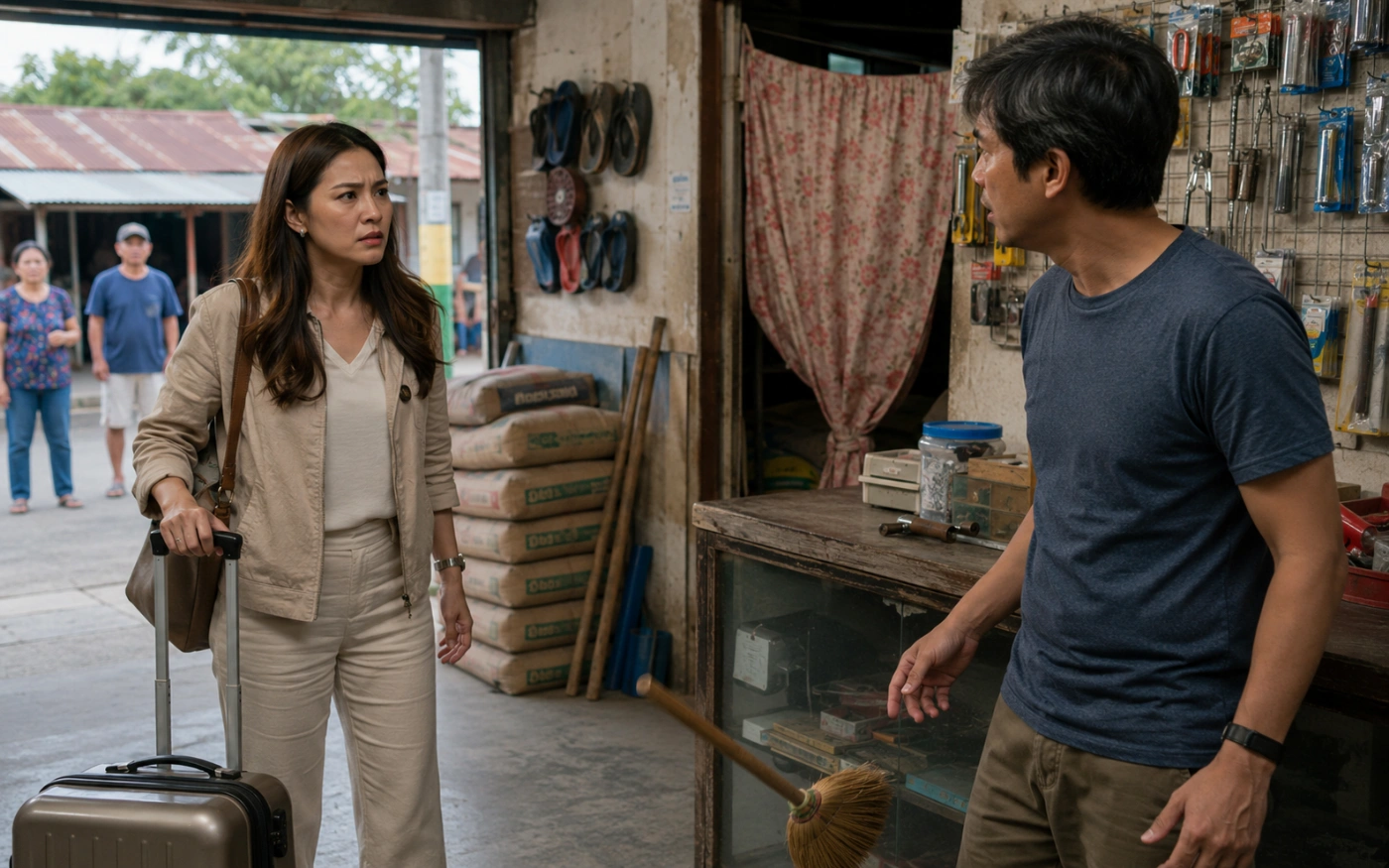
I finally saw Papa’s hardware store at the end of the road.
The old sign was freshly painted. ROSALES HARDWARE, it said, although the final E sagged.
The shutters were open.
Boyet was inside, sweeping.
He had more gray hair than I remembered. He was thinner, too. For one painful second, all I wanted was to call his name and let him hug me.
Then stranger number eleven stepped out from beside me.
He was carrying a toolbox. He recognized me, put it down, and reached for my hand.
I pulled away.
“Tama na,” I said.
The man froze.
Boyet looked up.
The broom fell from his hand.
“Ate?”
I dragged my suitcase into the store and looked around.
Three sacks of cement.
One wall of assorted screws.
Six pairs of rubber slippers coated in dust. I remembered those slippers from a photograph dated 2019.
There were no customers. There was almost no stock.
My heart sank so hard I felt it in my stomach.
“Nine years,” I said. “I sent you twenty thousand every month for nine years.”
Boyet glanced at the phone in my hand. “Is Tetchie listening?”
“Of course I am,” Tetchie said.
His face tightened.
“Ate, sana nagsabi ka.”
“So you could buy a fourth sack of cement?”
He flinched.
I hated that. I had promised myself I would stay calm, but my eyes were burning now.
“Where is it, Boyet?”
He looked toward a faded curtain behind the counter.
Then he reached beneath his shirt, pulled out a key, and said, “Nasa likod.”
PART 2: What Was Behind the Curtain
Behind the curtain was not a second family.
It was worse at first, because it made no sense.
There was a wooden desk, two plastic chairs, a dented coffee can, and shelves crowded with notebooks. A blackboard covered one wall. Names and numbers had been written across it in Boyet’s careful block letters.
MARITES — SEWING MACHINE — PAID.
JUN — FISHING NET — PAID.
REY — SIDECAR — 8,000 BALANCE.
LIZA — TUITION — PAID.
I turned to him. “Ano ito?”
“The business.”
“This is not hardware.”
“The hardware is in front.”
“There are slippers older than some children in front.”
He nodded. “Mahina ang hardware.”
Tetchie said through the phone, “Ask him about the coffee can.”
“What is in the coffee can?”
Boyet opened it.
Receipts. Folded bills. Coins. A key labeled MOTORCYCLE, though no motorcycle was visible.
He pulled out the chair for me.
“Umupo ka muna, Ate.”
“I will stand.”
“Please. Mahaba ito.”
I sat.
Boyet took the thickest notebook from the shelf and opened it. Every page carried a name, an amount, a date, and small repayments marked in blue ink.
Nine years earlier, he explained, Aling Marites had come to the store crying. Her husband had left. Her old sewing machine was broken. She could sew uniforms, but she could not accept work without a machine.
Boyet had just received my twenty thousand.
He gave her eight.
“You gave away my money?” I said.
“Pinautang.”
No interest. No collateral. She paid him back a few hundred pesos at a time.
While she was repaying, Mang Jun needed a fishing net. Somebody else needed the deposit for a market stall. A father needed a sidecar so he could drive passengers. A student was about to leave school because her tuition was six months behind.
The money came back.
Then it went out again.
My twenty thousand did not vanish each month. It joined the repayments from the month before, and Boyet lent from the growing amount.
“Why would they pay you?” I asked. “No contract, no interest, no collateral?”
He looked offended. “May notebook.”
Tetchie made a small choking sound.
Boyet turned pages.
Some people paid weekly. Some paid after harvest. One man had paid nothing for five months, then arrived with the whole balance after selling two pigs. Beside every completed loan, Boyet had written PAID and drawn a box around it.
“And if they do not pay?”
“I visit.”
“And then?”
“I sit there.”
“You threaten them?”
“Hindi.”
“You take something?”
“Kape, sometimes.”
He said it so sincerely that even Tetchie became silent.
Then Boyet showed me the totals.
I checked them once.
I checked them twice.
Over nine years, he had lent out considerably more than everything I had sent him. The same money had come back and gone out again, sometimes three or four times.
Most of it was outside that room now—in sewing machines, nets, stalls, school fees, roofing sheets, sidecars, and small weekly promises.
My money had not disappeared.
It had kept moving.
I sat back in the plastic chair because suddenly my legs had no strength.
“You did all this?”
Boyet shook his head. “Galing sa iyo.”
“No. You managed it.”
“Pero pera mo.”
“Why does everyone know my face?”
His eyes moved toward a door at the other end of the room.
He looked guilty for the first time.
“Boyet.”
“Ate, huwag kang magalit.”
“Open it.”
He did.
And there, covering the wall from floor to ceiling, was the reason he had photographed the same empty corner for nine years.
PART 3: Why My Face Was There
My face was in the middle of the wall.
It was huge.
It was laminated.
It had warped through nine rainy seasons, so my left cheek curved outward like I was hiding bread in my mouth.
Of all the photographs ever taken of me, Boyet had enlarged my Dubai employment agency ID picture.
My chin was down. The lighting was green. My hair looked frightened. Even my surname was spelled wrong.
Around that terrible face were more than a hundred photographs taped over one another where the wall had run out.
A repaired roof.
A blue tricycle with a new sidecar.
A woman standing behind vegetables at her first market stall.
A classroom with electric fans.
A fishing boat.
A boy in a graduation toga, holding his diploma with both hands.
Every picture had a name and date written beneath it.
I stood up slowly.
“Nine years,” I said.
Boyet backed toward the coffee can.
“Ate—”
“Nine years, and ito ang picture?”
“It was the only one Nanay had printed.”
“My surname is wrong.”
“Hindi ko napansin.”
“My cheek is wet.”
“The roof leaked before we repaired it.”
“You made me this big!”
“People needed to see.”
“See what? My pores?”
Tetchie said, “Boyet, move aside. I need a screenshot.”
She had switched sides completely.
For four full minutes, I was furious about that photograph.
Then I asked why he had never told me about the fund.
Boyet’s shoulders dropped.
He reminded me of a call in the second year. He had started telling me about Marites and the sewing machine.
I barely remembered it.
Apparently, I had laughed and said, “Ay, huwag mo akong gawing hero. I only send money.” Then my supervisor had entered the room, and I had changed the subject.
Boyet had thought I meant I did not want to hear about it.
For seven years, my brother had been respecting a wish I did not remember making.
He was not hiding anything.
He was simply an idiot who loved me and took my words too seriously.
A bell sounded in the front room.
The woman from the sari-sari store entered carrying bread. Behind her stood the man with the rebar. Behind him waited the girl who had nearly headbutted me.
Then more people appeared.
Not a crowd.
A line.
Someone had posted that I was home. Word traveled down the road, through the market, across barangays, then two towns over.
They came one at a time.
Aling Marites took both my hands. “The sewing machine,” she said. “Buhay pa. Araw-araw ginagamit.”
The jeepney driver returned and pointed outside. “The engine repair. Kaya may trabaho pa ako.”
Then came stories I had not seen on Boyet’s wall.
A baker told me about the oven that let her take bigger orders. A father showed me a photograph of the water pump behind his house. A young mechanic held up a grease-blackened tool case. An old woman squeezed my hand and said only, “My medicine.”
The girl of fifteen said her mother’s market stall had paid for her books.
One person after another named the thing that had changed.
School shoes.
A handcart.
Roofing sheets.
A secondhand refrigerator.
Medicine that kept a man working until harvest.
I kept saying, “Hindi, please. Si Boyet iyon.”
Boyet kept answering, “Galing sa iyo.”
“Tama na,” I begged when an old man started crying.
But the line continued.
Near noon, a woman in a nurse’s uniform came running from a tricycle. She was breathing hard, and one shoe was not fully on.
“I came from San Jose,” she said. “May nag-text.”
She looked at Boyet. He pointed at me.
Her face folded.
“Six months of tuition,” she said.
Then she took my hand.
I had no words left.
So I let her hold it.
I let all of them hold it.
By afternoon, the store was loud with voices, paper plates, bread, pancit, and people arguing over who had repaid fastest. Tetchie watched through my phone until the battery died.
I looked at Boyet’s notebooks again that night.
The pages were soft at the corners from nine years of hands. The cash still lived in a dented coffee can.
“Hindi puwede ito,” I told him.
His face fell. “You want to stop?”
“Stop? No. But if one cup of coffee spills on these notebooks, I will kill you.”
He smiled then.
“Also, that coffee can retires today.”
For the next three months, I stayed.
I did not take over. Boyet still knew every borrower, every harvest, every family, every reason somebody needed two more weeks.
I made the records clearer and the cash safer. Mostly, I sat beside him and watched the money come back in small bills, then leave again in somebody else’s hands.
By the time I had to return to Dubai, enough repayments were coming back to keep it going without my monthly twenty thousand.
For the first time in nine years, I stopped sending money.
For the first time in eleven years, I could choose when to come home.
On my last afternoon before returning to Dubai to finish my contract, Tetchie sent us a framed photograph she had taken the Sunday I arrived.
In it, Boyet and I stood in front of the shop. My eyes were swollen. His shirt was crooked. We were both laughing too hard to face the camera properly.
I climbed onto a chair and removed the giant agency picture from the wall.
“Finally,” I said.
Boyet caught it before I could throw it away.
“Akin na iyan.”
“Pangit, Boyet.”
“Ikaw pa rin.”
I hung our new picture in the center of the wall.
Then, because he would not surrender it, I put the old ID photo beside us.
Boyet straightened both frames, stepped down, and reached for my hand.
This time, before he could bow, I pulled him into my arms.