
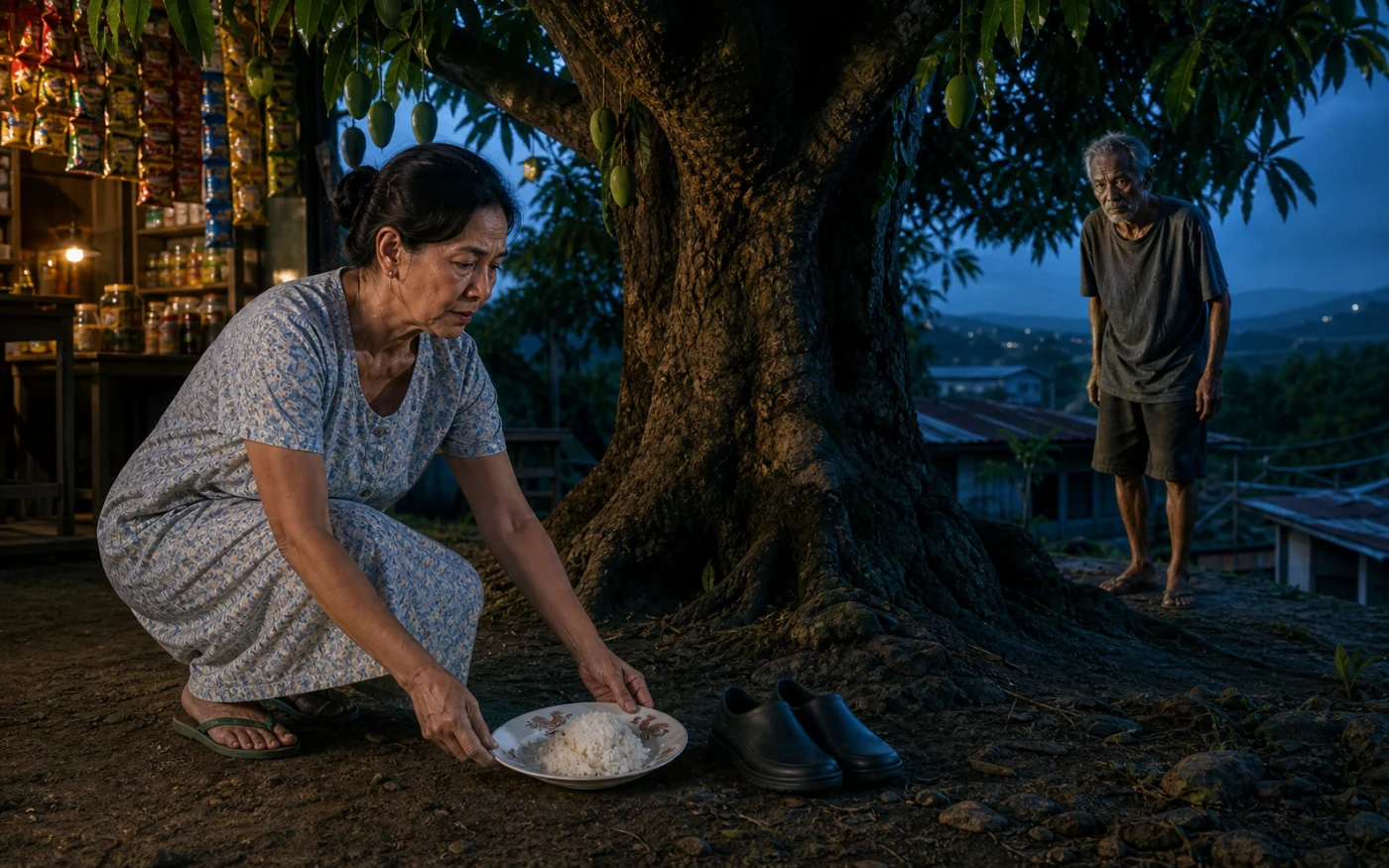
Every Night I Left Rice Under the Mango Tree. My Family Thought I Was Feeding a Ghost — But Ghosts Don’t Wash Plates
PART 1: The Washed Plate
Every night at seven I bring a plate of rice to the mango tree behind my house.
White plate. The one with the rooster on it, almost faded now. Last of my mother's set.
I keep the sari-sari store at the front of the house. Forty-one years. I can tell you who is pregnant before their own mother knows, and who is hiding tuba behind the softdrinks case. A store like mine is a confession box with a price list.
So yes. I know what people say about me.
"Auntie Cory feeds the multo."
The kids dare each other to touch the tree. My grandniece charges them five pesos each. She has my blood, that one.
My sister-in-law says it nicer. "It's her devotion." The way you say devotion when you mean the poor thing.
At parties they seat me next to the food so I have something to do with my mouth besides answer questions.
Eleven years I have been feeding this ghost. Eleven years of teasing. I let them.
It started on All Souls' Day, with one plate for my mother and a prayer I was too embarrassed to say indoors. The next morning the rice was gone and the plate had been washed. So I left another the next night.
Because here is the thing about my ghost.
Every morning the plate is empty. Fine. Ants, they say. Dogs. Spirits, if you like your stories with wings.
But the plate is not just empty.
It is washed.
Scrubbed with sand, rinsed, and set upside down on the root so the rain doesn't pool in it. Eleven years, not one morning missed. Once, during the typhoon, I found it wedged under a stone so it wouldn't fly.
Ants do not do the dishes.
The first year I said nothing because I wasn't sure. The second year I said nothing because I was.
Whoever came down from those hills wanted to stay unknown. I respected that. If you are hungry enough to eat in the dark and polite enough to wash the plate, I do not make you explain yourself.
I started adding things. A boiled egg. Dried fish on Fridays. In December, one puto bumbong wrapped in banana leaf, because some hungers are about the calendar.
The egg shells came back in a neat little pile. The banana leaf, folded in four.
You want to know why a sixty-three-year-old widow with a bad knee walks to a mango tree every night in her tsinelas, in the rain, during her own birthday dinner one time, excuse yourself politely, be back before the karaoke.
Because a ghost does not fold banana leaves.
Somebody up in those hills was raised right.
And I wondered by whom.
Three nights before baby Emilio's baptism, something changed.
That morning the rooster plate came back clean with a folded hundred-peso bill underneath it.
Eleven years, not one peso. Now somebody was trying to pay me back.
That afternoon, the invitation arrived.
Under his name, my grandnephew's parents had printed a dedication: Named for his late Lolo Emilio.
My father. The good dead man in the framed photograph.
That was the night I finally waited.
I brought the flashlight with the masking tape holding the back on. My husband, rest him, fixed it that way in 1998 and it has outlived him out of spite.
I sat inside the pigpen wall. Empty pigpen. The pig became my roof repair years ago.
Seven o'clock. Nothing. Eight. The radio from the neighbor's house, a love song sung by a man who has clearly never done laundry.
Nine-forty. The grass moved.
An old man came down the hill path. Slow. Careful with his feet the way you are when your feet are your whole transportation.
He knelt by the plate. He made the sign of the cross over the rice.
Then he ate like he was apologizing to it.
Small bites. Nothing dropped. When he finished, he took the plate to the drum of rainwater, scrubbed it with sand from the tin can I keep there, and set it upside down on the root.
Then he patted the tree. The way you pat a carabao that worked hard.
I stood up. My knee announced me first.
He froze. Susmaryosep, the fear on that man. He looked at the hill, measuring the run, and we both knew his running days and my chasing days retired the same year.
"Sit," I said. "There's more rice."
He didn't sit. He begged. Hands together like Sunday. Please don't tell anyone. Please. I'm not stealing, the plate is offered, please, I'll go, I'll go tonight, please —
"Nobody's telling anybody," I said. "Eat your egg."
He ate the egg. Shaking.
I watched his face in the flashlight. Something about the jaw. Something about the way he tucked his thumb inside his fist, an old habit, a habit I knew, a habit I had seen across a dinner table when I was small enough to sit on a rice sack.
I told myself no. I told myself old men look alike in the dark.
Then he finished, and wiped his mouth with the back of his wrist, and said thank you.
Except he didn't say Cory. He didn't say Aling Corazon.
He said, "Salamat, Neneng."
One man called me Neneng. One man in my entire life.
We buried him in 1987.
Well.
We buried a box.
PART 2: The Last Hundred Meters
Here is what came out under that mango tree over the next two nights, in pieces, the way rice comes out of a torn sack.
"Papa?" I said.
The old man flinched as if the word had struck him.
Up close, I found pieces of my father everywhere. The notch in his eyebrow. The crooked little finger. The thumb hidden inside his fist whenever he was afraid.
- My father left for Saudi. A recruiter with a clipboard and a Rolex, kuno. Papa carried his own placement fee and, because he was the barangay's honest man, the fees of three neighbors too.
The agency was a door in Manila with nothing behind it.
He could not come home to say that sentence. Four families had sold pigs and pawned earrings because he said the opportunity was real. So he worked. Docks, kitchens, fishing boats. Thirty years of jobs with no names. One letter came in 1985. Then nothing.
After a storm sank a boat where he had worked, another laborer reported him missing. In 1987 the court gave my mother a paper, and we buried a box with his barong in it. My mother wore black until 2003, when we buried her for real.
Papa learned about her death from an old newspaper wrapped around dried fish.
Papa returned eleven years ago, already old. He slept in an abandoned copra shed above the hill, repaired farm tools for food, and watched our house through the trees. Every night, he came down for my plate.
Then I asked about the hundred pesos under the rooster plate.
Papa looked down.
"I finished."
"Finished what?"
"The three families."
For eleven years, every peso he could spare from repairs and day work had gone back to the families whose placement fees he carried to Manila. Quietly. One payment at a time.
"Last one this week," he said.
That was why my plate had finally come back with money underneath it.
He had paid everyone else. Now he was trying to pay me.
"Eleven years, Papa."
He did not answer.
"You were close enough to wash my plate every night. You were close enough to hear them laughing at me."
"I know."
"Then why did you not knock?"
"Let them keep the dead man," he said. "The dead man was still good."
"That is not an answer, Papa."
He looked toward my house.
"Because you would have opened the door."
I wanted to slap him, hug him, and drag him home by one ear.
Instead, I sat beside him until he looked at me. Then I told him about Dodong's grandson.
"They named him Emilio," I said. "After the lolo in the framed photo."
Papa put down his spoon and looked toward the church bell tower. He did not eat anymore that night.
The baptism was a Sunday.
Saturday night, I brought the plate. Rice, dried fish, one boiled egg.
Beside it, I left one of Dodong's barongs, the invitation with the little embossed shell, and a pair of rubber shoes, size nine, price sticker still on.
I did not say anything. You cannot talk a man down a hill. You can only leave shoes at the bottom of it.
Sunday. The church fan turning slow. The priest at the part with the water, and baby Emilio starting his opinion of the whole arrangement.
The door at the back opened.
An old man. Barong pressed by hands, not by iron. New shoes, squeaking on the tile with every step, the whole church turning to the sound.
And my brother saw our dead father walking toward him.
PART 3: The Ghost Came Home
Dodong stood up so fast his chair fell. My sister-in-law grabbed the pew like the ground moved. Somebody's rosary hit the floor and nobody picked it up.
Papa kept walking.
Squeak.
Squeak.
Squeak.
Those shoes announced every step of the last hundred meters he had been too ashamed to cross.
"Papa?" Dodong whispered.
My brother was fifty-eight, broad-shouldered, gray at the temples.
But he sounded eight.
Papa raised one hand.
Dodong folded around him.
It was not graceful. Nothing in our family is graceful with witnesses. My brother made one broken sound, and the entire church seemed to exhale.
Papa stopped at the font. He looked at the baby with his name.
He put his thumb inside his fist. Then he took it out and placed his hand on that wet little head.
The priest, God bless that young priest, simply moved over and made room, the way you do for family.
"This is your great-grandson," Dodong's boy said.
Papa looked at him. "Emilio?"
"For you, Lolo."
That destroyed us.
Nobody asked questions in the church. The questions could wait. Some had waited forty years already, they were patient by now.
At the reception, the questions came like monsoon rain. Where had he been? Why had he hidden? Did I know? Was that why I fed the tree?
Papa answered before I could. He told them about the recruiter, the money, the jobs with no names, and the shame that kept turning one more month into forty years. Then he told them about the eleven years of quiet payments, until the last debt was gone.
"I was fooled," he said. "But I also hid. For that, I am sorry."
Dodong stared at me.
"Ate. You knew?"
"That it was Papa? For three days."
Dodong opened his mouth.
"That somebody was eating my rice? Since the second year."
"Ate."
"Ghosts don't wash plates."
I looked around the table.
"You people were busy diagnosing my relationship with a mango tree."
My grandniece laughed first. Then everyone did.
My sister-in-law found me beside the baptism bowls and apologized for the jokes and for seating me next to the food so I would keep quiet. I handed her a dish towel and told her to help me make room at the table.
During the next week, Papa visited each family whose money he had carried to Manila. One shouted. One cried. One made him sit down and eat.
The debts had been paid. The apologies had not. Papa gave all three.
Restoring a dead man's legal identity took four months, a stack of affidavits, and one clerk who stared at him before saying, "Sir, you have caused paperwork."
Papa moved into the room behind my store.
At first, he slept with his bag packed under the bed, ready to disappear.
Every morning, I pushed it a little farther under the frame.
Dodong came after work. Sometimes they spoke for hours. Sometimes they peeled mangoes without saying anything at all. Baby Emilio grabbed Papa's finger and refused to let go.
Tonight the rooster plate is not under the tree.
It is on my table, in the middle, with rice for two.
He still eats like he's apologizing.
Small bites. Nothing wasted.
But when we finish, he carries the plate to the sink, scrubs it clean, and sets it upside down beside the basin.
I let him.
Not because he owes me.
Because somebody raised him right too.