
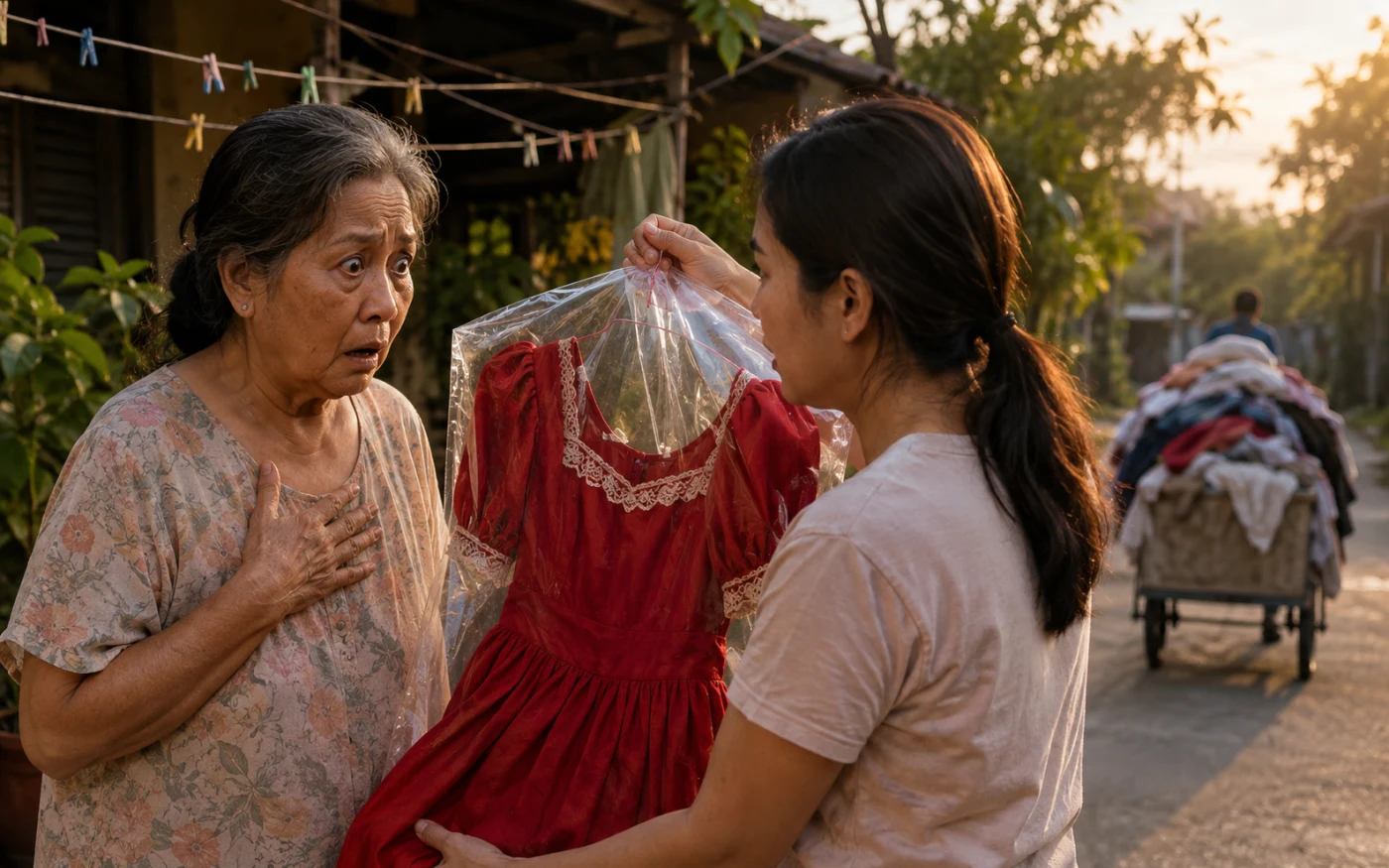
My Mother Said a Tikbalang Kept Moving Her Laundry. I Thought She Was Getting Forgetful Until My Missing Sister’s Red Dress Came Home from Another Barangay...
PART 1: The Helpful Tikbalang
The first thing that vanished was my mother’s flowered bedsheet.
“Christina,” she called from the yard, “kinuha na naman ng tikbalang!”
I found her standing beneath the empty clothesline with both hands on her hips. At sixty-eight, Mama could make an accusation sound like a court verdict, even when the accused was a half-horse creature hiding behind our banana trees.
“Mama, walang tikbalang,” I said. “Baka nilipad lang.”
“Then why did it leave the clothespins?”
She pointed at six wooden pins still clipped neatly to the line.
That was strange.
But not as strange as the bedsheet returning two days later, washed, sun-dried, folded into a perfect square, and placed on our plastic table.
It wasn’t even our bedsheet.
Ours had yellow sampaguita. This one had giant purple orchids and someone’s initials—B.R.—sewn into the corner.
Mama stared at it.
Then she crossed herself.
“Sabi ko sa ’yo,” she whispered. “Tikbalang.”
My husband Noel laughed so hard he almost choked on his pandesal.
Our daughter Stephanie posted a picture in the family group chat with the caption: LOLA’S LAUNDRY SPIRIT STRIKES AGAIN.
By dinner, every relative had an opinion.
Tita Baby said Mama was imagining things.
Kuya Jun claimed some secret admirer was washing Mama’s linens.
My cousin Nerissa asked if the tikbalang accepted curtains.
Even Mama laughed—until three of Noel’s shirts disappeared and came back smelling of lavender, along with a pair of enormous men’s shorts none of us had ever seen.
“Helpful naman,” Noel said, holding the shorts against his waist. “May free upgrade pa.”
Then our neighbor Nena arrived, waving one of my bras over her head.
“Kanino ito?” she shouted from the gate.
“Nena!” I nearly dropped the rice pot. “Ibaba mo!”
“It was folded with my grandchildren’s uniforms!”
For two weeks, laundry traveled through our barangay like it had its own social life.
Baby clothes appeared at a widow’s house.
A barangay tanod received three lace pillowcases.
Mama’s missing bedsheet turned up at the chapel convent, while the purple orchid sheet belonged to a woman near the basketball court.
People began writing their names on everything.
Nobody locked up their laundry, though. Where was the fun in that?
Every morning, someone would yell, “Dumating na naman ang tikbalang!” and half the street would run outside to inspect the latest delivery.
Then one Friday at sunrise, I heard a rusty bell outside.
Clang-clang.
An elderly man in a white undershirt pushed a battered laundry cart past our gate. He stopped, placed a clear plastic bag on our bench, and kept going.
“Hoy!” I shouted.
He did not turn around.
Inside the bag was a red dress.
Old-fashioned. Square neckline. Tiny covered buttons. Full skirt.
I had never owned it, never worn it, and never seen it hanging in our house.
Mama came outside carrying sliced papaya.
The bowl slipped from her hands.
“That’s Rowena’s.”
My sister had been gone since I was nine.
One night she slept beside me, irritated because I kept stealing the blanket.
The next morning, she was gone.
Papa said she had run away with her boyfriend and disgraced us. After that, saying her name in our house felt dangerous.
I stared at Mama.
“How can you know that dress after twenty-five years?”
“I made it.”
She touched the waist seam.
“For her graduation. She packed it the night she left.”
I checked the collar.
Mama showed me three tiny stitches in blue thread.
“She caught it on a nail. I repaired it myself.”
My hands went cold.
A dress that had vanished with my sister had just been delivered by the same mysterious laundry man who had been scattering underwear across the barangay.
Then I found something in the pocket.
A fresh tailoring receipt.
MILA’S ALTERATIONS — SAN ROQUE.
Customer: ROWENA ALCANTARA.
RED DRESS — SIDE SEAMS, HEM.
PAID.
The date was yesterday.
I read it twice.
“Mama.”
She was already crying.
“This isn’t some old dress somebody found.”
“No.”
“She’s here.”
Mama looked down the road where the laundry cart had disappeared.
Then she looked at me.
“Find that man.”
PART 2: Where Did He Get It
The whole street knew the laundry man.
Of course they did.
Nena slapped her thigh the second I described him.
“Si Mang Tino! He used to run a wash-and-fold in San Roque.”
A tricycle driver had seen him heading toward the rice fields. Noel drove. Mama came with us, gripping Rowena’s red dress in her lap.
We found Mang Tino beneath an acacia tree, folding school uniforms on a bamboo bench.
His cart overflowed with towels, pillowcases, one mosquito net, and what looked suspiciously like Father Emil’s undershirts.
He looked up.
“Late kayo sa pickup.”
I held up the red dress.
“Did you bring this to our house?”
He squinted.
“Magandang tahi.”
“Where did you get it?”
He frowned.
Then a man came jogging toward us.
“Tatay!”
Mang Tino sighed. “Huwag kang sumigaw. May customer.”
The man was his son, Arnel.
He apologized before I could explain.
Their family laundry had closed years ago. Mang Tino’s eyesight was poor now, and some mornings he forgot the shop was gone. He would push out the old cart, follow pieces of his former route, collect clothes he thought belonged to customers, then deliver them according to memories that no longer matched the houses.
So much for Mama’s tikbalang.
I showed Arnel the receipt.
“This was altered yesterday.”
His smile vanished.
I turned back to Mang Tino.
“Please. Saan mo kinuha?”
He studied the dress.
Then his face brightened.
“Blue gate.”
“What blue gate?”
“San Roque. Maraming bougainvillea. Red dress on the line.”
Arnel nodded slowly.
“I know that house. Purok Three. Near our old shop.”
Mama grabbed my arm.
“Before we go, you need to know why Rowena left.”
I stared at her.
Mama did not drag it out.
“Your sister was pregnant. Your father found out.”
The air left my chest.
“Dante?”
She nodded.
I remembered a skinny mechanic’s son bringing green mangoes to our kitchen and pretending he had come to see Papa.
“Your father locked the front gate,” Mama said. “He took Rowena’s phone. He said Dante would never come near us again.”
“What did you do?”
“I waited until he slept. Then I opened Rowena’s bedroom window.”
I stared at her.
“You helped her escape?”
“I gave her money and sent her to Dante’s aunt in San Roque. I thought I could bring her home when your father calmed down.”
He never did.
Papa found out where Rowena was. He threatened Dante. He intercepted Rowena’s letters. Once, Rowena called our house and Papa answered.
After that, Rowena and Dante disappeared.
“When Papa died, I looked,” Mama said. “The aunt had moved. The old shop was closed. Nobody had an address. I truly did not know where they were.”
Her voice cracked.
“I lost her.”
For years I had thought Mama had simply accepted Rowena’s disappearance.
She hadn’t.
Papa had kept the door shut from both sides.
I took Mama’s hand.
“Then we go to the blue gate.”
Arnel drove us there.
It was faded blue, almost buried under pink bougainvillea.
I knocked twice.
A young woman opened it carrying a laundry basket.
She was about twenty-five.
She had my eyes.
No.
Rowena’s.
Her gaze dropped to the red dress.
“Oh no.”
“Who are you?” I asked.
She looked past me.
Mama had stepped out of the van.
The young woman went pale.
“My name is Ana.”
Then she said the words that made Mama grab the gate.
“Rowena is my mother.”
I could barely speak.
“Where is she?”
Ana looked toward the house.
“She came back because she wanted to see you. She just keeps losing her nerve.”
A screen door opened.
A woman stepped onto the porch.
Silver ran through her black hair. Her face was older, but I knew the scar through her eyebrow.
I knew the way she tucked her thumb into her fist when she was frightened.
She looked straight at me.
Then she smiled through tears.
“Hello, bunso.”
PART 3: Why Ate Came Back
For twenty-five years, I had imagined what I would do if I saw my sister again.
I thought I might yell.
Instead, I crossed the yard and hit her shoulder with the red dress.
“Twenty-five years!”
“I know.”
“I thought you forgot me!”
Her face broke.
“Never.”
Then I was hugging her so hard the hanger dug into both of us.
When I finally let go, Rowena looked at Mama.
Mama stood beside the blue gate, crying silently.
“I looked for you after he died,” she said.
Rowena nodded.
“I know that now.”
Mama blinked.
“How?”
“Dante’s cousin found Ana online last year. She told us Papa had died years ago. She also remembered you asking around San Roque for us.”
Mama’s shoulders dropped.
“Why didn’t you come then?” I asked.
Rowena wiped her face.
“Because I was still scared.”
Ana folded her arms.
“I told her fear gets old.”
Rowena gave her daughter a look.
“She has been bullying me home for a year.”
That was how I learned my niece was wonderful.
Rowena and Dante had gone to Cebu after Papa found them in San Roque. They married. Dante worked in a repair shop until he opened his own.
And Dante was alive.
Mama burst into fresh tears.
“Ma,” Rowena said, laughing now. “Buhay siya.”
“I know. Let me cry.”
Rowena had returned to San Roque six days earlier with Ana.
Every morning, she walked toward our barangay.
Every morning, she reached the same sari-sari store, panicked, bought something she did not need, and turned back.
Ana pointed toward the kitchen.
“We have nine sachets of soy sauce.”
“I forgot what I bought.”
“You bought soy sauce four times.”
Then Rowena touched the red dress.
“That was supposed to help.”
Mama frowned.
“What?”
“I kept it all these years. I had it altered this week.”
The fresh receipt.
The new side seams.
Everything clicked.
“I was going to wear the dress you made me,” Rowena said. “I thought maybe if I wore it, I could make myself walk through our gate.”
Mama touched one of the tiny covered buttons.
“You kept it.”
“Of course I kept it.”
“I’m sorry I couldn’t find you.”
Rowena shook her head.
“You opened the window, Ma.”
Mama’s mouth trembled.
“You were the only one who did.”
That was enough for both of them.
Rowena changed into the dress.
The new seams fit neatly. The red skirt moved around her knees when she came back outside.
Then Mama reached into her handbag.
She opened her palm.
A brass key.
Our front-gate key.
Rowena stared at it.
Mama pressed it into her hand.
“No more windows,” she said. “Sa pinto ka na dumaan.”
Rowena made one small broken sound.
Then she closed both hands around the key.
“Can Ana come too?”
Mama looked offended.
“Apo ko ’yan.”
“What about Dante?”
“Bring him.”
Rowena laughed through her tears.
“Ma, bahay pa ba natin ’yan?”
Mama grabbed her face in both hands.
“Anak, umuwi ka.”
This time Rowena went into Mama’s arms.
Ana wrapped herself around them. I joined from one side.
Then we heard the rusty bell.
Clang-clang.
Mang Tino was pushing his cart past the blue gate with Arnel behind him, returning the last of the wandering laundry.
Behind them came Nena holding the purple orchid bedsheet, plus Tita Baby and two neighbors who had apparently decided the laundry mystery now included a family reunion.
Tita Baby saw Rowena.
Her mouth opened.
Mama raised one finger.
“Not today.”
Tita Baby closed it.
Mang Tino rang his bell again.
“Delivery!”
Everyone laughed.
We walked home together.
At our gate, Rowena stopped.
For twenty-five years, the story of my sister ended at a bedroom window.
Mama pointed at the lock.
“Go on.”
Rowena slid the brass key in.
The gate opened.
She reached back for my hand.
And this time, my sister came home through the front.