
I Found Out My Sister Never Gave Mama a Single Peso of the Money I Sent Home for Nine Years — What She Did with It Instead Made Me Cry
PART 1: Nanay Asked About the Money
I came home from Dubai four days early to surprise my mother.
Instead, at six-thirty in the morning, after nine years abroad and one overnight bus from Cubao, I stood in front of the same rented shack near the shore with my suitcase sinking into the dirt.
Same bamboo walls. Same corrugated roof held down by rocks. Same blackened kettle.
And there was Nanay, seventy-two years old, squatting beside a firewood stove and blowing into the coals with a piece of cardboard.
I had sent ₱20,000 home every month.
For nine years.
More than two million pesos.
Every transfer went to my older sister, Nerissa. Her job was simple: give it to Nanay, fix the house situation, make sure our mother never had to count coins before buying medicine again.
Nanay looked up and her whole face opened.
“Josie!”
She ran to me. I hugged her.
I looked over her shoulder at the shack.
“Nanay,” I said. “Bakit ka nandito?”
“Ha?”
“Why are you still here?”
“Anak, kakarating mo lang. Kain muna—”
“Where is the money?”
Her eyebrows came together.
“What money?”
I laughed once because I honestly thought I had heard her wrong.
“The money I send Ate Nerissa. Every month.”
Nanay stared at me.
Then she said softly, “Anak… I never received anything. Kahit isang piso.”
Not one peso.
You need to know why that money mattered.
My father, Isko Delgado, had a fishing boat, three daughters, and a small piece of land on the hill road with a narra tree in front. He planted that tree the week I was born and cut a little mark into the trunk every birthday to measure me.
By fifteen, the tree had won.
“Accept it,” Tatay told me. “Mas matangkad talaga kapatid mo.”
Then Tatay got sick.
Two years of Lucena hospitals, medicine envelopes, and receipts Nanay kept in a biscuit tin left us with a debt we could never pay.
Berting Sazon was the only man in Mauban who could produce that kind of cash quickly. He lent money to families who had run out of choices, and in our case, he took the hill lot.
I had half a scholarship and a nursing-school slot in Lucena.
I gave it up.
Three months later, I was in Dubai caring for somebody else’s father.
That became nine years.
Nine Christmases through a phone screen. Nine birthdays missed. Nine years of saying, “Next year siguro.”
But every payday, I sent ₱20,000 home.
So when Nanay told me she had never received a single peso, I went looking for my sister.
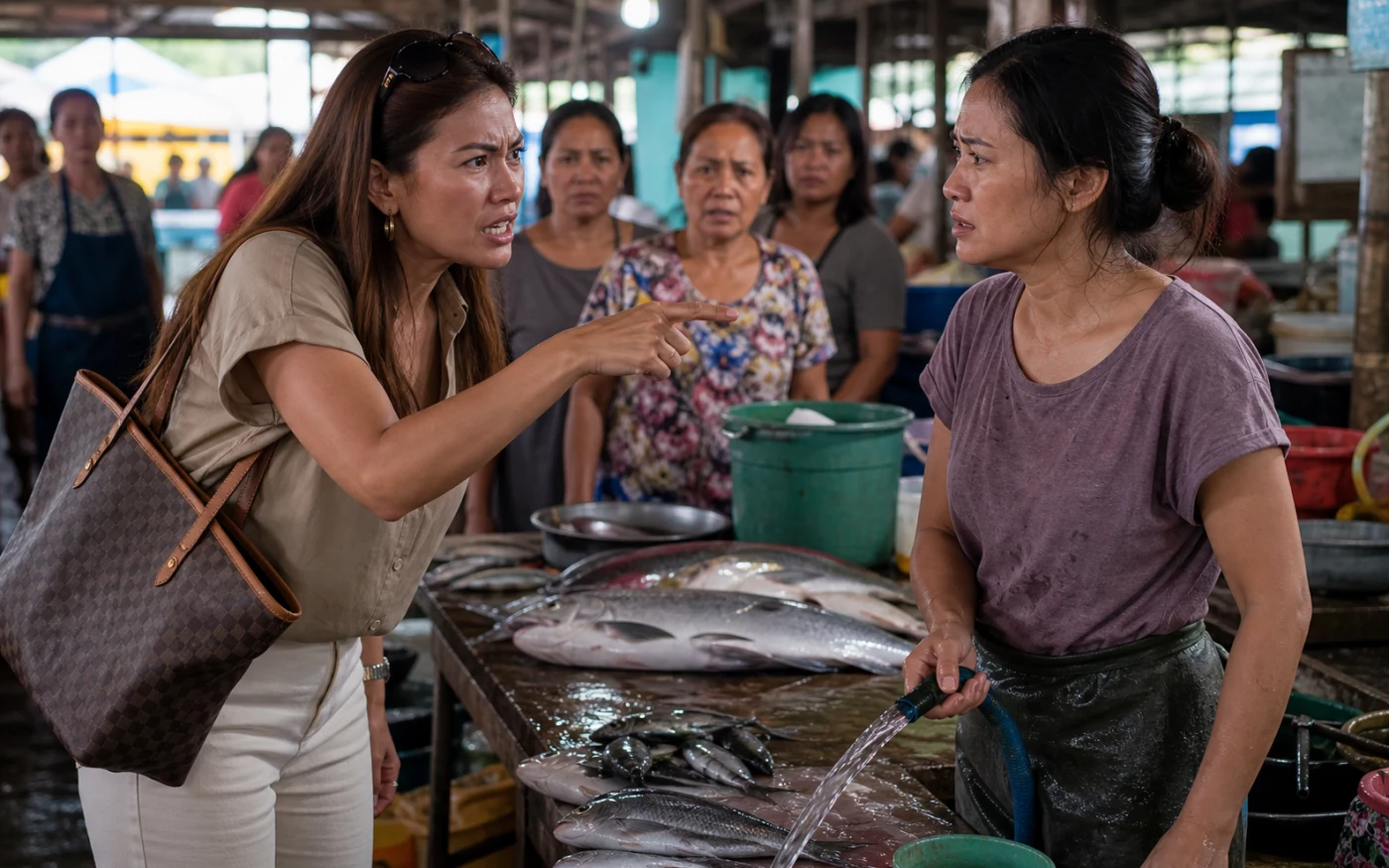
I found Nerissa at the wet market at eight, hosing fish scales off a table.
She was two years older than me, still sharp-tongued when she wanted to be, but the woman at the stall barely looked like the sister I remembered. She was thin, sun-browned, wearing a faded shirt I recognized from a video call years ago.
She saw me.
She froze.
“Josie,” she said. “Bakit ang aga mo?”
Why are you early?
That was not the greeting I expected.
“Two million pesos, Ate.”
Her eyes closed.
One fish vendor quietly moved the chopping knife farther from me.
“Nanay is cooking with firewood.”
“I know.”
“You KNOW?”
The market went silent.
“WHERE IS THE MONEY?”
Nerissa gripped the hose.
“Wala akong ninakaw.”
“Then where is it?”
“Four days, Josie. Please.”
“Ate, I have been sending money for nine years.”
“I know.”
“Then tell me.”
“Four days.”
Then she disappeared behind the plywood door of the stall and refused to come out.
An old vendor finally took my elbow.
“Anak,” she said, “drink some water first.”
That night, I went through Nerissa’s things.
I knew I should not have. But by then I was convinced my sister had taken more than two million pesos while Nanay was still living beside that firewood stove.
Her plywood room had almost nothing in it. Three shirts. A cheap fan. A rice cooker with one broken handle.
Then I found a pawn ticket for Nanay’s wedding ring.
My stomach dropped.
“Oh, Ate,” I whispered. “What did you do?”
Under her mat was a blue plastic folder.
Inside were four keys and a new land title.
The hill road.
Our old lot.
The land Berting Sazon took eleven years ago.
My hands shook as I read the owner’s name.
Not Nerissa.
Not Nanay.
JOSEFINA DELGADO-RAMIREZ.
Mine.
Behind me, the plywood door creaked.
Nerissa stood there, staring at the title in my hands.
Then she said, tired and upset, “Josie. You really could not come home on the date you told us?”
PART 2: The Blue Gate
I did not sleep.
At five in the morning I shook Nerissa awake and held the title over her face.
“Explain.”
She pulled a pillow over her head.
I yanked it away.
“Ate.”
“Four days.”
“WHY FOUR DAYS?”
From the other side of the partition came Nanay’s voice.
“Nerissa. Tama na.”
My sister went still.
Nanay sighed.
“O sige. Sabihin mo na. But I’m not coming.”
I stared at the wall. “Coming where?”
Nanay added, “Gusto kong makita mukha niya pagdating.”
I want to see her face when she arrives.
That was when I realized my mother was also in on it.
“I cannot believe either of you,” I said.
“Get dressed,” Nerissa said.
We walked up the hill before sunrise.
I was still angry, and I was carrying a bag of pandesal because Nanay chased us outside yelling, “Mag-away kayo pero kumain kayo.”
Fight, but eat.
The road climbed through sleeping houses.
Slowly, I realized where we were going.
Our old road.
Our old hill.
“Ate.”
“Just come.”
“You know what I did for nine years?”
She stopped.
“I slept in other people’s houses. I missed Christmases. I missed Nanay turning seventy. I gave up school.”
“I know.”
“You always say that.”
Her jaw tightened.
“And every Sunday,” she said, “you talked and talked and never once asked me how the fish stall was.”
That shut me up.
Nerissa looked down at the keys.
Then she added, quieter, “But I listened anyway.”
And suddenly I remembered those Sunday calls from Dubai.
I would sit on a plastic stool in the laundry room because it had the best signal. I talked about home because I missed it.
I said I missed narra wood. I complained that our old roof leaked over the dining table. I said if I ever had a kitchen, I wanted a window over the sink because Nanay liked watching the road.
I wanted low shelves because Nanay is tiny and hates asking anyone to reach things for her.
I wanted a bedroom where you could hear the sea without smelling the fish port.
Nerissa always answered, “Hmm.”
Or, “Sige.”
Or sometimes, “Anything else, Your Highness?”
I thought she was teasing me.
Then we came around the last bend.
A blue steel gate stood in a low concrete wall.
On the mailbox was one word.
DELGADO.
Beyond it stood a small white house with a green roof.
A porch.
Eight steps.
A kitchen window facing the road.
Warm yellow light glowed inside.
I stopped.
Someone moved behind the glass.
A small figure.
Sweeping.
“Nerissa…”
My sister unlocked the gate.
For the first time since I came home, she smiled.
“You ruined the blessing,” she said. “So now we are doing this ugly.”
Then she pushed the gate open.
PART 3: The House That Was Waiting
It was Nanay inside.
Of course it was.
The woman who said she was not coming had taken the shortcut through the Aguilars’ lot and beaten us there.
She wore her one good dress and was sweeping a clean kitchen, trying very hard not to cry first.
I made it three steps up the porch before I had to sit down.
Nerissa sat beside me and put a cheap blue notebook in my lap.
Inside was nine years of my own words.
March 2018 — narra. She misses the smell.
August 2018 — fix eaves. She still complains about rain on food.
January 2019 — window over sink, facing road, for Nanay.
November 2019 — low shelves. Nanay is tiny but proud.
Page after page.
My homesick complaints. My “one day” wishes.
Written in Nerissa’s cramped handwriting between fish orders.
“Ate,” I whispered. “Where did the money go?”
She pointed at the house.
“Everywhere.”
For years, she had saved everything she could, certain that one day Berting Sazon would sell.
When Nanay needed medicine, it came out of the fish stall.
When money ran short, she skipped meals herself. She pawned Nanay’s wedding ring.
From the kitchen Nanay called, “I redeemed it already. Stop making that face.”
She held up her left hand.
There was the ring.
Last year, Berting’s son needed money in Manila.
Suddenly the land he had sworn he would never sell became negotiable.
Nerissa emptied what she had saved.
Last month, he signed.
“The rest built this,” she said. “Slowly. One part at a time. We only finished the last rooms a few weeks ago. The bathroom alone took more than a year because cement prices are terrible.”
I looked at the title.
“Why is my name on it?”
Nanay came outside holding the broom.
“Because I told her.”
“Told her what?”
“That I would not take your money.”
“Nanay, that money was for you.”
“No.”
“Yes.”
She pointed the broom at me. “Listen before your blood pressure becomes my problem.”
Nerissa smiled.
Nanay pointed it at her too. “Ikaw din. Quiet.”
Then she looked back at me.
“That money was nine years of your life. I already watched you give up nursing school because your father was sick. I was not going to let you give up nine more years and come home with nothing except balikbayan boxes.”
My throat closed.
“So I told your sister: get the land back. Build something in Josie’s name.”
I looked at the house.
“The house is ready now. Why were you still sleeping in the shack?”
Nanay lifted her chin.
“Hindi ako papasok sa bahay ng anak ko nang wala siya.”
I will not move into my daughter’s house without my daughter in it.
The house had only become livable recently, but even then Nanay had refused to move in before I came home. She walked up to help clean, opened the windows, checked what still needed fixing, then went back down to the shack.
Because the house was mine.
And I was not home.
I covered my face and cried.
Nerissa rubbed my back for a few seconds.
“Okay,” she said. “Enough. You are becoming wet.”
That made me laugh and cry at the same time.
Then she pulled me up.
“Come. Look at the door.”
It was dark, heavy narra.
So were the railings and the frame around the kitchen window.
“Ate…”
“Berting cut down our tree in 2019. Aling Pina heard the chainsaw and called me. I bought the lumber before he could haul it away.”
“You paid for our own tree?”
“Eleven thousand.”
I stared at her.
“That man is evil.”
“Yes.”
“Language,” Nanay said.
I ran my fingers down the doorframe.
Near the bottom were tiny old cuts in the wood.
Nine.
Ten.
Eleven.
Twelve.
Tatay’s birthday marks.
Nerissa had saved them.
That was when I understood what I was looking at.
Every Sunday phone call.
Every wire transfer.
Every long day my sister spent at the fish stall.
Every time she had said “hmm” while secretly taking notes.
The blessing was supposed to happen four days later.
That plan did not last until breakfast.
By nine, plastic chairs had appeared in the yard.
By ten, somebody brought pancit, somebody else brought a pig, and the fish vendors were hanging streamers.
The old vendor from the market handed me a glass of water.
“See?” she said. “Water first.”
At noon, the yard went quiet.
Berting Sazon stood at the blue gate.
White barong. Polished shoes.
He looked at the mailbox.
DELGADO.
Then at the house sitting on the land he once swore we would never own again.
Then at the narra door made from the tree he cut down.
Nobody insulted him.
Nobody needed to.
Behind me, the karaoke microphone gave a sharp burst of feedback.
Berting flinched.
Nerissa leaned toward me.
“Even the microphone hates him.”
I tried not to laugh.
Nanay, because she is a better Christian than her daughters, carried a plate of lechon to the gate.
“Berting,” she said. “Kain.”
He took it.
For once, he had nothing to say.
He ate outside the gate while inside, the priest blessed the walls, children ran through the kitchen, and Aling Pina shouted at someone to stop leaning on the narra railing because “that thing has already survived enough.”
Then the priest said, “Rosita, open the door.”
Nanay shook her head.
“No.”
Everybody looked at her.
She took my hand.
Then Nerissa’s.
She put both our hands on the narra door.
“Together,” she said.
We pushed.
The door swung open.
The whole yard cheered.
Nanay stepped across the threshold between her two daughters for the first time.
She stopped in the kitchen, beneath the window I had described years ago from a laundry room in Dubai.
Outside, the whole road was visible.
Neighbors coming uphill with food. Children running through the gate. People arriving.
Nanay looked through the glass and smiled.
“Ah,” she said softly. “So this is why you wanted the window.”
I laughed.
“Yes.”
She squeezed our hands.
Then, without looking away from the road, my mother said the one thing I had spent nine years trying to buy for her.
“Good,” she said. “Now I can see my children coming home.”