
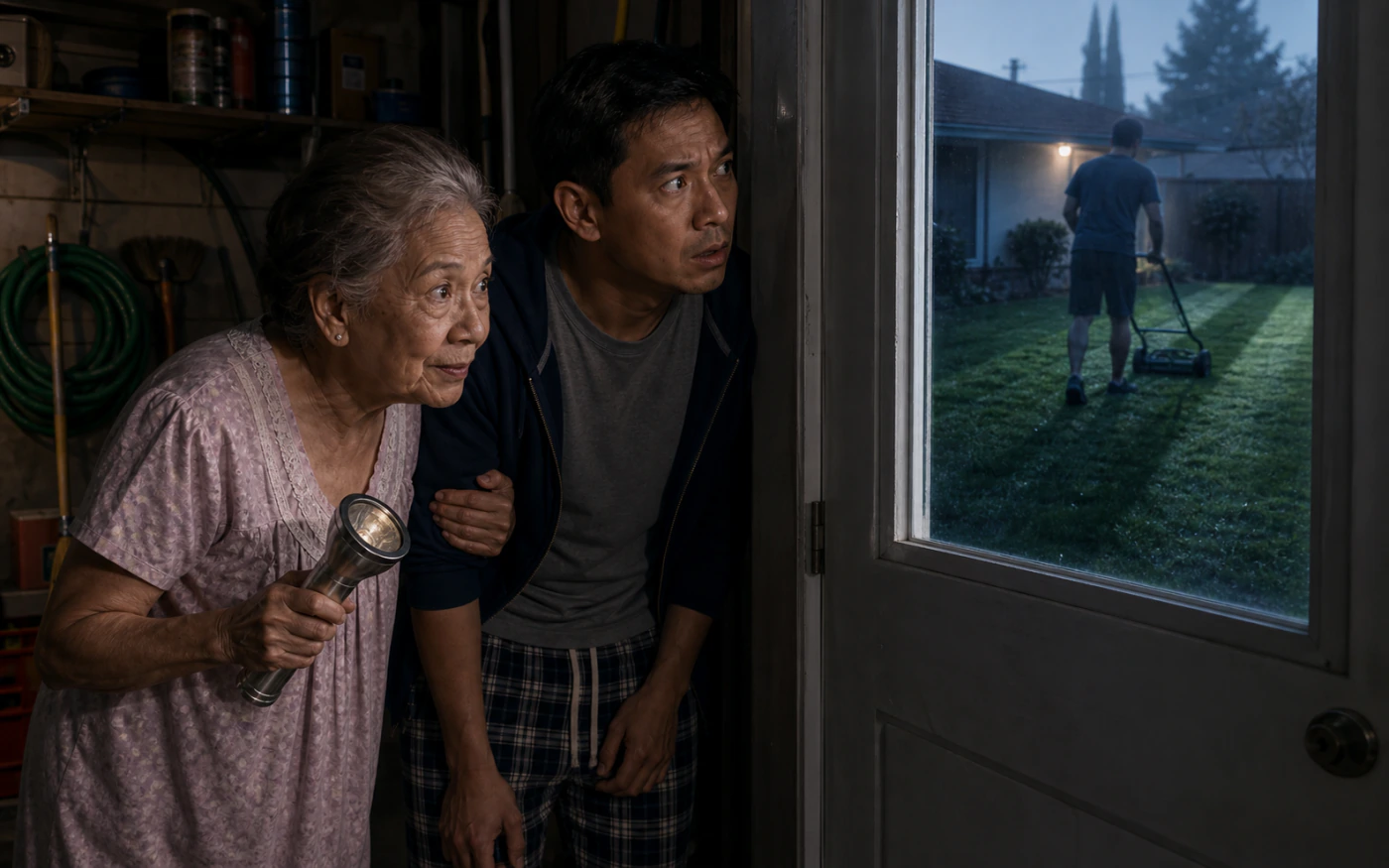
Somebody Mowed My Mother's Lawn Every Thursday for One Year. She Refused to Buy a Camera. "That Is Cheating." We Sat in the Dark Instead.
PART 1: The Diagonal Lines
My phone rang at 6:12 in the morning.
"It happened again."
"Ma. It's six o'clock."
"Twelve," she said. "Six twelve. Come and see before the sun dries it."
My mother is eighty one years old. She lives alone in the house in Milpitas, four blocks from me, which she will tell you is the correct distance for a son.
I drove over in my slippers.
She was standing on the porch with her arms crossed, looking at her front lawn.
The lawn was mowed.
Fresh. Perfect. Still smelling green. The lines went corner to corner, on the diagonal.
Nobody in our family had mowed it.
This had been going on for one year.
Every Thursday. Fifty two Thursdays. Somebody came, mowed the lawn, and left. Nobody ever saw them. Nobody ever heard them.
The first month, Mama thought it was me.
"It's not me, Ma."
"Then it's your cousin Ferdie."
It was not Ferdie. Ferdie does not do free things.
The second month, she asked the mailman. She asked the meter reader. She asked Mrs. Salonga next door, who is deaf in the good ear and answered a completely different question for ten minutes.
The third month, she started keeping notes.
I found the notebook on her kitchen table. It said THURSDAY across the top. Under it, in her small handwriting, fifty two dates. Next to some dates, observations.
Diagonal again.
Grass in the driveway crack also trimmed.
Rain Wednesday. Still came Thursday.
Here is what you need to know about my mother. She does two crossword puzzles every morning. She finishes the hard sudoku in the doctor's office and then does the easy one for dessert. When we watch a mystery show, she says the killer's name in the first fifteen minutes, quietly, once, and then waits forty five minutes to be right.
She was enjoying this. She would never say it. She was having the time of her life.
But she could not crack it.
And it was starting to make her crazy, because of three things.
One. The diagonal.
Nobody mows on the diagonal. You go back and forth, straight lines, like a normal person. My papa mowed on the diagonal. Every Thursday of his life, corner to corner, because he said it made the lawn look bigger. The neighbors used to tease him. Cerilo, this is not a golf course.
Papa has been gone eleven years.
Two. The santan.
Mama has three santan bushes under the front window. The mower never touches them. The grass around them is trimmed by hand. Short, even, careful.
Papa did that with scissors. Kitchen scissors. Because the mower bruised the branches, he said. I watched him do it a hundred times, kneeling in the grass in his weekend shirt.
Three. The sound.
There is no sound. Mama sleeps light. The neighbors sleep light. Fifty two Thursdays, and not one person on that street has ever heard a mower.
"So buy a camera, Ma," I said. "They're forty dollars. It sends the video to your phone."
She looked at me the way she looks at a wrong crossword answer.
"That is cheating."
"Ma."
"A camera." She said the word like it smelled. "Any fool can have a camera catch something. Then what did I do? Nothing. I want to catch them myself."
"You're eighty one."
"And they come to MY lawn," she said. "On MY Thursday."
Then she poured me a coffee I did not ask for, which is how I know a plan was coming.
She sat down across from me.
"Thursday night," she said. "You bring the coffee. I have everything else."
"Everything else? Ma, what else is there?"
She opened the hallway closet.
There were two folding chairs in there. A thermos. Two flashlights, the big silver kind. A blanket. Binoculars.
And a bag of chicharon.
"For the stakeout," she said.
PART 2: We Set the Trap
The first stakeout was a disaster and it was my fault.
We set up Wednesday at eleven at night, in the dark living room, chairs facing the window, curtains open one inch.
Mama took the first watch. I took the couch, just to rest my eyes.
I woke up at 7:30 in the morning with the blanket over me.
The lawn was mowed.
Mama was in the kitchen making rice, and she did not say one word to me, which was worse than anything she could have said.
"Ma. You could have woken me up."
"You looked tired, anak."
"Did YOU see anything?"
Silence.
"Ma. Did you fall asleep too?"
She turned the rice down.
"The chair is very comfortable," she said.
We both fell asleep. Both of us. The mower came, cut the whole lawn on the diagonal, trimmed around the santan, and left, twenty feet from two sleeping adults with binoculars.
The second Thursday, we prepared better. Mama drank half the thermos before midnight. I brought my son's energy drink, which tasted like melted freezies and fear.
At 2:15 in the morning, the trap went off.
I need to explain the trap. Mama had tied a string across the front walk, ankle height, and connected it to a cookie tin full of spoons on the porch. She engineered it herself. She tested it four times.
At 2:15, the tin went off like a car crash.
We both hit the window at the same time. Mama had the flashlight up and ON, a beam like a prison movie, sweeping the yard.
It was Mrs. Salonga's cat.
The cat sat in the middle of the lawn, in the spotlight, and looked at us. It did not run. It licked its shoulder. It took its time. That cat had no respect for the operation at all.
Mama turned off the flashlight.
"Recon," she said darkly. "They sent the cat first."
"Ma, nobody sent the cat."
The third Thursday, it rained, and we sat in the dark listening to it, eating chicharon, and Mama told me a story I had never heard about her and Papa and a dance hall in 1963, and the lawn did not get mowed, and honestly it was the best night I had had in a year.
The mystery, meanwhile, was eating her alive.
She interrogated the whole block that week. Casually. Over fences. She brought Mrs. Salonga a bilao of pancit as a bribe, which was wasted, because Mrs. Salonga answered questions about her gallbladder.
The notebook got thicker.
Comes between 5 and 6, must be. Dew tracks Thursday morning point AWAY from driveway.
Does not use our gate. Gate hinge squeaks. I never oiled it ON PURPOSE.
That one stopped me.
She had left the squeaky hinge squeaky for months. As an alarm. My mother had been running counterintelligence on her own front yard while the rest of us thought she was just old and sweet.
The fourth Thursday, we changed everything.
"No chairs by the window," she said. "They can see the window. This week, we sit in the dark in the garage, and we watch through the little door glass. And Boyet."
She looked at me.
"No sleeping. If you sleep, I am telling your wife about the energy drinks."
We took our positions at midnight. The garage smelled like Papa still. Motor oil and grass.
At 5:40 in the morning, when the sky was gray but not light, we heard it.
Not a motor.
A click. Soft. Steady. Click, click, click, coming up the street.
Mama grabbed my arm with the grip of a woman half her age.
"REEL mower," she whispered. "A push mower. NO ENGINE. That's why nobody ever hears it. Boyet. Your papa's mower was a reel mower."
The clicking turned up our walk.
And my mother, eighty one years old, in her nightgown and her good walking shoes, which I only now realized she had been wearing all night, stood up and put her hand on the garage side door.
PART 3: The Mower Comes Back
"Ma. Ma, wait. The plan was we observe."
"That was YOUR plan."
She opened the door.
The sky was just light enough to see. In the middle of the lawn, halfway through the first diagonal, there was a man with a push mower.
Young. Big shoulders. Moving fast and quiet, laying that line corner to corner like he had done it five hundred times.
My mother crossed her own yard in the half dark, in her nightgown, with a silver flashlight the size of a bread loaf, and when she was ten feet behind him she turned it on and yelled.
"AHA."
I want to describe what the man did.
He went straight up. All of him, at one time, like a cat on a cucumber video. The mower shot forward without him. He came down turned halfway around, stepped backward onto the coiled hose, and the hose end, which was resting on the spray handle, went off.
He watered himself. Full in the chest, then the face, because he grabbed the sprayer to stop it and pointed it the wrong way.
It took him three seconds to find the trigger. Three long, beautiful seconds.
Then he stood there. Six foot something, soaked from the eyebrows down, at 5:40 in the morning, in the flashlight beam.
And he said, "Po."
Just that. Po.
And my mother lowered the flashlight, and looked at his face, and said, "…Berto?"
I had not recognized him. I promise you I had not.
But my mother does two crosswords every morning, and she had the answer the second the light hit him, and by the way she said his name I could tell some part of her had guessed it weeks ago and had not let herself believe it.
Berto Reyes. From the yellow house, three doors down, before the family moved to Fremont.
The boy who used to follow Papa around this yard like a duckling. Whose own father left when he was nine. Who Papa paid five dollars to help with yard work, and then taught, and taught, and taught. The diagonal, because it makes the lawn look bigger. The scissors around the santan, because the mower bruises the branches. How to sharpen a reel mower with a stone.
He is twenty six now. He has a landscaping company. Four employees, two trucks. It is called Diagonal Landscaping and I am ashamed as a family we did not solve this eleven months earlier.
Mama made him come inside. He stood dripping on the kitchen floor while she yelled at him gently and made rice.
The story came out over breakfast.
His crew starts at seven. For one year, every Thursday, he had been getting up at four thirty, driving from Fremont with his own money in the gas tank, and mowing our lawn before work with Papa's kind of mower, in Papa's pattern, in the dark.
"Why Thursday?" I asked.
He looked at me like the answer was obvious.
"Mang Cerilo mowed on Thursdays."
Mama put down the rice paddle and turned around to the stove and did not turn back around for a minute. Nobody said anything. Berto looked at the table.
Then she sat down across from him and asked why he never knocked.
He turned red. A big soaked man, red to the ears.
"Because you would feed me," he said. "And then it would be for something. Mang Cerilo said you don't take payment for a lawn you learned on."
Grabe. Papa said that. I could hear him say it.
So here is how it ended.
Nobody pays anybody. Mama tried to give him money once, and he looked so miserable she put it away and has never tried again.
But the deal is different now. He still comes Thursdays. He does not come at 5:40 anymore. He comes at 7:30, when it is light, and when he is done, there are two plates on the porch table. Rice, egg, longganisa. He eats one. She eats one. His crew waits in the truck and they know better than to hurry him.
The string and the cookie tin are still in the closet. Mama refuses to throw them out.
"It worked," she says.
"Ma. It caught a cat."
"It worked ONCE," she says, "and that is more than your camera ever did."
The notebook is finished. On the last page, under fifty two Thursdays, she wrote one line and closed it.
Case closed. It was the duckling.