
A Patient Left Me a Worn Wooden Rosary Before She Passed. Five Years Later, An FBI Agent Knocked on My Door With a Photograph of It.
PART 1: The Woman Without a Name
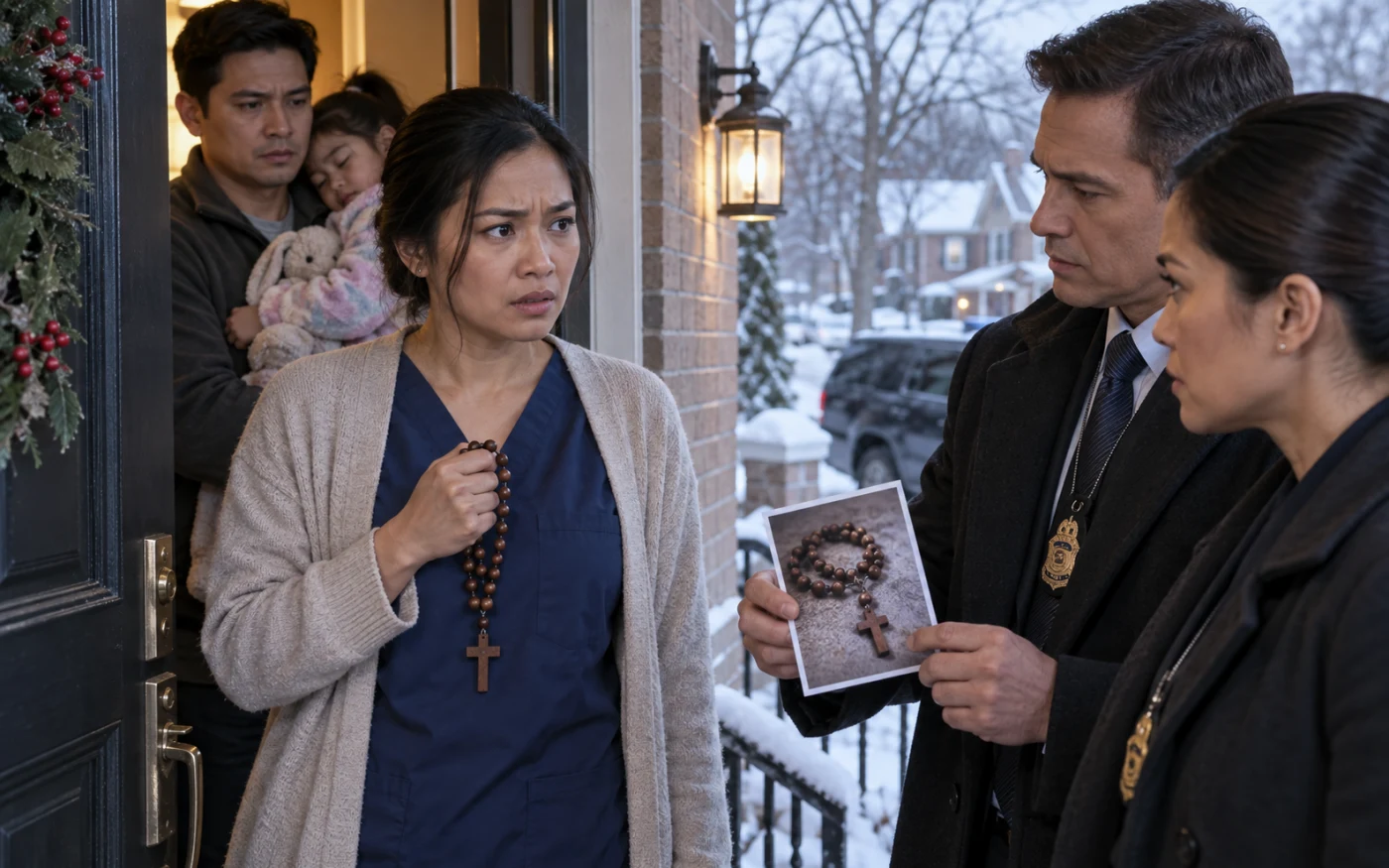
The FBI agent on my porch held up a photograph of my wooden rosary and said, “Mrs. Mercado, we need you to surrender those beads.”
I forgot how to breathe.
The actual rosary was inside my blouse, resting against my skin.
I had worn it every day for five years.
“Why?” I whispered.
The second agent opened a black folder. Inside was a photograph of the old woman who had given it to me three hours before she died.
Under her face were the words INTERNATIONAL ART THEFT INVESTIGATION.
Five years earlier, she had arrived in my emergency room on a freezing Chicago night with no identification, no family, and a name nobody could confirm.
She was tiny, silver-haired, and soaked through. A bus driver had found her confused at the end of his route.
The admitting clerk entered her as Jane Doe.
She grabbed my wrist when I tried to take her blood pressure.
“Rowena?” she asked.
I looked at my badge. “Yes, po. I’m Rowena.”
Her frightened eyes softened.
“Filipina?”
I nodded.
“Batangas,” she said, touching her chest. “I was born where the sea is blue.”
That was almost all she told us.
She had pneumonia, an old scar near her temple, and a heart too weak for the infection tearing through her. She called herself Teresa, but every search came back empty.
For three weeks, she stayed upstairs while social workers tried to discover who she was.
I was an ER nurse. She was no longer my patient. But after my shifts, I kept going to her room.
At first I told myself it was because she had no visitors.
The truth was that I knew the sound of a hospital room after everyone stopped expecting anybody to come.
My father spent his last weeks in a Manila hospital. My sister and I were both working overseas. A storm delayed my flight home from Chicago. By the time I reached Manila, he had died alone.
So I sat with Teresa.
I brought arroz caldo in a thermos when she could eat. She tasted it and whispered, “Ang sarap.” I rubbed lotion into her dry hands. I found an old recording of kundiman songs, and she closed her eyes as if a door had opened somewhere.
Some nights she was clear.
Some nights she woke crying and asked me to hide her from people who wanted her declared “useless.”
“Huwag mo akong iwan,” she whispered once, clutching my sleeve.
I assumed the fever was talking.
“You’re safe,” I would tell her. “And you are not useless.”
She would study my face for a long time.
“You stay even when I have nothing to give you,” she said once.
“You let me steal your pudding.”
She pushed the unopened cup toward me with complete seriousness. “Then take it. I hate that flavor.”
On my last night with her, the doctor told me she might not make it until morning.
Teresa was awake when I entered. Her breathing sounded like paper crumpling slowly.
She pulled a worn wooden rosary from beneath her pillow.
The beads were dark from years of fingers moving over them. The little cross was hand-carved and slightly crooked. One bead near the center was lighter than the rest.
“For you,” she said.
I shook my head. “No, keep it with you.”
“I carried it long enough.”
“Teresa—”
She closed my fingers around it with surprising strength.
“When you see the sea, remember I was not always an old woman in a bed.”
Then she smiled.
“And build something beautiful, Rowena.”
I thought she meant my life.
Three hours later, I was holding her hand when it went still.
The county buried her after nobody claimed the body. I went to the service with two hospital aides and the social worker. I wore her rosary beneath my black coat.
For five years, it stayed with me through everything: my wedding to Marco, my mother’s surgery, two miscarriages, and the morning I finally held our daughter, Isabel.
Then the FBI came.
Agent Daniel Reed told me Teresa’s fingerprints had recently been matched to a woman named Teresa Villareal.
She had owned homes in three countries. Several paintings once stored in one of those homes had disappeared during a bitter guardianship fight with her relatives.
Investigators believed her rosary contained a micro-key connected to a private safe-deposit box.
“That sounds impossible,” I said.
Agent Reed pointed to the pale wooden bead in the photograph.
“That bead unscrews.”
My hand flew to my chest.
“She gave it to me.”
“It may be evidence.”
Marco had come up behind me holding Isabel. Our little girl was half asleep against his shoulder.
“Do you have a warrant?” he asked.
The agents looked at each other.
They did not.
I should have been terrified by the words FBI and art theft. I was terrified.
But all I could see was Teresa pushing away the pudding and asking me to believe she had once stood beside a blue sea.
I curled my fingers around the rosary under my blouse.
“Then you can come back when a judge tells me I have to give away the last thing my patient owned.”
Agent Reed closed his folder.
Before he left, he said quietly, “Mrs. Mercado, her family has been searching for this for years.”
The next morning, a courier handed me a court summons.
And behind him was a black car parked across the street. An elderly man sat inside, watching my house.
PART 2: What Did Teresa Hide?
The man in the black car was Teresa’s younger brother.
His name was Augusto Villareal, and he was waiting outside the courthouse three days later when Marco and I arrived with the rosary locked in a small metal case.
He stood as I passed.
“You were her nurse?”
“I was.”
His mouth tightened. “Then you should understand that sick people become confused.”
I stopped.
“She knew my name.”
“She knew many names. She also accused her own family of stealing from her.”
“Did you?”
Marco gently touched my elbow, but it was too late.
Augusto’s face went red.
“My sister belonged with us.”
“She died alone.”
The words came out sharper than I intended.
For one second, anger vanished from his face. What remained looked like shame.
Then his lawyer called him away.
Inside, the government asked the judge to take temporary custody of the rosary.
Augusto’s lawyers claimed it was Villareal family property.
My attorney, Leah Kim, argued that it had been a personal gift made by a competent woman in front of a witness.
That witness was Maribel, the night aide who had been changing Teresa’s water pitcher when she gave me the beads.
“She was weak,” Maribel told the judge, “but she was not confused. She told Rowena exactly what she wanted her to do.”
“Build something beautiful,” the judge repeated.
My throat tightened.
The judge ordered the rosary examined by a neutral expert while all of us watched.
The expert put on white gloves.
When he twisted the pale bead, it opened along a seam so fine I had never seen it.
Inside was a piece of metal smaller than a grain of rice.
Augusto began crying.
Not loudly. He covered his mouth and bent forward as if somebody had struck him.
That reaction frightened me more than the FBI agents had.
Agent Reed explained that the micro-key and an encrypted number in the bead corresponded to a private vault service in Chicago.
The box had been rented under an alias linked to Teresa.
The FBI believed it might contain records revealing where the missing paintings had gone.
The judge scheduled the opening for the following week.
Until then, the rosary would remain sealed with the court.
For the first time in five years, I went home without it.
That night I stood in Isabel’s room watching her sleep.
I felt foolish and empty, as if I had let strangers turn a dying woman’s kindness into something dirty.
Marco found me there.
“Maybe the family is right,” I whispered. “Maybe she was confused. Maybe I took something I shouldn’t have taken.”
He leaned against the crib beside me.
“Did you ask her for it?”
“No.”
“Did she know who you were?”
“Yes.”
“Then stop helping people erase her choice.”
On the morning the box was opened, the courthouse conference room was packed.
Two federal agents stood by the wall. Augusto sat with three relatives and two attorneys. A government photographer aimed a camera at the long gray box in the middle of the table.
The key turned.
I braced myself for diamonds, stolen paintings, or documents proving Teresa had been someone I never knew.
The lid lifted.
Inside was a yellow envelope, folded papers, a slim packet of sale records, and a photograph of a young woman standing barefoot on a beach.
There was no stolen art.
Across the envelope, in Teresa’s familiar handwriting, were the words:
TO THE PERSON I GIVE MY ROSARY TO.
Everyone looked at the rosary in its sealed bag. Then they looked at me.
PART 3: Why She Chose Me
My hands shook so badly that Leah had to open the envelope.
But I read the letter aloud.
“To the person I chose,” it began. “If you are reading this, you have found the key in my rosary. You have also found the part of my life I kept hidden.”
Augusto lowered his head.
Teresa wrote that the missing paintings had never been stolen.
She had sold them legally years earlier to pay debts from her late husband’s failed business.
Her relatives knew that, but admitting it would expose how close the family fortune had come to disappearing.
When Teresa refused to let Augusto manage what remained, the family tried to have her declared incompetent.
She ran.
She hid the key in her childhood rosary because it was the one thing nobody in her family valued.
Then the letter changed.
“I have spent much of my life surrounded by people who loved what my name could give them,” I read.
“I wrote this before I knew who would receive my rosary. I wanted to choose someone who would see me as a person, not a fortune.”
My voice broke.
Marco reached for my hand.
I kept reading.
“If I placed those beads in your hands, I trusted you. So I leave you the last place where I remember being happy. Please do not make it grand. Make it useful. Let someone who is frightened enter and find a person who stays.”
I remembered Teresa pushing the pudding toward me.
“You stay even when I have nothing to give you.”
The folded papers included the deed to six acres of oceanfront land in Batangas, along with a small house Teresa had inherited from her mother. Her will left the property to the person she personally chose by giving away her wooden rosary.
An attached statement showed an account reserved for taxes and maintenance.
I stared at numbers larger than anything Marco and I had ever imagined owning.
Augusto stood so suddenly his chair scraped the floor.
“That land has been in our family for eighty years.”
The judge looked over her glasses. “And your sister owned it.”
“She was ill.”
“The will was signed and witnessed eleven months before her hospitalization. It says she would choose the person herself by giving away her rosary.”
His lawyer pulled him back, but Augusto looked straight at me.
“You sat with her for three weeks. We loved her for a lifetime.”
I thought of the empty chair beside Teresa’s bed.
Then I noticed the beach photograph still in the box.
The young woman was Teresa. Beside her stood a skinny boy of about ten, squinting into the sun.
On the back, in faded ink, she had written: Teresa and Gusting, 1958. He followed me everywhere.
I carried the photograph to Augusto.
“She kept this,” I said.
He stared at it.
His whole face collapsed.
“She called me Gusting.”
Nobody in the room moved.
“Why didn’t you visit her?” I asked.
He sank into his chair.
“I didn’t know where she was.” His voice was barely there. “And when she disappeared, I was so angry that I told myself she wanted to be alone.”
He pressed the photograph to his chest.
“It was easier than admitting she was afraid of us.”
That was the end of the fight. Augusto withdrew his claim to the land.
The FBI officially closed the art investigation after finding the sale records Teresa described.
I did not build a resort.
I did not sell the beach to developers, though their offers arrived every month.
Marco and I moved to Batangas with Isabel for one year that became two, then three.
We used Teresa’s maintenance fund, our savings, and donations from nurses in Chicago to turn the old house into a free clinic.
Augusto sent the first large check.
He did not include a letter.
He only wrote, For my Ate Teresa, on the memo line.
The clinic opened on a bright morning with plastic chairs borrowed from the barangay hall and children crowding around the doorway.
We named it the Teresa Villareal Community Clinic.
Before we cut the ribbon, a white van stopped on the dirt road.
Augusto stepped out.
He looked smaller than I remembered. In his hands was a narrow wooden frame.
Inside it rested Teresa’s beach photograph.
“I thought she should come home,” he said.
I led him inside.
The FBI had returned the rosary after the case closed.
It now hung in a glass box above the clinic entrance, the crooked cross glowing warm in the morning sun.
Augusto reached up but did not touch the glass.
“She carved that cross herself,” he said. “Our father taught her. She made it crooked, and she refused to let him fix it.”
For the first time, I could picture Teresa as the stubborn barefoot girl in the photograph.
A little boy came running up to the entrance with blood pouring from his knee. His mother was behind him, pale with panic.
I opened the clinic door wide.
“Come in,” I told her. “We’re here.”
As Marco carried the boy to an exam table, Augusto hung his sister’s photograph beneath the rosary.
Then he pulled up a chair beside the frightened mother.
And he stayed.