
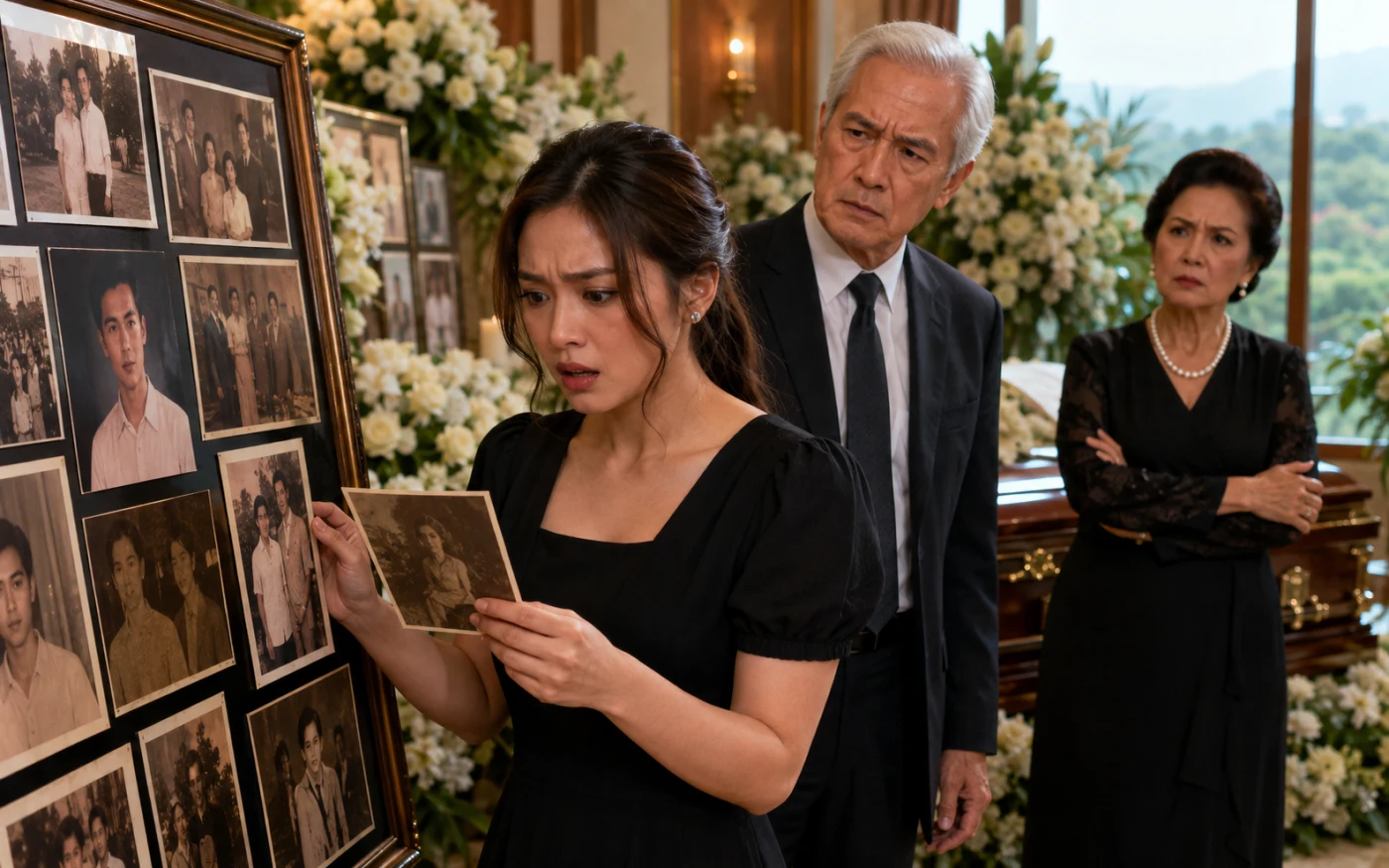
I Was Hired to Play the Dead Man's Granddaughter at His Funeral. Halfway Through, I Realized the Photos on the Memorial Board Were of My Mother...
PART 1: The Perfect Mourner
The day I was hired to play a dead man’s granddaughter, I had forty-three pesos in my wallet and an eviction notice taped to my apartment door.
So yes, I took the job.
“Discreet family engagement,” the message said. “One afternoon. Black dress required. Ten thousand pesos.”
Ten thousand for four hours? I would have pretended to be the dead man’s favorite horse.
The “casting agency” was a polished office in Makati with no posters, no headshots, and no actors waiting in the hall. Just a silver-haired lawyer named Attorney Gabriel Santos.
He glanced at my résumé.
“Mara Reyes,” he said. “Twenty-eight. Theater-trained.”
“Mostly commercials now.”
“What kind?”
“Cold medicine. Instant noodles. Once I played a woman deeply moved by floor wax.”
He didn’t smile.
“This role requires restraint.”
“Sayang. Floor wax is my specialty.”
He slid a photograph across the table.
The man in it was thin and severe, with white hair and eyes that seemed annoyed even in old age.
“Eduardo Villanueva,” Attorney Santos said. “He died on Monday. You’ll attend his funeral as his estranged granddaughter.”
I stopped smiling.
“You’re hiring fake relatives?”
“The family wants the funeral to look complete.”
“Does the family know I’m fake?”
“The relevant people do.”
That answer should have sent me running.
Instead, I looked at the contract. Ten thousand pesos meant rent, groceries, and a few days of not pretending coffee counted as dinner.
“What’s my character’s name?”
“Ana Reyes. Daughter of Eduardo’s youngest child, Celina.”
I looked up. “My surname?”
“A coincidence.”
“And my father?”
“Tomas Reyes. A musician. Deceased.”
My real father had also been named Tomas Reyes.
I gave a little laugh, but it came out wrong.
“Ang weird naman.”
Attorney Santos folded his hands.
“These are common names.”
He kept going. Eduardo had three children: Ramon, Beatriz, and Celina, the youngest, who disgraced everyone by falling in love with a poor musician and disappearing while pregnant.
Then the details piled up.
Celina played piano. So had my mother.
Celina hated papaya. My mother used to drop hers onto my plate.
Celina always tapped the same three notes before she played anything. My mother did too.
“Where did you get these details?” I asked.
“Family records.”
“Did she use sampaguita soap?”
His expression changed.
Just for a second.
“What?”
“My mother did. Kahit mahal, she always bought it. Our whole bathroom smelled like flowers.”
“That isn’t in my notes.”
I stood up.
“This is too strange.”
Attorney Santos stood too.
“Mara, wait.”
“You knew my father’s name. You knew things about my mother.”
“I told you, the names—”
“Are common. Oo, narinig ko.”
I grabbed my bag.
Then he said, “The payment is now twenty thousand.”
I turned. He looked ashamed, which somehow made everything worse.
“Why?”
“Because the family may be difficult.”
“Difficult how?”
“They erased Celina’s name a long time ago. Seeing you may disturb them.”
I should have walked out.
But my landlord had given me three days. My mother’s hospital debt still followed me five years after we buried her. And I had spent my whole life taking roles because somebody else thought my face belonged in their story.
So I signed.
The funeral was at the Villanueva estate in Tagaytay, the kind of place where rich people in teleseryes slapped each other beside fountains.
Attorney Santos met me near the gate.
“You’re late,” he murmured.
“I had to borrow shoes.”
He glanced at my black heels.
“They’re too small.”
“That’s how borrowing works.”
Inside, white flowers covered every table. People spoke in low voices while watching one another with bright, hungry eyes.
Attorney Santos guided me toward a tall woman in pearls.
“Beatriz,” he said, “this is Mara.”
Her face went still.
Not sad. Not confused.
Furious.
“You brought her here?” she whispered.
“She has a right to attend.”
“She is an actress.”
My stomach dropped.
So Beatriz knew.
She looked me up and down as if I had arrived carrying garbage.
“Listen carefully,” she said. “You will sit in the back. You will not speak to reporters. You will not approach my father’s coffin. After the prayers, kukunin mo ang bayad mo, then leave.”
“Fine by me.”
Her mouth twisted.
“You don’t even look like her.”
“Like who?”
But she had already walked away.
I pulled away from Attorney Santos.
“What exactly did you bring me into?”
“Please. Just stay until the will is read.”
“The will? That wasn’t part of the job. Tell me the truth.”
Before he could answer, an elderly woman carrying a tray came through the doorway.
She saw me.
The tray fell.
Cups shattered across the floor.
“Celina?” she gasped.
My heart began pounding so hard I could hear it.
Beatriz rushed forward. “Luning, tama na.”
But the old woman came straight to me. Her shaking hand touched my cheek.
“Hindi,” she whispered. “Her daughter.”
I couldn’t breathe.
Behind her stood a huge memorial board covered in photographs of Eduardo Villanueva’s life.
Eduardo as a young father.
Eduardo beside a green gate.
Eduardo at a piano with a laughing girl on his lap.
And there, in half the photographs, was my mother.
Not someone who resembled her.
My mother.
Young, alive, smiling in the house where her name had supposedly been erased.
PART 2: Who Really Hired Me
I walked straight to the memorial board and tore down the photograph nearest me.
My mother looked about seventeen, wearing the tiny gold sun pendant she had given me before she died.
On the back someone had written, “Celina and Papa, Christmas 1987.”
I slapped the photograph against Attorney Santos’s chest.
“You knew.”
“Yes.”
“You knew she was my mother?”
“Yes.”
The room erupted. Ramon Villanueva, a heavyset man with Eduardo’s angry eyes, shoved through the crowd.
“What is this?”
Beatriz pointed at me. “Gabriel hired an actress to humiliate us.”
“I hired her to attend,” Attorney Santos said. “Her profession was useful, but her identity is real.”
I wanted to throw up.
“You investigated me?” I asked.
“For two years. Eduardo asked me to find Celina. We found her death certificate first.”
My throat closed.
“He knew she died?”
“Five years too late.”
“So you sent me a fake audition?”
“I sent letters first. You returned one unopened.”
“Because it looked like a scam!”
“I knew you would never come here for Eduardo.”
“So you lied to me.”
“Yes.”
“Ginawa mo akong tanga.”
“I brought you here because your grandfather’s family would never have let you through the gate if they knew who you were.”
Beatriz made a sharp sound.
“She is not family.”
The old woman, Luning, spun toward her.
“Don’t you dare.”
Luning grabbed my hand and pulled me toward the coffin.
“Your mother used to sit under that piano,” she told me. “Kapag galit ang papa niya, she played louder. She said no one could shout over Beethoven.”
I laughed before I could stop myself.
My mother had done the same thing in our tiny apartment. Whenever the neighbors fought, she attacked our broken keyboard until the walls shook.
Luning looked at me with wet eyes.
“She waited for him.”
Beatriz stepped between us.
“That’s enough.”
“No,” I said. “Hindi pa sapat.”
I faced her.
“Why did my mother leave?”
“She chose your father.”
“That’s not an answer.”
“It is the only answer you need.”
Ramon frowned at his sister.
“You told us Celina refused to come home,” he said.
“She did.”
Luning shook her head.
“Sinungaling.”
Beatriz slapped her.
I grabbed Beatriz’s wrist before she could strike again.
“Touch her one more time,” I said, “and I’ll forget I was hired to show restraint.”
For the first time, Beatriz looked afraid.
Attorney Santos held up a bundle of envelopes tied with blue ribbon. “These were found behind a drawer in Beatriz’s writing desk.”
Ramon took one addressed to my mother.
Celina Villanueva Reyes. Return to sender.
Another was addressed to Eduardo in handwriting I knew from birthday cards and notes beside our phone.
Papa, please let me come home.
My knees nearly gave way. There were dozens. Beatriz had hidden all of them.
“For thirty years,” Attorney Santos said, “Eduardo believed Celina rejected every attempt at reconciliation. Celina believed her father refused to answer.”
Ramon turned on his sister.
“Bakit?”
Beatriz’s mouth trembled.
Then she laughed.
A hard, ugly little laugh.
“Because she always won.”
“She could scream at Papa, disobey him, embarrass him, and still be his favorite. I stayed. I did everything right. Ako ang nag-alaga. Ako ang naiwan. But every letter he wrote was for her.”
“So you stole them?” I said.
“I protected this family.”
“You stole my mother’s father.”
“She stole mine first!”
For one second, she looked like a child in pearls. Then she straightened.
“Don’t pretend Eduardo was innocent. Your mother came back once.”
Attorney Santos frowned. “What?”
Beatriz looked at me. “She stood in this room with a little girl in her arms. Your grandfather saw both of you.”
My skin went cold.
“You were five,” Beatriz said. “You cried because you wanted to touch the piano.”
A memory flashed through me: a green gate, rain on my mother’s hair, my small hand against cold glass.
Beatriz leaned close.
“Your mother begged him to open the door.”
I could barely force out the words.
“What did he do?”
Her smile was merciless.
“He turned his back.”
Then Attorney Santos looked toward the coffin and said, “That is not what Eduardo told me.”
PART 3: What Happened at the Door
Attorney Santos removed a small recorder from his briefcase. “Eduardo made this three weeks before he died.”
Beatriz lunged for it. Ramon caught her.
“Bitawan mo ako!”
“No. Tapos na, Bea.”
Attorney Santos pressed play. My grandfather’s weak voice filled the chapel.
“If Mara Reyes is in this room, then Gabriel’s terrible plan worked.”
Attorney Santos stared at the floor.
“I owe you the truth,” Eduardo continued. “Not the version that makes me easier to forgive.”
“Celina came home during a storm. I saw her from the upstairs landing. She held a little girl wearing a yellow raincoat.”
My breath caught. I remembered that raincoat. My mother had kept it long after I outgrew it.
“I wanted to run down,” he said. “But pride is a cruel thing. It makes cowards feel powerful. I told myself she should enter first. She should apologize first.”
“By the time I reached the door, Beatriz had sent her away.”
Beatriz shook her head wildly.
“He’s lying.”
“No,” Luning said. “I saw him run outside. Barefoot. Sumisigaw siya sa ulan.”
“I drove after them, but they were gone. The next morning, Beatriz told me Celina had said she never wanted to see me again. I believed what allowed me to stay angry.”
I pressed my fist to my mouth.
My mother had never told me.
Not once.
“She protected you,” Eduardo said, as if answering me. “She did not want your childhood filled with our ugliness. When I finally found her letters, it was too late to ask her pardon.”
“I will not ask you to love me, Mara. I will not ask you to mourn me. But stand beside your mother’s photograph once. Say her name in this house. That is the inheritance I have no right to give and the debt I cannot pay.”
The recording clicked off.
Beatriz said, “A performance. Convenient, now that he’s dead.”
“You’re right about one thing. This whole funeral is a performance.”
I kicked off the borrowed shoes cutting my feet and walked to the front of the chapel.
Beatriz hissed, “What are you doing?”
“The job you paid for.”
“I did not pay you.”
“No. Your father did.”
I stood beside Eduardo’s coffin.
“My name is Mara Reyes. I was hired to pretend I belonged here. I was given lines, told where to sit, and how much sadness to show.”
I held up my mother’s photograph.
“But nobody had to teach me this woman.”
My voice shook.
“Her name was Celina Villanueva Reyes. She called herself Lina because the old name hurt too much. She played piano when she was angry and sang while frying bangus, kahit sintunado siya.”
Luning laughed through her tears.
“My mother worked two jobs. She clapped the loudest even when I had one line. When cancer took her hair, she told everyone she finally had the cheekbones for it.”
“She kept a yellow raincoat in a box for twenty-three years.”
Beatriz lowered her eyes.
“She should have been in these photographs. She should have been invited through that door. She should have heard her father call her anak one more time.”
I placed her photograph beside Eduardo’s.
“So if this family wants a beautiful funeral, here is the truth that ruins it.”
I looked at Beatriz.
“Celina came home.”
Ramon moved first, placing one of the hidden letters beneath my mother’s photograph. Luning added the gold rosary from her pocket.
A young woman stepped forward with a white rose. “I’m Isabel,” she whispered. “Ramon’s daughter.”
My cousin.
She laid the rose beside my mother. Then other relatives followed with flowers, letters, and photographs from their wallets—tiny proof that my mother had not vanished as completely as Beatriz wanted.
“Stop this,” Beatriz said from the doorway.
Ramon stepped between her and the memorial board. “No. You stopped her long enough.”
Beatriz looked around the room. Nobody moved toward her. She turned and walked out.
Attorney Santos approached me with an envelope.
“Your payment.”
I took out the contract, tore it in half, and laid it on Eduardo’s coffin.
“I’m done acting.”
“The money is still yours,” he said.
“Give it to Luning for the cups.”
Luning clicked her tongue.
“Twenty thousand for cups? Aba, gold ba iyon?”
The room laughed.
Not politely.
Really laughed.
At the worst, strangest funeral I had ever attended.
Then Luning shoved the envelope back into my hands. “Pay your rent. Cups lang iyon.”
This time, I kept it.
Then Isabel sat at the piano.
“Did Tita Celina have a favorite song?” she asked.
I told her.
Her fingers found the melody slowly. Luning began singing under her breath. Ramon joined, badly. Then others followed.
I couldn’t sing at first.
My throat hurt too much.
But Isabel looked over at me and patted the empty space on the piano bench.
“Halika, pinsan.”
Cousin.
Just one word, offered without a test.
I sat beside her and tapped out the same three notes my mother always played before she began.
As the song filled the house, I looked at the memorial board. My mother’s photograph now rested at its center, surrounded by white roses and thirty years of opened letters.
I touched the little gold sun at my neck.
“Ma,” I whispered, “nakapasok na tayo.”
Then I sang with my family.