
My House-Sitting Client Has a Shrine to Me in Her Closet. She Says She's My Mother.
PART 1: The Unlocked Closet
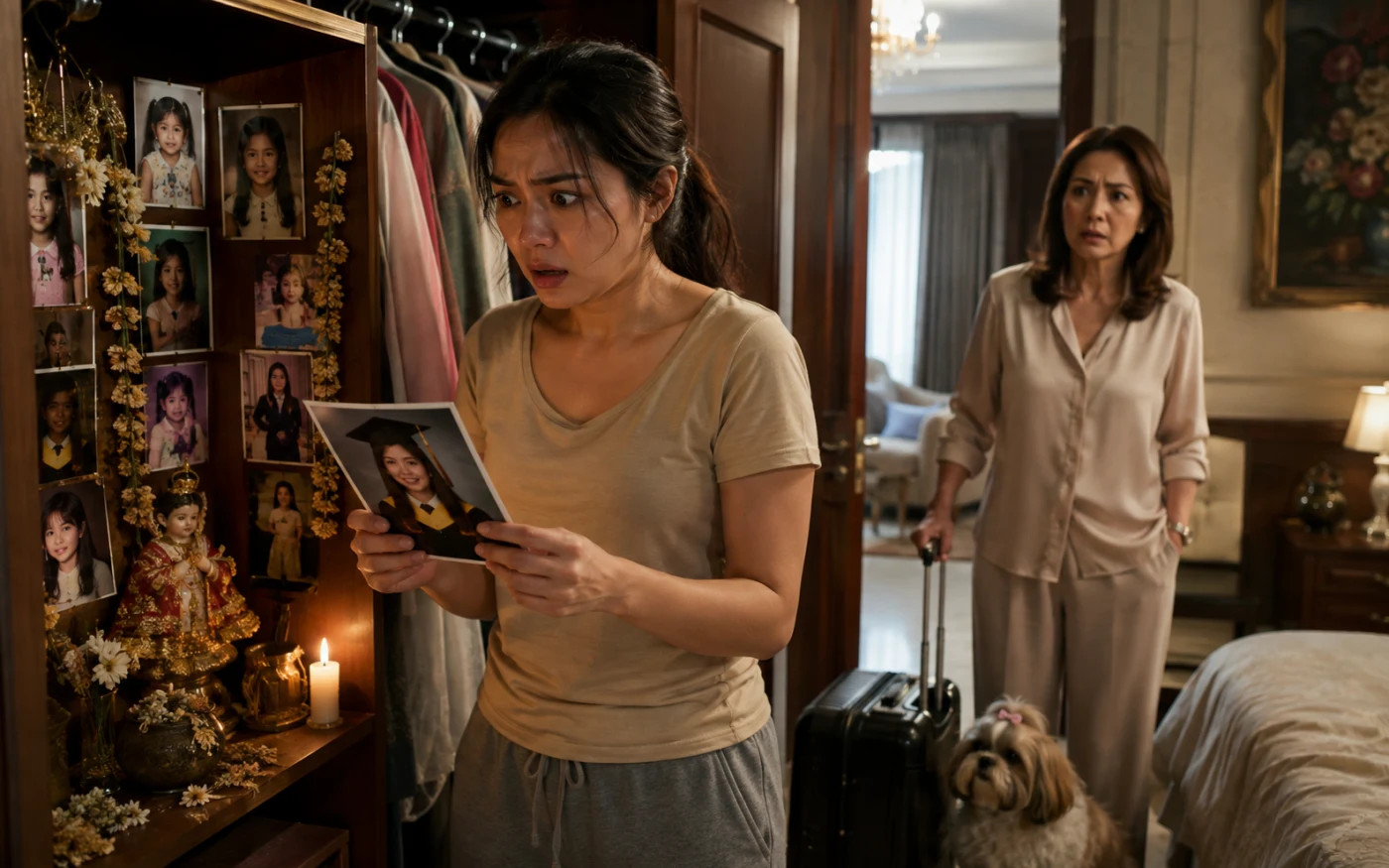
I found my own graduation picture inside a stranger's closet.
Not a copy from Facebook.
The actual photograph.
It still had the tiny coffee stain in the corner from the day Mama cried over it at Jollibee.
I was standing there holding it when the bedroom door opened behind me.
“Gina,” my house-sitting client said. “I can explain.”
Her name was Camille Vergara. Late forties. Elegant. Quiet. The kind of woman who wore pearl earrings while taking out the trash.
I had been staying in her enormous house in an expensive subdivision for six days, feeding her spoiled shih tzu, Bruno, while she visited Singapore.
The job came through a house-sitting agency. Good pay. Free food. Air-conditioning so cold I slept under two blankets. My only strange instruction was this:
“Please don't open the closet in the blue guest room.”
Of course I had no plan to open it. I was thirty-one, not twelve.
Then Bruno chased a lizard into that room. He hit the closet door with his fat body, and it swung open.
It had never been locked.
At first I saw candles. Dried sampaguita. A tiny Santo Niño. Then I saw the photographs covering the entire back wall.
Me at seven, missing both front teeth.
Me in a yellow costume at a school program.
Me at my college graduation.
Me crying beside Papa's coffin.
My stomach turned.
Some pictures belonged to our family albums. Others had been taken from far away.
In one, I was drinking iced coffee outside a café three months earlier.
I remembered that afternoon because I had spilled syrup on my white blouse.
Under the photos sat a plastic box labeled REGINA in careful black letters.
Inside were newspaper clippings, old report cards, a ribbon from my high school, and a hospital bracelet from 1994.
The bracelet said BABY GIRL MANALO.
My mother's maiden name was Manalo.
My knees went weak.
That was when Camille walked in, two days early, still pulling a small suitcase behind her.
She looked at the open closet. Then at the bracelet in my hand.
She didn't scream. She didn't accuse me of snooping.
She simply closed her eyes.
“How long?” I asked.
“Gina—”
“How long have you been following me?”
Bruno squeezed between us and wagged his tail, delighted that his mother was home.
I wanted to be angry at him too, but his tongue was hanging out sideways.
Camille lowered herself onto the bed. Her perfect hands were shaking.
“I wasn't in Singapore,” she said. “I stayed at a hotel nearby. I thought if you spent time here, maybe you would feel comfortable with me before I told you.”
I laughed once. It sounded ugly.
“You hired me to sleep in your house while you watched from a hotel?”
“I didn't watch you here. I swear.”
I pointed at the café photograph. “Then who took that?”
She looked ashamed. “A private investigator.”
I grabbed my bag.
She stood so quickly that Bruno barked.
“Please. Isang minuto lang. I have tried to approach you so many times. At your graduation. At your father's wake. At that café. Every time, I lost my courage.”
“So you built a museum?”
“It wasn't meant to be a shrine.”
There were candles.
“It has a saint, Tita.”
Her mouth trembled at the word Tita.
Then she said the sentence that broke the floor beneath me.
“I am not your tita. I am your mother.”
For a few seconds, I heard nothing except Bruno chewing the wheel of her suitcase.
“My mother is Lourdes Mercado,” I said.
“Lourdes raised you. She loves you. I will never deny that.”
Camille pressed one hand to her chest. “But I gave birth to you on August 18, 1994, at St. Martha's Clinic. You had a dark patch of hair behind your left ear. You still have the mark on your shoulder.”
My hand flew to that shoulder.
Nobody could see that birthmark unless I wore a swimsuit.
Camille began crying silently.
“I was seventeen. My father decided everything. I was told you would have a safe life, and I would destroy it if I came near you. But I looked for you anyway. I found you when you were six.”
Six.
The age in the first photograph.
I ran out of the room so fast I forgot my slippers.
I drove barefoot to Mama's house with Camille's hospital bracelet digging into my palm.
Mama answered on the third ring.
“Anak? Why are you calling? Kumakain ka ba diyan?”
“Who is Camille Vergara?”
Silence.
Not confusion.
Silence.
When Mama finally spoke, her voice had changed.
“Where are you?”
“On my way to you.”
“Do not bring her here.”
“She says she's my mother.”
Mama breathed in sharply.
“She told you the pretty version,” she said. “Now come home. I will tell you what she did in 1994.”
PART 2: What Happened in 1994
Mama was waiting beside our dining table with a rusty biscuit tin I had seen all my life.
When I was little, she told me it contained Papa's tax papers.
It did not contain tax papers.
It contained my life.
There was a newborn photograph of me wrapped in a faded green towel.
A clinic bill. Adoption papers. Three returned letters.
And one picture of Mama, much younger, standing beside Camille. On the back, Papa had written: Lourdes and Camille, 1993.
They had the same eyes.
“You're sisters,” I whispered.
“My half sister,” Mama said. “Seventeen years younger than me.”
I sat down hard.
Mama had told me my birth mother was a frightened teenager from another province who died when I was five. Papa and Mama had adopted me privately, she said, because my birth mother's family wanted no contact.
Almost every piece was a lie.
“Why?” I asked.
“Because I was afraid, anak.”
“Of her?”
Mama looked straight at me. “Of losing you.”
In 1994, Camille was seventeen and pregnant by a twenty-four-year-old boyfriend who disappeared the moment their father found out.
Lolo Manalo hid her at Mama and Papa's small house until she delivered.
Mama and Papa had been trying to have a child for nine years.
“Camille chose us,” Mama said.
“Your grandfather pressured her, yes. But she chose us too. She held you and said, ‘Ate, give her the life I cannot.’ She signed the first papers after six weeks.”
That was already different from Camille's story.
Then Mama unfolded a yellowed police report.
When I was four months old, Camille climbed through our kitchen window while Mama was hanging laundry on the roof.
She took me from my crib, wrapped me in a blanket, and headed for the bus terminal.
“She wanted to run away with you,” Mama said. “She had no money, no milk, nothing but two dresses in a plastic bag.”
Mama noticed the open window and raced through three streets in house slippers.
Papa called the police.
They found Camille on a bus bound for Baguio, holding me while I screamed from hunger.
“I did not press charges. Bata lang siya.” Mama's lips tightened. “But after that, your grandfather sent her to relatives in California. She wrote to me. I returned every letter.”
“You told her I was dead?”
Mama flinched.
I had guessed from the envelopes. Each had RETURN TO SENDER written in Mama's handwriting. Across one, in angry red ink, were the words: THE BABY YOU KNEW IS GONE.
“I meant gone from her life,” Mama whispered.
“And you told me she died.”
“I thought a clean wound would hurt less than an open one.”
I stood up so fast the chair scraped the floor.
“You don't get to call a lie clean.”
Mama's face crumpled, but I was too angry to comfort her.
All my life, Mama had been the safe place.
She knew when I was pretending not to have a fever.
She sold her earrings when my tuition increased.
After Papa died, she slept with the hallway light on because I hated entering a dark house.
But she had also looked into my face for thirty-one years and buried a living woman.
“Did she ever come back?” I asked.
Mama stared at the biscuit tin.
That was another answer.
Camille returned when I was six. She stood outside my school during dismissal.
Mama saw her before I did and threatened to call the police.
“She took the picture of me with missing teeth.”
Mama nodded.
“And the graduation photo?”
“I sent it.”
My anger stopped moving. “What?”
After Papa became sick, Mama quietly resumed contact with Camille.
She sent updates but refused to give her our address.
At my graduation, Camille stood at the back of the auditorium.
At Papa's wake, she left flowers before dawn.
“You let her watch me from corners,” I said, “but not speak to me?”
“I kept thinking I would tell you after the next birthday. Then after graduation. Then after Papa recovered.” Mama wiped her cheeks. “Then he didn't recover, and I could not bear another loss.”
I wanted to shout. I wanted to hug her. I did neither.
My phone rang.
Camille.
I answered and put it on speaker.
“Gina, please tell me you're safe.”
Mama's back became stiff.
“I'm with Mama,” I said.
Camille went quiet.
“She showed me the police report.”
“Then she should show you the last page.”
Mama grabbed for the papers, but I moved first. The last page had been folded under the others.
At the bottom was Camille's statement.
I read one sentence aloud.
“Lourdes Mercado told me to take my baby tonight or I would never see her again.”
I looked at Mama.
“Did you?”
Before she could answer, someone knocked at the front door.
Three slow knocks.
Mama went pale.
Camille's voice came through the phone and through the door at the same time.
“Gina,” she said. “I came to tell you what both of us have been hiding.”
PART 3: Why They Both Lied
I opened the door.
Camille stood there holding my forgotten slippers.
Even furious, I almost laughed. Imagine discovering your secret birth mother and she still arrives saying, “Anak, you left your tsinelas.”
“Come in,” I said. “But nobody leaves until I hear the truth.”
The two women sat across from each other at the dining table. Same eyes. Same stubborn chin. Neither would look at the other.
I placed the hospital bracelet between them.
“Start with the bus.”
Camille spoke first.
She had signed the adoption papers, but she said she had not understood that the decision was final.
Their father had told her she could visit anytime.
Mama had told her visits would only confuse me.
The night before the bus, Mama gave her an ultimatum: leave me alone forever or take me and survive without the family.
“I chose you,” Camille said.
“But I had no plan. Ate Lourdes was right about that. By the time the police found us, you were burning with fever. I was so scared I could not even remember the address of the clinic.”
Mama's anger cracked.
“You were seventeen,” she said softly.
“And you were my sister. You knew I would fail.”
Mama covered her mouth.
There it was. Not one monster. Two frightened women making permanent decisions in one terrible year.
Mama admitted she had wanted Camille to take me that night because she believed Camille would return within an hour.
Then Mama could stop feeling like a thief.
Instead, Camille reached the terminal.
When the police brought us back, I stretched my arms toward Mama.
Camille saw it.
“You called her Mama,” Camille whispered. “That was when I signed the final consent. Not because I stopped loving you. Because you already loved her.”
Mama began to sob.
Camille's own lie was simpler.
She had told me she gave me up at birth because the full truth made her look reckless.
She had also hidden the private investigator, the secret photographs, and the fact that Mama had sent half the pictures in that closet.
“I was ashamed of the bus,” she said. “Then I became ashamed of waiting. Every year made the next year harder.”
“So you hired me?”
She nodded. “The agency showed me your profile by chance. I thought it was a sign.”
“It was a background check, not the angel Gabriel.”
Mama made a wet, surprised sound that was almost a laugh.
Good. I needed them both uncomfortable.
I told Camille the shrine frightened me.
I told Mama her lie had stolen my chance to decide.
Then I said the words that had been growing in my chest since I opened that closet.
“You both keep talking about who gets to be my mother. Nobody asked what I want.”
They went silent.
“Mama raised me. That does not disappear.” I looked at Camille. “You gave birth to me. That does not disappear either. But love does not give either of you permission to manage my life from behind a door.”
Mama reached for my hand, then stopped herself.
For once, she waited.
I took her hand.
Then I looked at Camille.
“I don't know what to call you yet.”
“Camille is enough,” she said quickly.
“And no more investigators. No secret pictures. No surprise jobs.”
“Never again.”
“I want the closet taken down tonight.”
That was how the three of us ended up back at Camille's house at ten in the evening, peeling thirty-one years of my face off a wall.
It was awkward. Painful. Sometimes ridiculous.
Mama found a picture of me asleep during my high school retreat and snapped, “Where did you get this?”
Camille pointed at her.
“You mailed it to me.”
Mama studied the photo. “Ah. Yes.”
I laughed so hard I had to sit on the floor.
We placed the family photographs in albums.
The secret café pictures went through the shredder.
Camille handed me the hospital bracelet and every letter she had saved.
Then she reached behind the Santo Niño and brought out one last envelope.
Inside was a photograph I had never seen.
Camille was seventeen, exhausted and smiling, with newborn me on her chest.
Mama sat beside her on the clinic bed, one arm around both of us. All three of our faces were swollen from crying.
On the back, Papa had written: Our girls. August 18, 1994.
Nobody had been cut out.
Nobody had been hidden.
“Can I keep this?” I asked.
Camille nodded, crying again.
Mama wiped her own eyes and said, “At least make a copy. Akin din iyon.”
Same eyes. Same chin. Same nerve.
I set my phone on a shelf and turned on the timer.
“Come here,” I told them.
Mama stood on my right. Camille stood on my left, careful not to touch me until I hooked my arm through hers.
The first picture caught all of us looking terrified.
The second caught Mama ordering Camille to fix her hair.
The third caught me laughing between them.
I printed that one the next morning.
It is the only photograph hanging in Camille's closet now.
No candles. No dried flowers. No secrets.
And the door stays open.