
A Bride Brought Me a Vintage Gown for Alterations. It Was Stolen from My Family's Shop in 1994 — the Night My Sister Disappeared...
PART 1: I Knew That Hem
The bride had barely unzipped the garment bag when I stopped breathing. Not because the dress was beautiful.
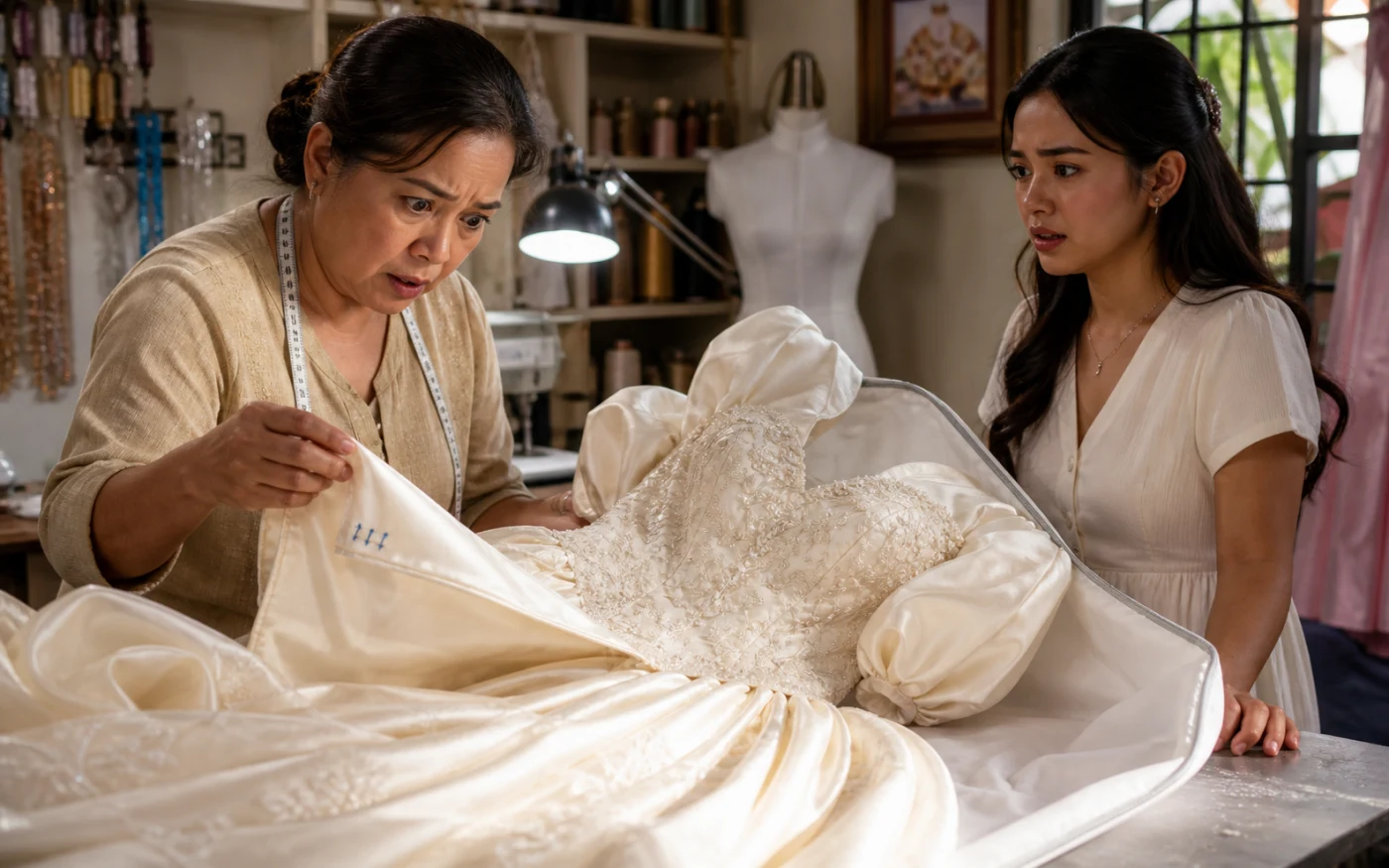
It was: ivory silk, hand-beaded bodice, cathedral train, enormous 1990s sleeves that had somehow become expensive-looking again.
I stopped breathing because I had sewn one corner of that train myself when I was sixteen. And that gown had been stolen from my family's bridal shop in 1994.
The same night my older sister disappeared.
"Ma'am?" the bride said. I realized I was gripping my counter. Her name was Danielle Salazar—Dani—and she had come into my little alterations shop in Marikina carrying the dress like a sleeping baby.
"My lola kept it," she said. "She told me if I ever got married, only you should alter it."
"Me?" She nodded. Behind her hung a framed photo of my parents' old store in Cubao.
DE VERA BRIDAL HOUSE. Established 1978. Closed 1995. One year after my sister Mila vanished.
I forced myself into seamstress mode. "Bust needs letting out. Waist can come in. Sleeves?"
"Gone. I love my lola, but I don't want to marry wearing curtains." I almost laughed. Then I turned over the train.
Three tiny blue stitches hid under the left corner. One long. Two short. Mila's signature.
Mama taught us never to use blue thread on ivory. Naturally, Mila used it whenever she could. "Para may sikreto," she would whisper.
So there's a secret.
The last time I had seen those stitches, Mila was nineteen, sitting cross-legged on our shop floor at nearly ten at night. I was sixteen. Papa was upstairs. Mama was steaming veils. Our uncle Ramon—Papa's younger brother and business manager—was arguing with someone in the stockroom.
Mila looked at me and said, "Rose, if I tell you something, can you keep your mouth shut for once?"
I threw a pin cushion at her. She laughed.
That was the last time I heard my sister laugh.
The next morning, the gown was gone. So was sixty thousand pesos from the payroll envelope. So was Mila.
Uncle Ramon said he had seen her leave through the back door carrying a garment bag. Papa called her a thief before breakfast. By Sunday, half our relatives had improved the story. Mila had a married boyfriend. Mila was pregnant. Mila fled to Hong Kong. Mila joined a cult.
Nobody knew anything. But everybody enjoyed knowing it.
Mama would only say, "Your ate had reasons." Reasons. What kind of reason makes you leave your little sister waiting beside the telephone for years?
I looked at Dani. "Who is your lola?" "Ester Salazar."
My stomach dropped. Ester Mercado. Mila's friend. Big earrings. Loud laugh. Always bringing pancit to the shop. After Mila disappeared, Ester disappeared from our lives too.
"Where did your lola get this gown?"
Dani's smile faded. "She said it belonged to a friend."
"This dress was stolen from my parents' shop."
Her face went pale. I showed her the old label. "My mother did the beadwork. My sister hemmed the train. She disappeared the night this disappeared."
Dani stared at the gown. Then she grabbed her phone.
She called her lola once. No answer. Twice. Nothing. On the third try, an old woman picked up.
"Lola?" A pause. Then Ester's voice came through.
"Did Rose see the blue stitches?"
Dani whispered, "Lola... what did you do?"
Ester breathed into the phone. Then she said six words that split my life in half.
"Tell Rose to open the hem."
PART 2: It Was Still Inside
I locked the shop. Dani flipped the sign to CLOSED. The gown lay across my cutting table between us.
"Open it," she said.
"Your wedding is in nine days."
"I think the sleeves can wait." Fair.
I slid my smallest seam ripper beneath Mila's blue stitches. Under the silk was the original lining. Under that was a strip of muslin. And sewn inside the muslin was something hard. Small. Rectangular. Wrapped in yellow plastic.
A microcassette.
Dani said, "What the hell?"
On its label, Mila had written one letter in blue pen. R.
We had no player. It was 2026. I barely owned anything that could play a CD. Dani called her fiancé. Paolo arrived twenty minutes later carrying an old Panasonic recorder. "My dad never throws electronics away," he said. "Today, finally, he is a genius."
The cassette squealed. Static. Then Mila's voice. Thirty-two years vanished in one second.
"Kuya Ramon, ibalik mo 'yan."
My whole body went cold. Uncle Ramon answered.
"Don't tell me what to do."
"That's payroll."
"I'll replace it."
"You already took from the supplier envelope."
Silence. Then Ramon said, "Watch your mouth."
Mila's voice shook. "You blame me because Papa believes you."
A chair scraped. Then Ramon said the sentence my family had spent three decades living inside.
"If that money is missing tomorrow, who do you think he'll blame? Me? Or the girl who's been talking about leaving?"
Dani covered her mouth.
Mila said, "I have proof now."
A slap cracked through the recorder. I made a sound I didn't recognize.
Then Ramon whispered, "You tell anyone, I'll say you stole the dress too. Your father will believe me before he believes you."
The tape cut off. Nobody spoke. Paolo rewound it. We listened again. At the very end, faint beneath the scuffling, came my mother's voice. "Mila?"
I called Ramon. He was eighty now, wealthy, respected, owner of three fabric warehouses. People called him Sir Ramon. Apparently if you steal enough payroll, eventually people add "Sir."
He answered. "Rose?"
"I found the dress."
Silence. Not confusion. Silence.
"I found what Mila sewed into the hem."
He hung up.
Ten minutes later, my relatives began calling. One cousin texted: PLEASE DON'T SPREAD OLD MISUNDERSTANDINGS. Another: THERE ARE LEGAL IMPLICATIONS. Beautiful. Nobody had heard the tape, but everybody had discovered law.
Then Ester called back. I didn't say hello. "Where is my sister?"
"Alive," she said. One word.
I stood so fast my chair fell. "Where?" "Vancouver."
Ester told me what happened after the recording stopped. Mama found Mila in the stockroom with a split lip. Mila showed her the recorder and told her Ramon had been stealing for months. Mama believed her.
But Papa worshipped his brother, and Mila was already fighting with him about leaving the shop to study nursing.
So Mama panicked. She called Ester. Before dawn, Ester's family hid Mila in a delivery van headed south.
Mila left the gown with Ester, afraid to travel with the only evidence she had.
After Mila escaped, Ramon planted the empty payroll envelope in her locker.
"Why didn't Mama tell me?" I asked.
"She planned to."
Then Mama had her stroke three months later. She survived, but much of her speech never returned. The shop failed. Papa became bitter. And Mila became the family criminal because the truth required sentences Mama could no longer build.
"She could have written," I said.
Ester went quiet.
"Rose. She did."
I couldn't speak.
"She wrote to you for years. Some letters came back opened."
Uncle Ramon handled our shop mail. Mila had tried calling too. Papa answered once and told her I wanted nothing to do with her. After that, she believed I had chosen the family story over her. I sat down slowly. Ramon hadn't just taken money. He had stolen every chance for us to find each other.
Then Ester said, "There's another problem." At this point, why not.
"What?"
"Ramon is one of Dani's principal sponsors on Saturday."
Dani nearly dropped her phone. "Lola!" "Your father invited him. Business connection."
Dani looked at the opened gown. At the cassette. Then at me. "He is not standing behind me while I get married in your sister's dress."
Her phone buzzed. Unknown international number. A message appeared.
ROSE? THIS IS MILA.
I HAVE A FLIGHT.
DON'T FIX THE BLUE STITCHES YET.
PART 3: The Ballroom Doors Opened
For nine days, I altered the gown. I removed the sleeves. Took in the waist. Rebuilt the lining. And under the left corner of the train, I put back three blue stitches. One long. Two short. Para may sikreto.
Except this time, the secret was done hiding.
Mila and I spoke every night before the wedding. The first call lasted three hours. The first ten minutes were crying. Then anger. Then both of us talking too fast.
She had become a nurse in Canada. She had a son and two grandchildren. She had spent decades believing I had read her letters and chosen Papa's side. I had spent decades believing she had stolen from us and chosen never to come home.
Saturday arrived hot and bright. Dani's reception was in Quezon City, only a few kilometers from where our old shop once stood. I helped her into the gown. When the silk settled, she started crying.
"Too tight?" I asked.
"No."
"Then stop. Your makeup artist will murder us." She laughed. Then she touched the train. "Thank you for letting me wear it."
For thirty-two years I thought this gown was the thing Mila stole. Now I knew it was the thing she trusted to keep the truth safe.
"Make it worth the trouble," I said.
"Oh, I plan to." That should have warned me.
The ceremony went beautifully. Nobody fainted. Nobody objected. The groom remembered his vows. Suspiciously efficient.
Then came the reception. Ester sat near the front in a wheelchair, wearing pearls and the expression of a woman who had waited thirty-two years to stop being afraid.
Uncle Ramon arrived late. White barong. Gold watch. Cane he did not need. He kissed cheeks like a senator. Then he saw me. Then the gown. His face emptied.
Dinner passed. Speeches began. Finally the emcee announced, "And now, one of our principal sponsors, Mr. Ramon De Vera—"
Ramon stood. So did I. My husband grabbed my wrist.
"Rose."
"I am only standing."
"You are standing like someone about to commit a felony." Fair.
But before Ramon reached the microphone, Dani stepped in front of him. In the stolen gown. "Ninong Ramon," she said sweetly, "before you give us marriage advice, my lola says there's someone you should greet."
The ballroom doors opened.
Mila walked in.
I had seen her on video all week. It didn't matter. On a screen, she was information. Walking through those doors, she became my sister again. Short silver hair. Dark blue dress. The same crooked smile she had at nineteen.
Ramon dropped his cane. Nobody moved. Mila walked all the way to him.
"Kuya," she said.
His mouth opened. Nothing came out. She held up the microcassette.
"You remember this?"
The room exploded in whispers. Phones appeared everywhere. Some auntie said "Ay, Diyos ko" so loudly I thought the chandelier shook. Ramon recovered.
"That recording is ancient. Anyone can fake—"
"Good news," Dani said. "My fiancé digitized it."
Paolo pressed a button. Ramon's thirty-two-year-old voice filled the ballroom. "If that money is missing tomorrow, who do you think he'll blame? Me? Or the girl who's been talking about leaving?"
Ramon lunged toward the sound table. He got three steps. Then Ester rolled her wheelchair directly into his path. Eighty-six years old, arthritis in both hands, blocking him like an NBA center. He stopped so fast he almost fell over her.
Ester looked up. "You scared us when we were young," she said. "Try it now."
Dead silence.
Then Ramon turned to me. "Rose, you don't understand."
There it was. The sentence guilty men save for the moment everybody finally understands. I walked past him. Not toward the microphone. Toward Mila.
For thirty-two years, I had planned what I would say if I saw her again. I had angry speeches. Sad speeches. Questions. Instead, I slapped her arm.
Not hard.
"Aray!"
"You could have called another way!"
"I tried!"
"Thirty-two years, Ate!"
"I KNOW!"
Then she grabbed me. I grabbed her. And suddenly we were laughing and crying so hard neither of us could stand properly.
The ballroom disappeared. I felt her hand at the back of my head. The same hand that used to braid my hair badly before school.
"Rose," she whispered. "I'm sorry."
I pulled back.
"No. Later. We have thirty-two years to fight about. Later."
Behind us, somebody started clapping. Then another. Then the whole room.
Dani was crying too, destroying the makeup I had specifically warned her about. Her train had twisted around her shoes. She held out both hands to Mila. "Tita," she said, "before anyone removes anyone from this reception... will you fix my train?"
Mila stared at her. Then at me. I crouched on one side of the ivory silk. Mila crouched on the other. Just like we used to on the floor of our parents' shop.
She found the three blue stitches immediately. One long. Two short. Her fingers stopped. Then she looked at me.
"You kept them."
"Of course."
Mila smiled. That crooked nineteen-year-old smile.
And together, while the bride laughed above us, my sister and I lifted the stolen gown off the floor.