
Lola Left the House to "Whoever Finishes My Crossword." It Has 1,400 Clues and She Wrote It Herself.
PART 1: The One-Line Will
My grandmother left her house to whoever could finish her crossword.
I thought the lawyer was making a cruel joke.
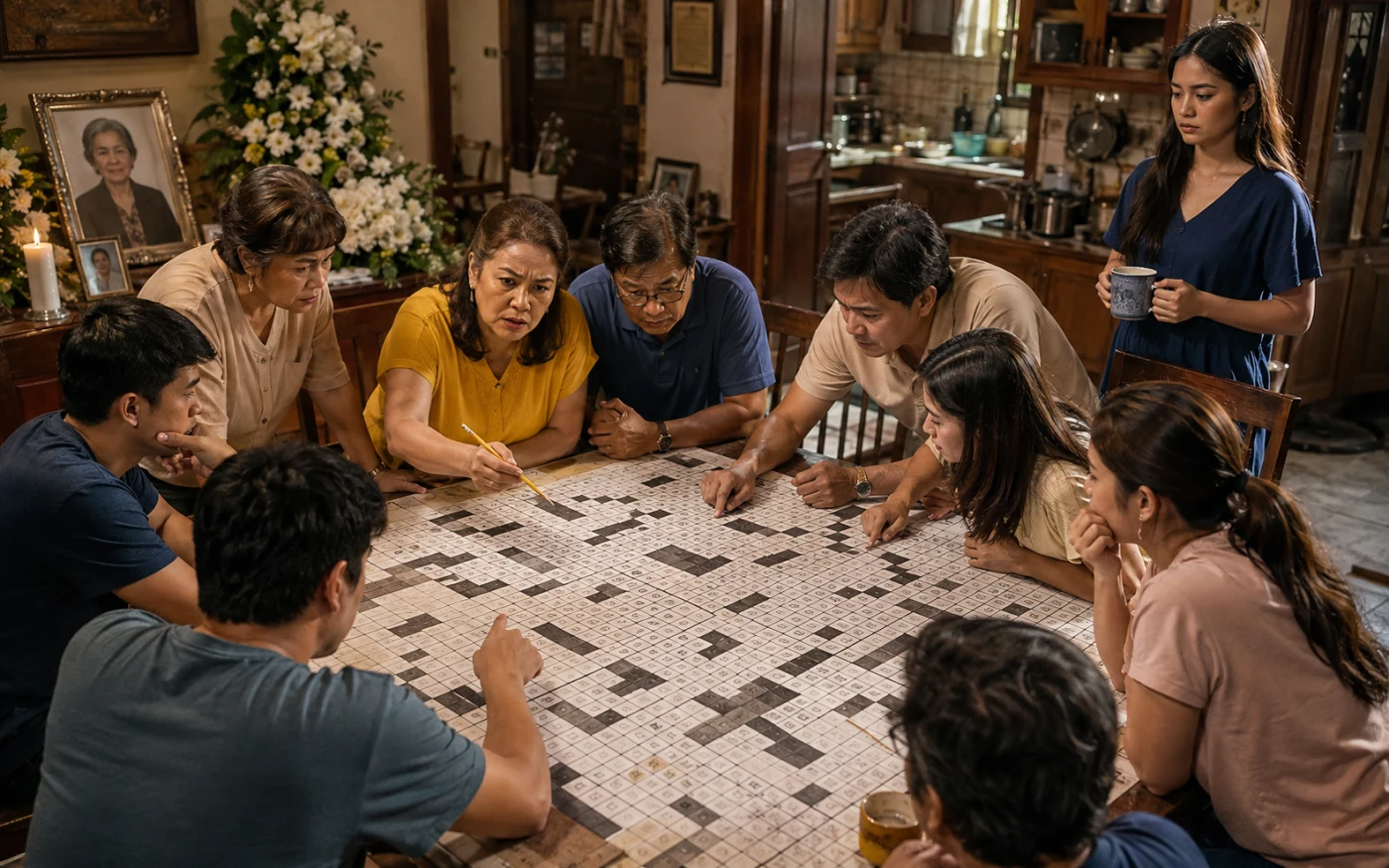
Then he unrolled the puzzle across Lola Soledad's dining table, and all twelve of us stopped breathing.
The paper covered the whole table.
Lola had taped together sheets of graph paper and drawn every black square by hand.
Her tiny writing ran along the margins in four neat columns.
There were 1,400 clues.
Every single one was about us.
The will itself was one sentence: “My house at 18 Sampaguita Street shall belong to the first member of my family who correctly completes my crossword.”
The rules in the envelope made the competition even worse: there was only one official grid. Anyone could enter an answer, but the house went to whoever entered the final correct one.
My aunt Celia grabbed the clue pages before the lawyer had finished speaking.
“Mama wanted me to have the house,” she said. “This is just her way of making it interesting.”
Nobody challenged her at first.
Tita Celia had spent thirty years calling herself Lola's favorite.
Her framed graduation portrait hung above the television.
Lola wore the pearl earrings Celia gave her every Sunday.
Celia had also paid for the new roof, and she reminded us of that before we even opened the envelope containing the rules.
I stood by the kitchen doorway holding Lola's old blue mug.
I was still expecting to hear her slippers scrape down the hall.
My name is Leni. I am the granddaughter who lived ten minutes away and came whenever Lola called because the faucet was dripping, her phone had changed languages, or she wanted pandesal from one particular bakery across town.
Nobody called that important.
Least of all me.
The house was small, old, and suddenly worth enough money to make kind people behave badly.
By noon, three camps had formed.
Tita Celia claimed the dining room with her daughters.
Tito Boy set up in the living room with two cousins and a whiteboard.
My cousin Marites locked herself in Lola's bedroom because she said memories came to her better in private.
I took the corner of the kitchen table that the giant puzzle did not cover.
The early clues looked easy.
“Six down: Soledad's eldest child's first word.”
“Milk,” Celia announced.
“Wrong,” Tito Boy said. “It was Papa.”
Their older brother, Uncle Rene, quietly wrote “truck.”
The letters fit.
Then came first cars, confirmation names, childhood streets, wedding songs, report-card disasters, and the exact dish Lola cooked when somebody had a broken heart.
People began bargaining.
“I'll give you 188 across if you tell me 74 down.”
“No. That birthday is worth three answers.”
By evening, family photographs had been pulled from albums. Drawers were emptied. Old Christmas cards lay across the floor like evidence.
Marites's husband, Dennis, took pictures of every clue and fed them into a crossword app.
It gave up on “The name Soledad called Ernesto when he lost both front teeth.”
The answer was NGUSO.
It also failed on KULOT, NENE, TOTOY, and the private nickname Lola had given a pressure cooker that screamed too loudly.
Dennis stared at his phone as if it had betrayed him.
Nobody laughed. We were too busy trying to win.
At ten that night, we reached 611 down.
“The cousin whose chair remained empty after 2009.”
Six letters.
The room went silent.
There was one cousin nobody discussed.
Martin.
My cousin had left after a terrible fight with his father, Uncle Rene. Money had gone missing from the family store. Rene accused Martin in front of everyone. Martin denied it, packed a bag, and disappeared from every gathering after that.
Celia lifted her pencil.
“Leave it blank.”
But I looked at the grid. Martin's name crossed several other answers. We could not finish without him.
Then someone knocked on the front door.
When I opened it, Martin was standing under Lola's porch light with rain on his shoulders and a key in his hand.
“She mailed this to me last month,” he said.
Behind me, his father rose so quickly that his chair fell backward.
Martin looked past all of us toward the giant puzzle.
“Which clue are you stuck on?”
PART 2: What Martin Brought Back
Nobody welcomed Martin inside.
I did.
I stepped aside, and he walked into the house he had not entered in seventeen years.
Uncle Rene's face turned gray.
“You came for the property,” he said.
Martin held up the key. “Lola asked me to come after the funeral.”
“Of course she did,” Tita Celia muttered. “She needed your answers.”
Martin looked older than the cousin I remembered, but his expression was the same. Calm on the surface. Hurt underneath.
He put a dented metal cashbox on the dining table.
“She said this belonged with the crossword.”
Inside were hundreds of index cards tied into bundles.
Each had a clue number on top and a date underneath.
Some held recipes. Some held names. Others held one or two sentences in Lola's handwriting.
They were not answers.
They were memories.
For clue 214, about Celia's graduation dress, Lola had written, “Celia said yellow made her look brave. I sold my bracelet for the fabric but told her it was imitation.”
For clue 389, about Tito Boy's first car, she had written, “Would not start unless we pushed. He still washed it every Saturday.”
For 611, Martin's clue, the card said, “A chair is not empty when you keep waiting.”
Martin sat down hard.
Uncle Rene turned away.
The puzzle changed after that.
It stopped feeling like a contest Lola had designed to torment us.
It began to feel like Lola was moving from person to person, tapping each of us on the shoulder.
Still, the house waited at the end, and nobody forgot it for long.
We worked through the night.
Alliances broke and re-formed.
Tita Celia traded five answers for the spelling of an old neighbor's surname.
Tito Boy hid the baptism album under his shirt.
Marites caught him and shouted so loudly that Dennis dropped his phone into a bowl of cold arroz caldo.
At dawn, only 216 clues remained.
By noon, there were eighty-three.
The hardest answers belonged to moments we had misunderstood.
“What Rene bought with the missing store money.”
Uncle Rene stared at the clue.
“There was no purchase,” he said.
Martin was across the room. He did not look up.
I found the matching index card. It held only a date and three words: “Ask him now.”
Rene's hands began to shake.
“It was a bus ticket,” he said.
Martin looked at him then.
Rene told us the truth in a voice I barely recognized.
His wife had left for two days after a fight.
He had taken money from the store to follow her to Baguio and bring her home.
When the accounts came up short, he panicked.
Martin had already argued with him that week. Rene blamed the son who was angry enough to leave.
“I thought I would fix the books before anyone knew,” Rene whispered. “Then you were gone. Every year I waited too long to tell you.”
Martin's jaw tightened.
“Lola knew?”
Rene nodded. “I told her when she got sick.”
Martin stood and walked outside.
His father followed.
No one went after them.
Through the window, I saw them sit on the low wall beneath Lola's calamansi tree.
They did not touch. They spoke for almost an hour.
When they came back, Martin's eyes were swollen. Rene carried the dented cashbox.
Martin wrote BUS TICKET into the grid.
The crossing letters unlocked six more answers.
By sunset, we had filled 1,399 clues.
Only one remained.
The lawyer returned to witness the finish. We crowded around the table while Tita Celia smoothed her hair and positioned herself beside the final blank.
Clue 1,400 across had eight squares.
It read: “Soledad’s promise on the night the house went dark.”
Everyone started talking at once.
“A candle?”
“New wiring.”
“Generator.”
None fit.
Celia gripped the pencil. “I was here for every brownout. Mama always said she would keep us safe.”
KEEP SAFE was eight letters without the space.
She wrote it in.
The lawyer checked the sealed answer sheet.
Then he shook his head.
Celia erased so hard the paper nearly tore.
Midnight came. Then one in the morning.
People searched cabinets, diaries, and phone messages. Dennis tried his app again. The final line stayed empty.
I had said almost nothing for an hour.
Because I remembered the night the house went dark.
And I knew Lola had made that promise to only one person.
Me.
PART 3: The Promise in Darkness
I was sixteen when that brownout happened.
My mother and I were living with Lola then. Mama had taken a job overseas after my father left, and I was furious with everyone who tried to love me.
That night, the power failed during a storm.
I sat on the kitchen floor and told Lola I did not belong anywhere. I said Mama had chosen money over me, Papa had chosen another life, and one day Lola would choose somebody easier too.
Lola lowered herself onto the floor beside me.
She did not argue.
She lit one candle and put it between us.
Then she said, “As long as this house stands, you can always come home.”
Eight letters.
COME HOME.
I told the family.
Nobody spoke when I took the pencil from Celia's hand.
I filled the last squares: C O M E H O M E.
The lawyer compared the grid with Lola's answer sheet.
“The crossword is complete,” he said. “The house belongs to Leni.”
Tita Celia sank into Lola's chair.
Her face did not show anger at first. It showed heartbreak.
“I was her favorite,” she whispered.
That hurt more than if she had shouted.
I looked around the room at the wreckage of two days: photographs, bowls, pencils, blankets, twelve exhausted relatives, and a cousin who had finally come home.
Then the lawyer handed me one last envelope.
My name was written on it.
Inside was a short note.
“Leni, you kept coming even when you thought it didn't matter. You were the one who understood that a house must keep its door open. Finish what I started.
“Everyone thinks the answer is MINE. Everyone is wrong.”
I looked at the deed, then at my family.
“Ours,” I said.
Celia covered her mouth.
I placed the deed in the center of the crossword.
“Nobody is selling this house,” I said. “And nobody is winning it alone.”
Tito Boy frowned. “What does that mean?”
“It means Sunday lunch stays here. Martin keeps his key. Tita Celia can keep telling everybody she's the favorite. The upstairs room can belong to whoever needs somewhere to sleep.”
Celia looked at me through tears. “Talaga? You would share it after the way we behaved?”
“Lola already shared it. I'm just not locking the door.”
For the first time since the funeral, Celia reached for me instead of the puzzle.
She pressed her forehead to mine.
“Anak,” she said. “I am sorry.”
Across the room, Uncle Rene held the old house key out to Martin.
Martin stared at it.
Then he closed his father's fingers around the key and wrapped his own hand over them.
“Open it with me,” he said.
They walked to the front door together.
Morning light spilled across the floor when they pulled it wide.
Three Sundays later, we carried Lola's dining table into the courtyard because the whole family no longer fit inside.
The giant crossword lay beneath a clear plastic cover.
The children ran their fingers over the answers while the adults brought out pancit, lumpia, grilled fish, rice, and more chairs than Lola had ever owned.
Tita Celia arrived last.
She was carrying a framed photograph of Lola and a yellow cushion for the empty chair at the head of the table.
“Reserved,” she said softly.
Martin took one side of the frame. Uncle Rene took the other. Together they set Lola's picture in the chair.
Then Martin looked at the crowded table and asked where he should sit.
Celia moved her own plate and made room beside her.
“Here,” she said. “You have clues to explain.”
I stood in the doorway with Lola's blue mug in my hands.
Behind me was the house she had left in my name.
In front of me was the answer she had wanted all along.
I put the mug beside her photograph and sat down with my family.