
My Ex-Fiancé Vanished Eight Years Ago, Two Weeks Before Our Wedding. Yesterday He Moved into the House Next Door — Holding a Little Girl’s Pink Backpack.
PART 1: The Man Next Door
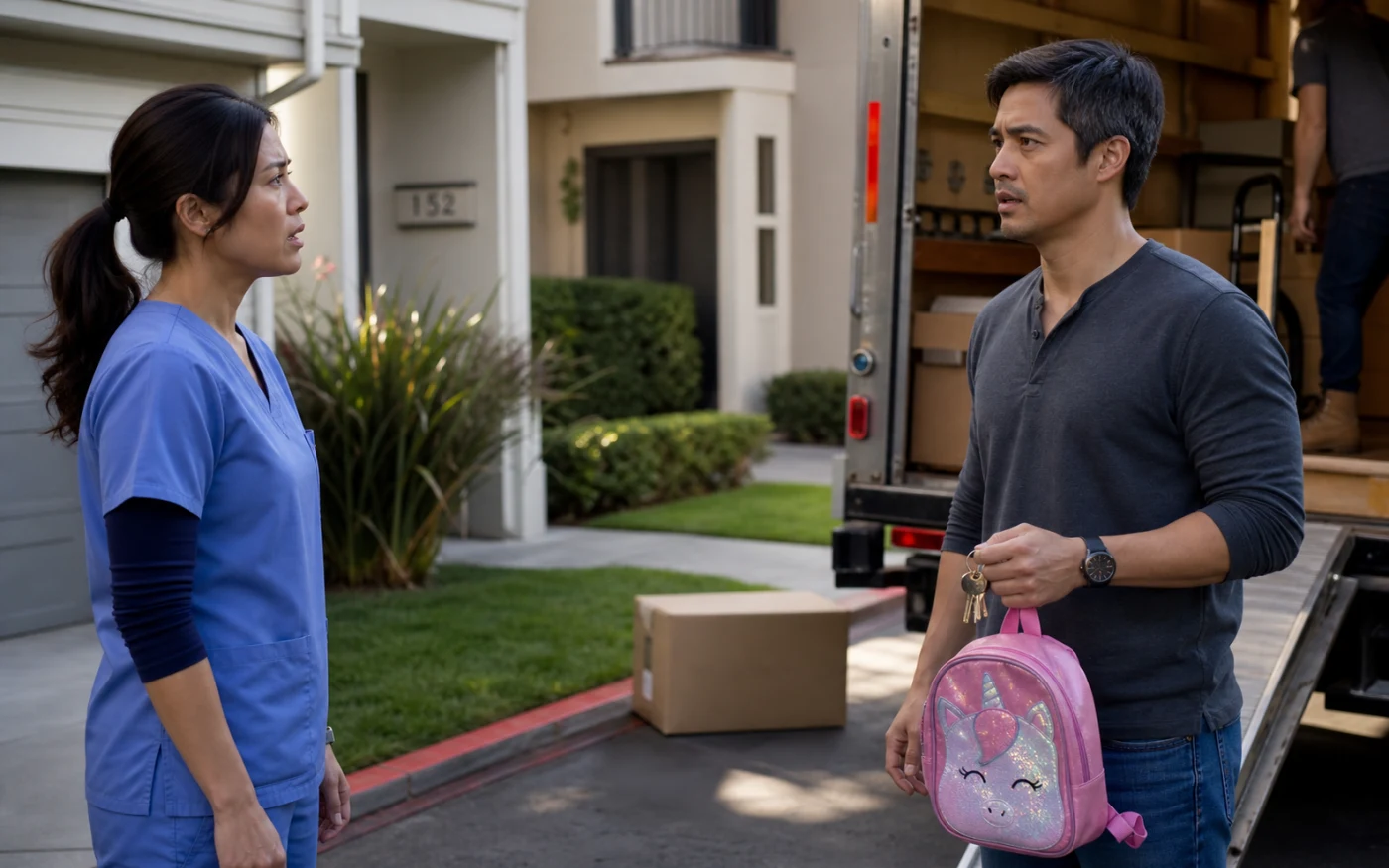
The man who destroyed my life stepped out of a moving truck yesterday, carrying a little girl's pink backpack—and walked straight into the house next door.
For eight years, I had imagined what I would do if I ever saw Adrian Bautista again.
Slap him. Scream at him. Ask him the one question that had followed me through every lonely birthday, every awkward date, every wedding where people looked at me with pity.
Why?
Instead, I stood frozen behind my curtains, still holding a mug of coffee that had already gone cold.
He looked older. Of course he did.
We were twenty-six the last time I saw him, two weeks before our wedding.
Back then, his hair was always falling into his eyes, and he laughed like the whole room belonged to him.
Now silver touched his temples.
He moved carefully, almost stiffly, as two movers carried boxes into the blue house beside mine.
But I would have recognized his shoulders anywhere.
Then I saw the backpack.
Pink canvas. Tiny unicorn keychain. The name “MAYA” stitched across the front.
My stomach dropped.
“Clarissa, anak, bakit bukas ang pinto?” my mother called from the kitchen.
She visited every Thursday with enough pancit to feed my entire clinic. I pointed through the window because I couldn't make my mouth work.
Mama looked outside. The food container slipped from her hands and landed on the counter.
“Ay, Diyos ko.”
“That's him.”
“I can see that.” Her voice hardened. “Kapal ng mukha niya.”
Eight years earlier, I had woken up and found Adrian gone.
His clothes were missing. His phone was disconnected. On our dining table sat his key and a note containing six words: Don't look for me. I'm sorry.
We had already paid the florist. My gown was hanging in Mama's closet. One hundred and forty people knew what flavor our wedding cake would be.
Nobody knew where my groom had gone.
His friends claimed ignorance. His landlord said he had ended his lease. Even his sister, Elena, cried with me and swore she didn't understand.
After three months, I stopped calling hospitals.
After one year, I stopped checking crowds.
After three, I finally took off the engagement ring I had kept hidden on a chain beneath my uniform.
I built a life without him.
At thirty-four, I was a physical therapist in Daly City. I owned my small house, grew calamansi in pots, and slept peacefully most nights.
It wasn't the life I had planned, but it was mine.
And Adrian had just parked his betrayal ten feet from my driveway.
I marched outside before Mama could stop me.
Adrian was lifting a box when he saw me. His hands went slack. The box hit the driveway, spilling children's books across the concrete.
For one terrible second, his face looked exactly as it had when he proposed to me at Ocean Beach—open, frightened, hopeful.
“Clari.”
“Don't call me that.”
He swallowed. “Okay.”
I picked up one of the books. A glittery princess smiled from its cover.
“So this is what happened?” I asked. “You had another family?”
“No.”
“Then whose things are these?”
His gaze moved to the pink backpack. “It's complicated.”
I laughed, sharp and ugly. “Eight years, Adrian. You don't get to say complicated.”
“I know.”
“Did your wife leave you? Is that why you're alone?”
“I was never married.”
“Girlfriend?”
“No.”
“Then why bring your baggage here?” I held up the princess book. “Sa tabi ko pa talaga?”
He flinched, but he didn't defend himself. That made me angrier.
“I didn't come to hurt you,” he said.
“You don't get credit for failing twice.”
Mama appeared on my porch, arms crossed. “Umuwi ka na, Clarissa.”
Adrian glanced at her. “Tita Lorna.”
“Huwag mo akong Tita.”
He lowered his head. “Opo.”
I turned away, but he called after me.
“Clarissa, wait. May itatanong sana ako.”
I looked back despite myself.
“Do you know a good elementary school nearby?” His voice softened. “For a five-year-old?”
The question felt like one final cruelty.
“Ask her mother.”
I slammed my door so hard a framed photo fell from the wall.
That evening, I watched from my darkened living room as Adrian sat alone on his porch.
No woman arrived.
No child did either.
He held the pink backpack on his lap and pressed his face against it.
Then his shoulders began to shake.
PART 2: Whose Name Was Inside
I told myself I didn't care why Adrian was crying.
For three days, I went to work early and came home late. I treated sprained knees, surgical shoulders, and an elderly lolo who flirted shamelessly while learning to walk again. I smiled when required. I avoided my windows.
But the house next door stayed strangely quiet.
On Saturday morning, someone knocked. When I opened the door, a delivery driver held out a large box.
“Bautista?” he asked.
My heart kicked. “Next house.”
He checked his scanner. “This says this number.”
The label had my address, but Adrian's name. I should have refused it. Instead, I signed, set the box inside, and stared at it for an hour.
It wasn't sealed properly. One corner had split open, revealing a folder and a child's yellow sweater.
I reached only to push them back in.
The folder slid onto the floor.
A photograph slipped out.
Elena smiled up at me.
Adrian's younger sister had been twenty-two when he disappeared. In the photo, she was older, thinner, kneeling beside a little girl with Adrian's dark eyes. Both wore paper crowns.
On the back, in Elena's handwriting, were the words: For Kuya Adrian—so Maya always remembers her mama loved her.
My anger went silent.
Below it lay a death certificate.
Elena Bautista Santos. Age thirty. Cancer.
My knees gave way.
I found more documents I hadn't meant to see: guardianship papers, school forms, pediatric records. A crayon drawing showed three stick figures beneath a crooked rainbow. MAMA was written over one. MAYA over another. The third figure had broad shoulders and the label TITO ADRIAN.
At the bottom, a child had written, Mama is in heven. Tito will come get me soon.
Someone knocked again.
Through the glass, I saw Adrian.
I opened the door holding Elena's photograph.
His eyes closed. “You saw.”
“She died?”
“Four months ago.”
All the fury I had carried became shame so quickly it made me dizzy. “And Maya?”
“With Elena's best friend in San Diego until I finish the custody process and prepare the house. She arrives Tuesday.” He looked at the open box. “She starts kindergarten next month.”
“Why didn't you tell me?”
“You didn't owe me a conversation.”
“But you asked about school.”
“You help people for a living. I thought you might answer even if you hated me.” A faint, sad smile crossed his face. “Mali pala ang timing.”
“Don't.” My voice broke. “Don't act like this is only about timing. You vanished.”
“I know.”
“You let me believe I wasn't worth an explanation.”
“You deserved one.”
“Then give it to me now.”
For a long moment, he stood completely still. Then he nodded toward his porch.
On his kitchen table, Adrian placed a worn envelope in front of me. Inside was a hospital report dated eight years earlier.
I recognized only a few words: giant cerebral aneurysm. High rupture risk. Poor prognosis.
“Two weeks before our wedding, I collapsed at work,” he said. “The scan found it. The first doctor said surgery might kill me. Without surgery, it could rupture anytime.”
I stared at him. “You were sick?”
“I thought I was dying.”
“So you left me?”
“I watched my father die slowly, Clari. My mother spent everything. Elena stopped school. I couldn't make you a widow at twenty-six. I couldn't let you waste your life bathing me, feeding me, waiting for my brain to bleed.”
“That was my choice!”
“Oo. Dapat choice mo.” Tears filled his eyes. “Pero natakot ako.”
“I would have stayed.”
“That's why I ran.”
The words struck harder than any excuse could have.
He told me he went to Seattle, where a specialist agreed to attempt a high-risk surgery.
“Elena didn’t know where I’d gone until after the surgery,” he said. “When I finally called her, I made her promise not to tell you.”
He survived, but woke with weakness along his left side.
For months, he couldn't button a shirt. For nearly two years, he struggled to speak without slurring.
“I wrote to you every week,” he said. “Hindi ko pinadala.”
He carried a shoebox from the bedroom. It was filled with envelopes, each bearing my name.
“Why?” I whispered.
“At first, I couldn't bear for you to see me. Later, too much time had passed. I saw online that you finished your degree and bought your house. Mukha kang masaya.”
“You decided again.”
“Yes.” His voice cracked. “And I was wrong again.”
I stood to leave, overwhelmed, but he reached for the table—not me—as if the room had tilted. His left hand trembled.
The physical therapist in me noticed immediately.
The woman he abandoned noticed something else.
On the counter was the property closing statement. Beneath it, in Adrian's handwriting, was a list: Safe yard for Maya. Good school district. Near hospital. Next to Clarissa.
I pointed at the last line.
“Why did you really buy this house?”
Adrian looked at me with eight years of unsent words in his eyes.
“Because Elena's last request wasn't only that I raise Maya,” he said. “She told me to stop hiding from the woman I never stopped loving.”
PART 3: Why He Came Home
I left without answering him.
For the next two days, I read every letter in that shoebox.
Adrian had written from hospital beds, rehabilitation centers, rented rooms, and employee break rooms. Some letters were only three shaky sentences. Others were ten pages long.
He wrote about relearning to walk. About working nights at a warehouse and weekends repairing appliances. About Elena becoming a mother, then becoming sick.
And in every letter, he wrote to me as if I were still beside him.
I love you was never the painful part.
The painful part was the ordinary things.
You would hate this coffee.
May nakita akong yellow house. You'd plant herbs by the window.
I walked six blocks today. Sana nakita mo.
By Tuesday afternoon, I had cried until my face hurt.
A car stopped next door.
A little girl climbed out wearing purple sneakers and clutching the pink backpack. Adrian stood on the walkway, visibly terrified.
Maya stared at him.
He crouched slowly. “Hi, anak.”
She ran past him into the house.
Adrian's smile collapsed.
The woman who had driven her murmured something to him, hugged him, and left. Through my window, I watched him enter the house alone.
Ten minutes later came a small knock on my door.
Maya stood there, tears streaming down her cheeks.
“Are you Clarissa?”
I knelt. “Yes.”
She opened her backpack and pulled out a creased envelope.
“Mama said if Tito gets scared, I give you this.”
My name was written on it.
Inside was a short note from Elena.
Clarissa, Kuya thinks love means leaving before he becomes a burden. Please teach him that staying is also love. If you cannot forgive him, I understand. But please don't let fear make the choice for both of you again.
I looked toward Adrian's house. “Where is your Tito?”
Maya wiped her nose. “Kitchen. He made adobo, pero sunog.”
Despite everything, I laughed.
This time, I didn't let anyone else decide for me.
I crossed the strip of grass between our homes with Maya's small hand in mine.
Adrian stood over a smoking pan. When he saw us, he turned off the stove.
“Sorry,” he said quickly. “She slipped out. Hindi ko napansin.”
“You still burn adobo.”
His mouth opened, but no sound came.
I placed Elena's note on the counter. Then I took the old engagement ring from my pocket—the ring I had kept through every move, every year, every attempt to forget.
Adrian stared at it.
“I can't give you back eight years,” he whispered.
“No.”
“And I can't ask you to trust me today.”
“No.”
His face crumpled, but I stepped closer.
“You can ask me to stay for dinner.”
He looked at me as if he hadn't understood.
“Dinner?”
“Oo, dinner. But we're ordering take out. Delikado ang kusina mo.”
Maya giggled.
Adrian didn't. Tears rolled down his face. “Clari, mahal pa rin kita.”
“I know.” My own tears came. “Mahal pa rin kita. Galit din ako. Both are true.”
“I'll spend every day making it right.”
“Then start by staying.”
He crossed the distance between us.
For the first time in eight years, Adrian held me.
Not like a man reclaiming something he had lost.
Not like an apology asking to be accepted.
He held me carefully, his trembling hand against my back, while I pressed my face into the shoulder I had tried so hard to forget.
I cried for the wedding that never happened, for his hospital rooms, for Elena, for the young people we had been. Adrian cried too, whispering, “Patawad, Clari. Patawad talaga.”
Then two small arms wrapped around both our waists.
Maya squeezed herself between us and looked up.
“Are we having dinner now?”
Adrian laughed through his tears. It was quieter than the laugh I remembered, but it still made the room feel full.
“Yes,” I said, reaching for my phone. “At sa bahay ko tayo.”
Maya grabbed her backpack. Adrian took my hand.
Together, the three of us crossed the little patch of grass between his house and mine—and this time, nobody let go.