
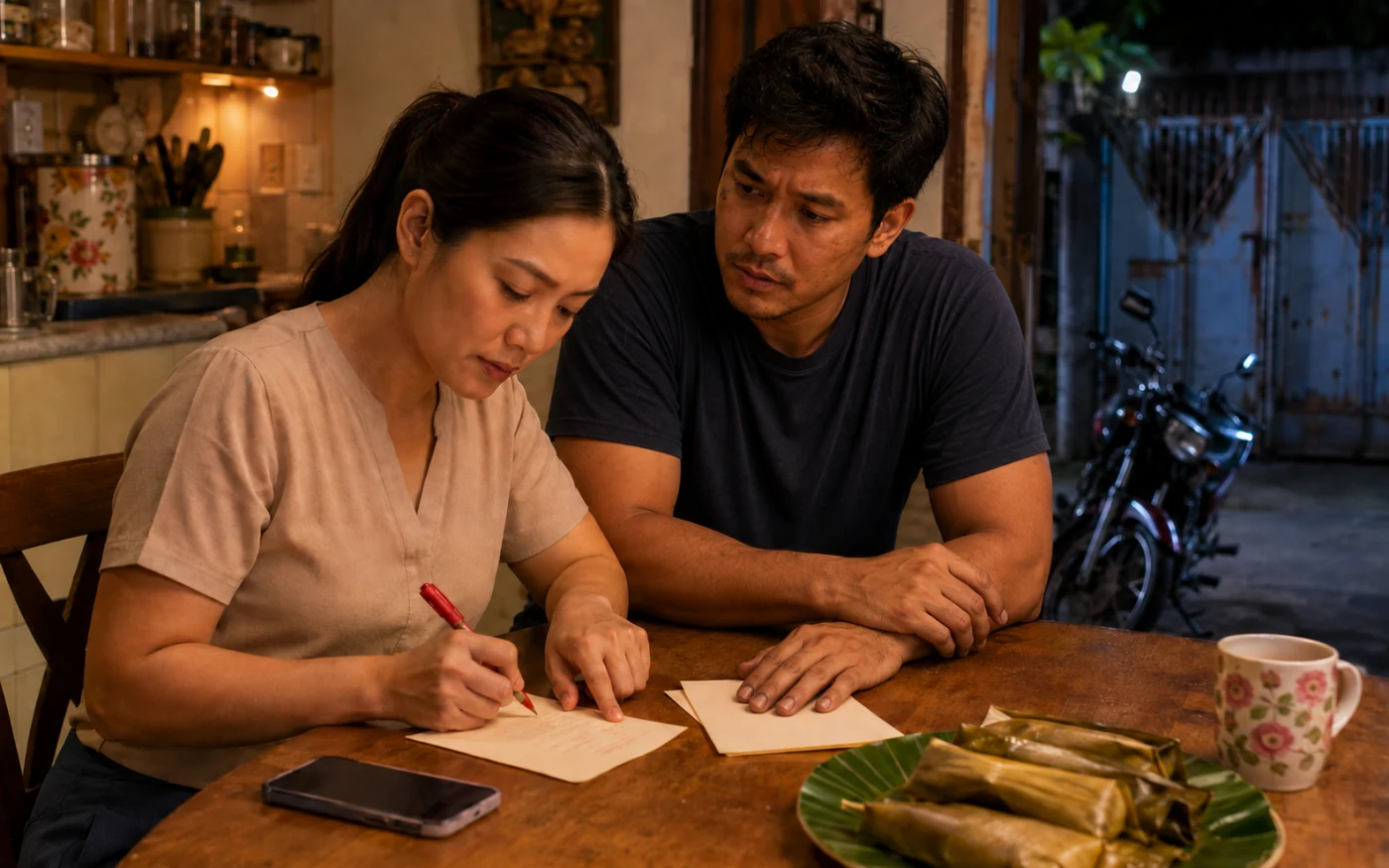
My Best Friend Asked Me to Help Him Write Love Messages to a Girl He Was Too Shy to Name — For Five Months I Fixed Every Word, and I Never Once Asked Who She Was
PART 1: The Other Woman
There is a special place in purgatory for a woman who edits love letters addressed to somebody else.
I know because I spent five months there, holding a red pen and helping my best friend fall in love with a woman I was too afraid to name.
My name is Lani. I am thirty-four, I teach English at the public high school, and until last February I believed I was a reasonably intelligent person.
Then Marco arrived at my gate holding his phone like it had bitten him.
“Lani,” he said. “Tulungan mo ako. There is someone.”
My stomach dropped so quickly I almost looked down to see where it had gone.
Marco and I had been best friends since we were nine, when he traded me half a turon for half my eraser and insisted it was fair because his half had more banana.
He fixes motorcycles in a small shop near the road to Baras.
He can rebuild an engine while three people shout questions at him.
But ask him how he feels and he clears his throat twice, wipes his hands, and suddenly remembers an urgent carburetor.
“Someone?” I repeated.
“A girl.”
“At thirty-five, perhaps call her a woman.”
“A woman, then. Basta. I don’t know how to say things.”
I should have asked who she was.
Instead, I opened the gate.
He followed me to the kitchen table, where Nanay had left a plate of suman and strict instructions not to finish all of it.
Marco placed his phone between us and showed me four lines.
You are very beautiful and good. I like when you are there. I hope you can know my heart because my mouth is useless.
I read it twice.
“Your mouth is not the only problem,” I said.
“Aray.”
“You asked an English teacher.”
He leaned forward, serious now. “Can you help me?”
I set one rule. He had to say what he meant. I would only fix how he said it.
“Ayoko gumawa ng feelings for you,” I told him. “Your feelings, your words.”
“My bad words.”
“Exactly.”
That first Sunday, we worked for two hours.
He wrote, crossed out, groaned, and accused commas of being a conspiracy.
I corrected his verbs and refused to let him call anybody an angel sent from heaven.
When he left, he noticed our gate dragging against the cement.
“Sandali,” he said.
He took tools from his motorcycle and fixed the hinge before I could bring him coffee.
The next Sunday, he came back with a new draft written longhand because, according to him, the blinking cursor was “too judgmental.”
She laughs before the joke is finished, he wrote, like she already trusts it will be funny.
I stared at that sentence.
It was not polished, but it was tender. It sounded like he had been watching this woman for years.
“Well?” he asked.
“Good image. Too many words.”
I crossed out three and handed it back.
He looked offended. “Those words had purpose.”
“Their purpose was to leave.”
He smiled at me, and I had to look down.
Before he went home, he repaired our electric fan.
The following week, he replaced the broken latch on Nanay’s cabinet.
After that, he brought my scooter back from the dead after three shops had declared it beyond saving.
I thought he was paying me for the lessons.
There is no man on earth worse at courtship than Marco Velasco.
Every Sunday, the mystery woman became more vivid.
She gives away her food at parties and then complains she is hungry.
She sings the wrong lyrics confidently.
She carries safety pins, candy, and two kinds of headache medicine, but never remembers an umbrella.
When she is angry, her ears turn red, and she will deny that those are her ears.
“That last line is ridiculous,” I said.
“It is true.”
“How can someone deny her own ears?”
He glanced at mine. “Practice, siguro.”
I covered them with my hair.
Whoever this woman was, I decided, she sounded exhausting.
I never asked her name. Not once.
I called that professionalism.
It was self-defense.
Because I had loved Marco quietly for so long that the feeling had become part of the furniture of my life.
It was always there, useful and unmentioned.
I knew how he took his coffee, which shoulder hurt when rain was coming, and how silent he became every August on the anniversary of his father’s death.
He knew when I was pretending not to be tired.
He brought lugaw when I was sick and never stayed long enough for me to feel embarrassed.
When Nanay needed tests at the clinic, he drove us before sunrise and waited outside with a plastic bag of pandesal.
But he had never said anything.
Neither had I.
So I corrected the love messages meant for somebody else.
By May, I could not walk through the market without examining every woman near his shop.
Was it the pharmacist with glossy hair?
The widow who sold kakanin?
The cheerful cashier who called him Kuya even though she was obviously flirting?
I hated all of them for five seconds each, then hated myself longer.
One Sunday he handed me a page that ended, You make ordinary days feel like I was waiting for them.
My eyes burned.
“Too much?” he asked.
“No.” I drew a red line under the sentence. “This one is good.”
“Grade?”
“B-plus.”
“B-plus lang?”
“Cliché ang ending.”
I wrote sayang in the margin and pushed the paper back.
He folded it carefully and put it in his pocket as if my handwriting mattered as much as his.
On the last Sunday of June, Marco did not sit down.
He stood beside our table, pale beneath his sun-browned skin, gripping a thick envelope.
“Tonight,” he said, “I’ll send the real one.”
My chest tightened.
“The final message?”
He nodded. “The long one. I wrote it alone. No more editing.”
I smiled at him with my whole face and none of my heart.
“Good,” I said. “Kaya mo na.”
He looked as if he wanted to say something else.
Then he put the envelope back in his bag and walked toward the gate.
For the first time in five months, he did not fix anything before leaving.
That was when I knew I was about to lose him.
PART 2: Who Got the Message
At nine o’clock that night, my phone buzzed.
I was lying in bed with the lights off, still wearing the blouse I had worn to Mass that morning.
I had skipped dinner because every bite felt too large to swallow.
The message was from Marco.
It began: Please check one last time.
Then came everything.
Five months of drafts had been gathered into one terrible, beautiful letter.
The laugh before the joke. The food given away at parties. The wrong song lyrics. The medicine, the missing umbrella, the red ears.
My hands began to shake.
There were new memories too.
The time she climbed a guava tree at ten and refused help getting down.
The day she stood in the rain outside the hospital because his father was dying and she did not know what else to do.
The half turon with more banana.
I sat up so fast the room spun.
“Hindi,” I whispered.
I read the final paragraph.
I could not say this to your face, so for five months I practiced with the only person who could teach me. Ikaw. It was always you.
I tried to show you by fixing everything near you, but you kept finding more broken things and calling it payment.
Please look at your ears in the mirror.
Under that, he had written:
Revised. Hoping for an A.
I touched my ears.
They were burning.
I stumbled to the small mirror above my dresser.
My face was pale, my hair was wild, and my ears were the color of a fire truck.
From outside came Marco’s voice.
“Bakit ang tagal mong mag-check ng messages?”
I froze.
My phone buzzed again.
I am at the gate. Please do not fail me while I am standing beside your bougainvillea. There are ants.
I ran out of my room, nearly collided with Nanay in the hallway, and stopped.
She was wearing her nightgown and holding a cup of salabat.
“Where are you going?” she asked.
“Marco is outside.”
“I know.”
“You know?”
“He has been walking past the window for twenty minutes. Nakakahilo.”
She sipped her drink.
“Nanay, he wrote the letters to me.”
“Of course.”
I stared at her. “Of course?”
“Anak, he repaired a rice cooker we threw away in 2022.”
Then she pushed me toward the door.
Marco stood under the porch light with one hand behind his back.
His hair was damp with sweat.
There was grease under one thumbnail, and his good blue polo was buttoned wrong.
For once, I had no words.
“Say something,” he pleaded.
I opened the gate.
“Your second paragraph has a dangling modifier.”
His face collapsed.
“Lani.”
“And you used ‘everyday’ when you meant ‘every day.’”
“Ay, grabe. I knew it.”
He pulled his hidden hand forward. He was holding the thick envelope from that afternoon.
“I wrote all the drafts again,” he said. “Even the ones you corrected. Para sa’yo.”
I took it. On the front, in block letters, he had written TO THE STRICTEST WOMAN IN RIZAL.
“You could have said my name,” I whispered.
“I was shy.”
“For five months?”
“You kept giving low grades.”
I laughed, but the sound broke.
Suddenly I was crying so hard I could barely see him.
His own eyes filled with panic.
“Masama ba?” he asked. “Did I make a mistake?”
“Many mistakes.”
“In the letter?”
“In making me suffer since February.”
He stepped closer. “Sorry.”
“I hated a pharmacist because of you.”
“Which pharmacist?”
“Never mind.”
He reached through the open gate and wiped my cheek with his thumb.
“So,” he said softly, “A?”
I looked at the man I had loved since childhood.
The man who could repair anything except one honest sentence.
The man who had spent five months learning to say what I had spent years hiding.
“A,” I said.
He let out one breath, grabbed the gate to steady himself—and the newly repaired hinge snapped.
The gate dropped between us with a crash loud enough to wake half the street.
Nanay shouted from inside, “Marco! B-plus!”
He looked down at the gate, then at me.
“I can fix that.”
“Tomorrow.”
I stepped over it and kissed him.
By morning, everybody knew.
But Marco still had one message left to write, and this time he refused to let me see it.
PART 3: Why He Needed Fifty Copies
For the next five months, Marco courted me with the same stubborn care he used on broken engines.
He brought taho to school before my first class.
He waited outside faculty meetings without complaining.
He drove Nanay and me to Pililla when my aunt needed help, then spent the afternoon repairing her leaking faucet while six relatives questioned him about his intentions.
“Serious ka ba?” Tita Baby demanded.
“Opo.”
“May ipon?”
“Meron po.”
“How many children?”
Marco looked at me in terror. “Can I submit that answer later?”
At family parties, he told everyone I had edited my own love letters for five months without noticing.
The titas screamed every time.
I maintained that I had known by month three. This was a lie I intended to keep.
Still, there was one secret.
Every Wednesday evening, Marco disappeared after closing his shop. If I asked where he was going, he said, “Homework.”
He stopped asking me to correct messages. He also began buying cream-colored paper by the pack.
Then, in November, he asked the owner of the print shop for fifty copies of something and made her promise not to show me.
I found out because the owner was my former student, and secrecy had never been among her talents.
“Ma’am,” she whispered when I passed her shop, “Marco’s order is ready.”
“What order?”
Her eyes widened. “Ay.”
That evening, I confronted him beside his workbench.
“Why do you need fifty copies?”
He dropped a wrench.
“Copies of what?”
“Do not insult an English teacher with weak fiction.”
He picked up the wrench and placed it carefully on the table.
“Saturday,” he said. “Please wait until Saturday.”
“Is it another letter?”
“Yes.”
“To me?”
“Mostly.”
Mostly.
That word tormented me for three days.
On Saturday afternoon, he told me to wear comfortable shoes and brought me to the covered court near the school.
I expected a quiet conversation.
Instead, the place was full.
Nanay sat in front with Tita Baby.
Marco’s mother was crying before anything had happened.
My fellow teachers lined one side.
Mechanics from his shop stood on the other, freshly washed and visibly uncomfortable in collared shirts.
Even the pharmacist was there.
“Why is she here?” I hissed.
“She is my cousin.”
I closed my eyes.
Fifty people held fifty cream-colored pages.
Marco led me to the center of the court.
There was no fancy arch, no musicians, no hidden photographer.
Just the people who had watched us grow up, holding words in their hands.
“I needed help again,” he told me.
My heart pounded. “From all of them?”
“No. For all of them.”
He nodded to Nanay.
She stood and read the first line from her page.
“Lani taught me that love must say what it means.”
Then his mother stood.
“But Lani also taught me that the person writing must provide the feelings.”
One by one, the pages were read around the court.
His workers. My teachers. Our titas. People from our childhood.
Each person had one sentence, and every sentence carried Marco’s unmistakable, stubborn heart.
He wrote that he loved my fierce red pen and my soft heart.
He wrote that I had stood beside him on the worst day of his life.
He wrote that I made room for everyone and saved none for myself, so he wanted to spend his life making room for me.
Then the pharmacist read, “Also, I am his cousin, so please stop glaring at me in the market.”
My ears caught fire while the whole court turned toward me.
Finally, Marco unfolded the only page I had not seen.
His hands shook.
“Lani,” he said, “I can fix a gate, a fan, a scooter, and maybe one day my grammar. But you are not something broken. You are the home I want to take care of.”
He knelt on the painted basketball line and held up a small ring.
“Will you correct me for the next fifty years?”
I was crying before he finished.
“There is one problem,” I said.
The entire court groaned.
Marco shut his eyes. “What grammar?”
“Fifty years is not enough.”
His eyes opened.
“Make it every year we get,” I said. “Then yes.”
The sound that rose around us shook the metal roof.
Nanay cried. His mother cried. The titas screamed exactly as expected.
Marco stood, slipped the ring onto my finger, and kissed me while fifty cream-colored pages fluttered in the warm Rizal air.
We are getting married in December.
Last Sunday, I found the original B-plus draft framed above his workbench, my red sayang still visible in the margin.
Under it, Marco had added one final line in his crooked handwriting.
Corrections pending for the next fifty years—and every year after that.