
My Neighbor Filed Six Barangay Complaints Against My Flower Farm. Then I Found What He Was Building in His Shed at Midnight...
PART 1: Six Complaints Too Many
I kicked open my neighbor’s shed at midnight, ready to shove six barangay complaints into his face, and found him secretly building the most beautiful thing ever.
Four months earlier, I had come home with two suitcases, a dying flower farm, and a divorce I could barely say out loud.
My husband of nine years had left me for a woman from his office. Worse, he had told our friends that I was “too difficult to build a life with.”
Those words followed me everywhere.
So I moved into my late Lola Remy’s cottage at thirty-five and decided I would rebuild something without asking anyone’s permission.
The farm had once supplied sampaguita, roses, and anthuriums to churches and wedding shops all over Rizal.
After Lola died, weeds swallowed the paths. The greenhouse roof collapsed. Vines climbed through the kitchen window.
Still, the first morning I woke there, I smelled wet earth and coffee, and I thought, Kaya ko ito.
Then Gerald Dizon walked up my driveway.
Gerald was thirty-seven, broad-shouldered, quiet, and always covered in fine sawdust from his carpentry workshop next door. He had serious eyes and the habit of standing with his arms folded as if the whole world had been assembled incorrectly.
Unfortunately, I had always thought he was handsome.
He looked at the workers repairing my fence.
“That post is six inches over the boundary,” he said.
No hello. No welcome home.
I stared at him. “Good morning din, Gerald.”
He pointed again. “It will cause trouble later.”
“The surveyor placed it there.”
“Then the surveyor was careless.”
My cheeks burned. I had spent nine years being told I did everything wrong. I was not going to take it from a man who communicated like a warning label.
“Thank you,” I said tightly. “You can go home now.”
Three days later, a barangay officer arrived with the first complaint: unsecured fence boundaries.
Gerald had filed it.
I moved the post.
The second complaint came two weeks later, after a delivery truck brought fertilizer at ten in the evening. Unauthorized late-night commercial activity.
“Commercial activity?” I cried to Kagawad Nestor, who stood on my porch holding the notice while rain dripped from his cap. “It was twelve sacks of compost!”
“Official matter lang, Lia,” he said, looking embarrassed. “Please sign here.”
Across the field, Gerald’s workshop light was on.
I signed so hard the pen tore the paper.
The third complaint was about loose roofing sheets. The fourth was about trucks blocking emergency access. The fifth accused me of storing unsecured fuel because I had left one red gasoline container beside the mower overnight.
Every complaint brought barangay officers up my long, dark driveway.
Every complaint had Gerald’s name at the bottom.
When I confronted him by the boundary fence, he was planing a strip of narra wood beneath the acacia tree.
“Are you trying to make me leave?” I demanded.
His hand stopped.
“No.”
“Then why are you watching everything I do?”
He looked at the broken latch on my gate instead of at me. “Someone has to notice.”
“I don’t need someone noticing me.”
His jaw tightened. “You should replace that latch.”
I laughed because if I did not laugh, I would scream.
“Grabe ka. That is your answer?”
He gathered his wood and walked away.
I hated how calm he remained. I hated that even while I wanted to strangle him, I noticed the sawdust on his forearms.
I hated how alone I felt after he left.
But the farm began to live again.
My cousin Mina helped me post bouquets online. Tito Ben repaired the irrigation pump. I planted rows of celosia and marigolds until my shoulders ached. At dawn, color spilled across the hillside.
Sometimes I caught Gerald watching from behind his fence.
Once, after a hard wind, I found six new braces fixed to my nursery roof. The screws were clean and expertly sunk. I asked my workers who had done it.
Nobody knew.
Another morning, my gate latch had been replaced with a heavy brass one.
I assumed Tito Ben had done it and forgot to ask.
Then the storm came.
The wind began before midnight, bending the bamboo nearly to the ground. Rain hammered the cottage roof. I was in the packing shed, trying to save two hundred roses for a wedding, when headlights climbed my driveway.
Kagawad Nestor and another barangay tanod stepped out under umbrellas.
He held a fresh envelope.
“Please don’t tell me,” I said.
Nestor gave me an apologetic look. “A sixth complaint.”
Something inside me broke.
“At midnight? During a bagyo?”
“It concerns your delivery schedule.”
I snatched the paper. Gerald’s name stared up at me again.
Behind his house, a thin line of golden light shone beneath his workshop door.
I grabbed my flashlight and marched into the rain.
Mud sucked at my slippers. My nightdress clung to my legs. Nestor called after me, but I did not stop.
I crossed the property line, climbed Gerald’s steps, and heard hammering inside.
He was working at midnight while sending officers to harass me.
I had never been so angry in my life.
“Gerald!” I shouted.
The hammering stopped.
I tried the door. Locked.
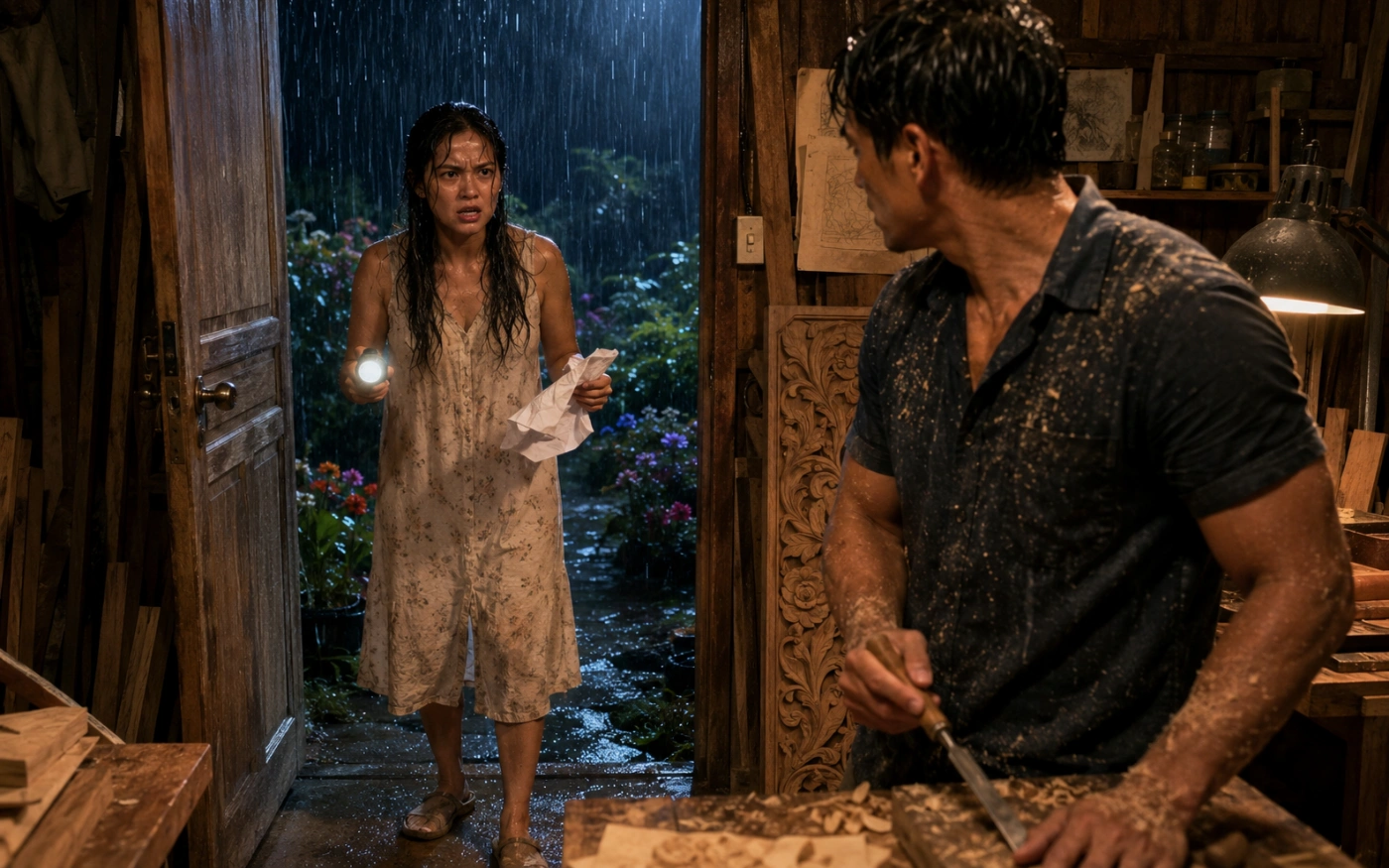
So I stepped back and kicked it with everything I had.
The old latch split.
The door flew open, and the smell of fresh cedar and night-blooming jasmine rushed over me.
“Gerald, I am sick of your petty—”
Then I saw what stood in the middle of the shed.
And I forgot how to breathe.
PART 2: What Was He Hiding
It was a greenhouse, but not like any greenhouse I had ever seen.
The frame was made from thick, polished wood, joined so perfectly that the corners looked folded instead of cut. Clear storm panels waited against the wall. The roof beams curved like open hands.
Every border had been carved with flowers.
Roses climbed one post. Gumamela opened along another. Around the double doors, tiny sampaguita blossoms twisted through wooden leaves so delicate I wanted to touch them just to prove they were real.
At the center of the doors, Gerald had carved my grandmother’s initials.
R.A.
Remedios Alonzo.
Gerald stood behind a workbench with a chisel in one hand. His black hair was damp with sweat. He looked less like the frightening neighbor in my head and more like a boy caught stealing mangoes.
“Lia,” he said.
“What is this?”
His gaze dropped to my muddy feet.
On the bench beside him lay yellowed pages, sketches, and an open envelope. I recognized the handwriting before I reached it.
My knees weakened.
Lola Remy had written my name on birthday cards exactly that way, with the L leaning too far forward.
I picked up the letter.
Gerald moved toward me. “Please, ingat. The ink is fading.”
I unfolded it with shaking fingers.
Lola had written it three years before she died, when her hands were already unsteady. She asked Gerald to build a storm-proof greenhouse for the farm. She had included rough measurements and a list of flowers she wanted carved into the doors.
At the bottom, her words became smaller.
If Lia ever comes home alone, please look after her. She acts brave when she is hurting. Do not embarrass her by making a fuss.
I read that part twice.
Rain battered the metal roof.
“She knew?” I whispered.
Gerald set down his chisel. “She knew you were unhappy before the rest of us did.”
My throat closed.
“Why didn’t you tell me?”
“You came home angry at everyone.”
“I was not angry at everyone.”
He gave me one long look.
“Fine,” I said. “Most people.”
He rubbed the back of his neck. His ears turned bright red.
“I planned to finish before the heavy rains. Then you repaired the farm faster than I expected.”
I looked around at the stacks of lumber, the hand-drawn plans, the hundreds of carved petals.
“You have been doing this alone?”
“After work.”
“For how long?”
“Since your lola asked me.”
Three years.
The anger inside me shifted, but it did not disappear.
I slapped the complaint notice onto his bench.
“And these? Was harassing me part of Lola’s plan?”
Gerald stared at the paper as if it were the most complicated object he had ever made.
“No.”
“Five complaints, Gerald. Six tonight. You reported my fence, my roof, my fuel, my trucks. Ano ba?”
He opened his mouth, then closed it.
“Tell me.”
“You live alone on a secluded road.”
“I know where I live.”
“Your suppliers arrive after midnight. You open the gate without checking who is there. Sometimes you work in the shed until two. There is no signal behind the hill.”
“So you called the barangay?”
His ears became even redder.
“Nestor and Paolo are my cousins. A filed complaint gave them an official reason to drive up, check the road, and make sure your lights were on.”
I stared at him.
He continued quickly, as if confessing to a crime.
“The first fence post really was over the line. The roof sheets were dangerous. But the other notices…”
“Were fake?”
“Exaggerated.”
“Unauthorized compost?”
“Very exaggerated.”
I remembered Nestor lingering until I locked my gate. Paolo carrying the gasoline container into the shed. The patrol vehicle following a delivery truck back down the mountain road.
“You could have knocked on my door,” I said.
Gerald looked stricken. “At two in the morning?”
“You sent government forms instead!”
“I did not want to frighten you.”
For one second, neither of us spoke.
I had spent months wondering whether my ex was right about me.
Standing there with a man who had turned worry into six official complaints and a secret greenhouse, I had one ridiculous thought.
Maybe I had finally met someone more difficult than I was.
Then a tremendous crack sounded outside.
The shed floor trembled.
Gerald ran past me into the rain. I followed.
Across the boundary, one of my old mango trees had split. A massive branch lay over the packing shed roof.
The lights inside flickered.
Then I heard Mina scream.
“Ate Lia! The flowers!”
Gerald grabbed my arm before I could run.
“The electric line is down,” he said. “Huwag kang lalapit.”
Water poured through the broken roof onto two hundred wedding roses, and smoke curled from the wall beside them.
PART 3: Who Came Through the Rain
The bride was collecting those roses at six in the morning.
I had spent my last savings buying the plants and repairing the irrigation system. If the order failed, I could not pay my workers on Friday.
“We have to get them out,” I said.
Gerald pointed to the sparking wire. “Not through that door.”
He ran back to his workshop.
For one terrible moment, I thought he was leaving me.
Then his double doors burst open.
Gerald rolled the unfinished greenhouse into the rain on a heavy platform with wheels. I had not noticed them beneath the frame.
“Help me push!” he shouted.
Nestor and Paolo came running from my driveway. Mina splashed through the mud behind them. Together, we pushed the wooden structure toward the damaged packing shed while the storm tore leaves from the trees.
Gerald stopped it beside the rear window, away from the fallen wire.
He smashed the window frame with a mallet, climbed through, and began passing flower crates out to us.
“One at a time!” he yelled. “Keep the stems upright!”
I stood inside the greenhouse, soaked and shivering, receiving my roses through the rain.
Nestor carried buckets. Paolo covered the open panels with tarps. Mina lined the floor with old fertilizer sacks. Gerald went back again and again until smoke thickened inside the packing shed.
On his last trip, he emerged through the window coughing, clutching the final crate against his chest.
I grabbed his shirt with both hands.
“Tama na! Are you trying to die for flowers?”
“They are your flowers,” he said, breathing hard.
Paolo used the patrol vehicle’s extinguisher on the smoking wall while Nestor kept everyone away from the fallen wire.
Then the power failed completely.
Darkness swallowed us.
Then Nestor switched on the patrol vehicle’s headlights.
The beams poured through the greenhouse walls, lighting every rose and every carved blossom from within.
It was breathtaking.
The unfinished building glowed gold in the storm. Red roses filled the center. Sampaguita curled around the doors. Water shone on Gerald’s face as he stood beneath Lola’s carved initials.
I saw exactly what my grandmother had imagined.
Not a monument. Not a favor I had to repay.
A safe place for things still trying to bloom.
I started crying so hard I could not hide it.
Gerald immediately looked alarmed.
“Nasaktan ka?”
“No.”
“Did we crush the roses?”
“No, Gerald.”
“Then why—”
I stepped over the sawdust and wet leaves, held his face, and kissed him.
He went completely still.
Behind us, Nestor cleared his throat and said, “We should inspect the road.”
Mina pulled both officers toward the door. “Oo. Very far road.”
When they disappeared into the rain, I lowered my hands.
Gerald looked stunned.
“I’m sorry,” I said, suddenly breathless. “I should have asked.”
“You can ask now.”
“Can I kiss you again?”
He nodded once. “Please.”
This time, he wrapped his arms around me.
He smelled like cedar, rain, and the jasmine vines crushed beneath our feet. His mouth trembled against mine, and something bruised inside me finally loosened.
At dawn, the storm passed.
The wedding roses survived.
We tied them into bouquets inside the glowing greenhouse while Gerald sat on an overturned bucket and pretended he was not exhausted.
At six fifteen, the bride arrived with her mother. She stopped at the broken packing shed, the tarps, and the mud.
Then she stepped through the carved doors, saw her roses beneath the rain-bright roof, and began to cry.
“They’re perfect,” she whispered.
Gerald looked at me from across the flowers.
For once, he did not look away.
Two weeks later, he finished the greenhouse in its permanent place beside Lola’s cottage.
He hung the carved doors just before sunset. I brought him salabat and found one small addition beneath my grandmother’s initials.
He had carved a single unopened rosebud beside an L.
“What does that mean?” I asked, though my heart already knew.
His ears turned red.
“It means I am trying to knock on the front door.”
I took his rough hand and led him up the path.
That night, for the first time since I came home alone, someone knocked.
And I opened the door before he could knock twice.