
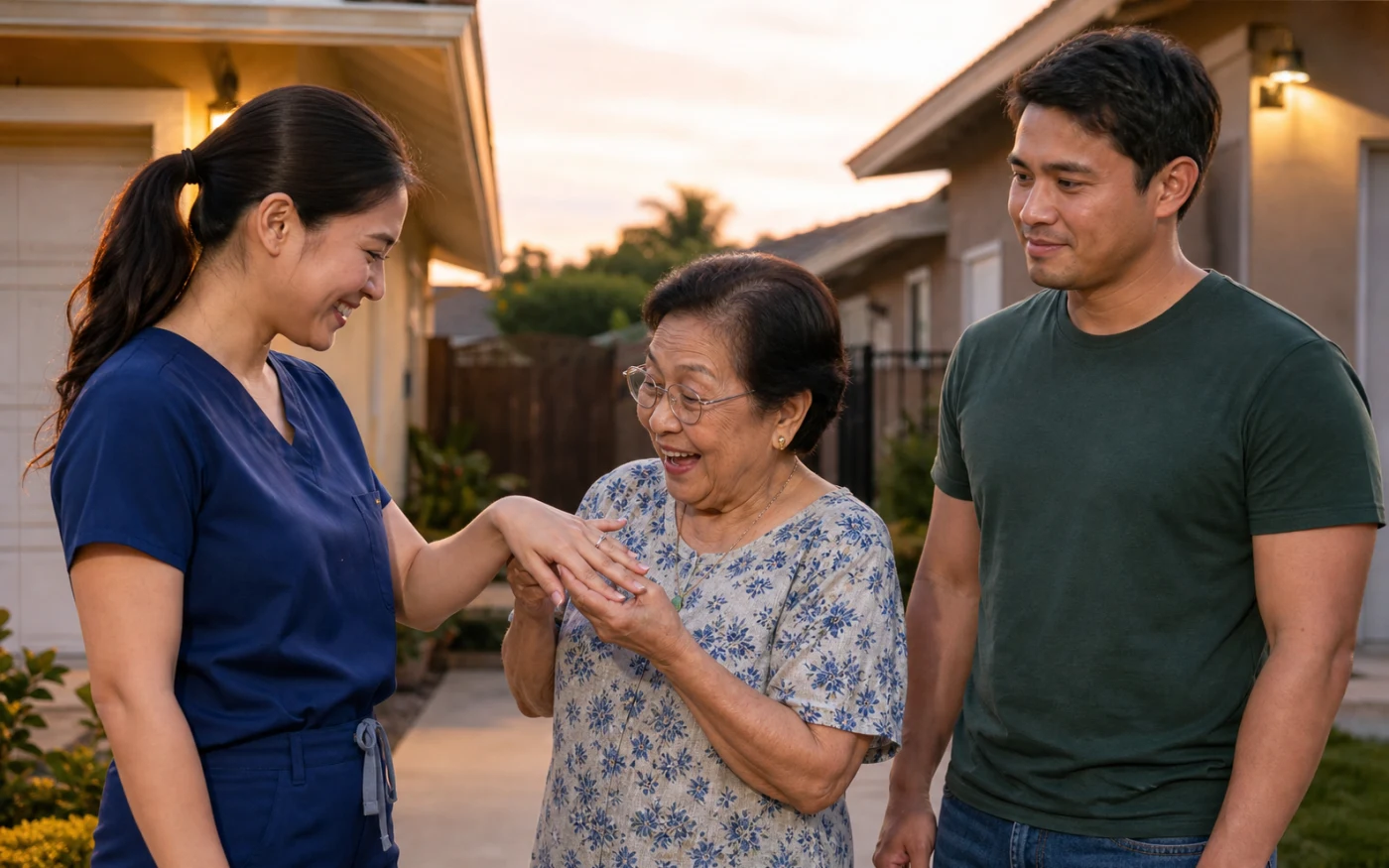
My Neighbor Asked Me to Fake an Engagement for His Visiting Lola. Then I Found a Notebook Under His Bed Dated Three Years Ago...
PART 1: The Favor Next Door
The man next door asked me to fake an engagement for his lola, and I said yes because I thought the dangerous part would be lying to her.
I was wrong.
The dangerous part was discovering how good Marco felt with his hand around mine.
I was thirty-five, an ICU nurse in Los Angeles, and my romantic life was a graveyard of bad timing.
Every man I liked was moving, healing, married to his job, or suddenly “not ready” after six months of eating my sinigang.
Marco Villanueva had lived next door for four years.
He was thirty-six, a contractor, quiet, broad-shouldered, and always carrying lumber into his garage before sunrise.
We were not friends. We were garbage-day neighbors.
“Morning, Joy.”
“Morning, Marco.”
That was our great love story.
Sometimes he rolled my bins back when I was sleeping after a night shift.
Once, I left pancit on his porch after he fixed my loose gate without asking.
We never discussed either thing.
Then, at ten on a Tuesday night, someone pounded on my door.
Marco stood outside in gray sweatpants and a faded San Ildefonso College shirt, looking more frightened than some families did when I said the doctor was coming.
“Joy, please,” he said. “I need a favor.”
Behind him, through his open front door, I saw a tiny woman arranging plastic-covered food containers across his dining table as if she had conquered the house.
“My Lola Cora flew in yesterday,” he whispered. “She’s seventy-eight. She brought pictures.”
“Pictures of what?”
“Women.”
I stared at him.
“Family friends’ daughters. One is flying from San Francisco this weekend. Lola already booked brunch.” He pressed both hands together.
“Please. Two weeks. Pretend we’re engaged so she stops setting me up. I’ll do your yard work for a year.”
“You want me to lie to your lola?”
“I want you to save my life.”
From his house came a sharp voice. “Marco! Sino kausap mo?”
He flinched.
I had worked fourteen hours. My feet hurt. My brain was soup. Maybe that was why I said, “Fine.”
His whole face changed.
“Talaga?”
“Two weeks. No weirdness.”
“No weirdness,” he promised.
He was lying already.
The next evening, he arrived with a small velvet ring box and a lavender latte.
“I borrowed the ring from my cousin Mia,” he said. “And this is yours.”
I took the coffee. “How did you know my order?”
“I’ve seen the cup in your recycling.”
“You inspect my trash?”
His ears turned red. “We put our bins beside each other.”
The latte was exactly right: extra espresso, barely sweet.
Most people heard lavender and turned it into perfume syrup. Marco somehow knew I hated that.
Before I could ask anything else, Lola Cora marched across the driveway in a flowered house dress.
“Ikaw si Joy?” she demanded.
“Opo.”
Her eyes dropped to the ring Marco had just slipped onto my finger.
She gasped, slapped his arm, then hugged me so tightly my coffee tilted.
“Four years ka diyan,” she scolded him. “You never told me!”
Marco slid an arm around my waist.
“We wanted privacy, Lo.”
His palm settled against my side like it belonged there.
My body forgot this was acting.
Over the next week, our fake engagement developed a terrifying amount of detail.
Marco drove me to work when my car battery died.
He packed chicken adobo and rice for my break because he claimed engaged men did not let their fiancées live on vending-machine crackers.
He replaced the porch light I had ignored for eight months.
At dinner, Lola Cora asked how we met.
I opened my mouth, ready to invent something simple.
Marco squeezed my hand.
“I first noticed her during a blackout,” he said.
“The whole street was dark, and Joy was checking on Mrs. Alvarez across the road because she uses an oxygen machine. Joy had worked all night, but she stayed until the power came back.”
I turned toward him.
That had happened three years ago.
I had not known he was watching.
“Then one morning,” he continued, “she came home so tired she sat on her steps because she couldn’t find her keys. I wanted to help, pero nahihiya ako. So I left coffee.”
My heart stumbled.
I remembered that coffee. I had assumed a delivery driver left it at the wrong house.
“And when did you know?” Lola asked him.
Marco looked straight at me.
“When she thanked me for fixing her gate with pancit and three pieces of calamansi in a sandwich bag. I thought, ito na.”
Lola Cora sighed like she was watching the final scene of a teleserye.
I was holding my breath.
On my porch later, I whispered, “That was very convincing.”
“You said we had to make her believe it.”
“You remembered the blackout?”
He looked toward his house. “I remember things.”
Then he kissed my forehead because Lola was watching through his blinds.
At least, that was why I told myself he did it.
By the end of the first week, I had stopped noticing the ring was fake.
By the end of the second, I was afraid of the day I would have to give it back.
Then Lola Cora announced her farewell dinner.
“Tomorrow, tapos na,” Marco murmured while we washed dishes together.
I stared at the soap sliding over his hands.
“Yes,” I said. “Tapos na.”
He went quiet.
And for the first time, I wondered if I was the only one who did not want our lie to end.
PART 2: Why He Knew Everything
Lola Cora’s farewell dinner should have been a relief.
Instead, it felt like someone was dismantling a home while I was still inside it.
She made kare-kare. Marco grilled eggplant in the backyard.
I brought cassava cake from a bakery in Historic Filipinotown, and Lola inspected it before declaring, “Pwede na.”
All evening, she talked about Pampanga, cousins in Baras, and a church pilgrimage she wanted to make on her next trip. She told me which flowers survived the heat and which ointment Marco needed for his bad shoulder.
“He will say wala lang,” she warned me. “Do not believe him.”
“Lo,” Marco protested.
“Tahimik.”
I laughed, then nearly cried, because tomorrow she would leave and I would become the woman next door again.
After dinner, Lola held out her phone.
“Picture. For your wedding invitation.”
Marco stood behind me, his chest warm against my back. His fingers covered mine over my stomach.
“Closer,” Lola ordered.
He bent until his cheek touched my temple.
The camera flashed.
For one second, I saw the photograph on her screen. We did not look like two neighbors performing. We looked tired, happy, and already chosen.
“Maganda,” Lola said softly.
Then she frowned and began patting the pockets of her cardigan.
“My passport.”
Marco checked the sideboard. I searched the kitchen.
Lola became more upset by the minute, insisting she had placed it inside a blue envelope after calling the airline.
“Maybe in your room,” she told Marco. “I was looking for the luggage scale.”
He and I went upstairs while Lola emptied her purse downstairs.
I checked his desk. Marco opened drawers.
I tried not to notice that his bedroom was neat except for a pile of work shirts on a chair—and that the yellow lilies from his yard were visible through his window.
“Look under the bed,” he said. “She hides important things in safe places, then forgets the safe place.”
I knelt and reached into the dark.
My fingers found a blue envelope, but when I pulled it forward, my elbow struck a heavy wooden box.
It tipped over.
A leather notebook slid across the floor and opened near my knee.
I grabbed the passport first.
Then I saw my name.
Not once.
Again and again.
The page was dated October 14, 2023.
Three years earlier.
Joy came home from her 12-hour shift looking exhausted. Left an extra coffee on her porch.
My skin went hot.
I turned the page.
Joy stopped by the fence today and said the yellow lilies were beautiful. Planting six more bushes tomorrow.
Another page.
Joy laughed at my terrible joke by the bins today. Sana ako someday.
Another.
Fixed her gate. She left pancit. Ate it cold because I didn’t want to wait.
My hands started shaking.
There were years inside that notebook.
The morning he found me crying in my car after losing a patient and quietly left a box of tissues on the hood.
The Christmas I worked overtime and found my bins already pulled in.
The week my mother visited from Nevada and Marco carried her suitcase without being asked.
He had written things I had forgotten saying.
Joy says she wants a little table under the jacaranda, but she never has time to buy one. Build it before summer.
That table had appeared beside my fence two summers ago. Marco told me a client had rejected it.
Then I reached the newest entries.
Lola brought the pictures today. She already booked brunch with the woman from San Francisco. I finally told her there’s already someone.
The next page was worse.
Lola has a plan: ask Joy to fake an engagement for two weeks so she’ll stop setting me up. I told her it was insane. She said waiting four years to ask one woman to dinner was more insane.
I stopped breathing.
The visit was real.
The matchmaking was real.
But Lola Cora knew about me.
And somehow, instead of telling Marco to grow up and ask me to dinner, she had helped him turn his panic into a fake engagement.
“Joy?”
I turned.
Marco stood in the doorway, pale as a sheet, staring at the notebook in my hands.
Downstairs, his lola called, “Nakita n’yo?”
I held up the blue envelope.
But my eyes stayed on Marco.
“Yes,” I called back. “I found everything.”
PART 3: What He Finally Admitted
Marco closed the bedroom door.
For once, he had nothing to say.
I stood with his secret life open between my hands, and every sweet moment from the past two weeks rearranged itself in my mind.
The coffee.
The forehead kiss.
The way he knew I rubbed my thumb against my palm when I was anxious.
My eyes filled before I could stop them.
“You made me lie to your lola.”
“She knew.”
“You made me think this was only about stopping her matchmaking.”
“It was. The fake engagement was her idea.”
“And you agreed.”
His voice cracked. “I panicked.”
That almost undid me.
I shut the notebook against my chest.
“Why, Marco?”
He looked down at his hands. Those hands had built hospitals, kitchens, decks, and one small table under my jacaranda.
“Because every time I tried to ask you out, you looked exhausted, or you were leaving for work, or somebody had just hurt you.” He swallowed.
“I kept telling myself next week. Then next month. Tapos four years na.”
“So Lola knew?”
“Since the first night.”
“And fake engagement was her solution?”
He nodded. “She said you would discover it because I cannot lie properly.”
“You lied very properly.”
He shook his head. “Not about how I felt.”
The room went still.
“When I held your hand, that was me,” he said.
“When I packed your food, that was me. Everything I told her at dinner was true. I only wanted two weeks where I didn’t have to pretend I felt nothing.”
There it was—the one lie beneath all the others.
For four years, we had both pretended nothing was happening.
I stepped toward him.
He stepped back.
“If you want me to leave you alone, sabihin mo,” he said. “I’m sorry, Joy. Sobra.”
“You are an idiot.”
He blinked.
“A complete idiot,” I said, crying now.
“You spent three years writing in a notebook when all you had to do was knock on my door.”
“I did knock.”
“With a fake engagement!”
“I told you. Idiot.”
I closed the distance between us, grabbed the front of his shirt, and kissed him.
For half a second, he froze.
Then his arms came around me.
He kissed me like a man ending three years of silence in one perfect breath—careful at first, then shaking, then laughing soundlessly against my mouth because neither of us seemed able to believe we had wasted so much time.
A knock hit the door.
“Marco,” Lola Cora called. “The passport is not getting younger.”
We broke apart.
His forehead rested against mine.
“She planned that interruption,” he whispered.
“Mana sa iyo.”
We went downstairs holding hands.
Lola Cora sat at the table with her purse already zipped.
The instant she saw my face, she covered her mouth.
“Ay, salamat,” she whispered.
I placed the passport in front of her.
Then I placed the notebook beside it.
She looked at Marco. “You left the box open?”
“You put your passport under his bed?” I asked.
Her guilty expression answered before she did.
Marco stared at her. “Lo.”
“What?” She lifted both palms. “Two weeks finished. Still no progress. Ako pa gagawa.”
I should have been angry.
Instead, I started laughing with tears still on my cheeks. Marco sat down heavily and covered his face. Lola Cora pushed the cassava cake toward us as if her work were complete.
Then her gaze fell to the borrowed ring on my finger.
“So,” she said, “fake pa rin?”
Marco looked at me, suddenly nervous again.
I slipped off the ring and handed it to him.
His face fell.
“This belongs to Mia,” I said. “And if you ever ask me the real question, you are not using your cousin’s ring.”
Lola slapped the table once. “Tama.”
Marco stared at the ring in his palm, then at me.
“You mean someday?”
“I mean take me on one real date first.”
“Tomorrow?”
“Your lola’s flight is at six.”
“Breakfast?”
“You’re taking her to the airport.”
“Dinner?”
I let him suffer for one more second.
“Dinner.”
Six months later, Marco set a little table beneath the jacaranda and covered it with yellow lilies from his garden.
There were no relatives hiding nearby. No fake emergency. No borrowed ring.
He put the old leather notebook in front of me.
Inside, every written page had been carefully tied together with a lavender ribbon.
After the last entry were dozens of blank sheets.
Marco knelt beside my chair and opened a small velvet box.
This time, the ring was simple, bright, and ours.
“Joy,” he said, his voice trembling, “will you help me fill the rest?”
I did not make him wait four years.
From behind the fence came a familiar voice through Marco’s phone, loud enough for the whole street to hear.
“Ano? Sumagot ba?”
I laughed, pulled Marco to his feet, and held my hand toward the screen.
“Opo, Lola,” I said. “Totoo na.”