
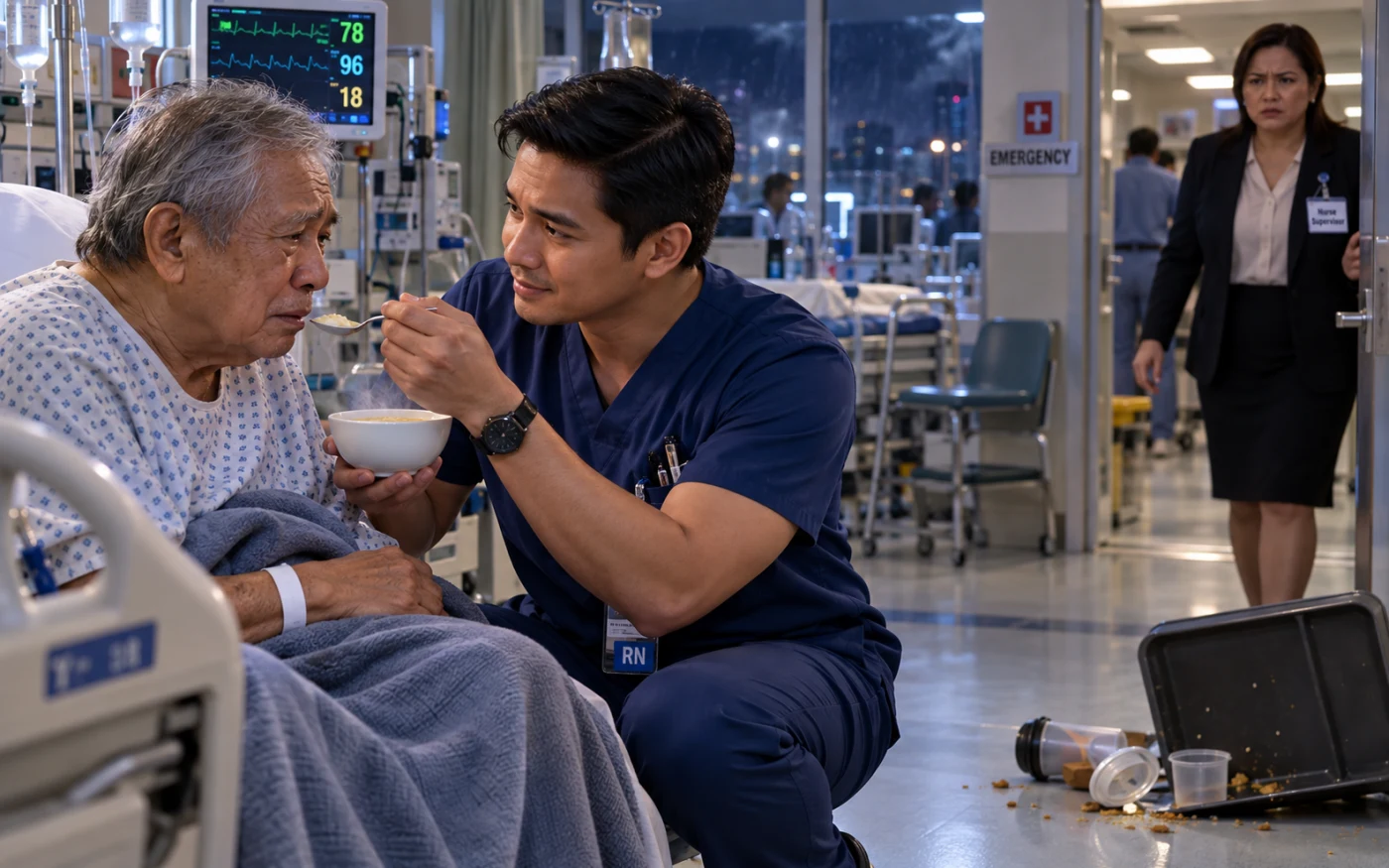
I Was Fired on the Spot for Giving Homemade Soup to a “Combative” ER Patient — Then the Hospital CEO Recognized Him and Asked, “Who Saved His Life?”
PART 1: The Thrown Tray
The old man threw his dinner tray at me.
I gave him my soup.
Twenty minutes later, my supervisor fired me.
My name is Carlo Pangilinan, and until that stormy night in Houston, I thought the worst sound in an emergency room was a flatline.
I was wrong.
The worst sound was my own nursing badge hitting Brenda Coleman's desk while two security guards waited outside her office.
But I'm getting ahead of myself.
That night, rain hammered the ER windows so hard that the whole building seemed to shiver.
Ambulances kept arriving. A highway collision filled Trauma Two. A little boy screamed while a doctor reset his wrist.
Every bed was occupied, every call light was blinking, and all of us were moving as if one missed step might cost a life.
At 9:17 p.m., paramedics brought in an elderly man found wandering beside a flooded road.
No wallet. No phone. No medical bracelet.
He was soaked through, trembling, and wearing one leather shoe.
Mud streaked his gray trousers.
A thin hospital-style undershirt clung to his chest, but nobody knew where it had come from.
"John Doe, Room 412," Brenda said, pushing the chart against me. "Confused, uncooperative, possibly combative. Get his vitals and keep him quiet."
Brenda was our night supervisor. She wore spotless white shoes through the messiest shifts and treated compassion like a supply we couldn't afford.
When I entered 412, the man was backed into the corner beside the bed.
"Sir, I'm Carlo. Nurse po ako."
His eyes snapped toward me.
For half a second, something changed in his face.
Then an orderly rolled in a tray of meatloaf, cold peas, and gelatin.
The man stared at it in horror.
"No," he whispered.
"It's okay," I said. "You don't have to eat."
He shoved the tray away. It struck the rail, flipped, and crashed across the floor.
Brenda appeared almost instantly.
"That's enough!" she barked.
The old man flinched so violently that his shoulder hit the wall.
"He's scared," I said.
"He's violent." Brenda handed me a form. "Document refusal of food and treatment. Restraints if he does it again."
She left before I could answer.
I crouched several feet from the man and watched him.
His lips were pale. Sweat shone above his eyebrows even though his soaked clothes must have been freezing.
His fingers trembled, but not like someone shaking from anger.
He kept swallowing, breathing too fast, pressing one hand against his stomach.
Then he muttered something.
I leaned closer.
"Sabaw," he said.
I froze.
"Gusto mo ng sabaw?"
His eyes filled with tears.
"Mainit," he whispered. "Please."
That was all he had been asking for.
I checked his chart. The first glucose test had been marked unsuccessful because he had pulled his hand away. Nobody had tried again.
"Sir, tingin po dito." I held up the lancet. "One small stick."
He shook his head, frightened.
So I sat on the floor.
I told him my mother, Remy, still packed my meals even though I was thirty-two and perfectly capable of feeding myself.
I told him she would consider an empty thermos a personal compliment.
I spoke softly, mixing English with the familiar words my lolo once used when he was afraid in a hospital.
The old man's breathing slowed.
Finally, he gave me his hand.
The meter flashed 43.
My stomach dropped.
His blood sugar was dangerously low.
I reached for the emergency glucose gel, but the bin was empty. Supplies were delayed downstairs.
The medication nurse was helping with the highway trauma, and the man began batting my hands away again when I tried to explain an IV.
"Mainit na sabaw," he begged.
Then I remembered my thermos in the breakroom.
That afternoon, Mama had made arroz caldo because I'd complained of a scratchy throat.
"Luya is medicine," she'd declared, filling the thermos to the top. "And don't share. Lagi kang gutom."
Hospital policy forbade giving patients food that hadn't come through dietary services. I knew the allergy rules, swallowing risks, contamination rules—all of it.
I also knew what 43 meant.
I called the attending physician twice. No answer. I paged dietary. No answer. In the hall, Brenda was shouting about wait times while three nurses fought to keep the ER afloat.
The old man slid lower against the wall.
I made my choice.
I ran to the breakroom, grabbed my thermos and a sealed packet of sugar, then returned to 412. I checked his swallow carefully with water. I stirred in the sugar and sat beside him with a spoon.
The scent of ginger and toasted garlic rose between us.
His whole face softened.
"Arroz caldo," he breathed.
"Opo. Homemade."
His trembling hand closed around my wrist—not to stop me, but to steady the spoon.
He took one bite.
Then another.
"Dahan-dahan lang," I said.
Tears rolled down his cheeks as he ate. With every spoonful, his breathing became calmer. The terror in his eyes began to loosen.
"My Pacita made this," he murmured.
"Your wife?"
He nodded, then frowned as if the memory had disappeared behind a door.
I was checking his glucose again when Brenda walked in.
She saw the thermos.
She saw the spoon in my hand.
And she shouted my name so loudly that the old man dropped the bowl.
PART 2: Who Knew His Name?
"Are you out of your mind?" Brenda demanded.
"His glucose was 43. He needed—"
"You fed unidentified homemade food to a patient with no allergy history and no diet order."
"The glucose bin was empty. I paged—"
"Office. Now."
The old man reached for me.
"Carlo," he said.
It was the first time he had used my name.
"I'll come back," I promised.
"No, you won't," Brenda said.
Inside her glass-walled office, she shut the blinds and snatched my badge from my chest.
"You ignored a direct instruction, violated food-safety policy, and endangered a patient."
"He was in shock. Look at his repeat glucose. It's rising. He can speak now. He said his wife's name is Pacita. We can use that to identify him."
Brenda didn't even glance at the reading.
"Your job was to document refusal."
"My job was to care for him."
The moment the words left my mouth, the room went still.
Brenda's jaw tightened.
"Excuse me?"
I thought about backing down.
My father had been driving a delivery van since his hours were cut. Mama's blood pressure medicine wasn't cheap.
I sent money to my younger sister while she studied physical therapy.
Losing my job didn't only belong to me.
But through the blinds, I could see Room 412.
The old man was sitting up now.
Alive. Watching the door.
"He wasn't rude," I said. "He was terrified, hypoglycemic, and unable to tell us what he needed. We failed him before he threw anything."
Brenda opened a drawer and pulled out a termination form.
"You are fired, effective immediately. I'll also report you to the nursing board for reckless conduct."
My knees nearly gave way.
"Brenda, please. Review the chart. Talk to the doctor."
"I don't need a lecture from someone who thinks his mother's leftovers outrank hospital protocol."
Heat rushed to my face.
"Huwag si Mama," I said quietly.
"What?"
"Leave my mother out of this."
She shoved the form toward me. "Sign."
I looked at the line above my printed name.
Seven years in nursing.
Seven years of night shifts, double shifts, missed birthdays, and Christmas video calls from supply closets.
Seven years of holding strangers' hands when their own families couldn't arrive in time.
Reduced to one blank line.
I didn't sign.
Brenda called security.
Two guards I knew—Marcus and Luis—appeared at the office door. Neither would meet my eyes.
"Sorry, man," Marcus murmured.
"It's okay," I lied.
I tucked my thermos under my arm. There was still a strip of masking tape on the lid where Mama had written, in blue ink, CARLO—UBUSIN MO.
I almost laughed. Instead, my eyes burned.
We had taken three steps into the corridor when the elevator doors opened.
Hospital CEO Margaret Whitmore rushed out, still wearing a raincoat over her evening clothes.
Beside her was Dr. Samuel Greene, our Chief of Medicine, and a woman with wet hair and no umbrella.
"Room 412," Dr. Greene called. "Where is he?"
Brenda stepped forward, instantly changing her voice.
"Dr. Greene, I have the situation under control. The unidentified combative patient—"
The wet-haired woman looked through the open doorway of 412.
She screamed.
"Papa!"
She ran into the room and wrapped both arms around the old man.
He blinked at her.
Then he touched her cheek.
"Isabel?"
She began sobbing.
Dr. Greene gripped the doorframe as if he needed it to remain standing.
The CEO turned toward us, pale and breathless.
"That's Dr. Eduardo Lazatin," she said. "And I need to know who saved his life."
Brenda slowly looked down at the thermos in my hands.
PART 3: Why The CEO Cried
I knew the name.
Everyone in the hospital did.
Dr. Eduardo Lazatin had built our cardiac surgery program decades earlier. His portrait hung outside the operating wing.
Surgeons still taught procedures he had pioneered, and the Lazatin family had donated ten million dollars to expand cardiac care for patients without insurance.
But the man in the portrait had sharp eyes, silver hair, and a commanding smile.
The man in Room 412 looked small beneath a heated blanket.
"He has vascular dementia," Isabel explained between tears.
"He slipped out of his care residence when the storm damaged a side gate. We've been searching for six hours. A police officer matched him to our missing-person alert. I called Dr. Greene from the car."
Dr. Greene was already reading the chart.
"Initial glucose?"
No one answered.
I did.
"Forty-three. He was sweating, trembling, confused, and refusing the cold meal. The glucose supplies were empty, and he wouldn't tolerate an IV. I gave him sweetened arroz caldo after checking that he could swallow. Repeat reading was 68 and rising."
Dr. Greene looked at me. "You recognized hypoglycemic shock from behavior everyone else called combative?"
"He asked for soup."
Isabel stared at my thermos.
"Arroz caldo?"
I nodded.
She covered her mouth.
"My mother Pacita made it whenever Papa came home after a long surgery. She died three years ago. Sometimes he remembers her through food before he remembers us."
Inside the room, Dr. Lazatin lifted his head.
"Carlo," he called weakly.
I went to him.
He reached beneath the blanket and held out his hand. When I took it, his grip was firmer than before.
"Good nurse," he said.
That was when the CEO began to cry.
Not loudly. She simply turned away, pressed two fingers beneath her eyes, and gathered herself.
Then Brenda cleared her throat.
"There was a serious policy violation. Mr. Pangilinan gave outside food to a vulnerable patient. I had no choice but to terminate him."
CEO Whitmore looked at my bare uniform where my badge had been.
"You fired him?"
"For patient safety."
Dr. Greene closed the chart.
"Patient safety? The first failed glucose test was never repeated. His symptoms weren't escalated. A critical supply bin was empty. No physician responded to two pages. And the nurse who corrected every failure is being escorted out?"
"He disobeyed me," Brenda said.
"Because your instruction was to document the patient, not understand him," the CEO replied.
Brenda's confidence cracked.
"Margaret, surely we can discuss this privately."
"We will. With Human Resources."
The CEO took the termination form from Brenda's hand.
She tore it once.
Then again.
The pieces fluttered into the trash.
"Mr. Pangilinan is not fired," she said. "You are suspended effective now, pending termination for gross patient neglect and falsification by omission. Hand Marcus your badge."
For once, Brenda had nothing to say.
She placed her badge in the same guard's palm where mine had rested minutes earlier. Then she walked past me without looking up.
I thought that would be the end of it.
It wasn't.
Isabel asked me, CEO Whitmore, and Dr. Greene to step into the hall.
"Before Papa's dementia worsened," she said, "he was planning one last gift to this hospital. Three million dollars for patient dignity—interpreters, cultural training, familiar meals for confused patients, and family advocates in emergency care. He was afraid medicine had become too efficient to be kind."
She looked through the doorway at him.
"Tonight proved he was right. It also showed us who should lead it."
I actually looked behind me.
"Me?"
"Yes, you," CEO Whitmore said.
"If you'll accept, I want you to help build the program as its nursing director. Not because you broke a rule. Because you understood why the rule existed, exhausted the safe options, and refused to stop seeing the person in front of you."
I could barely speak.
"I don't know how to direct a three-million-dollar program."
Dr. Greene smiled. "You knew how to reach a patient none of us had reached. We can teach you the paperwork."
From the room came Dr. Lazatin's voice.
"Give him the job."
We all laughed, even Isabel through her tears.
Three months later, the hospital opened the Lazatin Center for Cultural Compassion beside the emergency department.
But the moment I remember most wasn't the ribbon cutting.
It happened the following Friday at 7 p.m.
The ER was loud and overcrowded again. A frightened grandmother who spoke little English had been admitted after a fall. Her granddaughter was stuck across town, and the woman refused every meal placed in front of her.
This time, nobody called her difficult.
An interpreter sat beside her. A nurse asked what food felt safe. Dietary warmed a bowl of arroz caldo from our new familiar-meals kitchen.
I carried it into her room myself.
As I lifted the lid, steam curled into the air—ginger, garlic, chicken, rice.
The woman's shoulders relaxed.
Behind me, someone whispered, "Needs more fried garlic."
I turned.
Dr. Lazatin stood in the doorway with Isabel supporting one arm. His memory came and went now, but his smile was unmistakable.
Beside him was Mama, holding an enormous pot wrapped in towels.
"Anak," she said, kissing my cheek. "Your nurses look hungry."
Dr. Lazatin tapped the lid eagerly.
"Pacita?"
Mama's eyes softened.
"Remy po. This one's for the nurses."
She nodded toward the grandmother's bowl.
"That one's mine too."
I stared at her. "What?"
"Dietary asked for my recipe."
The woman tasted one spoonful, closed her eyes, and smiled.
Dr. Lazatin looked at me across the steam.
"Good nurse," he said again.
Mama squeezed my shoulder.
"O, ubusin ninyo," she told us.
And this time, nobody ate alone.