
Our Elderly Janitor Was Fired After 25 Years for Sleeping in the Staff Room. Then I Found His Hidden Notebooks...
PART 1: Asleep at 2 AM
I found Manong Delfin asleep at 2:07 in the morning.
Ten minutes later, he was fired.
And by sunrise, I was standing in front of his open locker, holding the first of twenty-five notebooks that would make our entire hospital board cry.
My name is Dr. Christine Soriano. I had worked in the pediatric wing of St. Catherine Medical Center in Seattle for eleven years.
Manong Delfin had been there for twenty-five.
He was sixty-eight. Small, silver-haired, and always pushing a cleaning cart that squeaked at the left wheel.
Every child knew him.
“Mr. Delfiiin!” they would call.
He would raise his mop like a royal staff. “The king of kalat has arrived!”
Even children with IV lines laughed.
That Tuesday night, our new administrator, Richard Caldwell, was inspecting the pediatric floor.
He had been with us for only six weeks, but he already walked like the building belonged to his grandfather.
Richard loved rules, polished shoes, and sending emails with the words FINAL WARNING in capital letters.
He hated overtime.
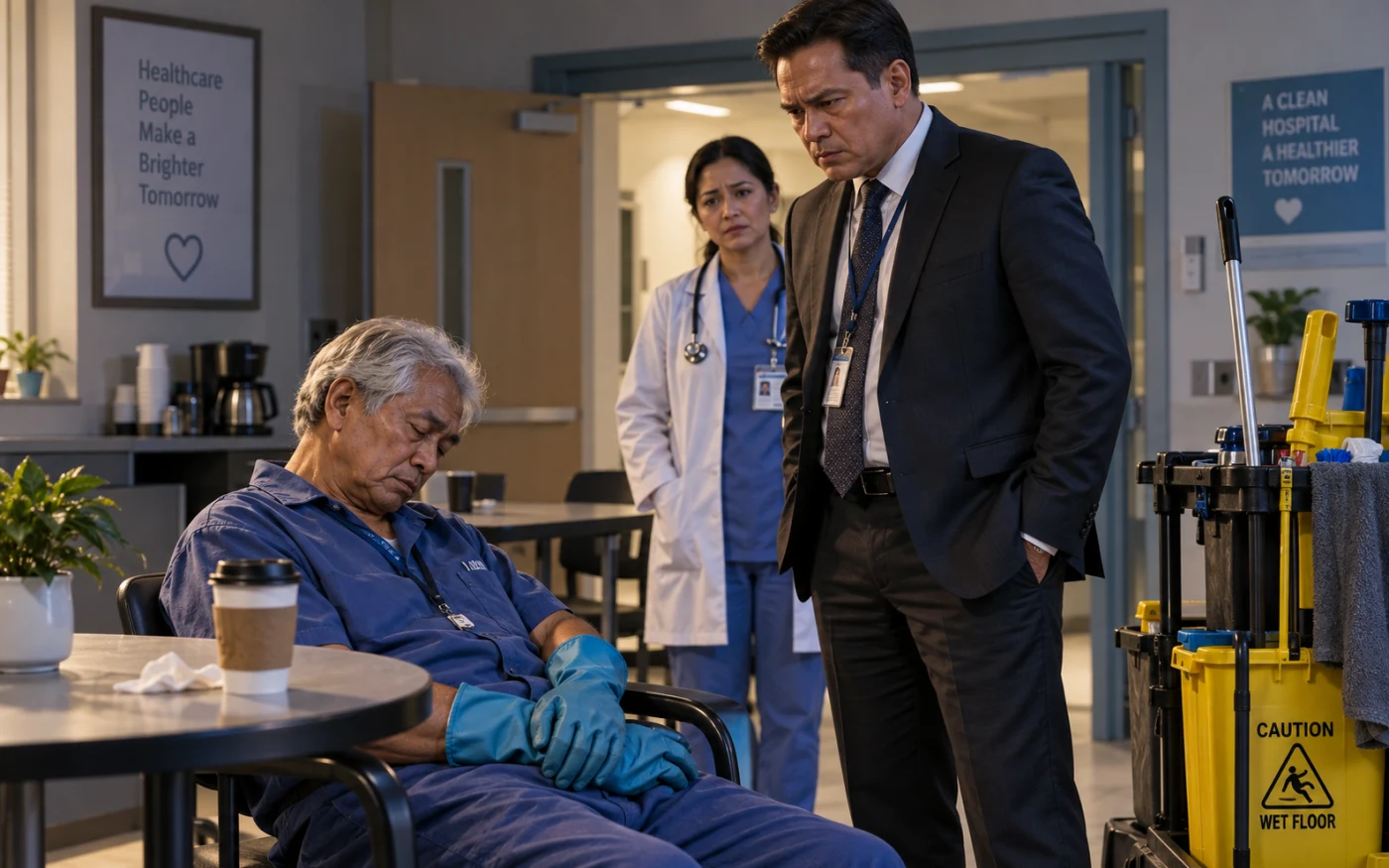
At 2:07, he opened the staff breakroom and saw Manong Delfin asleep in a chair.
His chin was on his chest. His cleaning gloves were still on.
Beside him sat a paper cup of untouched coffee.
“Unbelievable,” Richard said.
I was behind him, eating crackers between emergency calls.
“Keep your voice down,” I whispered. “He looks exhausted.”
Richard switched on every light.
Manong Delfin jerked awake. “Ay! Sorry, Doc. I only sat for one minute.”
Richard checked his watch. “You are being paid to work, not sleep.”
“His shift ended at midnight,” I said.
Richard looked at him. “Then why are you still here?”
Manong Delfin rubbed his face. “A child was crying.”
“You are not assigned to patient care.”
“Room 417 needed—”
“You left your assigned duties and slept in a restricted staff area. Hand me your badge.”
I thought he was bluffing.
He was not.
Manong Delfin went very still. “Sir, I’ve been here twenty-five years.”
“Then you know the policy.”
“Richard,” I snapped, “you cannot fire someone in a breakroom at two in the morning without even asking what happened.”
“I just asked. He abandoned his post.”
Manong Delfin slowly removed the badge clipped to his faded blue uniform. His fingers shook.
That hurt me more than I expected.
I had seen those hands polish floors, fix broken toy wheels, open juice boxes, and wipe vomit from terrified children without once making them feel ashamed.
Now those same hands placed twenty-five years on a plastic table.
“It’s okay, Doktora,” he told me softly. “Please go back to your patients.”
Then he walked away with his coat over one arm.
His cleaning cart remained in the hallway.
The left wheel squeaked all night.
At seven that morning, I checked room 417.
Inside was nine-year-old Luis, a boy from Yakima who had arrived with pneumonia and a dangerous fever.
He had recently entered foster care after his mother died.
No parent sat beside him. No balloons crowded the window.
But one chair had been pulled close to his bed.
On the blanket lay a yellow cleaning glove.
“Luis,” I asked, “was Mr. Delfin here?”
His eyes opened a little. “He stayed when the scary dreams came.”
“For how long?”
“A lot.” He swallowed. “He sang the same song again and again. He said I could squeeze his hand until I wasn’t scared.”
I checked the overnight chart.
At 10:48, Luis had awakened screaming.
At 10:52, Manong Delfin entered after hearing him cry.
At 11:15, the nurse called the emergency foster number. No answer.
At 12:06, his fever rose.
Luis finally fell asleep at 1:51.
Manong Delfin had sat there for almost three hours, most of it after his shift ended.
Then Richard found him asleep sixteen minutes later.
I stormed into the administrator’s office.
“You fired him for holding an orphan’s hand.”
Richard did not look up from his laptop. “I fired an employee for negligence. Emotional stories do not change policy.”
“He stayed unpaid.”
“Which is another violation.”
I wanted to throw his laptop into Puget Sound.
Instead, I said, “Reverse it.”
“No.”
“Then I’m taking it to the board.”
That made him look up.
“With what evidence, Doctor? A child’s sleepy memory?”
I had no answer.
At noon, our facilities supervisor asked me to witness the clearing of Manong Delfin’s locker.
Richard wanted it emptied before the next shift, as if a man could be erased between lunch and dinner.
His locker held ordinary things: spare socks, menthol candy, a tiny Santo Niño, three family photographs, and a dented thermos.
Behind his things was a stack of leather notebooks tied with cooking twine.
Each spine had a year written in black ink.
Twenty-five notebooks.
All the way to the present.
I opened the newest one.
At first, I saw floor charts and cleaning times. Then the handwriting changed.
Room 403. Mia. Afraid of thunder. Likes “You Are My Sunshine.” Slept 11:42 PM.
Room 411. Jacob. Father working night shift. Wants hallway light left one-third open.
Room 417. Luis. Fever. No family reached. Ilokano cradle song calmed him.
There were hundreds of names.
Thousands.
And on the last page, written only hours earlier, was one unfinished sentence:
If nobody comes when a child cries, then I will—
PART 2: Why He Kept Records
I carried those notebooks into Richard’s office and dropped them on his desk.
The sound made his coffee jump.
“What is this?” he asked.
“The evidence you wanted.”
He opened one notebook, glanced at a page, and shut it. “These are personal notes. They don’t change the termination.”
“Read them.”
“I’ve made my decision.”
He pushed the stack back toward me.
Before I left the hospital, I took photos of several pages and handed the notebooks to Dr. Ruth Kaplan, our department chief, for the board appeal.
Then I called Manong Delfin.
He answered on the fifth ring. Traffic roared behind him.
“Doktora?”
“Why did you keep the notebooks?”
Silence.
Then he sighed. “Because children forget what helps when they are afraid. Adults forget faster.”
“Where are you?”
“Bus stop.”
I found him twenty minutes later sitting under cold rain with a grocery bag containing his uniform.
He refused my umbrella until I stood over him and said, “Move, Manong. I am already angry. Don’t make me wet and angry.”
That finally made him smile.
We went to a small Filipino bakery near the hospital.
He wrapped both hands around a cup of salabat while I opened photos I had taken of several notebook pages.
He looked embarrassed.
“In the first notebook,” he said, “there was a little girl named Hannah. Six years old. Leukemia. Her mother cleaned offices at night, so Hannah was often alone after visiting hours.”
He had heard her sobbing while he mopped.
“I did not know what to say,” he continued.
“So I sang the song my mother sang in Ilocos when the wind was loud. Hannah slept. The next night, she asked for it again.”
He tapped the photograph of his first notebook.
“I wrote it down because I was afraid I would forget.”
After Hannah came Marcus, who needed the closet checked three times for monsters.
Then Sophie, who slept only if someone described how to cook pancit step by step.
Then baby Noah, soothed by the sound of Manong Delfin’s keys shaking softly like a tiny tambourine.
He recorded room temperatures because some children cried when feverish but could not explain they felt too hot.
He noted which night-light colors helped. Which songs worked. Which stuffed animals were missing.
Which parents were delayed by work, weather, or fear.
“Why didn’t you tell us?” I asked.
“Sometimes nurses knew. Sometimes doctors knew.” He looked at me gently. “You knew some nights.”
I did.
I remembered seeing him outside rooms, humming while polishing a handrail. I had mistaken love for a habit.
“But I am janitor,” he said.
“If I made a big announcement every time I sat with a child, people might stop me. So I cleaned. I listened. If someone cried, I stayed a little.”
“A little? You stayed three hours with Luis.”
“He had nobody.”
“You got fired.”
He stared into his drink. “At least he slept.”
I had to look away.
Then my phone buzzed.
It was a message from Dr. Ruth Kaplan.
BOARD MEETING. 8 A.M. TOMORROW. BRING DELFIN.
Below it was another message.
I FOUND SOMETHING IN THE 2004 NOTEBOOK.
The next morning, Richard entered the boardroom carrying a thick policy binder. Manong Delfin entered carrying his grocery bag.
I sat beside him.
Dr. Kaplan placed the 2004 notebook on the table. “Before we begin,” she said, “I want to read one entry.”
Richard objected immediately. “These records were created without authorization.”
“Then authorize yourself to listen,” she said.
I nearly applauded.
She read aloud.
October 16. Room 408. Rebecca, age seven. Surgery tomorrow. Mother, Dr. Kaplan, stuck across town in ice storm. Likes counting backward from one hundred but skips seventy-four. Asked me not to leave until her mother returned.
Dr. Kaplan’s voice broke.
She turned the page toward us. Taped inside was a faded drawing of a bald little girl holding hands with a man pushing a mop.
“Rebecca was my daughter,” she said.
Nobody moved.
“She died that winter. I was not only her doctor. I was her mother, and one night I got trapped across town during an ice storm. Delfin sat beside her for five hours.”
She faced him. “I never knew it was you.”
Manong Delfin lowered his eyes. “She was very brave.”
Dr. Kaplan closed the notebook. “These are not the records of a negligent employee. They are the memory of this hospital.”
Board members began opening other volumes.
Then the chairwoman suddenly stopped.
She stared at an entry from 2008, covered her mouth, and whispered, “That’s my son. He’s thirty now. He still remembers Mr. Delfin.”
One by one, people around the table began recognizing children they loved in Manong Delfin’s notebooks.
But Richard stood and reached for the policy binder.
“Whatever sentimental value these journals have,” he said, “the termination was lawful.”
The chairwoman looked directly at him.
“Sit down, Mr. Caldwell. We are not discussing the termination anymore.”
Richard smiled.
Manong Delfin squeezed his grocery bag.
And I realized neither of them understood what she meant.
PART 3: What the Board Decided
“We are discussing the hospital’s negligence,” the chairwoman said.
Richard’s smile disappeared.
She held up the 2008 notebook. “For twenty-five years, this man performed emotional care that our staffing plans failed to provide. He noticed children who fell between shifts, visiting hours, and job descriptions.”
Another board member opened the 2016 volume. “He documented a heater malfunction in room 422 three nights before maintenance logged it.”
“Because the baby kept kicking off her blanket,” Manong Delfin said. “The room became too hot, then too cold.”
The member stared at him. “Your notes may have prevented an injury.”
Richard cleared his throat. “With respect, none of that changes the fact that he was sleeping.”
I pushed back my chair.
“You’re right,” I said.
“He was sleeping. Sixteen minutes after holding a feverish child’s hand for nearly three hours. Unpaid. After his assigned shift. I was there, and I should have defended him sooner and louder.”
I placed my own badge on the table.
“If that is negligence, put my name beside his.”
Manong Delfin grabbed my wrist. “No, Doktora.”
“Yes, Manong.”
Dr. Kaplan placed her badge beside mine.
Then our head nurse did the same.
Clack.
Clack.
Clack.
By the fifth badge, Richard’s face looked like spoiled milk.
The chairwoman raised one hand. “Nobody else needs to resign. And Mr. Agbayani does not need to defend his humanity to keep a cleaning job.”
She turned to Manong Delfin.
“Sir, the board unanimously overturns your termination, effective immediately. You will receive full back pay.”
His shoulders dropped, but she was not finished.
“However, we do not want you to return as a janitor.”
His face crumpled.
For one horrible second, he thought they were firing him again.
“Ma’am,” he whispered, “cleaning is honest work.”
“It is,” she said. “But the work you taught yourself to do deserves a name, a salary, and support.”
She slid a printed page across the table.
At the top were two words in large letters:
COMFORT COORDINATOR.
The position included full benefits, daytime planning hours, paid evening rounds, and a small team of trained volunteers for children whose families could not be present.
Manong Delfin read the first line three times.
“This is for me?”
“If you accept.”
He looked at me. Then at Dr. Kaplan. Then at the notebooks spread across the table like twenty-five years of open doors.
“Can I still bring my mop sometimes?” he asked.
The entire room laughed through tears.
Even he laughed.
Richard did not.
The chairwoman asked him to remain after the meeting for what she called “a serious review of leadership judgment.” I never learned every detail of that conversation, and frankly, I slept very well without knowing.
Manong Delfin started his new job the following Monday.
He arrived two hours early in a pressed blue shirt, carrying the same dented thermos.
Facilities had repaired the squeaky wheel on his old cart and turned it into a mobile comfort station filled with books, soft blankets, night-lights, headphones, crayons, and a speaker for lullabies.
Luis was still in room 417.
When Manong Delfin stepped inside, the boy’s whole face changed.
“You came back!”
“Of course,” Manong Delfin said. “You still owe me one good dream.”
Luis lifted his left hand.
Manong Delfin took it.
Three months later, the board called us to the pediatric lounge.
A blue cloth covered a bronze plaque on the wall. Staff crowded the doorway.
Former patients had come too—some with children of their own.
There was Hannah, the first little girl from the first notebook, now a school principal. She carried the old drawing she had made of a janitor wearing a crown.
There was Marcus, now taller than everyone, laughing that he still checked closets in hotel rooms.
And there was Luis, thinner but healthy, standing beside his new foster parents.
The chairwoman invited Manong Delfin forward.
He looked ready to escape through the nearest supply closet.
“For twenty-five years,” she said, “Delfin Agbayani made sure no child in this hospital faced the dark alone.”
She pulled the cloth.
THE DELFIN AGBAYANI PEDIATRIC COMFORT LOUNGE.
Underneath, in smaller letters, were the final words from his unfinished notebook entry:
If nobody comes when a child cries, then I will stay.
Manong Delfin touched the plaque with both hands.
Then Luis tugged his sleeve. “Mr. Delfin, the room needs a song.”
Manong Delfin wiped his eyes. “Only one?”
He began the old Ilokano lullaby.
Dr. Kaplan joined him. Then Hannah. Then the nurses. None of us knew all the words, so half the room hummed and the other half cried.
I looked at Manong Delfin in the lounge carrying his name, surrounded by children who had grown up because someone had stayed.
His old cleaning cart stood beside him.
The left wheel gave one tiny squeak.
Manong Delfin smiled and kept singing.