
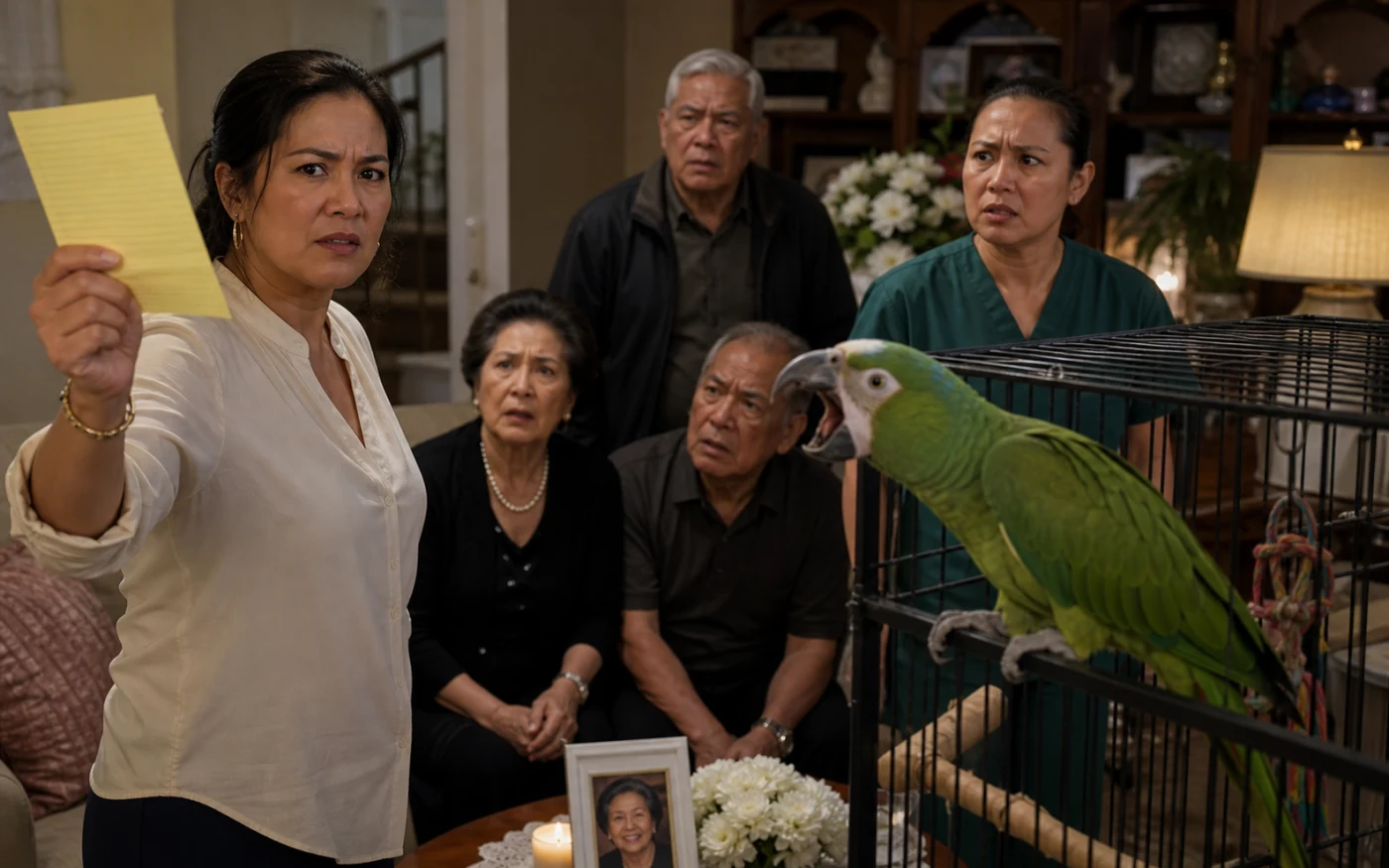
My Cousin Claimed Grandma’s Final Wish Was to Give Her the Family House. Then Grandma’s Parrot Started Screaming, “SHE LIED!”
PART 1: The Paper Teresa Brought
The first time Piko screamed “SHE LIED!” at my cousin Teresa, nobody laughed.
He said it in Grandma Nena’s voice.
Exactly.
Same rough little rasp. Same sharp anger.
“SHE LIED!”
Teresa froze with one hand on the dining table.
Then she smiled too quickly.
“Grabe. Even the bird wants drama.”
Piko stared at her from his cage beside the window.
We were in Grandma’s house in Daly City, five days after her funeral. Condolence flowers still crowded the piano. Foil trays filled the refrigerator. Extra chairs leaned against the wall.
That house had held our family for more than forty years.
Christmas Eve. Baptism lunches. Cousins sleeping under coats while the adults talked too loudly in the kitchen. Pencil marks inside a closet door where Grandma measured grandchildren and refused to paint over them.
My mother, Elena, lived upstairs and expected to stay there.
I had lived downstairs for the last three years, after Grandma’s second bad fall. I handled her medicine, drove her to appointments, cooked, and learned every small routine that made her days easier.
I never expected the house.
Grandma already had a will. As far as I knew, her three children would inherit everything, and Mom could remain in the house.
I only wanted that plan respected.
Then Teresa arrived carrying a cream envelope.
“Before Lola went to the hospital,” she said, “she changed her mind.”
Auntie Lorna frowned. “About what?”
Teresa placed one page on the table.
“The house.”
At the top, it said it was an amendment to Grandma’s will.
Below that was a sentence giving the entire house to Teresa.
Grandma’s name was there. A signature that looked like hers. Two witness signatures. A notary stamp.
Uncle Boy read it twice.
If the paper was real, Teresa might get the house.
Mom might lose her home.
Teresa folded her hands.
“Lola knew I’m struggling. She knew I need security for my family.”
Across the room, her older son Carlo looked down uncomfortably.
Teresa had always been easy to like when she wanted to be. She remembered birthdays, brought good food, made Grandma laugh.
She also had emergencies constantly.
Rent. Credit cards. Car payments. Business trouble. Grandma had rescued her more times than any of us could count.
“When did she sign this?” I asked.
Teresa pointed to the date.
My stomach dropped.
That afternoon, Teresa had visited while I went to pick up Grandma’s medicine.
They had been alone for about forty minutes.
“You did this while I was at the pharmacy?”
Her face hardened.
“That is exactly why she didn’t tell you.”
“Why?”
“Because you think being here made you in charge.”
“I never said that.”
“You don’t have to.” She looked straight at me. “You were her caregiver, Mara. Not her owner.”
That hurt because it was designed to.
I had spent three years making sure Grandma did not fall in the shower, miss a pill, or sit alone in an emergency room.
I had never asked her for the house.
“I’m not asking for anything,” I said. “I’m asking whether she understood what she signed.”
Teresa stood.
“She knew exactly what she wanted.”
My mother said, “Tess, Mama always said the house should stay with the family.”
“And I am family.”
“She also said I could stay.”
Teresa looked at Mom, then away.
“She changed her mind.”
Piko began climbing across his perch.
Teresa picked up the document.
“Lola knew you’d all call me irresponsible. She knew Mara would fight because Mara thinks this house belongs to her.”
“I never said that.”
“She wanted me to have one thing that could finally make my life stable.”
“SHE LIED!”
The room went silent.
Teresa’s fingers tightened around the paper.
Piko leaned forward.
“SHE LIED!”
Then, in Grandma Nena’s furious voice, he shouted:
“NO, TESS!”
Teresa took one step backward.
Piko flapped his wings.
“NO HOUSE!”
And this time, nobody looked at the bird.
We all looked at Teresa.
PART 2: Why Piko Knew
“It’s a parrot,” Teresa snapped. “He repeats things.”
“Yes,” I said.
That was exactly the problem. Piko did not invent sentences. He heard them.
Teresa moved toward his cage.
“Cover him.”
I stepped in front of her.
“No.”
“Mara, move.”
“Leave him alone.”
Piko paced along his perch.
“No, Tess. No house.”
Then he made three soft electronic notes.
Beep-beep-beep.
I knew that sound. Grandma’s old tablet made it whenever she started recording video.
For years she had used it to record Piko and send bird videos to our family group chat.
The tablet was still on the bookshelf across from the cage.
I grabbed it.
Teresa saw where I was going.
“Mara.”
The battery was dead. I plugged it in.
Uncle Boy said, “Let her look.”
When the screen came on, I searched the date on Teresa’s document. Three videos.
The longest one had started twelve minutes after I texted Grandma that I was waiting at the pharmacy.
My hands shook when I pressed play.
The camera showed Piko’s cage and one edge of Grandma’s recliner. Grandma and Teresa were mostly offscreen.
At first, ordinary voices.
Then Teresa said, very gently, “Lola, sign this one too.”
Grandma answered, “What is it?”
“Just paperwork so I can help with the house bills.”
My mother gripped my wrist.
On the recording, Grandma said, “Give me my glasses.”
“You don’t need them. It’s the same thing we talked about.”
“What thing?”
“The property paper. Just sign here.”
Paper rustled.
Then Grandma’s voice changed.
“Why does it say transfer?”
Nobody in our living room moved.
Teresa reached for the tablet.
Uncle Boy blocked her.
“Don’t.”
On the video, Teresa laughed nervously.
“It’s legal wording, Lola.”
“Legal for what?”
“So I can handle things if something happens.”
“I have Mara.”
Teresa’s recorded voice tightened.
“Mara is not your only family.”
“I did not say she is.”
“You help everybody except me.”
“I helped you last month.”
“I need something permanent.”
Grandma was quiet.
Then Teresa said, “Please. I’m drowning.”
“Give me my glasses.”
More paper moved.
Then Grandma spoke so loudly that Piko fluttered on the recording.
“You lied to me.”
“Lola—”
“You said bills. This gives you my house.”
“No, it protects—”
“You lied to me.”
A hard rip. Then another. Teresa gasped.
Grandma said, “You fix your own problems.”
“I have the boys.”
“They are men.”
“Lola, please.”
“The house is not yours.”
Piko shrieked.
“No house!”
Grandma said it with him.
“No, Tess. No house.”
There it was. Not a ghost. Not a miracle.
A bird sitting five feet away while Teresa tried to trick an old woman into signing away her home.
The front door slammed.
For several seconds, the video was quiet. Then Grandma shuffled into view holding torn pieces of paper.
She sat in her recliner and noticed the tablet’s red light. She leaned toward it.
“Mara,” she said, “when you come home, remind me to call Attorney Reyes.”
My mother squeezed my hand harder.
Grandma looked down at the torn paper.
“I should have settled this house properly a long time ago.”
She was quiet for a moment.
Then she looked toward the tablet.
“I know what I want now.”
The recording ended. Nobody spoke.
Teresa’s page was still on the table.
Grandma had torn the paper Teresa tried to make her sign.
But two days after that video, Grandma’s tablet calendar showed a long call with one name.
REYES. Her lawyer.
Grandma had made a real decision about the house.
And none of us knew what it was.
PART 3: Who Grandma Called
Attorney Miguel Reyes came to the house that afternoon.
He had represented Grandma and Grandpa for years. I gave him the tablet and Teresa’s document.
He watched the recording once. Then he took off his glasses.
“Tess,” he said, “your grandmother tore up the paper she saw. This one was notarized after her death.”
Teresa went pale. Attorney Reyes opened his folder.
“Two days after that video, your grandmother called. I came here with two witnesses. She was very clear.”
My mother whispered, “About the house?”
“Yes.”
He placed one document on the table.
One real document from Grandma’s real lawyer.
Then he read the sentence that changed my life.
“I leave my home to my granddaughter Mara, who already knows what a home is for. My daughter Elena may live there for as long as she wishes.”
I stared at him.
“What?”
My mother covered her mouth.
Auntie Lorna started crying.
Uncle Boy nodded once, hard, like Grandma had just walked into the room and settled everything herself.
Teresa said, “No.”
Attorney Reyes looked at her.
“This is your grandmother’s final signed will.”
Teresa turned to me.
“You knew.”
“I didn’t.”
“You had to know.”
“I swear, Tess. I didn’t.”
And I hadn’t.
Grandma never promised me the house. I had assumed that after she died, I would eventually pack my things and leave the downstairs room.
My only fear had been for Mom. Now Mom was crying beside me. I put my arm around her.
“You stay,” I whispered.
She nodded. Then the doorbell rang and Auntie Lorna opened it.
A woman stood on the porch holding a folder. Behind her was a young man with a camera bag and a real-estate lockbox.
“Hi,” the woman said. “I’m looking for Teresa? We’re here for the listing photos.”
Nobody spoke.
Teresa closed her eyes.
The realtor glanced at the funeral flowers.
“Oh. I’m sorry. She told me the family meeting would be finished by one.”
Uncle Boy slowly turned toward Teresa.
“Listing?”
Teresa’s older son, Carlo, was standing near the hallway. He had come over while we waited for Attorney Reyes.
“Mom,” he said.
Teresa did not answer.
The realtor backed toward the door.
“I can come another day.”
“No,” Carlo said. “You don’t need to.”
He looked at his mother.
“You told us you wanted the house so we would always have somewhere to come home to.”
Teresa started to speak.
Carlo shook his head.
“We never asked you to do this.”
That was enough.
Teresa had not planned to move her sons into Grandma’s house.
She had planned to sell it.
Turn Grandma’s kitchen, Grandpa’s old workbench, Mom’s bedroom, the pencil marks in the closet—everything—into money for her debts.
Teresa sat down.
“I was desperate.”
My mother looked at her.
“I know.”
No one rushed to rescue her. No one needed to destroy her either.
Auntie Lorna handed Teresa’s document to Attorney Reyes.
Uncle Boy said, “We love you, Tess. But this stops here.”
Carlo stood beside his mother, angry and embarrassed.
“We’ll help you make a real plan,” he said. “Not this.”
The realtor left with the lockbox. Teresa left without the house.
A few months later, Grandma’s place was loud again.
Mom was still upstairs.
Auntie Lorna was in the kitchen arguing with Uncle Boy about how much pancit one gathering required. Carlo brought his wife and little girl. Cousins came through the front door without knocking.
There were shoes everywhere.
Too much food on the table.
A child asleep on the sofa under somebody’s jacket.
For the first time since Grandma died, the house did not feel like a place we were trying to preserve.
It felt alive.
I had worried that inheriting it would feel wrong, as if I had been paid for taking care of Grandma.
It did not.
Standing in that crowded kitchen, I understood what she had left me.
Not a prize. A responsibility.
Keep Mom safe. Keep the door open. Let people come home.
Piko watched from his cage near the window.
I brought him a slice of mango. He took it from my fingers and leaned close.
For a second he only clicked his beak.
Then, in Grandma Nena’s softest voice, he said:
“Good girl, Mara.”
I cried before I could stop myself.
Around me, the house kept talking.