
I Caught My Husband Pawning the Watch I Gave Him on Our Wedding Day. When I Followed Him, I Found My Father Sitting in the Back Room...
PART 1: Behind the Gray Door
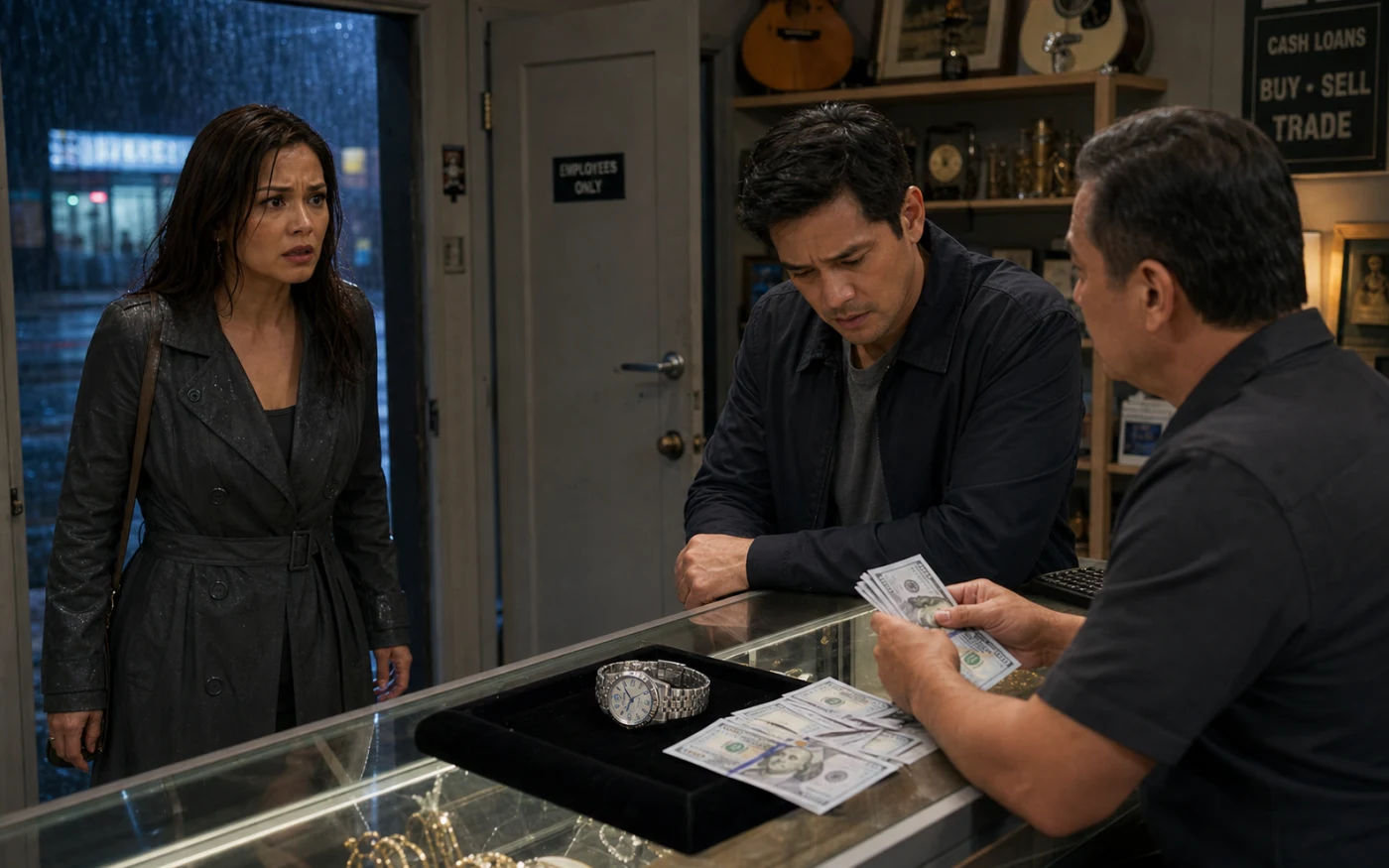
The watch was lying on black velvet when I saw it through the pawnshop window.
Silver case. Blue hands. A thin scratch beside the number four.
On the back were the words I had paid extra to engrave seventeen years earlier:
For every hour we choose each other.
And my husband was selling it.
For three weeks, Raul had left our house before sunrise and returned after I was in bed.
He said the accounting department was preparing for an audit.
He said the withdrawals from our savings were for an anniversary surprise.
Apparently, the surprise was bankruptcy.
I stood in the rain while the pawnbroker counted several hundred-dollar bills into Raul’s hand.
Raul did not look relieved.
He looked sick.
Then the pawnbroker pointed toward a gray door at the back. Raul nodded and disappeared through it.
Someone was waiting for him.
I stormed inside so hard the bell above the door nearly flew off.
Raul stepped back into the shop.
His face went white.
“Mila.”
I pointed at the watch.
“Are you gambling?”
“No.”
“Do you owe someone money?”
“No.”
“Is there another woman?”
He flinched. “Never.”
“Then why are you pawning our wedding watch?”
A chair scraped behind the gray door.
I pushed past him.
My father was sitting beneath a flickering light.
His jacket was folded beside him. His shirt was soaked with sweat. His wedding ring, the title to his truck, and a stack of medical bills were spread across the table.
“Tatay?”
He tried to stand.
His knees buckled.
Raul caught him before he hit the floor.
I dropped beside them. “What happened?”
“Nothing,” my father whispered.
“You are gray, sweating, and trying to pawn your wedding ring. Pick a better word.”
The pawnbroker brought water.
“Arturo had chest pain again,” he said.
“Again?”
My father closed his eyes.
I looked at Raul. “How long have you known?”
“Two weeks.”
The room tilted.
“You knew my father was having chest pain for two weeks?”
“He refused the hospital.”
“And you obeyed him?”
My father lifted one finger. “I said I would take a bus to Nevada if he told you.”
“You are seventy-two years old!”
“I know how old I am.”
“Then stop planning escapes like a teenage criminal.”
His mouth trembled.
The anger drained out of me.
My father had always been painfully proud.
Now his ring was on a pawnshop table.
I picked up the bills.
One was for cardiac testing. Another had FINAL NOTICE stamped across it.
Underneath them was a letter from Mendoza Machine Works, the company my father had built with his business partner, Raymond Vale.
The letter accused my father of stealing $612,000 from the employee retirement fund.
“I did not take it,” Tatay said.
“I know.”
Raul sat beside him. “Raymond moved the money through fake vendor accounts. Then he used your father’s electronic signature to approve the transfers.”
Raymond Vale had eaten at our table.
He had held my daughter at her baptism.
He called every employee “family” before cutting their overtime.
My husband had been the company controller for eleven years.
He had access to every account.
Every invoice.
Every lie.
“How do you know?” I asked.
Raul pulled a small recorder from his pocket.
“Raymond called Tatay this morning.”
He pressed play.
Raymond’s smooth voice filled the room.
“Tomorrow night, you will attend the company anniversary banquet. You will announce your retirement and sign the confession I prepared.”
My father’s recorded voice shook.
“And if I refuse?”
Raymond laughed.
“Then your daughter learns her husband helped you steal from two hundred employees. Raul will be charged beside you. Your house will be seized, and your grandchildren will hear the word thief every time someone says your name.”
There was a pause.
Then Raymond said, “Bring the signed confession tomorrow. Do not embarrass yourself.”
The recording stopped.
I looked at my husband’s bare wrist.
And I realized the watch was only the smallest secret the two men I loved had kept from me.
PART 2: What Raul Sacrificed
Raul opened his phone and showed me photographs of invoices, bank transfers, and emails.
Raymond had created three companies that existed only on paper. Mendoza Machine Works paid them for equipment that never arrived. The money went into an investment account controlled by Raymond’s brother.
“I found the transfers three weeks ago,” Raul said. “Raymond ordered me to sign an audit statement blaming Tatay.”
“And when you refused?”
“He suspended me.”
My stomach dropped. “You told me you were working late.”
“I was copying records before he locked me out.”
For three weeks, my husband had kissed me goodbye and pretended to go to a job he no longer had.
“How much of our savings is gone?” I asked.
He looked down. “Eleven thousand four hundred dollars.”
“Raul.”
“Tatay’s clinic visits. A lawyer. An investigator. And a forensic accountant who traced the vendor accounts.”
“So now the watch.”
“The final report was due today.”
I wanted to admire him.
I wanted to shake him.
Instead, I said, “You turned me into the only fool in my own family.”
“I promised your father.”
“And you promised me.”
That landed harder than any slap.
My father covered his face. “I made him do it.”
“Wonderful. Then I am furious with both of you.”
Raul reached for me, but I stepped back.
“What happens tomorrow?”
“Tatay signs the confession or Raymond goes to the police first,” he said. “The forensic report proves where the money went, but Raymond will claim we fabricated it.”
I picked up the confession.
At the bottom was my father’s full name:
Arturo Santiago Mendoza.
I read it twice.
Then I smiled.
“Raymond made a mistake.”
My father frowned. “What mistake?”
“You stopped using Santiago legally in 1989.”
I supervised archived filings at the county recorder’s office. Raymond thought I spent my days placing dusty deeds into boxes.
In fact, I knew that every paper from the company’s founding bore my father’s former legal name and original ink signature. If the new authorizations used that same obsolete name, Raymond had probably copied the old filing instead of getting my father’s approval.
The next evening, Raymond decorated the company ballroom in gold.
Gold curtains. Gold balloons. A six-tier gold cake.
Across the stage hung a banner:
MENDOZA MACHINE WORKS: FORTY YEARS OF FAMILY
Two hundred employees sat beneath it, wondering whether their retirement money still existed.
Raymond welcomed my father with open arms for the cameras.
His mouth stayed close to Tatay’s ear.
“Sign,” he whispered, “or I bury all three of you.”
I smiled brightly. “Lovely party, Raymond.”
His eyes narrowed. “You should not be here.”
“My family built this company.”
“Your husband no longer works here.”
The ballroom went quiet.
Raul stepped forward. “That is true. I resigned this afternoon.”
Raymond laughed. “You cannot resign after being suspended.”
“I can refuse to sign a fraudulent audit.”
The laughter vanished.
Raymond returned to the stage and raised the confession.
“Ladies and gentlemen, our company has discovered serious financial irregularities authorized by my longtime partner, Arturo Mendoza, with help from his son-in-law.”
Employees stared at my father.
Some looked furious.
Some looked heartbroken.
Raymond handed Tatay the confession and a pen.
“Sign it.”
My father looked at the people he had hired. Men and women whose children he had watched grow up.
His hand shook.
Then he snapped the pen in half.
The sound cracked through the microphone.
“My name is Arturo Mendoza,” he said. “And I did not steal from you.”
Raymond grabbed his arm.
I rushed toward the stage holding certified copies of the company’s original filing and my father’s legal-name change.
“Security!” Raymond shouted.
Two guards moved toward me.
Raul connected his phone to the ballroom projector.
The huge screen flickered.
“Before you throw us out,” he said, “everyone should see what Raymond Vale did at exactly 9:42 on March fourteenth.”
PART 3: The Minute Raymond’s Lie Collapsed
A banking authorization filled the screen.
It showed my father’s electronic signature approving a $94,000 payment to one of Raymond’s fake vendors.
The timestamp read March 14 at 9:42 a.m.
Raymond smiled. “Thank you for proving my point.”
“Not yet,” I said.
The authorization did more than use my father’s old legal name. Its signature was a pixel-for-pixel copy of the ink signature on the company’s original filing, down to the blot on the final letter.
“Real signatures vary,” I said. “Copied images do not.”
I held up my father’s passport and airline itinerary.
“My father was in Manila that week.”
Raymond shrugged. “Electronic documents can be signed from anywhere.”
“Correct,” Raul said. “But this one was approved from your office computer.”
The screen changed.
Security footage showed Raymond at his desk at 9:41, leaning over the keyboard.
The ballroom erupted.
Raul displayed the vendor records. All three fake companies shared one private mailbox registered to Raymond’s brother. Each had transferred money into the same investment account.
An employee stood and shouted, “That was our retirement!”
Raymond pointed at Raul. “He fabricated everything because I fired him.”
For the first time, fear crossed my husband’s face.
Not fear of Raymond.
Fear of telling the whole truth.
Raul took the microphone.
“My name appears on two false audit reports,” he said.
I closed my eyes.
Our lawyer had told him he could claim ignorance.
But Raul had said, “If I ask the employees to trust the records, I cannot hide from the records that include me.”
Now he faced two hundred angry people.
“I believed Raymond’s invoices were legitimate,” he continued. “I should have verified them. I did not steal the money, but my signatures helped conceal the theft. I have given every record to state investigators, and I will accept the consequences.”
Raymond smiled. “So you admit you were involved.”
Raul faced him.
“I admit I trusted you. That mistake ends tonight.”
The ballroom doors opened.
Three investigators entered with two officers.
Raymond stepped backward. “You cannot arrest me based on stolen records.”
The lead investigator held up a warrant.
“No,” she said. “We can arrest you based on your bank records.”
Raymond turned toward a side exit.
That was when the giant gold anniversary banner broke loose.
It wrapped around his shoulders and knocked him into the cake table.
Six tiers of gold frosting collapsed onto his chest.
A balloon printed with FORTY YEARS OF FAMILY floated down and bounced off his head.
My father began to laugh.
It started as a wheeze. Then it became the helpless laughter I had not heard since my mother died.
An officer pulled the banner away and handcuffed Raymond while frosting slid down his Italian suit.
“You think this is funny?” Raymond shouted.
Tatay wiped his eyes.
“No,” he said. “I think it is family.”
We took Tatay from the ballroom straight to the hospital. Doctors kept him overnight and arranged the cardiac treatment he had been postponing. By breakfast, he was complaining about the oatmeal, which was how I knew he was himself again.
Three months later, investigators recovered most of the retirement money. Raymond’s accounts were frozen, his properties were sold, and the company entered a restructuring agreement that gave employees partial ownership.
My father retired for real.
Raul was not charged, but his accounting license was suspended for one year because he had signed those reports.
He accepted it.
He took a bookkeeping job at a neighborhood clinic and came home before dinner every night.
For our eighteenth anniversary, he handed me a small box.
Inside was the watch.
The scratch was still beside the number four.
The engraving was still on the back.
“How?” I whispered.
“The pawnbroker never sold it,” Raul said. “He knew why I needed the money, so he kept it in his safe.”
My father appeared from the kitchen carrying a crooked cake.
“I paid the interest,” he announced.
“You were supposed to be resting.”
“I rested yesterday.”
Raul fastened the watch around his wrist.
“I am sorry,” he said. “I thought carrying everything alone made me strong.”
“It made you stupid.”
My father nodded. “Very stupid.”
Raul looked offended. “You threatened to run away to Nevada.”
“That was one time.”
I touched the watch.
“For every hour we choose each other,” I said.
Raul covered my hand with his.
“This time, I choose honesty.”
“Good.”
From the kitchen, Tatay asked, “And what do you choose?”
I picked up his car keys.
“I choose to hide these.”
“Anak!”
For the first time in weeks, our house filled with laughter instead of secrets.
The watch had measured seventeen years of our marriage.
That night, it began measuring something better: the hours in which we finally chose truth.