
My Sister Left Her Newborn on My Doorstep Twelve Years Ago. Yesterday She Came Back Saying “I’m Here for My Son” — Holding a Receipt for $150,000.
PART 1: The Woman at My Gate
My sister abandoned her newborn on my doorstep twelve years ago.
Yesterday, she came back for him.
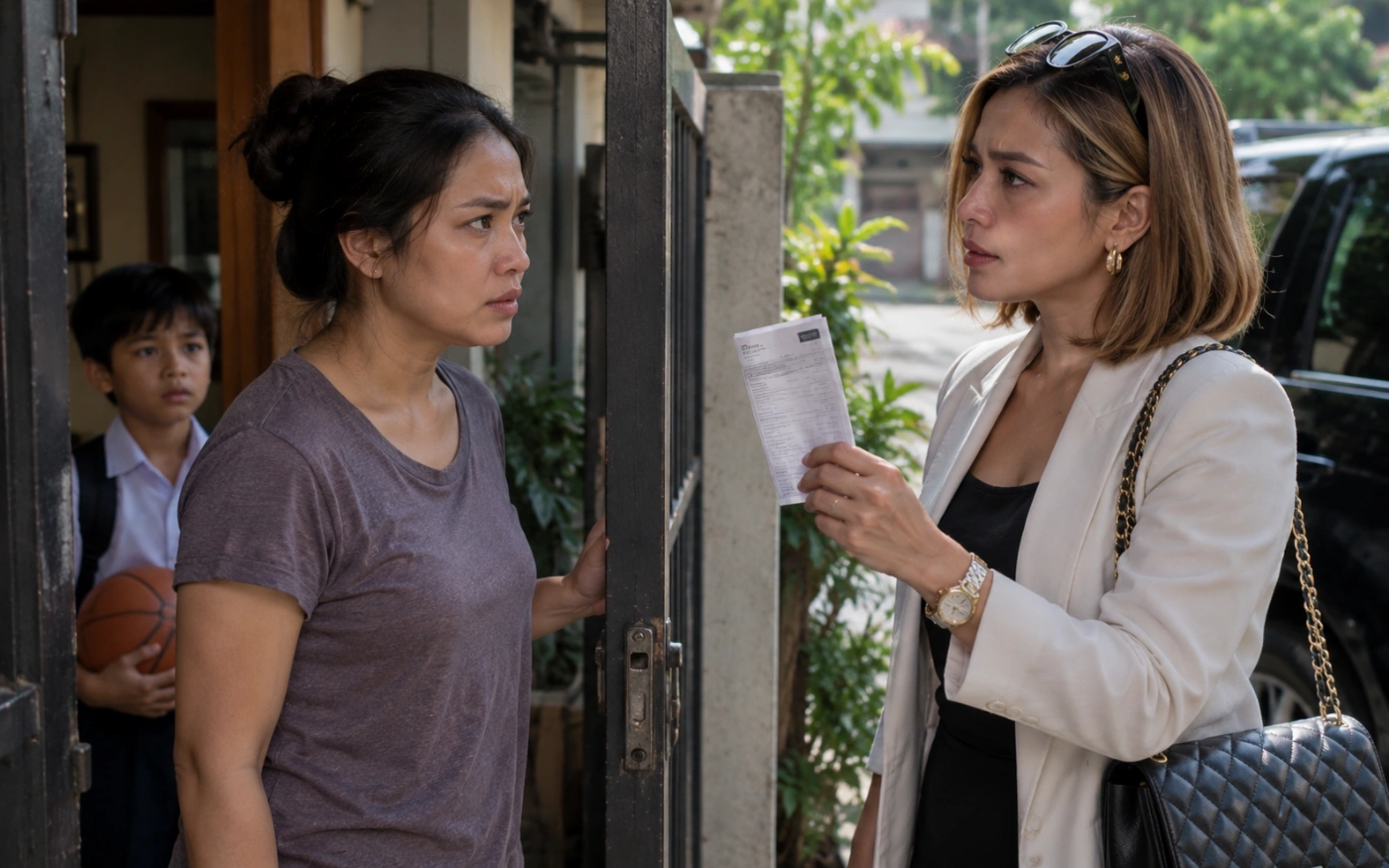
She stepped out of a black SUV, removed her sunglasses, and held up a bank receipt for $150,000.
“I’m here for my son,” Grace said.
Behind me, a basketball stopped bouncing.
Leo was standing in our hallway.
He had my late father’s eyes, my sister’s chin, and a smear of cheese powder on his school uniform.
He looked from Grace to me.
“Ma,” he whispered, “who is she?”
My knees nearly gave way.
I had imagined this moment for years.
In some versions, I screamed at Grace. In others, I slammed the gate.
Once, after too much coffee and too little sleep, I imagined throwing a whole pot of boiling sinigang at her car.
But now that she was there, all I could do was grip the doorframe.
“Go upstairs, anak.”
“But—”
“Please.”
Leo knew that voice. He disappeared, though I heard the stairs creak halfway up. He was listening.
Grace looked older than thirty-four.
Her cheekbones were sharper, and her blond-streaked hair was cut close to her jaw.
Yet her dress, watch, and polished shoes announced money before she even waved that receipt.
“You have five seconds,” I told her.
“Maya, sandali lang.”
“You used up twelve years of sandali.”
Twelve years earlier, I had been nineteen and two weeks away from starting university on a full scholarship.
I woke before dawn because something was crying outside our rented house in Quezon City.
At first, I thought it was a kitten.
Then I opened the door.
A newborn lay inside a laundry basket lined with Grace’s red jacket.
Beside him were six diapers, two bottles, and a folded note.
His name is Leo. I’m leaving for Italy. I finally have a chance to model. Please don’t hate me.
That was all.
No apology. No father’s name. No instructions for the fever he developed that same night.
I called Grace until her number stopped working.
I called our relatives until my prepaid load ran out.
Tita Nena said she could take the baby for three days, maybe four.
Our parents had died the year before, and everyone else already had mouths to feed.
So I held Leo beneath the flickering lights of a public hospital and whispered, “Huwag kang matakot. I’m here.”
I missed enrollment.
My scholarship disappeared.
Then one missed semester became a job at a bakery, night classes I could rarely afford, and years measured in formula tins, coughs, report cards, and shoes Leo outgrew before I finished paying for them.
I never told him he ruined my future, because he didn’t.
He became it.
I was there when he said “Mama.” I taught him to read using jeepney signs.
I stayed awake all night when dengue emptied the color from his face.
I learned to make dinosaur-shaped pancakes and sat through school programs in plastic chairs, crying harder than anyone when he forgot half his dance.
When he was six, Grace mailed adoption consent papers from Italy.
No letter. Just her signature and a small photograph of the Milan Cathedral.
I became Leo’s legal mother.
And now she was at my gate saying she had come for her son.
“You can’t take him,” I said. “I don’t care how much money you have.”
Grace’s fingers tightened around the receipt. “The money is for Leo.”
I laughed once. It sounded ugly. “Ah, ganon? Is this the price of twelve birthdays?”
“No.”
“Of every time he cried because his classmates had fathers and he didn’t even know his mother?”
She flinched.
Good, I thought. Let it hurt.
“You left him in a basket, Grace.”
“I know.”
“You chased cameras while I sold pandesal at five in the morning.”
“I know.”
“You don’t know anything!”
My shout brought our neighbors to their windows. Grace glanced past me, toward the stairs.
“I’m not here to fight in front of him.”
“Then leave.”
She pulled a thick brown envelope from her handbag and slid it through the gate.
“Read this first.”
I let it fall to the ground.
“Please, Maya.” Her voice cracked. “After that, if you never want to see me again, I’ll go.”
She returned to the SUV and drove away.
I wanted to throw the envelope into the trash. Instead, I carried it to the kitchen after Leo went to bed.
Inside was a trust statement in my name, showing deposits made over twelve years.
The total was $150,000. There was also a faded insurance document bearing our parents’ names.
And beneath it was a hospital file from Milan.
I read the first page twice.
Then I saw the date of diagnosis.
It was three days before Grace left Leo on my doorstep.
PART 2: What Grace Had Hidden
The file said my sister had stage-four lymphoma.
Not a modeling contract.
Not a glamorous new life.
Cancer.
The experimental treatment program in Milan had accepted her because regular chemotherapy had failed.
Her doctors estimated that she might have only months without treatment. They warned that even with treatment, she might never come home.
I kept turning pages.
Scans. Surgeries. Relapses. Infections.
Years of test results covered in medical language, but the photographs tucked between them needed no translation.
Grace bald in a hospital bed.
Grace smiling weakly beside an IV pole.
Grace washing dishes in a restaurant kitchen, a scarf hiding her head.
On the back of that photo, she had written: Leo’s fifth birthday. Double shift. Sent $400 today.
My anger did not vanish.
It cracked.
Under the hospital file were copies of transfers made to a trust managed by an attorney in Manila.
The first deposit came from our parents’ life insurance.
Grace had been the named beneficiary because she was older. Later deposits were smaller—$200, $600, sometimes only $75.
There was a letter from the attorney.
Grace had instructed him not to reveal the account until she either died or received a cancer-free declaration.
The money was reserved for Leo’s education and placed under my control because, in Grace’s own signed words, “Maya is his mother in every way that matters.”
I sat on the kitchen floor.
“Ma?”
Leo stood in the doorway, clutching his pillow.
“Why are you crying?”
I wiped my face. “Come here.”
He lowered himself beside me. He had heard enough at the gate that lying would only make things worse.
“That woman is Grace,” I said. “She gave birth to you.”
His face went still.
“So she’s my real mom?”
The question pierced me exactly where I had always feared it would.
I forced myself to breathe. “She is your birth mother. I’m your legal mother. But what you call us is your choice.”
He stared at the papers. “Why did she leave?”
“She was very sick.”
“Is she still sick?”
“I don’t know.”
Leo looked toward the gate as if Grace might still be standing there. “You said she went to be a model.”
“That’s what she told me.”
“Then she lied.”
“Yes.”
His jaw tightened. “Ayoko sa kanya.”
I recognized that anger. It had kept me warm for twelve years.
The next morning, I called the number on Grace’s card.
She answered before the first ring finished.
“Come back,” I said. “Alone.”
An hour later, she sat at our kitchen table with untouched coffee between her hands.
Without the sunglasses and expensive car, she seemed smaller.
Leo stayed upstairs. This time, I did not order him there.
“Why didn’t you tell me?” I asked.
“Because you had already lost Mama and Papa.”
“So you made me lose you too?”
“If I told you I was dying, you would have followed me.”
“Of course I would have!”
“Exactly.” Grace’s eyes filled. “I knew leaving Leo with you would cost you. I hated that. But if I told you I was dying, you would have tried to carry both of us. You would have brought Leo to Milan, slept beside my hospital bed, and spent every peso trying to save me. If I died, he might have lost the only stable person he had.”
I stood so quickly my chair scraped the floor.
“You had no right to decide that for me.”
“I had no right.” She didn’t defend herself.
“I was terrified. I thought I’d leave him with you for a few months. Then treatment failed. Then I relapsed. Every year I waited to be healthy enough to return without becoming another person you had to carry.”
I pointed at her dress. “And this?”
She almost smiled. “Borrowed from my lawyer’s wife. The SUV too.” She looked down at the dress. “I didn’t want you to open the gate and see another sick person to take care of.”
“The receipt?”
“The final transfer. I wanted proof I hadn’t forgotten him.”
“Money doesn’t prove that.”
“I know.”
“Then why did you say you came for your son?”
Grace looked up the stairs.
“Because he is my son, and I have thought those words every day. Then I saw him and forgot every careful sentence I had practiced. But I didn’t come to take him.”
She pulled another document from her bag and placed it in front of me.
It was not a custody petition.
It was a notarized statement affirming my adoption, surrendering any future claim, and granting me permanent control of Leo’s trust.
Then Grace reached into her wallet and set down a tiny photograph. A nurse had taken it that first night: me at nineteen, asleep in a hospital chair with newborn Leo on my chest.
“You mailed this to the return address on the adoption envelope,” she said. “I carried it through every treatment.”
Her hand trembled.
“My doctors declared me cancer-free last month. I sold everything I had to come home. I don’t want to be his mother now, Maya. You are. I’m asking…”
She pressed both palms over her mouth, but the sob escaped anyway.
“Please let me be Auntie Grace.”
From the staircase came a small creak.
Leo had heard everything.
He walked into the kitchen, holding his basketball behind his back.
PART 3: What Leo Chose
Grace rose, then seemed to think better of it and sat again.
“Hi, Leo,” she said.
He did not answer.
My brave, noisy boy stood between us, staring at the woman whose face he saw every morning in his own mirror.
“I don’t know you,” he said.
“I know.”
“Why didn’t you call on my birthdays?”
Grace’s tears slid freely now. “Because I was a coward. I was scared hearing your voice would make me come home before I was well. And I was ashamed that every year made it harder to explain the year before.”
Leo nodded once, absorbing this.
“I’m still angry.”
“I know.”
“My mom is there.” He pointed at me.
Grace’s face crumpled, but she nodded. “I know.”
“You can be my aunt,” Leo said. “But I’m not pretending everything’s okay.”
“I won’t ask you to.”
He looked at her for a long moment.
He set the basketball on the table between them.
“I have a basketball game Saturday.”
Grace blinked.
“You can come,” he said. “If you want.”
Her hand covered her mouth. “I’d like that.”
Three weeks later, Grace moved into the tiny guest house behind ours.
It had one bedroom, a leaky faucet, and a calamansi tree leaning over the roof.
She showed up for school pickup too early.
She burned her first tray of pandesal.
She learned Leo hated being called “little man” and loved extra gravy on everything. When she got tired, she told us instead of disappearing.
Grace found local work and began paying her share of the household bills. With her handling school pickup twice a week, I enrolled in weekend classes the next semester.
The first evening I came home with a student ID, she cried before I did.
“You should have had this twelve years ago,” she said.
“I have it now.”
But the moment I knew we might truly heal came one rainy evening.
Leo had a fever, nothing serious, but Grace froze outside his room. I saw twelve years of fear return to her face.
“What if I make things worse?” she whispered.
I handed her a basin and a clean towel.
“Then I’ll show you.”
We sat on opposite sides of Leo’s bed, taking turns cooling his forehead. Near midnight, he opened his eyes.
“Ma?” he murmured.
“I’m here, anak.”
His hand found mine beneath the blanket.
Then, without opening his eyes, he reached his other hand toward Grace.
“Auntie,” he mumbled, “ikaw rin. Stay.”
Grace held on.
And between us, Leo fell peacefully back to sleep.