
My Father Left His Restaurant to the Son Who Never Visited Him and Gave Me One Sack of Rice — When I Opened It, My Brother Called the Police
PART 1: The Worst Inheritance
My father left our restaurant to the son who never visited him.
To me, he left one sack of rice.
Fifty pounds. Jasmine. Still dusty from the storeroom.
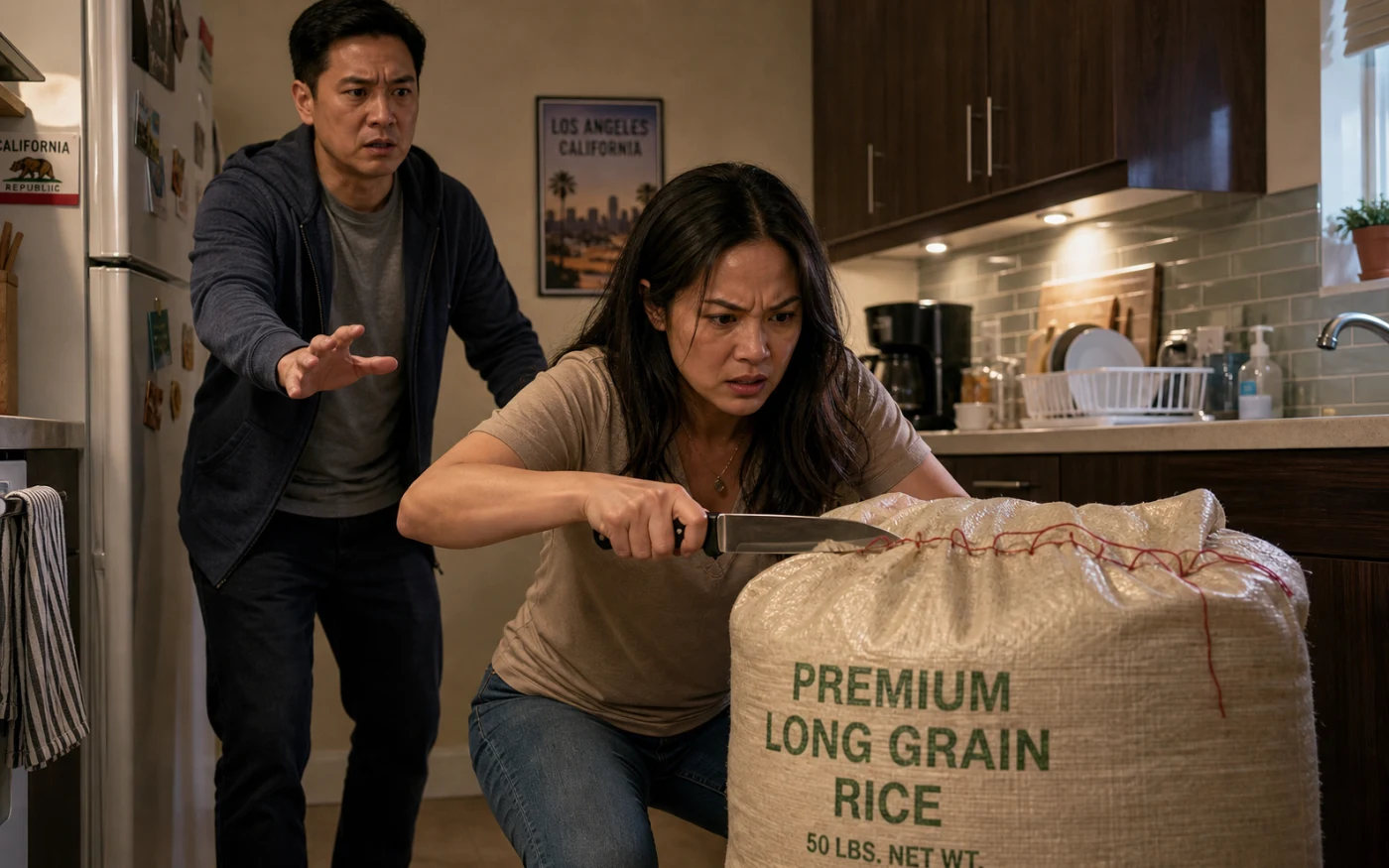
And when I cut it open, my brother called the police.
But that happened later.
First, I had to sit in a lawyer’s office and hear that twelve years of my life were worth less than one secondhand freezer.
“To my son, Eric Agbayani,” the lawyer read, “I leave Lola’s Kitchen, including the building, equipment, recipes, name, and all business assets.”
My aunt gasped.
My cousin dropped her rosary.
I stared at the empty chair beside me.
That chair was for my brother.
Of course Eric was late.
He had been late for Tatay’s sickness. Late for his final birthday. Late for every Christmas since he moved to Chicago eight years earlier.
Sometimes he called. Usually after midnight. The conversations lasted five minutes.
“How’s Tatay?”
“Tired.”
“How’s the restaurant?”
“Busy.”
“I’ll come home soon.”
He never did.
I was the one who stayed.
At twenty-two, I postponed culinary school for one semester because Tatay needed help. That semester became twelve years.
I unlocked Lola’s Kitchen at four-thirty every morning.
I chopped onions until my eyes burned, stirred arroz caldo before sunrise, carried steaming trays of pancit through lunch rushes, and argued with delivery drivers over wilted pechay.
When Tatay’s knees began to fail, I lifted the rice pots.
When his hands shook, I handled the knife.
When he fell asleep at the table after closing, I covered him with my jacket and mopped around his chair.
Everyone knew the restaurant would be mine.
Even I knew.
Then the lawyer cleared his throat.
“To my daughter, Maya Agbayani, I leave the sealed sack of Jasmine rice stored in the rear pantry.”
My mouth fell open.
“That’s it?” I asked.
The lawyer adjusted his glasses. “There is also a personal note attached to the bequest.”
“Read it.”
He looked uncomfortable. “It says, ‘Anak, take this home before you open it. Do not leave it at the restaurant.’”
A few relatives began whispering.
I stood so quickly my chair scraped the floor.
“Wonderful,” I said. “Kuya gets a building worth almost a million dollars, and I get uncooked rice with instructions.”
“Maya,” Auntie Consuelo whispered.
“No. Tatay knew what I gave up.” My voice cracked. “He knew.”
That was when the office door opened.
Eric walked in wearing a wrinkled black shirt, carrying one old backpack.
He looked thinner than I remembered. There was gray in his hair near his ears.
“Sorry,” he said breathlessly. “My flight—”
“Congratulations.”
I pushed past him.
He caught my arm. “For what?”
I laughed right in his face.
“For finally remembering where California is.”
By noon, I was standing behind Lola’s Kitchen with the sack at my feet.
The red thread across its top had been sewn by hand in tight, ugly loops. Tatay’s stitches.
I recognized them from the aprons he used to repair instead of replacing.
Eric came around the corner as I tried to drag the sack toward my car.
“Let me carry it.”
“Don’t touch my fortune.”
“Maya, please.”
“Go inspect your kitchen.” I pointed at the restaurant.
“Your refrigerators. Your tables. Your framed picture of Nanay. Apparently, even her picture belongs to you now.”
He flinched.
Good, I thought.
Let him hurt.
But he picked up the sack anyway and carried it to my trunk. His arms trembled under the weight.
“I didn’t ask for the restaurant,” he said.
“Then give it back.”
He went silent.
That silence hurt more than the will.
I slammed the trunk.
Twenty minutes later, I reached my apartment. Eric’s rental car pulled in behind me.
I marched upstairs. He followed with the rice.
“Why are you here?” I demanded.
“Tatay told me to make sure you opened it at home.”
I stopped.
“When did he tell you that?”
Eric’s eyes slid away. “Last week.”
The week Tatay could barely speak.
The week I sat beside his bed every day.
Yet somehow he had spoken to Eric.
Something hot and ugly burst inside me.
I grabbed the kitchen knife.
Eric stepped forward. “Careful.”
“Now you care?”
I sliced through Tatay’s red stitches.
Rice spilled across my floor in a white rush.
“Perfect!” I shouted. “Even his final gift gives me more work!”
Then I plunged both hands into the sack.
My fingers struck plastic.
Not one package.
Several.
I pulled out the first bundle and froze.
Inside the clear wrapping were stacks of hundred-dollar bills.
Eric whispered, “Oh, my God.”
I dug again. More cash. Then a thick folder sealed in plastic. Then a long brown envelope with my name in Tatay’s handwriting.
At the bottom was a folded document bearing a gold seal.
I opened it with shaking hands.
It was a property deed.
The address was two blocks from Lola’s Kitchen.
Before I could understand, Eric tore open the thick folder.
His face lost all color.
“No,” he whispered.
He backed into my counter, crushing rice beneath his shoes.
Then he grabbed his phone and dialed 911.
“Dispatch?” he said, his whole body shaking. “I need officers at 412 Maple Street. My father kept everything.”
He looked at me, and for the first time in my life, I saw my big brother terrified.
“Everything about the men who threatened us.”
PART 2: Why Was Eric Terrified
“What men?” I grabbed his wrist. “Kuya, what are you talking about?”
He pulled away and spoke into the phone.
“There are letters, payment records, names, phone numbers. Please send someone now. They may know he died.”
May know he died.
The words chilled my skin.
I locked the door.
Eric emptied the folder onto my rice-covered table. Handwritten receipts slid out. So did printed bank transfers, photographs of license plates, and letters covered in red ink.
One said: PAY FRIDAY OR THE KITCHEN BURNS.
Another said: YOUR DAUGHTER OPENS ALONE AT 4:30.
I stopped breathing.
That was me.
“Tell me,” I said.
Eric pressed both hands over his face.
“Eight years ago, Tatay borrowed money.”
“From a bank?”
“From men who pretend they are lenders until you miss one payment.”
I remembered that year. Our walk-in freezer died. A pipe burst above the stove. Business slowed for months. Tatay told me an old friend had helped him.
Eric picked up the first threat.
“I found this under the office door. I confronted Tatay. He said he could handle it.” His voice broke. “Then two men waited outside one night. They knew your schedule. They knew where you parked.”
I sank into a chair.
“Why didn’t anyone tell me?”
“Because you would have marched outside holding a soup ladle and challenged them.”
“I would not.”
He gave me a look.
I remembered chasing a thief for half a block with a frozen bangus.
“Fine,” I muttered. “Maybe.”
Eric almost smiled. Then his face collapsed again.
“They demanded the original loan, impossible interest, and ten thousand every month. Tatay had already paid them twice what he borrowed. It didn’t matter.”
“So you left?”
The old anger returned fast.
“You ran to Chicago and left us with them?”
“No.”
Eric unzipped his battered backpack and removed three cracked notebooks.
He dropped them in front of me.
Every page showed work shifts in different colored ink.
Warehouse: 11 p.m.–7 a.m.
Delivery route: 9 a.m.–2 p.m.
Restaurant dishes: 5 p.m.–10 p.m.
At the end of each month was the same dollar amount.
Ten thousand. Ten thousand. Ten thousand.
“I made an agreement,” he said. “I would move away. I would pay. They would stay away from you and Tatay.”
I flipped pages faster.
Eight years of shifts.
Eight years of payments.
Christmas Eve. New Year’s Day. His birthday.
There were months when the total was short, followed by frantic notes: sold car, borrowed from Ramon, double shift.
“Three jobs?” I whispered.
“Sometimes four.”
“But you posted pictures by the lake. Baseball games. Restaurants.”
“My roommates invited me. I took pictures so Tatay wouldn’t worry.” He laughed once, bitterly. “Most nights, I ate rice and canned tuna over the sink.”
I stared at his hands.
I had been too angry to notice them before.
His knuckles were swollen. Two fingernails were split. A pale burn scar crossed his wrist.
“Why didn’t you visit?”
“Flights cost money. And the men warned me not to come back until the debt was done.”
“Why were your calls so short?”
“Because I was usually between shifts.”
I stood and slapped his chest.
Not hard.
Then again.
“You should have told me!”
“I was ashamed.”
“Of helping us?”
“Of being scared.” Tears filled his eyes. “I was your kuya. I thought protecting you meant you should never see me afraid.”
That did it.
I hit him one last time, then grabbed his shirt and sobbed against him.
He wrapped both arms around me.
We stood there in spilled rice, crying like children while police sirens grew louder outside.
Two officers arrived with a detective. Eric showed them the threats and receipts. The detective recognized one of the names immediately.
“We’ve been building a case against this group,” she said. “Your father may have just given us what we were missing.”
She lifted a small memory card taped beneath one receipt.
Eric and I looked at each other.
Tatay had owned one ancient phone and complained whenever it updated. But he had recorded them. Photographed plates. Saved every threat. He had acted like a tired old cook while quietly building a trap.
That was our father.
Stubborn enough to fight criminals with reading glasses held together by tape.
After the officers took copies and promised protection, the apartment became painfully quiet.
The cash still sat on the floor.
We counted it twice.
One hundred fifty thousand dollars.
“It’s yours,” Eric said.
“And the restaurant is yours.”
He shook his head. “Maya—”
“No. I understand why he did it now. You paid for that place with eight years of your life.”
“And you kept it alive with twelve years of yours.”
We both looked at the brown envelope.
My name was written across it in Tatay’s crooked block letters.
I had been afraid to open it.
Now I slipped my finger beneath the flap.
Inside was one photograph and one sheet of paper.
The photograph showed me at thirteen, standing behind a lopsided chocolate cake. The frosting had melted. The words HAPPY BIRTHDAY NANAY leaned downhill.
On the back, Tatay had written: Maya’s first cake. Ugly but delicious.
I laughed through my tears.
Then I unfolded his letter.
The first line made my knees weak.
My sweet Maya, you stayed because you loved me. Now I am asking you to leave because I love you.
PART 3: What Tatay Really Gave Me
I read the rest aloud.
Tatay wrote that he knew about my secret bakery notebook hidden behind the flour bins.
He had seen the sketches of ube cakes, ensaymada, mango pies, and the little storefront I had drawn so many times the paper had torn at the folds.
I had forgotten that notebook.
He had not.
The deed belonged to a vacant shop two doors from Lola’s Kitchen.
Tatay had bought it quietly after discovering what Eric had sacrificed.
The cash was for renovations and equipment.
Then came the sentence that broke me open.
You always wanted your own bakery, anak. Stop postponing your life for mine.
At the bottom he had added:
Eric needs a home. You need a door of your own. Please stop being stubborn long enough to accept what I prepared.
I looked at my brother.
“He called me stubborn.”
“His final statement was accurate.”
I threw a handful of rice at him.
For the first time since Tatay died, we laughed.
Then Eric pulled something from his pocket.
It was the ring of keys to Lola’s Kitchen.
He placed it on the table between us.
“I don’t know if I can run it without you.”
That was the truth underneath all his fear.
He had worked in other people’s kitchens, warehouses, and delivery vans, but Lola’s Kitchen was filled with Tatay’s voice.
His knife marks. His old radio. His recipes that said things like enough vinegar and cook until correct.
Eric was not afraid of the business.
He was afraid of coming home and finding that home no longer wanted him.
I pushed the keys back.
“You can run it.”
“How do you know?”
“Because tomorrow at four-thirty, I’ll teach you how much garlic Tatay meant by enough.”
His mouth trembled.
“Tomorrow?”
“Only until my bakery opens. After that, you’re on your own.”
He nodded quickly, wiping his eyes. “Deal.”
Opening the bakery was not magical.
It was dust, permits, paint in my hair, and one mixer that arrived with a dent the size of a fist. Eric and I argued about everything.
He wanted beige walls.
I wanted yellow.
He bought twelve ugly chairs because they were cheap.
I made him return eleven.
Every morning, we cooked at Lola’s Kitchen.
Every afternoon, we renovated my shop.
At night, I tested recipes while Eric sat on an upside-down bucket and ate my failures.
“Too dry,” he said through his fourth slice of calamansi loaf.
“Then stop eating it.”
“I’m protecting the public.”
The police arrested three men connected to the lending operation.
When the detective called, she said Tatay’s records had helped other frightened business owners come forward too.
I wished I could tell him.
Then again, perhaps he had known exactly what would happen. Tatay always understood people better than he admitted.
Six months after I opened that rice sack, I stood outside my new bakery with giant scissors in my hand.
The yellow sign above me read MAYA’S BAKERY.
Through the window, trays of purple ube pandesal and glossy mango tarts filled the case. The whole sidewalk smelled like butter and sugar.
Neighbors crowded around. Auntie Consuelo cried before anything even happened.
My cousin was filming live and kept telling people to send stars, though none of us understood what she meant.
Eric stood beside me in Tatay’s clean white cook’s shirt.
He had gained weight. The gray near his ears was still there, but his face no longer looked like someone had been squeezing all the sleep out of it.
Across his chest was Lola’s Kitchen embroidered in red.
“Speech!” somebody yelled.
I shook my head. “No speech.”
“Speech!” the whole crowd shouted.
So I looked through the bakery window at the old photograph of my ugly first cake. I had framed it beside the register.
Then I looked at Eric.
“My father left my brother a restaurant,” I said. “He left me a sack of rice.”
People murmured.
“I thought he had chosen the child who left and punished the child who stayed.”
Eric lowered his eyes.
I took his hand.
“So this bakery is for the stubborn old man who tricked both his children into living again.”
I raised the scissors.
We cut the ribbon together.
The crowd cheered.
Eric hugged me so hard my feet left the pavement.
Then he whispered, “You know I still own Nanay’s picture.”
I shoved an ube pandesal into his mouth.
Now, every morning before he unlocks Lola’s Kitchen, my kuya comes through my yellow door for coffee.
He always sits beneath the photograph of that terrible first cake.
And beside the register, in a glass jar, I keep one handful of Jasmine rice.