
My Twin Sister Stole My Name at Nineteen and Vanished. Twenty Years Later a Lawyer Called to Tell Me That My Billionaire Husband Had Died
PART 1: My Name Was Already Taken
The first time my twin sister stole my identity, she used it to buy a red leather jacket.
The second time, she stole my entire life.
I was nineteen.
My name is—or technically was, depending on which government database you asked in 2004—Marisol “Mari” Santos.
My twin, Elena, was born eleven minutes after me and spent our childhood acting like those eleven minutes were a personal insult.
We looked identical enough to fool substitute teachers, boyfriends from across parking lots, and one extremely confused dentist.
But we were not alike.
I made lists.
Elena made exits.
I saved birthday money in envelopes marked TUITION.
Elena once spent eighty dollars on sunglasses because, according to her, “They make me look expensive.”
“Mahal ka na nga,” our mother told her. “You’re already expensive.”
Elena laughed.
That was the problem.
She laughed, and people forgave her.
When we were nineteen, I got into San Aurelio University on a partial scholarship.
It wasn’t Harvard. It wasn’t glamorous. But it was mine.
I had the acceptance letter taped above my bed for three months.
Then, two weeks before orientation, Elena disappeared.
So did my birth certificate.
My Social Security card.
My savings.
And the acceptance packet.
At first, I thought she’d just taken the cash.
Then the university called.
“Ms. Santos, we need to discuss your housing request.”
“I didn’t request housing.”
A pause.
“You checked in yesterday.”
My knees went weak.
She had dyed her hair exactly like mine.
Used my ID.
Signed my name.
Accepted my scholarship.
And enrolled as me.
By the time we figured out what she’d done, she was gone again.
Not just from campus.
Gone.
She had opened two credit cards in my name, drained a student account, signed a lease, and apparently told half the people she met that our parents were dead.
Our parents were very much alive.
My father proved this by shouting so loudly into the phone that the university administrator held the receiver away from her ear.
“You tell my daughter to come home!”
“Sir, which daughter?”
That shut him up.
The university froze everything while they investigated.
My scholarship vanished into bureaucratic purgatory.
My credit was wrecked before I had enough credit to understand what wrecked credit meant.
And Elena?
Nothing.
No call.
No letter.
No dramatic apology written in lipstick on a mirror.
She vanished wearing my name.
For almost a year, every official conversation began with me saying, “I am the real Marisol Santos.”
Do you know how insane that sounds?
Bank teller?
“I’m the real Marisol Santos.”
Police station?
“I’m the real Marisol Santos.”
Financial aid office?
“I’m the real Marisol Santos.”
One clerk actually looked at me and said, “That’s what the other one said.”
I nearly climbed over his desk.
Eventually, I got my identity legally untangled enough to function.
Enough.
Not perfectly.
There were debts I fought.
Records I couldn’t erase.
A lease in Nevada I had never signed.
A gym membership in Tampa.
Three parking tickets in a city I’d never visited.
And somewhere out there, Elena kept going.
I gave up college.
I took a job at a dental supply warehouse.
Then a shipping office.
Then, weirdly, I discovered I was good at logistics.
Not glamorous logistics.
No private jets.
No billion-dollar ports.
I mean loading schedules, angry drivers, damaged pallets, missing manifests.
I liked problems that had actual answers.
A truck was late.
A container was missing.
A customer was screaming.
Fine.
You fixed it.
People were harder.
Names were harder.
Family was hardest.
My mother kept hoping Elena would call.
My father pretended he didn’t.
I was the one who stopped hoping.
By thirty, I had built a life no one could steal because I had built it myself.
I married briefly.
Divorced peacefully.
Bought a small house with a lemon tree that produced exactly six lemons a year like it was unionized.
I became operations director for a regional freight company.
I had friends.
I had a goddaughter.
I had a Costco membership.
I was fine.
Then, twenty years after my sister disappeared, a lawyer called me at work.
“May I speak to Mrs. Marisol Vale?”
I nearly hung up.
“There is no Marisol Vale here.”
“I’m sorry. Marisol Santos Vale.”
My stomach turned cold.
“No.”
The lawyer hesitated.
“Are you Marisol Santos?”
“Yes.”
“Then I believe we need to meet.”
“About what?”
Another pause.
Then he said the sentence that detonated my entire week.
“Your husband is dead.”
I laughed.
Not because it was funny.
Because apparently my nervous system is a circus.
“I don’t have a husband.”
“According to his estate documents,” he said carefully, “you were married to Adrian Vale for seventeen years.”
I knew that name.
Everyone did.
Adrian Vale owned Vale Meridian, one of the largest private logistics companies in North America.
Ports.
Warehouses.
Freight corridors.
Cargo aircraft.
If something expensive moved from one place to another, there was a decent chance Adrian Vale had collected a fee somewhere along the way.
He was worth more than two billion dollars.
And according to the lawyer, he had spent seventeen years married to me.
I sat down.
My assistant, Jules, mouthed, “You okay?”
I held up one finger.
Absolutely not.
The lawyer kept talking.
“There is also the matter of the will.”
I stared at my desk.
“What matter?”
“You are the principal beneficiary.”
I stopped breathing.
“How principal?”
There was a rustle of paper.
“Essentially all of it.”
I whispered, “Oh, that stupid bitch.”
Jules slowly backed out of my office.
The lawyer said, “Excuse me?”
“My sister.”
Then I asked the question I already knew the answer to.
“What does Adrian Vale’s wife look like?”
The lawyer went quiet.
When he finally spoke, his voice had changed.
Careful.
Interested.
Almost afraid.
“Ms. Santos,” he said, “I think you should come to my office.”
And that was how, twenty years after Elena stole my name, I learned she had used it to marry a billionaire.
And now he was dead.
Leaving everything to me.
PART 2: The Widow Had My Face
The law office occupied the thirty-eighth floor of a glass tower downtown.
Of course it did.
Billionaires apparently refuse to have legal problems below cloud level.
The attorney’s name was Graham Pike.
Silver hair. Navy suit. Expression of a man who had seen rich families do unspeakable things over beach houses.
He offered me coffee.
I said, “Show me my sister.”
He slid a photograph across the desk.
There she was.
Elena.
Older.
Elegant.
Cream dress.
Diamonds at her throat.
Standing beside Adrian Vale at some charity gala.
And she was smiling that same smile.
The one that said consequences were for other people.
I stared at her face.
My face.
“She looks good,” I said.
Graham blinked.
“That’s your reaction?”
“I was hoping twenty years of felonies would be worse for the skin.”
He almost smiled.
Almost.
Then he put a marriage certificate on the desk.
Marisol Santos.
Adrian Vale.
My date of birth.
My parents’ names.
My identity.
I felt nineteen again.
Cheap apartment.
Overdrawn account.
My mother crying.
My father punching a kitchen cabinet.
Every stupid form where I had to prove I existed.
“She really did it,” I said.
“Yes.”
“And no one caught her?”
“Apparently not.”
“How?”
Graham gave me a look.
“Money helps people avoid inconvenience.”
Fair.
Then he placed the will in front of me.
The estate was obscene.
Company shares.
Real estate.
Trusts.
Investment accounts.
A private foundation.
A ranch.
Three apartments.
A yacht I immediately hated without ever seeing.
And controlling interest in Vale Meridian.
Everything went to:
My beloved wife, Marisol Santos Vale.
Not Elena.
Not “the woman known publicly as Marisol.”
Not “my spouse.”
My legal name.
My actual identity.
I looked up.
“So what happens when Elena shows up?”
“She already has.”
That made my heart kick.
“She’s here?”
“In the building.”
I stood so fast the chair rolled backward.
“Where?”
“Ms. Santos—”
“Where?”
Graham got up.
Before he could answer, his office door opened.
And my sister walked in.
For one insane second, it was like looking into a mirror that had been sent to finishing school.
Elena wore black.
Of course she wore black.
Perfect widow black.
Her hair was smooth.
Her shoes probably cost more than my first car.
She stopped when she saw me.
All the color left her face.
“Mari.”
Twenty years.
Twenty years, and my nickname came out of her mouth like she’d borrowed my sweater yesterday.
I crossed the room and slapped her.
Not hard enough to be cinematic.
Hard enough to be honest.
Graham said, “All right.”
Elena touched her cheek.
“You hit me.”
“You stole my Social Security number.”
“That was twenty years ago.”
“Oh, good. Then we’re even.”
She looked at Graham.
“You called her?”
He didn’t flinch.
“She is legally relevant to the estate.”
“I am his wife.”
I laughed.
“No. Apparently I am.”
Elena turned on me.
“You think this is funny?”
“I think it’s hilarious.”
Her eyes filled.
That almost got me.
Almost.
Then she said, “Adrian loved me.”
And suddenly it wasn’t funny anymore.
Because she meant it.
I could see that.
Whatever else Elena had done, whatever lie she had built, she had loved this man.
“Did he know?” I asked.
“No.”
Too fast.
Graham looked down.
Elena noticed.
Her whole body stiffened.
“What?”
Graham folded his hands.
“There is a complication.”
Elena snapped, “What complication?”
He slid the will toward her.
She didn’t read it.
“I know what it says.”
“Then you understand the problem.”
“There is no problem. Marisol Santos Vale is me.”
I leaned against the desk.
“Go ahead.”
She looked at me.
“Go ahead what?”
“Prove it.”
Silence.
I could practically hear the trap closing.
To claim the estate as Marisol Santos, Elena would have to prove she was legally me.
Which meant producing records.
Which meant scrutiny.
Fingerprints.
Old school records.
My current records.
The identity theft report my father had insisted we file in 2004.
The university investigation.
The credit disputes.
Everything.
If she told the truth, she would be admitting that her entire marriage had been built under a stolen identity.
If she kept lying, I was sitting right there.
Alive.
With twenty years of documents.
Elena stared at the will.
“This is insane.”
I said, “No. Insane was you taking my college acceptance.”
She finally looked at me.
“You could’ve reapplied.”
There are sentences that erase twenty years of personal growth.
That was one of them.
I stepped toward her.
“You stole my future.”
“I stole paperwork.”
“You stole my name.”
“And what did you do with it?” she shot back. “You stayed home. You took warehouse jobs. You could’ve done anything.”
Graham quietly moved a crystal paperweight out of my reach.
Smart man.
Elena’s face crumpled.
“I was scared,” she said.
I stared at her.
She swallowed.
“I thought I’d use it for one semester. Then I met people. Then things kept moving. Every time I tried to stop, it got worse.”
“Then you married someone under my name.”
“I loved him.”
“You could have told him.”
“I was going to.”
“When? Your seventieth anniversary?”
She looked away.
Then Graham said, “There’s something else.”
We both turned.
He opened a drawer.
Pulled out a sealed cream envelope.
And placed it on the desk.
My actual name was written across the front.
Not typed.
Handwritten.
Marisol Santos.
I felt the room tilt.
Elena whispered, “What is that?”
Graham looked at me.
“A letter from Adrian.”
She went very still.
“He wrote to her?”
“Yes.”
“When?”
“Three years ago.”
Elena grabbed the back of a chair.
I looked at Graham.
“You said he didn’t know.”
“No,” Graham said.
“Elena said he didn’t know.”
Then he pushed the envelope toward me.
“Adrian knew exactly who you were.”
PART 3: He Knew Which Twin Was Which
My hands shook opening the envelope.
Not delicately.
I tore the thing like it owed me money.
Inside were four pages.
I read the first line aloud.
“Dear Marisol—the real one.”
Elena made a sound like she’d been punched.
I kept reading.
Adrian wrote that seven years earlier, he had discovered a discrepancy during a security review tied to an acquisition.
His wife’s identity records didn’t match.
At first, he thought it was clerical.
Then he hired someone.
Quietly.
He found the university complaint.
The old credit fraud.
My father’s police report.
And me.
My house.
My job.
My life.
I looked up.
“You knew someone was watching me?”
Graham said, “Adrian wanted to know whether you had participated in the deception.”
“I didn’t.”
“He concluded that quickly.”
I went back to the letter.
Adrian had even visited my company once.
I remembered it.
A corporate tour five years earlier.
Vale Meridian had considered buying our firm.
Executives everywhere.
Bad coffee.
I had spent ten minutes explaining our routing software to a tall man in a gray suit who asked oddly specific questions.
That man had been Adrian.
My fake husband.
I laughed out loud.
Elena whispered, “No.”
The letter continued.
He knew Elena had lied.
He knew almost everything.
But he had confronted her only once.
Indirectly.
He’d asked what she regretted most.
She told him, “Not leaving sooner.”
Elena sank into the chair.
“I thought he meant my family.”
“He did,” I said.
“No.”
I read the next paragraph.
Adrian wrote that he could forgive fear.
He could forgive shame.
He could even forgive the first theft.
What he could not forgive was watching Elena choose the lie again every day for seventeen years.
Then came the part that made Elena stand up.
The will.
Adrian had deliberately left the estate to the legal identity Elena had stolen.
Not to punish me.
Not exactly to reward me.
To force a choice.
He wrote:
If Elena claims to be Marisol, the real Marisol can challenge her.
If Elena admits she is Elena, she admits the fraud.
Either way, the lie ends.
Elena lunged for the letter.
I jerked it back.
“Sit down.”
“You don’t understand.”
“I understand beautifully.”
“He loved me!”
“I’m sure he did.”
“Then why would he do this?”
That question broke something in her.
Not the money.
Not yet.
The humiliation.
The realization that the man she had fooled had spent years knowing.
I looked at the last page.
There was one more instruction.
A personal bequest.
Adrian had left Elena exactly one dollar under her true legal name.
One.
Dollar.
I started laughing.
I couldn’t help it.
Twenty years of fraud.
Seventeen years married to a billionaire.
And the man had tipped her like bad valet service.
Elena screamed, “Stop laughing!”
So I did.
Because she was crying now.
Really crying.
Mascara.
Shaking shoulders.
No elegance left.
Just my sister.
For one ugly second, I saw us at nineteen.
Two girls in one bedroom.
Me labeling notebooks.
Her lying on the floor painting her toenails.
Before everything.
She whispered, “He knew me.”
I said, “Apparently.”
“No. He knew who I really was.”
“Yes.”
“And he stayed.”
That landed harder than anything else.
Adrian had known.
And he stayed.
Maybe because he loved her.
Maybe because leaving would have been easier than deciding what justice looked like.
Maybe because rich men enjoy dramatic estate planning.
Who knows.
Then Elena looked at me.
“What are you going to do?”
Graham answered before I could.
“The estate cannot be distributed until identity is resolved.”
“I’m asking my sister.”
My sister.
Not Mari.
Not Marisol.
My sister.
I folded Adrian’s letter.
For twenty years, I had imagined seeing Elena again.
In some versions I screamed.
In some I forgave her.
In one particularly satisfying version she worked at a kiosk selling phone cases and looked terrible.
I had never imagined this.
I said, “Tell the truth.”
She stared at me.
“And lose everything?”
“You already lost it.”
“No. You’ll get it.”
I looked at the will.
Billions.
Me.
A woman whose lemon tree produced six lemons a year.
It was obscene.
It was tempting.
It was also the first time Elena had ever been trapped inside the consequences of her own choices.
“I didn’t ask for his money,” I said.
“But you’ll take it.”
“I don’t know.”
She laughed bitterly.
“Of course you will.”
That did it.
I reached into my purse.
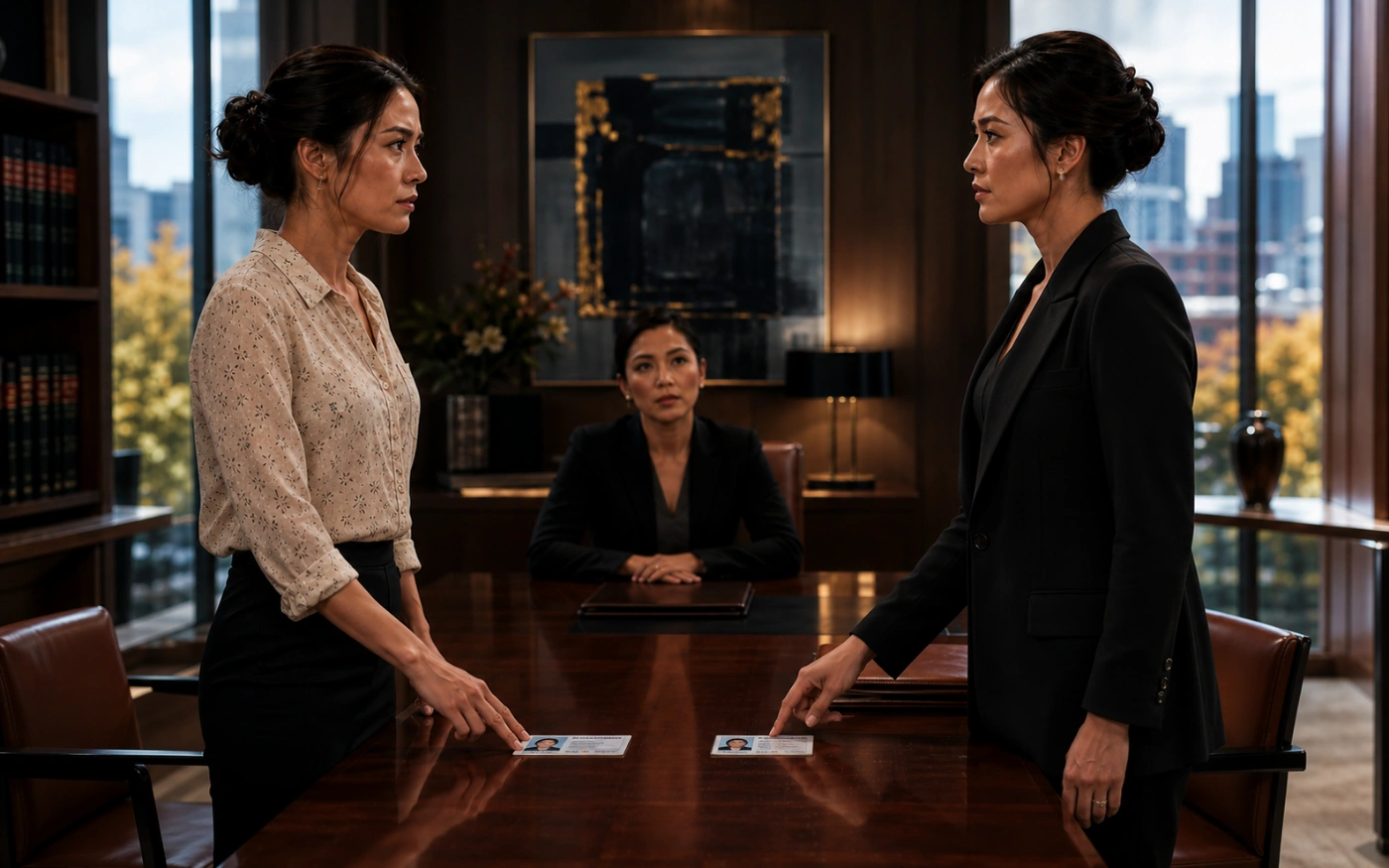
Pulled out my wallet.
And removed my driver’s license.
I placed it beside Adrian’s will.
My photograph.
My name.
My date of birth.
Then I pointed at it.
“This.”
Elena frowned.
“This is what I wanted.”
She said nothing.
“My name. That’s it. Not your husband. Not your house. Not your diamonds. My name.”
I slid the license toward her.
“You wanted Marisol Santos so badly? Fine. Look at her.”
Elena stared at my photo.
Then at me.
I saw the fight leave her.
Completely.
She reached into her black handbag.
Slowly.
Pulled out her wallet.
And laid her driver’s license beside mine.
Same name.
Same birth date.
Different photograph.
Two Marisols.
One desk.
Twenty years of lies reduced to two plastic cards.
Graham didn’t say a word.
Elena picked up her card.
Then snapped it in half.
The sound was tiny.
But God, it felt enormous.
She put the pieces on top of the will.
“My name is Elena Santos,” she said.
I started crying.
I hated that.
She was the criminal.
I should’ve had better emotional branding.
But there I was, crying.
Elena wiped her face.
“So now what?”
Graham looked at me.
I looked at Adrian’s letter.
At the broken license.
At my sister.
And I finally understood his little dead-billionaire chess move.
He hadn’t left me a fortune.
He had left Elena a door.
A horrible door.
A humiliating door.
But one she could only walk through as herself.
I said, “Now you fix it.”
She nodded.
“And the estate?”
I picked up the will.
That question would take lawyers.
Taxes.
Courts.
Possibly years.
But the biggest question was already answered.
I handed Graham the letter.
Then I picked up Elena’s broken fake ID and dropped the pieces into her palm.
“Whatever happens to the money,” I said, “you never get to be me again.”
Elena closed her fingers around the plastic.
For once, she didn’t argue.
She just whispered, “Okay.”
And after twenty years, my sister finally gave me back the only inheritance I had ever wanted.
My own name.