
A Food Critic Gave My New Restaurant One Star and Called It "Expensive Nonsense." Then I Found Out the Critic Was My Lola.
PART 1: The One-Star Funeral
My restaurant died at 8:07 on a Thursday morning.
I was standing in the kitchen, using tweezers to place three perfect chive blossoms on a spoonful of smoked eggplant foam, when my sous-chef dropped his phone.
“Nikki,” Mateo said. “The Spoon reviewed us.”
Nobody in Portland knew who The Spoon was.
Everybody knew what The Spoon could do.
One good review could fill your dining room for six months.
One bad review could make your landlord start checking the lease.
I wiped my fingers on my apron and grabbed the phone.
The headline was only four words.
EXPENSIVE NONSENSE ON HAWTHORNE.
My face went hot.
I kept reading.
The Spoon hated the pork belly under a glass dome of calamansi smoke.
The Spoon called my deconstructed lumpia “six lonely crumbs looking for their mother.”
The Spoon said my adobo reduction tasted afraid of vinegar.
Then came the line that finished me.
“The rice is shy.”
The final verdict was one star.
“The chef is hiding,” the critic wrote. “At these prices, hiding becomes expensive nonsense.”
By lunch, thirty-seven reservations had vanished.
By dinner, three tables came.
One couple asked for the check after taking photographs of the menu.
I had put everything into that room.
My savings.
My mother’s savings, though she called it a loan so I would accept it.
Two credit cards.
Sixteen months of sleeping four hours a night.
I had chosen every pale green tile and every brass light.
I had named the restaurant Tala because I wanted it to feel like a star people had discovered before everyone else.
Now people slowed outside only to point at the empty tables.
For the next five days, I pretended we were fine.
I reduced the schedule.
I called purveyors and asked for another week.
I made the portions even smaller because expensive chefs called that restraint.
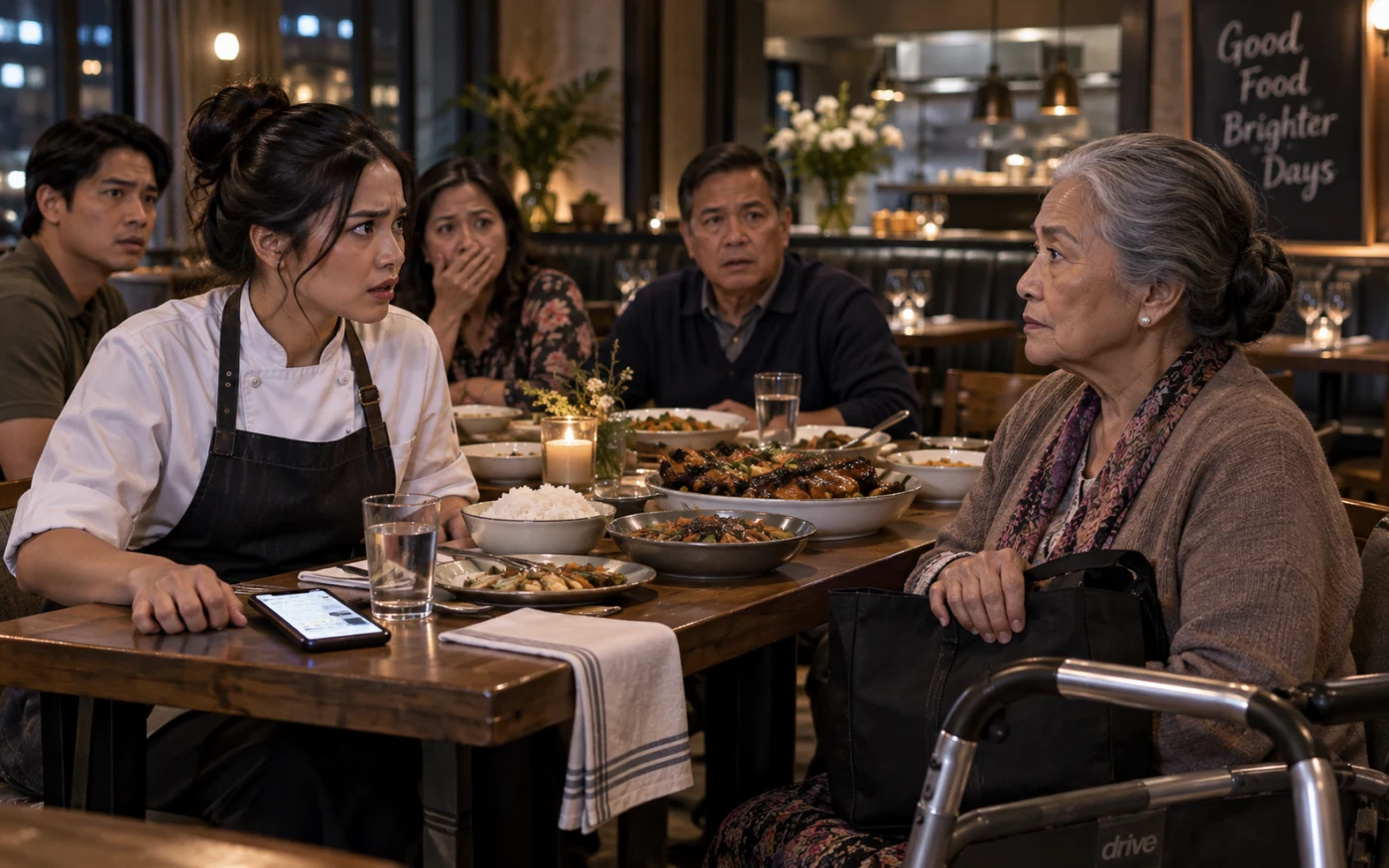
On Sunday, my family arrived for what my mother called an emergency dinner.
They brought enough food to feed my entire block.
Mama carried sinigang in a stockpot wrapped in towels.
Tita Fely had two trays of pancit.
Lola Estrella arrived last, steering her walker with one hand and holding a plastic container of kare-kare with the other.
“I have a restaurant,” I told them. “Why did you bring food?”
“Because your restaurant has six peas and a cloud,” Tita Fely said.
Nobody laughed.
They were all too worried about me.
We pushed two tables together while I told them The Spoon was probably a bitter old chef.
Maybe a failed chef.
Maybe someone who could not understand what I was trying to do.
Lola sat very still at the head of the table.
“Maybe the food was not good,” she said.
The room went silent.
“You haven’t even eaten here,” I said.
She looked at me over her glasses.
“I came opening week.”
“No, you didn’t.”
“Tuesday. Seven o’clock. I wore a hat.”
My twelve-year-old cousin Dani, who had been reading the review on her phone, suddenly looked up.
“Wait,” she said. “Lola, what do you always say about Uncle Edgar’s rice?”
“That it is shy,” Lola said. “He gives one little scoop as if rice is jewelry.”
Nobody moved.
Dani scrolled quickly.
“And what do you call food with too many decorations?”
Lola reached for the bagoong.
“Expensive nonsense.”
My mother made a sound like someone had stepped on her foot.
I stared at the woman who had taught me how to hold a knife.
Then I noticed the black canvas bag hanging from her walker.
Inside it was a small laptop, a restaurant notebook, and a receipt from Tala for one hundred eighty-six dollars.
The name printed at the top of the notebook was THE SPOON.
My grandmother met my eyes.
“You charged me twelve dollars for shy rice,” she said.
PART 2: What Lola Had Written
The explosion began before I could speak.
Tita Fely shouted, “Ma! Ikaw pala!”
Mama grabbed the notebook.
Mateo, who had come out of the kitchen, backed into the wall.
Dani whispered, “This is so bad.”
Lola calmly spooned bagoong onto her plate.
I asked her how long she had been The Spoon.
“Eleven years.”
“You ruined restaurants for eleven years?”
“Some. Others listened.”
“You ruined mine.”
Her spoon stopped.
For one second, hurt crossed her face.
Then it disappeared.
“I reviewed your food,” she said. “You ruined nothing by yourself yet.”
That word yet frightened me more than the review.
I asked why she had hidden from us.
She said people behaved honestly around an old woman they did not consider important.
After Lolo died, eating alone had become unbearable.
So she started visiting restaurants and writing down what she tasted.
A neighborhood paper printed one piece.
Then another.
Soon the whole city waited for her columns, while our family thought she spent Thursdays playing bingo.
I wanted that story to soften me.
It did not.
“You could have called me,” I said.
“You stopped listening before you opened.”
That was cruel because it was partly true.
For months, she had asked when I would put kare-kare on the menu.
I always told her people could get kare-kare anywhere.
I wanted to make something new.
I wanted chefs who had ignored me to say my name.
Now the most powerful critic in the city had said my name without printing it, and she was my own lola.
I walked out of my restaurant.
For four days, I did not answer her calls.
The family chose sides immediately.
Tita Fely said Lola had betrayed blood.
Uncle Edgar said twelve dollars really was too much for rice.
Mama said everyone should stop talking, which only made everyone send longer messages.
Then Dani posted a picture of Lola’s notebook in the family group chat.
Her brother forwarded it to a friend.
By that night, the photograph was online.
THE SPOON IS ESTRELLA MANALANG, one food blog announced.
The woman who had terrified Portland’s chefs was suddenly a seventy-eight-year-old widow in orthopedic shoes.
Reporters waited outside her house.
Chefs she had praised sent flowers.
Chefs she had savaged sent messages.
One left a bucket of overcooked risotto on her porch.
Another stood across the street holding a sign that said MY DUCK WAS NOT SAD.
Lola carried the bucket inside and said she would make arancini.
I still did not call her.
I spent my nights alone at Tala, staring at the dining room and adding numbers.
If reservations stayed this low, I had three weeks.
Four if I stopped paying myself, which I already had.
Mateo found me asleep at table nine one morning.
“We should close for a few days,” he said.
“Closed restaurants don’t earn money.”
“Neither do empty ones.”
He put the printed review in front of me.
I had read it so many times that I knew every insult.
Still, I read it again.
The smoke hid the pork.
The crumbs hid the lumpia.
The reduction hid the adobo.
The chef was hiding.
Then I reached the final paragraph.
I had never finished it.
The first time, anger had blinded me after the one-star verdict.
Every time after that, I had stopped at the same place because I wanted to stay angry.
But below the line about expensive nonsense, Lola had written three more sentences.
“I have eaten this chef’s real cooking on an ordinary Tuesday. It was the best food in this city. I hope she remembers where she left it.”
My hands began to shake.
Mateo read it over my shoulder.
“She told everyone you’re the best cook in Portland,” he said.
“After giving me one star.”
“Yes.”
“She’s impossible.”
“Also yes.”
I remembered the ordinary Tuesday.
Lola had come home from the hospital after knee surgery.
I made garlic rice with all the crisp edges she liked, chicken adobo sharp enough to make her eyes water, and sautéed green beans because her doctor had told her to eat vegetables.
She ate two plates from her recliner.
I had not used tweezers.
I had not made foam.
I had only wanted her to eat.
By noon, I had taped a sign to Tala’s door.
CLOSED FOR ONE WEEK.
When Mateo asked what we were doing, I handed him every menu in the building.
“Burn these,” I said. “Then call my mother.”
PART 3: The Table by the Window
Mama arrived with her stockpot and no questions.
For three days, we cooked like the restaurant was a crowded family kitchen.
She taught my cooks her sinigang, tasting the broth after every handful of sampalok.
Tita Fely rolled lumpia at the prep table and rejected every wrapper that tore.
I stood beside Lola’s kare-kare recipe, which Mama had copied years ago, and tried to make the sauce taste like Sunday.
It did not.
I added more peanut.
It tasted heavy.
I changed the vegetables.
It tasted clever.
I hated it.
On the fifth night, there was a hard knock at the back door.
Lola stood outside with her walker.
Behind her, the chef with the sad-duck sign was arguing with a television reporter.
I opened the door but did not invite her in.
“Your mother says you are ruining my kare-kare,” she said, holding up a grocery bag.
Inside were annatto seeds, peanuts, and two stained wooden spoons.
I moved aside.
We cooked until midnight.
At first, we spoke only about the sauce.
Lower heat.
More toasted rice.
Do not rush the oxtail.
Finally I asked, “Why didn’t you just tell me?”
She kept stirring.
“I did. You called my food old-fashioned.”
My throat tightened.
“I didn’t mean it like that.”
“You meant you were ashamed to serve what made you.”
I wanted to argue.
Instead I looked at her hands around the spoon.
Those hands had packed my school lunches while Mama worked double shifts.
They had guided mine through my first pot of rice.
“I thought if I made our food look expensive, people would respect it,” I said.
Lola tasted the sauce.
“And did you respect it?”
I could not answer.
“Tikman mo,” she said.
She handed me the spoon.
The kare-kare was deep and warm and familiar.
It tasted exactly right.
“I’m still angry with you,” I said.
“Good. Stir.”
We reopened on Sunday.
By five o’clock, the sidewalk was packed.
Some people came because they loved The Spoon.
Some came because they hated her.
Most came because a family fight with oxtail had become the biggest story in Portland.
Inside, there were no glass domes.
No foams.
No lonely crumbs.
We served Mama’s sinigang in wide bowls with steam rising into people’s faces.
We served Lola’s kare-kare with enough sauce to cover the rice.
I brought back the chicken adobo from that ordinary Tuesday.
And I made my garlic rice, fried dark at the edges, in portions that made Tita Fely nod once in approval.
The room became loud.
People passed plates across tables.
They asked for more rice.
They scraped sauce from bowls.
At seven, the front door opened and every voice dropped.
Lola entered in a purple dress and the same ridiculous hat she had worn during her secret visit.
The dining room stared at her.
Near the bar, the sad-duck chef stood up.
My stomach clenched.
He walked toward her carrying a plate.
Then he set it on her table.
“New recipe,” he said. “The duck has recovered.”
Lola cut a small piece and tasted it.
The whole room waited.
“Better,” she said.
The chef smiled so widely that people started clapping.
Soon everyone was on their feet.
Lola looked embarrassed for the first time in her life.
I led her to table one by the window.
It was the best table in the restaurant.
There was a little card on it that said RESERVED FOR ESTRELLA MANALANG, EVERY SUNDAY.
She touched the card with one finger.
“Even after one star?” she asked.
“Especially after one star.”
Her eyes filled, but she looked down before anyone else could see.
I brought her the kare-kare myself.
She tasted it.
Then she took another bite.
“Well?” I asked.
“Do not fish for compliments in my restaurant.”
“My restaurant.”
“We will discuss ownership later.”
That night, Tala served one hundred and forty-three people.
We sold every piece of oxtail, every bowl of sinigang, and every grain of garlic rice.
At closing, I found Lola at table one, typing on her little laptop.
The next morning, The Spoon published its first review under Estrella Manalang’s real name.
It gave Tala five stars.
The review was one sentence.
“The chef came home.”
Reservations filled the next three months before breakfast.
On Sunday, Lola returned to her table by the window.
I set down her kare-kare and kissed the top of her head.
She inspected the plate, frowned, and pushed it back toward me.
“Nikki,” she said, “the rice is shy.”
So I brought her the whole pot.