
For Twelve Years I Told Everyone I Made the Lumpia. Then They Put My Face on a Forty-Foot Banner and Asked Me to Demonstrate.
PART 1: The Forty-Foot Banner
For twelve years I told my family I made the lumpia.
I did not make the lumpia.
Before you judge me, understand what I was working with.
Lorna brings the pancit. My mother brings the leche flan and carries it in like a baby down a staircase. Auntie Baby brings her sister's kaldereta and a speech about how she improved it.
For nine years, I brought paper plates.
One time I brought ice. It melted in the trunk. My cousin still brings it up.
So when my niece's baptism came, and I had a six-month-old, a broken garbage disposal, and four hours of sleep across three days, I called Tess Mercado in Daly City.
Tess makes lumpia out of her own kitchen. Thin, golden, still crunchy even after somebody's auntie covers them with foil for forty minutes. No sign, no ad. You find her because somebody's cousin writes a number on a receipt.
I bought eighty. Cash. Side door.
Then I made one small adjustment in my garage, next to the recycling bins.
I moved them into my own aluminum tray.
That was all.
Then Lorna took one bite and closed her eyes.
"Marisa."
"Hm?"
"Ikaw gumawa nito?"
All I had to do was say no.
I looked at my sister. I looked at my baby, who had spit up down my back. I looked at eighty beautiful lumpia sitting in my personal tray.
"Of course."
One word. Twelve years.
By Christmas they were "Marisa's lumpia." By Easter, Auntie Cora wanted the recipe. I told her the secret was patience.
I have never been patient about anything in my life.
Danny caught me in year three. He opened the garage door while I was moving three white boxes into the tray, and he picked one up. TESS'S KITCHEN.
"You made these?"
"Yes."
He turned the box around slowly.
"With your printer?"
I begged. He agreed, because he is a good husband and because he understood this could entertain him until one of us died.
Every Christmas after that he watched me carry the tray in and whispered, "Your public awaits."
Meanwhile Auntie Baby stood beside my tray like a woman viewing a body.
"Pareho ang haba."
"Practice."
She picked up the crooked one at the edge.
"Kahit pangit, maganda."
"That's experience, Auntie."
She looked into my soul. Then she ate six.
Every year the questions got worse. What brand of wrapper. How do you seal them. How do you get them all the same size.
Never the filling. Always the rolling. Always the hands.
Then, around year six, the questions stopped completely.
I decided my family had finally learned to respect a woman's privacy.
That was the stupidest conclusion of my life.
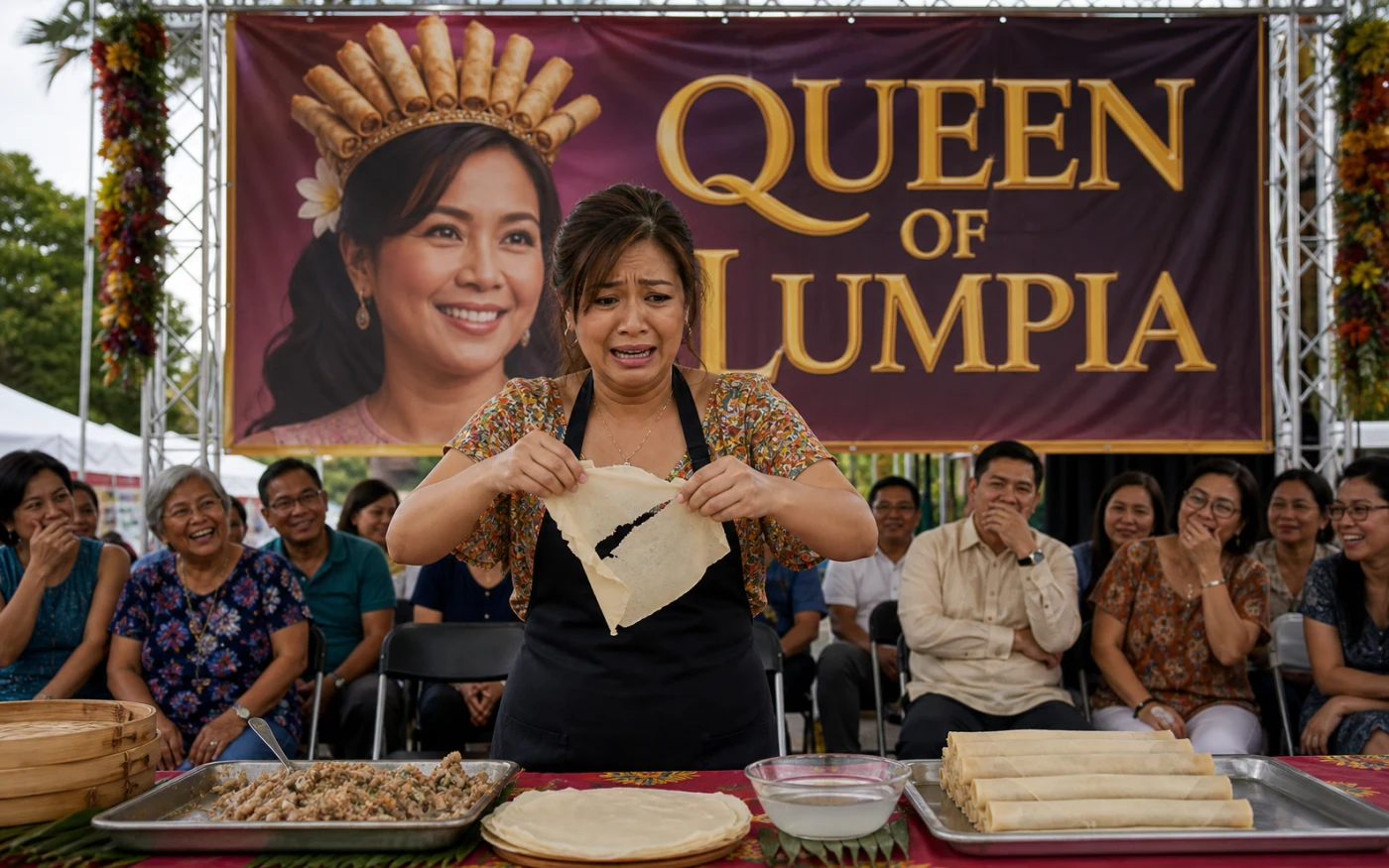
Because in July I walked into the parish hall at St. Matthew's after Mass, expecting coffee and pandesal, and saw my own face.
Forty feet of it.
MARISA REYES: QUEEN OF LUMPIA. Gold letters. Underneath, a crown made out of fried spring rolls.
I stopped so fast Danny walked into my back.
"Oh," he said.
"What does 'oh' mean?"
"Very flattering picture."
Lorna came running with her phone already up. "Surprise! The festival! Saturday! You're doing the demonstration!"
My stomach went down an elevator shaft.
Father Ben arrived with a program. "Three o'clock. Big stage. Live."
"Live?"
"Everyone wants to watch you roll."
Auntie Baby leaned in very close.
"Sige. Show us your hands."
Danny made a small choking sound.
Then Lorna put a microphone in my hand and two hundred people turned around.
I could have laughed. I could have confessed right there and been home by noon.
Instead I heard my own voice say, "I can't wait."
That afternoon I drove to Daly City with flowers I had no time to arrange.
Tess opened the door in an apron, looked at the flowers, and did not take them.
"Ilan?"
"I don't need lumpia."
She waited.
"Tess. I need you to teach me how to make them."
Her hand came off the doorframe.
"Ano?"
"In six days. On a stage. In front of two hundred people."
PART 2: Why Tess Said Yes
I told her everything at her kitchen table in one breath. The baptism. The garage. Twelve years. Saturday, three o'clock, live.
Tess listened with her hand over her mouth. I could not tell if she was going to cry or throw me out.
Then she sat down and laughed until she had to hold the edge of the table.
"Sorry," she said. "Sorry."
"You are not sorry."
"Hindi."
I flattened a printout on her table. Ground pork, carrots, garlic, a little soy. Four and a half stars, nine hundred reviews.
"I found a recipe. I can make the filling. I can chop. I can fry."
"Okay."
"Tess, I cannot roll."
She looked at the printout, then at my hands, and something in her face went soft.
"Sige."
"Just like that?"
"Just like that."
So for four nights I drove to Daly City after work, sneaking out of my own house to learn how to be myself.
She never touched my recipe. She stood at my elbow with a damp towel and corrected my hands.
"Konti lang."
"It looks empty."
"Lumpia 'yan, hindi burrito."
I took some out.
"More?"
"Less."
"There's nothing left inside."
"Mabuti. Roll."
My first wrapper tore. My second looked pregnant. My third opened in the oil and released its pork like a small grenade.
She could do six while I did one.
On the third night I gave up and watched her.
Six seconds each, not even looking down, telling me about her son's transmission.
"Tess."
"Hm?"
"It should be you up there on Saturday."
Her hands stopped.
"Hindi."
"I'm serious. Two hundred people watch you do this, they lose their minds."
"Hindi ako puwede."
"Why not?"
She picked up another wrapper and did not answer for a while.
"Nakakahiya."
"What is?"
"Lahat." She lifted one shoulder. "I can cook for two hundred people. Pero sa stage? Hindi."
I laughed. Then I saw she was not laughing.
"Tess, you have been doing this eighteen years. People should see you do it."
She sealed the lumpia in her hand and set it down straight.
"Ayoko," she said. "I like my kitchen."
"Tess—"
"Roll."
"No, listen—"
"Huwag na, Marisa."
So I dropped it. Tess liked her kitchen. I still thought two hundred people would lose their minds.
Meanwhile, at my house, the relatives began arriving.
My mother came Thursday "to bring calamansi." Lorna came Friday "with dessert." Auntie Cora came for no stated reason at all.
At one point there were five people in my kitchen watching me fight a single wrapper.
"This feels hostile."
"Ay, drama," my mother said.
"Sumusuporta kami," Lorna said, and her face did something I did not like. Almost proud. Almost guilty. Mostly entertained.
"Support me with your normal face."
"This is my normal face."
It was not.
Then Auntie Baby arrived with onions, a bottle of oil, and a plastic grocery bag she did not put down. Not on the counter, not on the chair. Not once in three hours.
She picked up a practice piece and turned it over like a jeweler.
"Ikaw gumawa nito?"
"Yes."
"Hm."
"What does 'hm' mean?"
"Roll your lumpia."
Twice that week I got as far as opening my mouth. Both times somebody rang the doorbell.
Friday night in Daly City, at eleven o'clock, I produced eight pieces that stayed shut and cooked through.
Tess ate one. Chewed. Nodded.
"Safe."
"Safe?"
"You asked me to prevent embarrassment. Walang ospital."
At the door I asked, "Will you come tomorrow?"
"I'll come," she said.
I drove home with eight edible lumpia and no remaining excuses.
Saturday at three o'clock I climbed onto the stage underneath my own enormous face. Somebody had added gold stars around my head during the week. Danny denied it. Nobody believed him.
Two hundred folding chairs. A camera on a tripod for the parish website.
And in the fourth row, sitting very straight with her purse on her lap, was Tess Mercado.
Two seats down, holding that plastic grocery bag on her knees like a woman at a bus station, was Auntie Baby Santos.
She caught my eye.
Then she lifted the bag, and she waved it at me.
PART 3: What Was in the Bag
Father Ben tapped the microphone.
"Sa wakas," he said. "Twelve years we have been eating these. Today we learn."
I laid out my bowl, my wrappers, my damp towel, exactly the way Tess had shown me.
Then I picked up a wrapper and my hands stopped working entirely.
The filling went in crooked. The wrapper tore straight down the middle. I reached for another one and dropped it.
And my family started cheering.
Not politely. My mother was holding on to the chair in front of her. When the next one split, Auntie Baby shouted "Ang ganda!"
"Why is everyone enjoying this so much?"
Nobody answered.
Then Father Ben leaned in, happy as a man on his own birthday, and said, "Show us how you get them all the same size."
That was the one thing.
I looked at Lorna. She had both lips pressed together. Danny was staring at the ceiling. My mother had hidden half her face behind the program.
Auntie Baby was practically vibrating.
Then six years of questions came back to me at once. The wrappers. The oil. The size. The hands. And then, suddenly, nothing.
I looked at Lorna.
"You know."
She made one terrible snorting sound and folded in half.
Danny lost it next. My mother covered her face. Auntie Baby slapped both hands on her knees.
Oh, those monsters.
I put down the wrapper and reached for Father Ben's microphone.
"Fine. I have something to say."
"I never made the lumpia."
Silence.
"Not one. I drive to Daly City and I pay Tess Mercado in cash and I move them into my tray in my garage, next to the recycling."
My mother put her hand on her chest.
"I did it the first time because I was tired. I kept doing it because for the first time in my life I was somebody who brought something."
I looked at the floor.
"I brought paper plates for nine years."
And my mother stood straight up in the second row.
"Ako pa naghugas? All those trays?"
The hall came apart.
Father Ben was laughing so hard he lowered the microphone. Lorna had her whole face in her hands.
I picked up the microphone again.
"You want to see how it's actually done?"
I pointed into the fourth row.
"Tess Mercado. Halika."
Tess shook her head, fast, twice.
"Marisa, hindi—"
Auntie Baby stood up, took Tess by the elbow, and walked her to the stairs. Then she let go.
Tess hesitated. Then she climbed onto the stage herself, holding her purse like a shield.
"Sabi ko huwag."
"I know." I took the purse out of her hands and gave her the damp towel. "You don't have to say anything. Just roll."
She stood over my ruined station and wiped her hands. She chose a wrapper from the middle of the stack, and something happened to her shoulders.
Then she started.
Fold, tuck, roll, seal. Six seconds. Fold, tuck, roll, seal.
The hall went quiet. Two hundred people watching a woman's hands.
She lined them up on the tray, identical, and somebody in the back whispered "Grabe."
At the twelfth one the applause came so loud she looked up, startled, like she had forgotten anybody was there.
Then a man near the front shouted, "Do you take orders?"
Tess blinked. "Po?"
"For Christmas?"
Three phones came out. Then ten. Then a crowd moving toward a woman holding a damp towel.
"Naku," Tess said, and stepped behind me.
So I took the microphone back, because that is the one thing in this world I can actually do.
"Everybody calm down. Christmas orders that side. Baptisms and birthdays over here. Ate, sit down, you'll get your turn."
Lorna found paper. Danny wrote names. My mother began accepting deposits, which nobody authorized. Auntie Baby planted herself at the front of the line like a bouncer.
"Isa-isa lang! Don't crowd her!"
Tess leaned toward me, white as her own flour.
"Hindi ko kaya. All this?"
"You can."
"I cannot."
"Then my eighty come first at Christmas."
When the line thinned out, Father Ben said there was one more thing, and Auntie Baby walked onto the stage and finally opened the bag.
It was a plastic bowling trophy from the youth league closet, with a lumpia wrapper taped around the little bowler like a cape.
The label on the base said BEST LONG-TERM LIAR. Underneath, TWELVE YEARS.
My whole body went cold, because nobody made that in the last four minutes.
"How long have you known?"
Lorna raised her hand. "Eight years."
My mother raised hers. "Mga pito."
Auntie Baby looked personally insulted. "Ako ang una."
"You brought the exact same lumpia to my house three weeks after Tess catered my office party," Lorna said. "Same wrappers. Same little bubbles."
"Also, anak," my mother said, "you don't even know how to chop sibuyas. You were using steak knife."
"It was available!"
"Twelve years we asked you about the rolling," Auntie Baby said, lifting her chin. "Hindi mo napansin?"
I turned to Tess to see whether she had known too.
She was standing there holding a damp towel with her mouth open, looking at my family like they had walked out of the ocean.
"Alam mo ba?"
"Hindi!" she said. "Akala ko... just me."
That December I drove to Daly City and picked up my order.
I did not go to my garage.
I carried Tess's boxes through my mother's front door with the name facing out, and the room stood up and applauded before I reached the table.
"Very funny," I said.
Lorna opened the first box, took one, and looked me straight in the eye.
"Ikaw gumawa nito?"
Behind her, Tess Mercado was sitting at my mother's table for the first time in twelve years, my mother refilling her glass while she told somebody on the phone that no, sorry, fully booked until February.
I picked up a lumpia.
"Of course."