
My Son Is the Barangay Captain and Too Busy to Visit Me. So I Ran Against Him.
PART 1: Vote for Nanay
I ran against my own son because he missed lunch.
Not one lunch.
Twenty-three Sunday lunches.
Randy lived three streets from me in Paete, but you would think I had given birth to a sailor lost in the Pacific.
Every Sunday, I cooked enough for him anyway.
Sinigang. Adobo. Kare-kare when I was feeling hopeful.
Every Sunday, his chair stayed empty.
His messages always came after the rice had gone cold.
Sorry, Nay. Barangay emergency.
Sorry, Nay. Meeting.
Sorry, Nay. Next week talaga.
Then one Sunday, I saw him pass my house on a motorcycle while I was standing at the gate with a bowl of hot ginataang bilo-bilo in my hands.
He raised one finger to tell me to wait.
He did not come back.
That Monday, I put on my good yellow blouse and went to the election office.
“I want to file my candidacy for barangay captain,” I said.
The young clerk stared at me.
“Aling Maring, your son is the barangay captain.”
“I know who my son is.”
By lunchtime, the entire town knew.
Randy arrived at my house still wearing his barangay vest.
“Nanay, tell me this is not true.”
I handed him a plate of rice.
“Sit down and I will tell you.”
“I cannot sit down. I have a meeting.”
“Then you already know why it is true.”
His mouth opened.
Nothing came out.
For the first time in months, I had made Barangay Captain Randy Mercado speechless.
My niece Jessa designed my campaign poster that afternoon.
It showed me smiling in front of the lake, with my hair freshly curled and one hand lifted like I was blessing a wedding.
Under my face were three words in red letters.
VOTE FOR NANAY.
By sunset, the posters were in sari-sari stores, tricycle terminals, and woodcarving workshops.
People took pictures beside them.
Randy tore down the one tied to my own gate.
I tied up two more.
“This is humiliating,” he said.
“Good. Now you are paying attention.”
I had never run for anything in my life, but I had spent forty years feeding people.
I knew nobody would shut the door on a woman holding pancit.
So I made pancit.
I visited every house from the church plaza to the narrow road behind the workshops.
I asked widows if their medicine requests had been answered.
I asked mothers why the covered court lights were still broken.
I asked old men why they waited outside the barangay hall under the sun.
Then I wrote everything in the old school notebook where I used to record Randy’s grades.
He laughed when he heard about my notebook.
He stopped laughing when people began calling it Nanay’s List.
Soon, his own volunteers were telling him he had to campaign door to door.
“I have work to do,” he complained.
“These people are your work,” I told him.
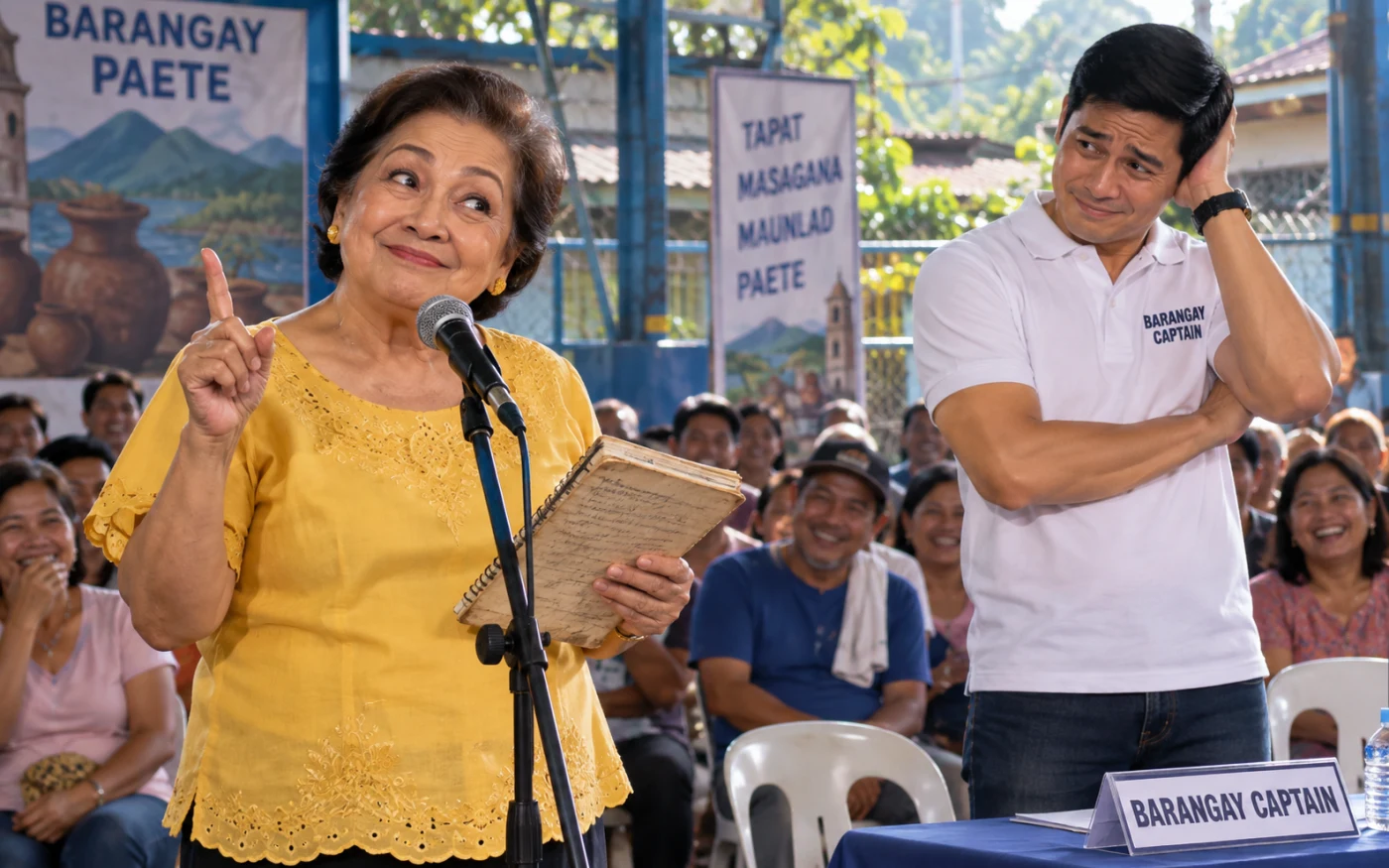
The public debate was held in the covered court on a Friday night.
Every plastic chair was full.
Randy wore a white polo and spoke about drainage, peace and order, and budget approvals.
He sounded impressive.
He also sounded like a man reading instructions for a rice cooker.
When my turn came, I walked to the microphone with Nanay’s List.
“My opponent says he has always been responsible,” I began.
Randy narrowed his eyes at me.
“When he was six, he blamed our cat for wetting his bed.”
The covered court exploded.
Randy turned bright red.
“Nanay!”
“The cat slept outside.”
Even the moderator bent over laughing.
Then I opened my notebook.
I talked about Aling Nena’s missing senior allowance papers.
I talked about the dark footpath where two children had fallen.
I talked about Mang Efren waiting five hours to ask for a certificate.
The laughter disappeared.
People listened.
Randy listened too.
Afterward, he followed me home.
“You made me look like a fool.”
“You forgot the people who cannot leave work to visit your office.”
He slapped both palms on my dining table.
“You do not know what this job takes.”
I put down two bowls of arroz caldo.
“Then explain it.”
He sat.
We argued until ten o’clock.
The next night, he came back with a folder to prove I was wrong about the senior allowance papers.
I fed him fried tilapia.
The night after that, I showed him photographs of the broken footpath.
I fed him tortang talong.
Soon, my opponent was eating at my table every night.
We fought over budgets, curfews, garbage collection, and whether my pancit gave voters an unfair emotional advantage.
“Your posters are everywhere,” he said one evening.
“You should have visited me before I learned how to use a stapler.”
Then Jessa burst through the door, waving her phone.
The latest neighborhood survey had been posted.
Randy read it once.
Then he read it again.
For the first time since I filed my candidacy, I was ahead.
PART 2: The Vote Nobody Expected
The next morning, Randy began knocking on doors before sunrise.
He visited Mang Efren.
He checked the footpath himself.
He stood beside the senior citizens waiting outside the barangay hall and ordered chairs brought into the shade.
I should have been angry that it took an election to wake him up.
Instead, I felt proud.
That annoyed me even more.
At dinner, he placed my old notebook beside my plate.
“Three items are finished,” he said.
I inspected his notes.
“The light on Mabini Street?”
“Tomorrow.”
“Aling Nena?”
“Her papers were found in the wrong folder.”
“And Mang Efren?”
Randy pushed the soy sauce toward me.
“He says your pancit is better than mine.”
“You do not make pancit.”
“Exactly. I had no defense.”
We continued campaigning against each other.
I held meetings inside carving shops while wooden saints watched from the shelves.
Randy walked until his shoes split near the heel.
I told the women at the market how he used to cry if his boiled egg was not perfectly round.
He told them I had once chased a councilor down the street with an umbrella over an unpaid raffle ticket.
Both stories were true.
But every night, we returned to my dining table.
Some nights he arrived after nine.
I began to see what I had refused to see before.
His phone never stopped.
A flooded kitchen. A drunken fight. A missing child who had only fallen asleep at a cousin’s house.
Randy answered every call.
Once, he left his soup untouched because a family needed help getting to the hospital.
He returned near midnight and ate the soup cold.
“You could ask other people to help,” I said.
He rubbed his eyes.
“If I ask them to do everything, what am I captain for?”
There it was.
The same foolish pride his father had carried.
The belief that love meant making yourself useful until nothing was left.
I did not give a speech.
I reheated his soup.
On the final night of campaigning, our supporters held rallies on opposite sides of the plaza.
Mine shouted, “Nanay! Nanay!”
His answered, “Captain Randy!”
When the rain suddenly poured, both groups ran beneath the same awnings.
My volunteers shared pancit.
His volunteers shared coffee.
Randy and I stood under one umbrella, pretending not to smile.
“You can still withdraw,” he said.
“So can you.”
“I am serious, Nay.”
“So am I.”
His smile faded.
“What if you win?”
I looked at the people crowded together in the rain.
“Then I work.”
“And what if I win?”
“Then you work better.”
Election day felt longer than all the years I had raised him.
People lined up before the school gates opened.
Old women squeezed my hands.
Young men asked Randy for photographs.
We were not allowed to campaign, so we sat at opposite ends of my sala and watched the clock.
At noon, I served lunch.
He moved from the sofa to the table without being asked.
Neither of us could eat much.
The counting began after sunset.
The covered court grew hot and silent.
Each time my name was read, my supporters cheered.
Each time Randy’s was read, his supporters answered louder.
The stacks stayed almost even.
With ten ballots left, he led by two.
With five left, I led by one.
The final ballot was unfolded.
“Randy Mercado.”
The election officer counted again.
Then another officer counted.
Then they announced the result.
An exact tie.
The room erupted.
The law required a drawing of lots to decide the winner.
It would happen the following morning in the barangay hall.
I found Randy alone behind the covered court, staring at the wet basketball lines.
“Did you vote for yourself?” I asked.
He looked at me for a long moment.
Then he shook his head.
“I voted for you, Nay.”
My knees nearly gave way.
His own vote had created the tie.
And in the morning, one folded piece of paper would decide which of us lost.
PART 3: What Randy Drew
“Why?” I whispered.
Randy looked toward the court where people were still arguing over the count.
“Because you were right.”
His voice broke.
“I kept saying I was too busy serving everyone. But I stopped seeing people. Even you.”
I wanted to scold him.
I wanted to hold him.
So I did both.
I struck his arm with my handbag, then pulled his head against my shoulder.
“Anak, ano ba? You almost voted yourself out of a job.”
“I know.”
“You have children.”
“I know.”
“Your wife will blame me forever.”
“She voted for you too.”
I struck him again.
The next morning, the barangay hall was packed.
Two folded papers waited inside a clear glass bowl.
One said WINNER.
The other said LOSER.
The election officer offered me the bowl first because I was older.
I pushed it toward Randy.
“Captain first.”
He reached inside.
The whole room seemed to stop breathing.
He opened the paper.
WINNER.
His supporters screamed.
My supporters groaned.
Randy did not celebrate.
He walked straight to me and held out the paper as if he wanted to apologize for it.
I took his face in both hands.
“Then win properly. Pangako?” I said.
He hugged me in front of everyone.
That should have been the end.
Instead, Randy took the microphone.
“My first act as barangay captain,” he said, “is to appoint Maring Mercado as head of the senior citizens’ desk.”
People began clapping before he finished.
I stared at him.
“There is no proper desk yet,” he added.
“Then where will I work?”
Randy smiled.
The following Sunday, three folding tables arrived at my house.
So did twenty-two senior citizens, two barangay workers, four trays of documents, and the newly reelected captain carrying a pot of rice.
We set up under the mango tree.
Aling Nena checked allowance forms while Mang Efren made a list of homes needing handrails.
Randy sat in his old chair at my dining table and signed requests between bites of kare-kare.
When his phone rang, he answered it.
“Yes, I’m in a meeting,” he said.
He looked at me and lifted his plate.
“Sunday meeting. Every week. Hindi puwedeng mawala.”
Then he asked me for more rice.
I had waited twenty-three Sundays to hear that.
I filled his plate until the rice rose like a small white mountain, and my son did not leave the table.