
My Daughter's Science Fair Rival Is the Son of the Guy Who Ruined My College Career. I Did Not Handle It Well.
PART 1: The Man Behind the Lettuce
I was holding a plastic volcano when I saw the man who had stolen my future.
He was standing behind a tower of lettuce.
“Dad,” my daughter whispered, “why are you squeezing Mount Kikimanjaro?”
I looked down. My fingers had crushed one side of the papier-mâché cone we had spent three nights painting.
“Ay, sorry.”
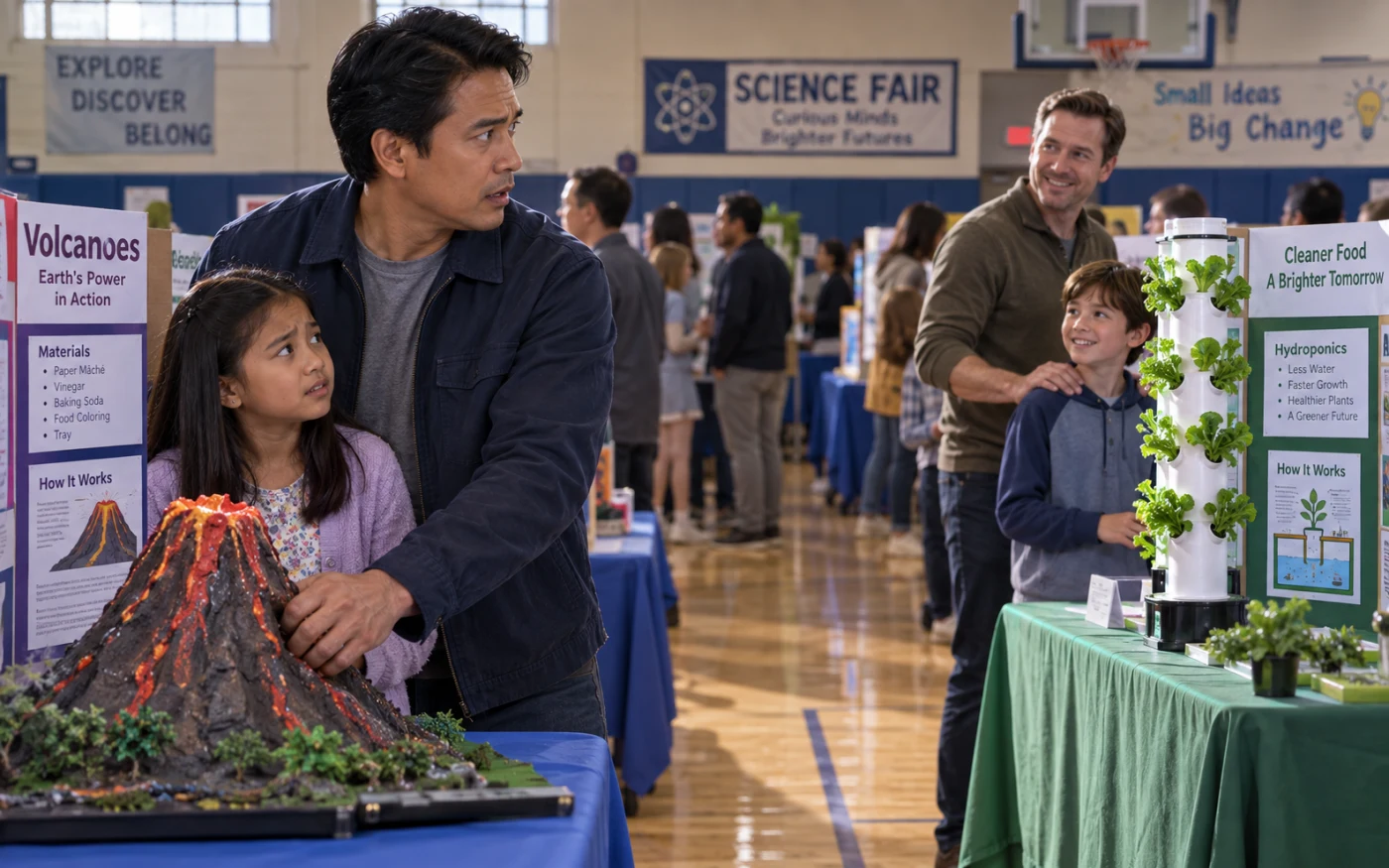
It was the school's science-fair project preview, before final judging the following week.
Across the gym, Trent Walsh smiled at me as if twenty-two years had been twenty-two minutes.
“Lito?” he called.
That voice took me straight back to freshman year, 2004.
A cramped dorm room. Two humming computers. Instant pancit canton at midnight.
And the scheduling program I had built for our final project—the one Trent submitted under his own name while I was home in Riverside because my father had suffered a stroke.
That program won Trent an internship.
Years later, it became the foundation of the scheduling software his startup sold.
The startup made him rich.
I got an academic misconduct hearing because he told the professor I had copied him.
The charge disappeared from my record eventually, but my scholarship was already gone, and by then I was working full time because I couldn't afford to go back without it.
I left school, started repairing office computers, and spent years telling everyone that I preferred learning “in the real world.”
Now Trent wore expensive sneakers in an elementary school gym, and his son’s hydroponic lettuce tower rotated beneath a little sign that read:
BRAYDEN WALSH — THE FUTURE OF FOOD
Beside it sat Kiki’s baking-soda volcano, patched with masking tape and shedding brown paint.
“You know Brayden?” Kiki asked.
“No.”
“I mean his dad.”
“Also no.”
Trent was already walking toward us.
He opened his arms. “Man, it’s been forever.”
I held out the volcano between us like a shield.
“Not long enough,” I said.
His smile slipped.
Kiki’s eyes widened. “Dad!”
Brayden came jogging over, a skinny boy with glasses and a lettuce leaf tucked behind one ear.
“Kiki, your volcano is cool,” he said. “Does it explode?”
“It erupts,” she corrected. “Explosions are not permitted.”
“Mine grows lettuce.”
“I can see that.”
“You can eat one if you want.”
She took a leaf, tasted it, and made a face. “Needs bagoong.”
Brayden laughed.
Trent and I did not.
That should have been the end of it. I should have taken Kiki home, repaired the volcano, and remembered that the science fair belonged to ten-year-olds.
Instead, I asked, “How does the water circulate?”
Trent’s face brightened. “Custom pump system. Brayden designed most of it.”
Most.
That word crawled under my skin.
“Nice,” I said. “Kiki designed all of hers.”
Kiki tugged my sleeve. “Dad, you mixed the paste.”
“Under your supervision.”
Trent nodded toward our dented mountain. “Classic project.”
Classic.
He might as well have said adorable.
That night, Mount Kikimanjaro got an aquarium pump.
By Thursday, it had a pressure sensor, three eruption chambers, and a release valve controlled by an app on my phone.
“Grabe, Dad. This feels like a lot,” Kiki said as I drilled into the plywood base.
“Ms. Perez said we should be able to explain every part ourselves.”
“I’ll explain it to you.”
“Before or after bedtime?”
“Both.”
My wife, Julie, called during our third midnight test.
“Why did Kiki text me a photo of a drone carrying vinegar?” she asked.
I lowered my voice. “It creates a controlled aerial delivery system.”
“She is in fifth grade, Lito.”
“Exactly. Early exposure.”
“To science?”
The drone struck a cabinet and dropped its paper cup into the sink.
“To problem-solving.”
Julie went quiet in the dangerous way I knew too well.
“This is about another father, isn’t it?”
“Of course not.”
“Susmaryosep.”
On Friday morning, Trent arrived at pickup with LED grow lights mounted around Brayden’s tower.
I arrived with safety goggles for Kiki’s entire class.
On Monday, he added an automated nutrient monitor.
On Tuesday, I added a fog machine.
Wednesday, he brought a woman in a blazer who handed his son a packet labeled PRESENTATION STRATEGY.
“A consultant?” I demanded.
Trent shrugged. “She coaches young innovators.”
That afternoon, I ordered a digital seismograph.
At pickup, Trent and I began circling each other with tight smiles, like two divorced people forced to share a table at a christening.
Our children sat on the curb together, trading crackers and ignoring us.
“Your dad is kind of intense,” I heard Brayden say.
Kiki sighed. “Naku. You should see him with karaoke.”
The night before the fair, I set my alarm for three in the morning so we could test the eruption pressure in cooler air.
When it rang, I found Kiki sitting at the kitchen table in her pajamas.
She had not touched the goggles or the chart I had made.
“Ready?” I asked.
She looked at me. “Are you mad at me?”
My chest tightened. “What? Never.”
“Then why does it feel like I’m losing?”
I sat beside her.
For the first time in two weeks, I really saw her.
The glue dried on her fingers. The dark circles under her eyes.
The little painted volcano pushed to the far end of the table while my wires and screens occupied everything else.
“Anak,” I said softly, “you’re not losing.”
She stared at the tabletop. “Then who are you trying to beat?”
I had no answer that did not make me ashamed.
The next morning, we reached the gym at seven.
Trent was already there, standing beside two empty tables.
His lettuce tower was gone.
So was Mount Kikimanjaro.
In the middle of Kiki’s table lay a folded note written in purple marker.
PLEASE DON’T BE MAD. IT WORKS BETTER THIS WAY.
PART 2: Where The Projects Went
“Brayden!” Trent shouted.
“Kiki!” I shouted louder.
Ms. Perez rushed from the registration desk. “Gentlemen, inside voices.”
“Our projects have been stolen,” Trent said.
“Combined,” said a small voice behind the stage curtain.
Kiki stepped out first. Brayden followed, carrying a coil of clear tubing.
“Combined how?” I asked.
The curtain moved.
Then two more classmates pushed out the strangest object I had ever seen.
Mount Kikimanjaro sat inside the bottom reservoir of the hydroponic tower.
Clear tubes climbed its painted slopes.
Lettuce sprouted from cups around the crater.
My pressure sensor was taped beneath Trent’s LED lights, and the drone rested on top with a tiny bucket hanging from it.
A cardboard sign read:
CAN VOLCANIC GAS POWER A GARDEN?
Underneath, in smaller letters:
Probably Not, But We Tested It.
“You destroyed my system,” Trent said.
“Your system?” I snapped. “That pump is connected to my release valve.”
“Because it was the only valve that fit,” Brayden said.
“And the volcano water feeds the lettuce,” Kiki added.
I stared at her. “Baking soda and vinegar will kill the plants.”
“That’s why we made a separate nutrient loop,” she said. “The volcano only pushes air through it.”
I looked closer.
They had not made nonsense. Not entirely.
Air pressure from the eruption chamber moved water through a second tube.
The drone delivered vinegar.
The lights powered on when the pressure sensor triggered.
It was ridiculous, overcomplicated, and held together with tape.
It was also clever.
“When did you do this?” Trent asked.
Brayden adjusted his glasses. “At lunch. And after school.”
“Ms. Perez let us use the supply closet,” Kiki said.
Ms. Perez suddenly became very interested in her clipboard.
Trent pointed at the crooked tubing. “It won’t survive judging.”
“Your tower wouldn’t survive without my pump,” I said.
“Your volcano couldn’t win without my tower.”
“There it is,” I said.
Trent blinked. “What?”
“You take someone else’s work, attach your name, then act like you invented it.”
The gym seemed to go quiet around us.
He lowered his hand. “Lito.”
“No. You don’t get to ‘Lito’ me.”
“Dad,” Kiki whispered.
But twenty-two years were coming out of my mouth now.
“You lied to Professor Harris. You took the internship. You let everyone think I copied you.”
Trent’s face went pale.
Brayden looked at his father. “What is he talking about?”
Trent glanced at his son, then at me. “Not here.”
“Of course not here. Somewhere private, where nobody sees what you do?”
“Tama na,” Kiki said.
Two words.
They stopped me harder than a shout.
My daughter stood between our projects, gripping the cardboard sign. Her eyes shone, but she refused to cry.
“Brayden didn’t steal from me,” she said. “I asked him to help.”
Brayden stepped beside her. “And I asked Kiki.”
“Why?” Trent demanded.
“Because you two made everything boring,” Brayden said.
I almost laughed. Trent looked personally wounded.
Kiki lifted her chin. “The fair is supposed to be about asking a question. Our question was whether you would notice we became partners.”
“That is not a science question,” I said weakly.
“We already answered it,” she replied.
The head judge approached with two other judges behind her.
“Team entry?” she asked.
Kiki looked at Brayden.
Brayden looked at Kiki.
“Yes,” they said together.
Trent started to object.
I do not know what changed in me.
Maybe it was Kiki’s trembling hand.
Maybe it was seeing my expensive pressure sensor held in place by a purple unicorn sticker.
I stepped backward.
“Let them present,” I said.
Trent stared at me for a long second.
Then he stepped back too.
Kiki began. “Volcanoes release gases and heat that affect nearby ecosystems.”
Brayden continued. “Hydroponic systems use pumps to circulate water and nutrients.”
They explained the separate loops. They showed their failed trials.
They admitted the lettuce had wilted when they accidentally sent vinegar through the roots.
The judges laughed.
Then Kiki held up the app controller.
“For our final demonstration, the drone adds vinegar to the eruption chamber.”
My stomach dropped.
I looked at the pressure reading.
The sensor flashed green.
Then yellow.
Then red.
“Kiki,” I said, “step away from the volcano.”
PART 3: What Erupted Onstage
The drone lifted with an angry buzz.
Every head in the gym turned.
It carried its tiny cup above Mount Kikimanjaro, tilted, and poured.
For one silent second, nothing happened.
Then the volcano burped.
A thick stream of bright blue foam shot from the crater, looped through the clear tubes, and blasted upward inside the lettuce tower.
The pump kicked on.
Water spun around the roots.
LED lights flashed purple.
The drone wobbled through a cloud of fog and landed perfectly on a tray of chocolate cupcakes three tables away.
Children screamed with delight.
Parents raised their phones.
One lettuce plant launched from its cup and landed on Trent’s head.
I tried not to laugh.
I failed.
Trent pulled the lettuce from his hair, stared at it, and began laughing too.
Not his old polished laugh. A helpless, wheezing laugh.
The kind I remembered from our dorm room before everything went bad.
The pressure alarm shrieked.
Kiki reached for the release valve, but her hand slipped on the foam.
I lunged forward.
So did Trent.
Our hands hit the valve together.
“Left!” he yelled.
“Your other left!” I yelled back.
We twisted. The valve opened. A final puff sent harmless blue bubbles raining over all four of us.
The gym erupted louder than the volcano.
Kiki wiped foam from her nose. “That was not supposed to happen.”
The head judge removed her glasses and cleaned them with the edge of her shirt.
“Can you explain why it did?” she asked.
Kiki and Brayden exchanged a look.
Then they rushed to the pressure chart, talking over each other, tracing the tubes, arguing about airflow.
They did not blame the equipment.
They did not blame us.
They treated the disaster like one more question waiting to be answered.
The judges stayed at their table longer than at any other display.
An hour later, the principal stood on the small stage with a box of ribbons.
“This year,” she said, “our overall award recognizes not only creativity, but collaboration, honest testing, and the ability to learn from spectacular failure.”
Kiki grabbed my hand.
Brayden grabbed Trent’s.
“The blue ribbon goes to Kiki Flores and Brayden Walsh for ‘Can Volcanic Gas Power a Garden?’”
The two children shrieked and ran to the stage.
Trent and I stood behind them, still streaked with blue foam, clapping like fools.
Then the PTA president took the microphone.
“One additional announcement,” she said. “After reviewing certain equipment purchases, after-hours construction, and the unauthorized indoor drone flight, Mr. Flores and Mr. Walsh are prohibited from assisting with next year’s science fair.”
The loudest applause came from Julie, who had arrived in time for the judging.
“Deserve ninyo ’yan!” she called.
Kiki laughed so hard her new ribbon bounced against her chest.
In the parking lot, the afternoon sun made dried blue foam sparkle on our clothes.
Kiki and Brayden walked ahead of us, carrying the battered volcano between them.
Trent stopped beside my old Honda.
“Lito.”
I kept my eyes on Kiki. “What?”
“I did ruin it for you.”
The simple words knocked the air from me.
He swallowed. “I was scared you’d get the internship. I told myself I had done half the work. Then I told one lie, and every day after that, it got harder to admit the truth.”
I looked at him.
“You could have called.”
“I know.”
“You could have fixed it.”
“I did.”
I turned toward him. “What?”
“The year after you left, I wrote Professor Harris and the dean. I told them the program was yours. I told them I lied at the hearing.”
My mouth went dry. “That was why they cleared my record?”
Trent nodded. “Yes. I should have told you myself.”
He looked toward Brayden, then back at me.
“And I kept using the scheduling system. When it became the foundation of my company, I knew part of what I was building belonged to you.”
He walked to his SUV and came back with a thick envelope.
“I brought this to the preview,” he said. “Then I kept bringing it every time I knew you’d be here.”
Inside was a copy of the confession he had sent the university years ago.
Behind it was a trust statement with my name across the top.
I looked at the number, then looked again.
“What is this?”
“Five percent of my founder shares. I put them aside for you in 2011.”
“How much?”
“As of Friday? A little over 1.4 million dollars.”
I sat down on the hood of my Honda.
Trent rubbed the back of his neck. “Brayden told me Kiki’s dad was named Lito. I knew it was you before I walked over. That’s why I came over smiling like an idiot. I thought I could finally hand you this.”
“Then I put a volcano between us.”
“You said, ‘Not long enough.’”
“I meant it.”
“I know. I lost my nerve. Then you asked about the pump, I got competitive, and suddenly we were nineteen again.”
That was so stupid I almost laughed.
“Why didn’t you find me years ago?” I asked.
“Because fixing paperwork was easy. Looking you in the face was harder.”
There was no excuse in his face. That helped more than an excuse would have.
He glanced toward Brayden. “For years, whenever he asked about college, I told him my best project was something I built with a guy named Lito.”
“With?” I said.
Trent winced. “It took me too long to learn the right word.”
“Which is?”
“Yours.”
I looked down at the trust statement again.
That money could buy a real shop for my repair business, replace my old Honda, and put Kiki through college without me lying awake over tuition.
The anger did not disappear. Life does not work like baking soda and vinegar.
You cannot mix an apology and a million dollars and watch twenty-two years foam safely out of you.
But for the first time in twenty-two years, I had choices again.
“Tell Brayden the whole story,” I said.
“I will.”
“And this time, get the names right.”
He nodded.
Ahead of us, Kiki shouted, “Dad! Are you coming?”
She had tied the blue ribbon around the volcano’s cracked crater. Brayden held one side. She held the other.
I tucked the envelope under my arm.
“Oo na,” I called.
I started toward her.
“Kiki,” Trent called, “don’t you want to split the ribbon?”
Brayden shook his head. “She keeps the ribbon.”
Kiki grinned at him. “He keeps the lettuce.”
She slipped her free hand into mine, leaned against my arm, and carried our ridiculous volcano home.