
I Inherited a Mountain Cabin in Baguio. The Only Other Beneficiary Was the Man Who Broke My Heart in College.
PART 1: The Second Name
The lawyer said I had inherited a cabin in Baguio.
Then he said the second owner's name, and I nearly knocked over his coffee.
“Mark Ocampo?”
“Yes,” Attorney Dizon said. “Do you know him?”
Know him?
Twelve years earlier, I had loved Mark so completely that I had planned our future between university classes.
Then he had accused me of using him, walked away while I begged him to listen, and never answered another call.
“He broke my heart,” I said.
The office door opened behind me.
“She broke mine first,” Mark said.
I knew that voice before I turned around.
He was thirty-three now, broader in the shoulders, with rain on his black jacket and the same serious eyes that had once believed everything I told him.
Until the one time it mattered.
Our late mentor, Professor Consuelo Valdez, had left us her cabin.
She had taught both of us literature, bullied me into publishing my first essay, and fed Mark whenever he pretended instant noodles counted as dinner.
She had also added one outrageous condition.
Before we could sell, we had to spend seven consecutive days together at the cabin and complete the repairs listed in her will.
If either of us left early, the property would go to the university.
“She cannot legally force me to vacation with my worst mistake,” I said.
“It is not a vacation,” Attorney Dizon replied. “The roof leaks.”
Mark folded his arms. “We renovate. We sell. We split the money.”
He spoke as if I were a difficult client.
“Fine,” I said. “But we drive separately.”
The cabin stood beyond a narrow road lined with wet pines.
Its green roof half-covered in moss. Fog drifted across the windows.
Hydrangeas crowded the stone steps as if they had been waiting for Professor Valdez to come home.
For one dangerous second, I loved it.
Then Mark carried both our toolboxes inside without asking, and I remembered I hated him.
The place smelled of old wood, coffee, and the lavender oil Professor used to dab on her wrists.
Her reading glasses still rested beside an unfinished novel.
I had to turn away.
Mark touched the back of her chair.
“She should be here,” he said quietly.
That was the first thing we agreed on.
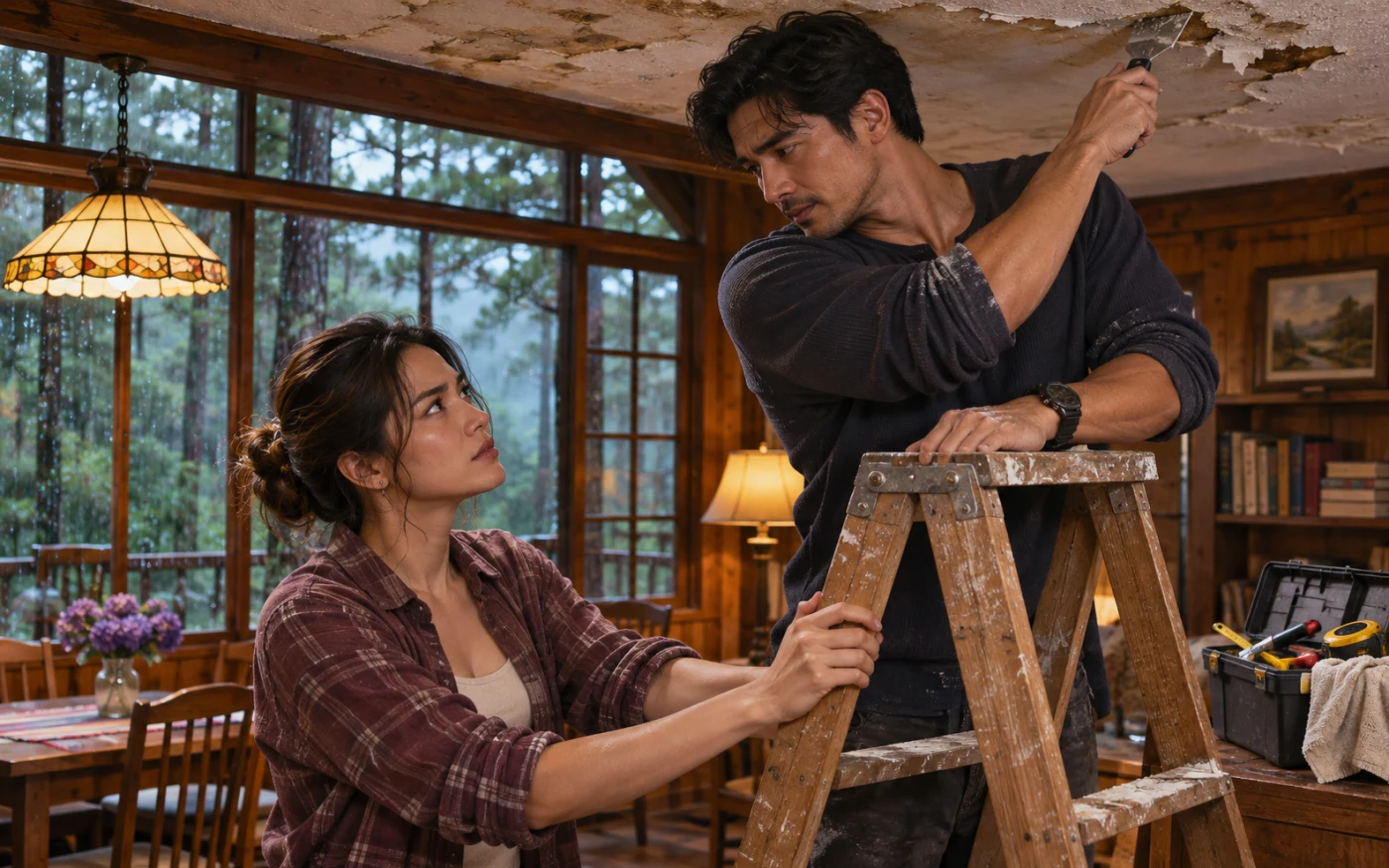
We began the next morning with the dining-room ceiling. I held the ladder while Mark scraped away damaged plaster.
“You can stop gripping it like you want to kill it,” he said.
“I am imagining it is your neck.”
“Good. At least you are focused.”
At lunch, I made coffee. I put one teaspoon of sugar in his cup without thinking.
He looked at it, then at me.
“You remembered.”
“It is not a sacred memory, Mark. You have a common sugar preference.”
He drank it anyway.
That night, the temperature dropped. I found him struggling with the fireplace and pushed him aside.
“Professor taught me how to open the flue.”
“She taught me too.”
“Clearly, she overestimated you.”
When the fire finally caught, his smile appeared so suddenly that my chest hurt.
It was the smile he used to give me across crowded lecture halls.
The one that said we shared a secret even when we did not.
I went to bed angry at myself.
On the second day, we repaired cabinet doors and argued about paint.
On the third, the rain became heavy enough to erase the mountains.
We worked without music because every song felt capable of exposing us.
By afternoon, water began dripping through the upstairs hallway.
Mark followed the stain to a narrow hatch in the ceiling.
“Attic,” he said.
“The list says to clear it.”
“The list also says to inspect the roof beams.”
“Then go inspect them.”
“You are coming with me.”
The attic was cramped and cold. Dust covered trunks, student papers, and boxes labeled in Professor's sharp handwriting.
While Mark checked the beams, I dragged a wooden trunk away from the leak.
It was locked.
Taped to its back was a small brass key and an envelope with two words written across the front.
ISABEL. MARK.
My hands started shaking.
Mark crouched beside me as I opened it.
Inside, Professor Valdez had written only one sentence.
Before you sell this house, please learn who stole twelve years from you.
PART 2: Who Stole Twelve Years
The trunk was packed with our past.
There were photographs from university events, drafts of our papers, and bundles of letters tied with faded ribbon.
Beneath them lay three leather journals and a thick envelope marked OPEN TOGETHER.
“This is manipulation,” Mark said.
His voice was unsteady.
“Then go downstairs.”
“I did that once. I am not doing it again.”
The words landed between us.
I opened the envelope.
The first page was a photocopy of an email I had supposedly sent to our classmate, Bianca Salcedo, twelve years ago.
I read the first lines and felt sick.
It said I had only dated Mark because Professor Valdez favored him.
It said his family had no money, no connections, and nothing useful to offer me after graduation.
“I never wrote this,” I whispered.
Mark sat back against a beam.
“Bianca showed it to me.”
“And you believed her?”
“It came from your address.”
“You knew me.”
“I thought I did.”
I wanted to throw the paper into his face. Instead, I reached deeper into the envelope.
There was another email. This one was from Bianca to Professor Valdez, sent six years later.
She admitted everything.
She had wanted Mark. She had seen me enter my password in the computer lab and sent the message while I was in class. She expected us to fight, not to disappear from each other's lives.
Years later, ashamed and newly sober, she confessed to Professor because she did not know how to face us.
Mark read the page twice.
Outside, rain battered the roof.
“I asked you whether you wrote it,” he said.
I laughed once, but there was no humor in it. “You cornered me outside the library. You called me a liar before I even understood what you were talking about.”
“You said if I thought so little of you, I should leave.”
“And you did.”
He covered his face with both hands.
I opened Professor's first journal because I could not bear to look at him.
She had recorded the day Bianca confessed. Professor had tried to find us. By then Mark was working in Singapore, and I had changed numbers and refused every invitation involving our old university circle.
One line had been pressed so hard into the page that the ink had scarred the paper.
These two proud children have made pain into a locked door, and neither will knock.
“Why didn't she tell us?” I asked.
Mark picked up the second journal.
The answer was there.
Professor had suffered a stroke days after trying to find us.
During her recovery, she lost Bianca's confession among boxes that were moved to Baguio.
When she found it again years later, she was already ill.
She wrote that a forwarded email would never be enough.
Mark and I had each built whole lives around what we believed. If she sent us proof separately, we might read it alone, cry alone, and retreat again.
So she made one final lesson plan.
Seven days. One leaking house. No escape.
I shut the journal.
“She had no right.”
“No,” Mark said. “But she knew us.”
He was crying.
I had imagined his regret for years. In my cruelest fantasies, he begged and I felt nothing.
But seeing him break did not make me victorious.
It broke me too.
“I waited for you,” I said. “Every birthday. Every Christmas. I thought maybe that would be the day you finally asked for my side.”
“I wrote to you.”
“You did not.”
He lunged for one of the ribbon-bound bundles and pulled it open.
“I gave these to Professor,” he said. “I couldn’t throw them away.”
Every envelope had my name on it.
None had a stamp.
“I wrote,” he said. “I just never became brave enough to send them.”
There were dozens. One from Singapore. One from his father's hospital room. One written the night he saw my first magazine article. One after Professor told him I had moved back to Manila.
I opened the oldest.
Isabel, if you tell me I was wrong, I will believe you. I am only afraid you will tell me I was right.
“You idiot,” I sobbed.
“I know.”
“You absolute idiot.”
“I know.”
I hit his chest with the letter. He did not stop me. Then my fist stayed there, pressed over his heart.
His hand closed around mine.
“Tell me now,” he said.
“You were wrong.”
He bowed his head until his forehead touched mine.
For a few seconds, we were twenty again, breathing the same air, one apology away from everything we wanted.
Then the lights went out.
A violent crack sounded above us.
The attic floor shuddered, and Mark threw himself over me as part of the rotten roof beam came crashing down.
PART 3: What Survived the Storm
When I opened my eyes, rain was pouring through a hole in the roof.
Mark was on top of me, silent.
“Mark.”
He did not move.
“Mark!”
I shoved at his shoulder, and he groaned.
It was the most beautiful sound I had ever heard.
The beam had struck his back, but a storage chest had taken most of its weight.
I crawled free, dragged a tarp over the trunk, and helped him downstairs one painful step at a time.
There was no signal. The road was blocked by a fallen pine. We were cold, soaked, and trapped until the storm passed.
I sat him near the fireplace and lifted his shirt to check the bruise spreading across his shoulder.
“You could have been killed.”
“You were under it.”
“That is not an answer.”
He looked back at me. “It is the only answer I have.”
I started crying again.
He reached for me, and I went into his arms so fast I nearly knocked us both onto the floor.
“I loved you,” I said against his neck. “I hated you, but I loved you. It was exhausting.”
His arms tightened.
“I never stopped.”
“You don't get to say that and fix everything.”
“I know.”
“Twelve years, Mark. Grabe.”
“I know.”
“Say something else.”
He pulled back, his face wet with rain and tears.
“Give me the rest of my life, Isabel. I will spend it saying something else.”
I kissed him.
It was not a polite reunion kiss.
It was grief and anger and relief.
It was every unsent letter and every unanswered question.
When we finally separated, the fire had begun to warm the room.
We slept on the rug with one blanket over us, my hand on his chest because I needed to feel it rise.
By morning, the storm had weakened.
For the next four days, we had the roof patched and finished the repairs around the cabin.
This time, we talked.
Mark told me about leaving Singapore to care for his father.
I told him how Professor had sat in the front row when I gave my first public reading because I was too frightened to invite anyone else.
We read the old letters at night.
Some made me cry. Some made me stare at him until he covered his face with a cushion.
In one, he had spent three pages describing a dream in which we argued about curtains.
“Even your fantasies were stressful,” I said.
“You chose yellow curtains.”
“Then dream-me deserved opposition.”
On the seventh morning, Attorney Dizon arrived with a contractor after the road cleared.
He inspected the work, checked Professor's list, and placed the sale documents on the dining table.
Mark and I had already agreed to sell before coming to Baguio.
The cabin was valuable. Half the money could change both our lives.
Attorney Dizon uncapped his pen.
Neither of us reached for it.
Through the repaired window, sunlight spilled between the pines. The hydrangeas glittered with rain.
Professor's two coffee cups sat drying beside the sink.
“There is one more item,” Attorney Dizon said.
He handed us a final envelope.
Inside was a photograph of Mark and me at twenty-one, asleep over our books in Professor's office.
My head rested on his shoulder. His cheek rested against my hair.
On the back, Professor had written: A good home is not where nothing breaks. It is where people stay long enough to repair it.
Mark looked at me.
“The roof will need more work,” he said.
“The plumbing is terrible.”
“The kitchen cabinets are crooked.”
“Because you installed them.”
Attorney Dizon slowly capped his pen.
I picked up the sale documents.
Then I walked to the fireplace and held one corner over the flame.
The paper caught with a soft orange curl.
Mark took the other pages from the table and fed them into the fire one by one.
We stood together as the asking price, the signatures, and the neat instructions for dividing everything turned to ash.
“Are you certain?” Attorney Dizon asked.
Mark slipped his hand into mine.
“No,” I said.
For once, uncertainty did not frighten me.
“But we're staying.”
Months later, when the cold rain returned to Baguio, Mark and I carried Professor's wooden trunk back into the restored attic.
The roof no longer leaked. The walls were warm cream. Downstairs, two new coffee cups waited beside the sink.
Mark set the old photograph on a shelf and handed me a small envelope.
My name was written across it.
This one had no stamp either.
I opened it.
Isabel, will you marry me here, in the house that made us stay?
When I turned around, he was holding a ring.
I dropped to my knees in front of him before he could drop to his.
“Yes,” I said, laughing through my tears. “But I am choosing the curtains. Walang reklamo.”
He put the ring on my finger and pressed his forehead to mine.
Below us, the fire cracked softly in the cabin we had nearly sold.
Outside, rain moved through the pines.
This time, neither of us left.