
Hours Before Our Landlord’s Bulldozer Arrived, My Mother Sent Me Digging Under a Tree for a Secret Our Family Had Buried for Decades
PART 1: What Nanay Made Me Dig
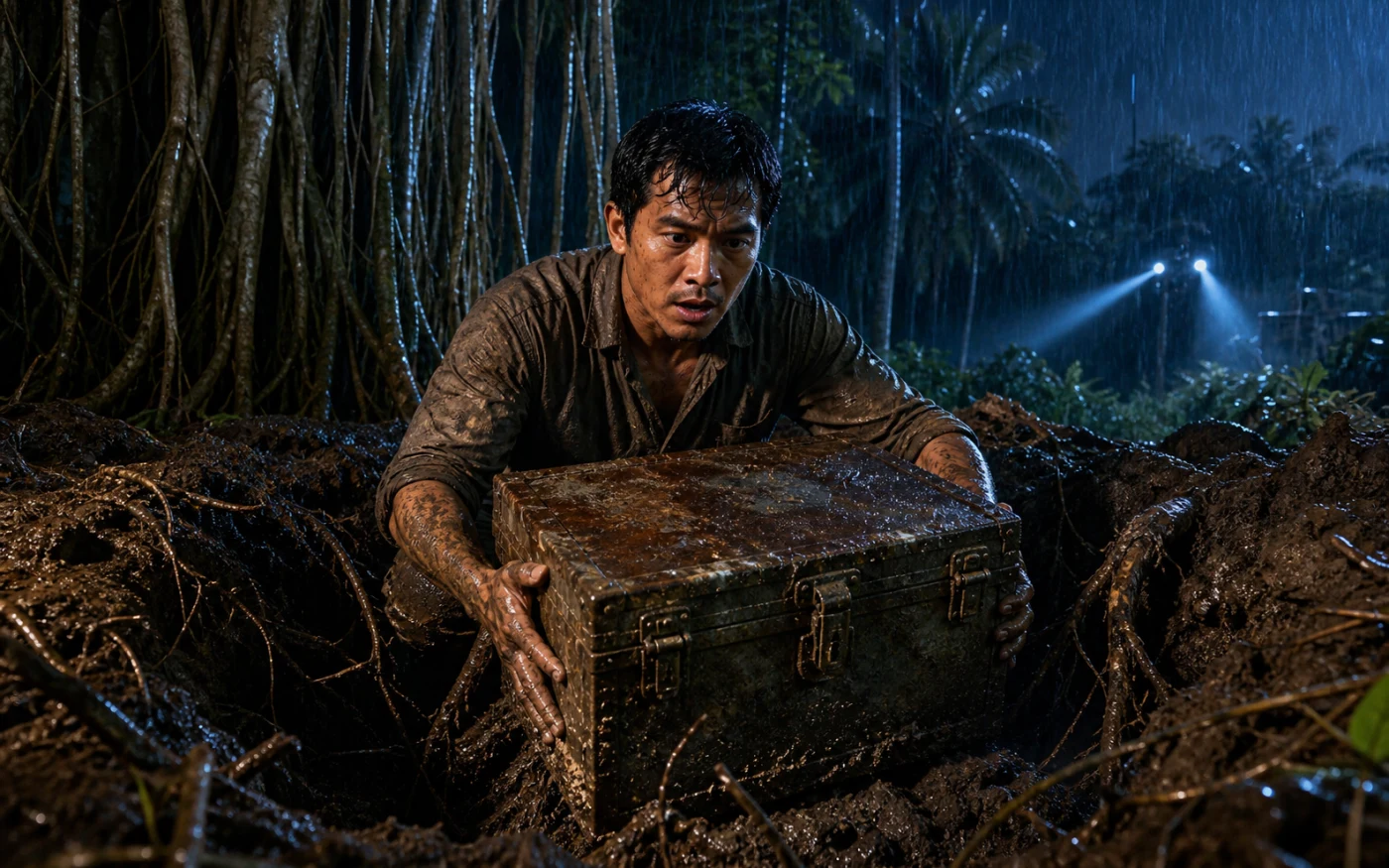
At eleven-thirty on a Tuesday night, I was ten feet underground with a shovel, a flashlight, and exactly one terrible plan.
Rain was pouring into the hole.
Mosquitoes were eating my neck.
My palms were bleeding.
And somewhere above me, Don Hector’s new security lights were sweeping across the mango trees.
I’m Lando. Thirty-four. Tenant farmer in Samboan, Cebu. My family had worked the same land for three generations, which sounds noble until you understand that we owned none of it.
Don Hector did.
At least, that was what everybody said.
He lived in a concrete house on the hill with two SUVs and a gate taller than our nipa house. We lived below the coconut grove with a leaking roof and a blue drum catching rainwater beside Nanay’s bed.
Every harvest, Hector found a new reason to cut our share.
“Too many spoiled mangoes.”
“Copra is light.”
“Fuel went up.”
“Your sacks are smaller.”
One time he deducted money because his truck got a flat tire.
I wasn’t even in the truck.
When I argued, he smiled and tapped his gold watch.
“Gusto mo umalis, Lando? Go. Maraming naghahanap ng lupa.”
That shut me up.
Nanay Rosa was sixty-eight. Bad knees. Worse lungs. She still washed clothes because medicine ate half our cash every month. All I wanted was enough money to fix our roof and get her checked in Cebu City.
Then Tuesday night, her fever went wild.
I was sitting beside her with a basin of water when she grabbed my wrist.
Hard.
“Lando. Listen.”
“Nay, bukas na.”
“Hindi. Tonight.”
Her eyes were glassy, but her voice was suddenly sharp.
“Go to the old balete by the river. Dig between the two biggest roots.”
I stared at her. “Nay, may lagnat ka.”
“Alam ko.” She smacked my arm. “Hindi ako baliw.”
Then she told me the story nobody in our family had ever told out loud. After returning from the guerrillas at the end of the war, my grandfather Berto hid a steel chest there before leaving Cebu. He told my grandmother it held something their children might someday need more than money.
“What thing?” I asked.
Nanay shook her head.
“Hindi sinabi ni Tatay. He only said, if our family ever gets pushed off this land, dig.”
I actually laughed. Not because it was funny. Because I was scared.
“Nay, that tree is on Hector’s side of the river path.”
“I know.”
“He put cameras there.”
“I know.”
“And tomorrow they pour concrete for his new wall.”
She looked at me.
Exactly.
So I took the shovel.
The balete stood near the river like a monster with a hundred legs. Its roots twisted through the mud. I killed my flashlight whenever Hector’s light swept downhill, then dug again.
Three feet.
Five.
Seven.
Nothing.
By eight feet, I was sure Nanay had remembered wrong. At nine, my shovel hit rock. At ten, I raised the crowbar and slammed it down.
CLANG.
Metal.
I forgot the rain. I dropped to my knees and clawed mud away with both hands.
There it was.
A dark steel chest. Iron straps. Rusted corners. A fat padlock. On one side was a faded Japanese military stamp.
My whole body started shaking. “Diyos ko.”
I wedged the crowbar under it and pulled until my back screamed. The chest came loose from the roots with a horrible wet sucking sound and landed against my boots.
Heavy.
Very heavy.
For one stupid second, I thought maybe it really was treasure. Enough for medicine, a roof, maybe our own little piece of land.
I touched the lock.
A red light blinked above me.
Then another.
Then a horn exploded across the hill.
A loudspeaker crackled.
“LANDO!”
My stomach dropped. Don Hector’s voice boomed through the rain.
“HUWAG KANG GAGALAW! I CAN SEE THE CHEST!”
Headlights burst through the trees. Engines roared toward the river.
And I realized I had just dug up my family’s secret directly under Don Hector’s brand-new camera.
PART 2: Who Wanted the Chest
Three trucks stopped around the hole so fast they sprayed mud over my shoulders. Don Hector jumped out wearing pajama pants, leather slippers, and a silk robe with a giant H on the pocket. I might have laughed if four guards were not behind him. Chief Alcantara climbed out of the last truck looking deeply annoyed to be awake.
Hector pointed his flashlight into the pit. Then he saw the chest. His whole face changed. Greed is amazing. One second he looked furious. The next he looked like a child staring through a bakery window.
“Yamashita gold,” he whispered.
“Hector, hindi mo alam—” Chief Alcantara started.
“Of course I know!” Hector snapped. “Japanese chest. Wartime markings. Buried treasure.”
Then he looked down at me. “You.”
He smiled. It was worse than shouting.
“You were stealing treasure from my land.”
“It belonged to my grandfather.”
“Everything under my land belongs to me.”
“You don’t even know what that is!”
“Exactly. So why were you digging for it at midnight?”
That one hurt because, technically, he had me. I climbed out, covered in mud from hair to ankles. Hector backed away from me like dirt was contagious.
“Chief, cuff him.”
Chief Alcantara frowned. “Hector, teka lang.”
“Cuff him.”
“It’s a family claim. We can bring everybody to the barangay and—”
Hector spun around. “Who bought your station’s generator?”
The chief’s jaw tightened.
“Who paid when your patrol motorcycle broke?”
Nobody spoke. Hector pointed at me again. “Arrest. Him.”
I hated that moment. Everybody knew what Hector was doing. Everybody was used to it.
Then I heard Nanay.
“Lando!”
She was coming through the rain with her walking stick, wrapped in a thin brown blanket. Barefoot. Feverish. Furious.
“Nay! Bakit ka nandito?”
She ignored me and went straight to Hector. “That chest is Berto’s.”
Hector laughed. “Your husband buried Japanese gold on my land?”
“My father,” Nanay snapped. “And hindi ginto. If it were gold, he would have sold it. Gutom kami noon.”
That stopped him. For half a second.
Then he crouched in front of her. “So you do know what’s inside.”
Nanay said nothing.
Hector’s eyes lit up. “Aha.”
He stood and shouted to his guards, “Load it.” Two men climbed into the pit. I lunged forward.
“Don’t touch it!”
A guard grabbed my shoulder. Hector stepped close enough that I could smell his expensive cologne through the rain.
“Listen carefully, Lando. By breakfast, I will file trespassing, theft, and property damage against you. And if your mother wants to keep that little hut, she should start praying this chest contains something valuable enough to improve my mood.”
Nanay’s face went white. I saw it. Hector saw it too. And because he was Hector, he enjoyed it.
He pointed uphill. “Actually, no. Forget the hut. Bulldozer comes at eight.”
“Hayop ka,” I said.
He smiled. “What was that?”
“You heard me.”
Nanay grabbed my arm before I made everything worse. Then she looked straight at Hector. “Open it in public.”
Everybody turned. Even me.
“Nay?”
She squeezed my wrist. “Sa barangay hall. In front of everyone.”
Hector’s smile got bigger. He thought she was scared he would steal the gold privately.
“Gladly.”
By six the next morning, the barangay hall was packed. Farmers. Vendors. Tricycle drivers. Hector’s cousins. Three old women from church who somehow knew everything before sunrise. Half the town was outside the windows.
The chest sat on a wooden table in front. Hector arrived freshly showered in a white barong. I arrived in yesterday’s muddy shirt with a police officer beside me. Nanay sat in the front row under a borrowed shawl. Hector spread both arms like he was launching a shopping mall.
“Everyone will witness this. Lando Villanueva was caught digging on my property. Whatever is inside this chest was found on my land.”
Murmurs rolled through the room. Then Nanay raised one finger. “Open it.”
Hector nodded to a guard. The angle grinder screamed. Sparks flew across the tiles. People backed away. The old padlock snapped and hit the floor.
Hector grabbed the lid himself. He looked at me. He looked at Nanay. Then he yanked the steel chest open.
His smile vanished.
PART 3: What Hector Had to Read
No gold.
No coins.
No jewels.
Just bundles of old papers wrapped in waxed cloth.
Hector stared into the chest like somebody had served him boiled receipts.
“What is this?”
Nanay leaned back in her chair. For the first time in my life, I saw her smile at him. “Basahin mo.”
Hector tore open the first bundle. Inside was an old land title. Thick paper. Blue survey lines. Red seals. My grandfather’s full name across the top.
NORBERTO VILLANUEVA.
Hector snorted. “Old title. So what?”
Mayor Santos had moved closer. He picked up another sheet. Then another. His expression changed. “Wait.”
The room quieted. He spread three papers across the table.
One was my grandfather’s title. One was a wartime tax record. And the third was a yellowed letter in a cracked envelope.
The envelope had a name on it.
DON EMILIO DE CASTRO.
Hector’s grandfather.
Hector saw it too. He reached for the letter. Nanay slapped his hand away. The whole barangay hall gasped. I nearly laughed.
Mayor Santos unfolded it. He scanned the ugly handwriting, then looked at Hector.
“Hector.”
“What?”
“You should read this.”
“Why me?”
“Because your grandfather signed it.”
Nobody moved. Hector’s face tightened. “I’m not reading some eighty-year-old nonsense.”
Nanay stood up. She was shaking from fever, but she stood. “You wanted the chest in public. Read it in public.”
People started murmuring. “Basahin mo.” “Sige na, Hector.” For once, the crowd was not moving out of his way.
Hector grabbed the letter. His eyes jumped across the page. Then stopped. His lips went gray.
Chief Alcantara folded his arms. “Loud enough for everyone.”
Hector swallowed. Then he read.
“Berto. I know you are returning from the mountains. Do not come back to the hacienda.”
The room went silent. Hector stopped.
“Continue,” Mayor Santos said.
His hand started trembling. “I have already registered the transfer using the papers you left behind. Nobody here will challenge my family. Take the money offered and leave Cebu, or my men will remove you.”
Somebody behind me whispered, “Diyos ko.”
Hector tried to fold the letter.
Nanay slammed her palm on the table. “May pirma?”
He said nothing.
“May pirma, Hector?”
Mayor Santos took the page and held up the bottom. There it was. Emilio de Castro. Signed.
Beside the letter was another document: the supposed deed where my grandfather had “sold” the land. There was one problem. The signature was completely different. Not close. It looked like somebody signed “Norberto Villanueva” while riding a carabao downhill.
Even the crowd laughed. Hector didn’t.
Mayor Santos laid my grandfather’s real signature beside the fake one. Chief Alcantara looked around the hall first. Counting. Then he pulled the handcuff key from his pocket.
Click.
My wrists were free. Hector stared at him.
“What are you doing?”
The chief looked almost cheerful. “Correcting my morning.”
Hector exploded. “This proves nothing! My family has held that land for decades!”
Nanay reached into the chest herself. There was one last bundle. Smaller. She opened it carefully. Inside was a black-and-white photograph of my grandfather standing under the same balete tree beside a wooden sign.
VILLANUEVA FARM.
And behind it was a short note in his handwriting. Nanay read that one. Not Hector.
“If my children find this, I am sorry I could not win the land back for you. But I kept the truth. Do not bow your head forever.”
Nanay stopped reading. Her mouth shook. All those years. All those harvests. All those times Hector yelled and she answered, “Opo.” She pressed the note against her chest and cried.
I did too.
Then Hector made his final mistake. He pointed at Nanay and shouted, “You think this makes you owners now?”
Nanay wiped her face. “No.”
Hector gave a wild little laugh.
Then she pointed at the chest. “That makes us people you should have been afraid to humiliate.”
Nobody laughed this time. Hector looked around the hall. The farmers he underpaid stared at him. So did the chief he bullied. The mayor held his grandfather’s signed threat beside the fake deed. For the first time, Don Hector looked small.
He turned to me. “Lando. We can settle this.”
Yesterday, I would have done almost anything to fix our roof. Now he was trying to buy me. “How much?” I asked.
His eyes brightened. “Name it.”
I looked at Nanay. Then at the other tenant farmers packed against the walls. Then back at him.
“Your bulldozer.”
He blinked. “What?”
“You said it was coming at eight.” A few people started smiling. I pointed toward the hill. “Good. It can start with your new boundary wall.”
The room erupted. Hector actually staggered backward. “I will sue you!”
“Okay.”
“I’ll sue your whole family!”
“Okay.”
“You’ll get nothing!”
Nanay sat back down and pulled the borrowed shawl around her shoulders. Then she looked at him with the calmest face I had ever seen. “Hector.”
He snapped toward her.
She pointed at the old steel chest. “Start with the letter.”
That shut him up.
The land records confirmed what was in the chest. Hector’s lawyers settled before the case reached court, and the disputed farm was returned to our family.
Nanay finally saw a doctor in Cebu City. Her lungs would never be perfect, but the new medicine helped.
Three months later, the concrete wall was gone. So was the blue drum beside Nanay’s bed. On the hill below our new roof hung one simple wooden sign, copied from my grandfather’s photograph.
VILLANUEVA FARM.
Nanay sat on the porch beneath it, wearing yellow slippers and yelling at me because I had planted her orchids too close together. “Lando! Siksikan!”
“Nay, they’re fine.”
“Hindi fine. Ayusin mo.”
I laughed, picked up the shovel, and moved them.
After everything that shovel had dug up, I knew better than to argue with her.