
My Son's Fiancée's Family Hired a Private Investigator on Us. The Report Came Back with Something Even I Didn't Know...
PART 1: The Blue Folder
My son’s future mother-in-law investigated me.
Then she handed me the evidence over a twelve-ounce steak.
“It’s standard practice,” Victoria said.
I stared at the thick blue folder she had pushed across the white tablecloth.
My name was printed on the cover. Under it was the name of my late husband, Dado.
Even a dead man had not escaped her.
We were at an expensive steakhouse in Atherton for the engagement dinner of my only son, Emilio, and Victoria’s daughter, Camille.
The waiter had just placed tiny dishes of butter beside us. I remember that because my hands wanted to throw one.
Instead, I folded them in my lap.
Victoria and Richard were paying for the wedding. At first, that had sounded generous.
Then I learned the person holding the checkbook was also holding the guest list.
The Fairmont ballroom, the white roses, the string quartet, the seven-tier cake—already chosen.
Emilio and Camille had forty seats for his side.
Lola Rosa in Baras was not on the list. Neither were three of the aunts who helped me raise him after Dado died.
I did not like it, but what could I say? I was not paying for the ballroom.
“What exactly is this?” Emilio asked.
His voice had gone flat. Camille reached under the table and gripped his arm.
Victoria gave me a smile so tight it looked painful.
Pearls at her throat. Cream silk blouse. Designer bag on the empty chair beside her, as if even the bag deserved its own seat.
“A routine background check,” she murmured. “We just needed to ensure our family’s security, Divina. With a marriage, assets become complicated.”
Her husband, Richard, suddenly became very interested in his water glass.
I looked around the table. “Were Emilio and I supposed to be carrying weapons?”
Camille choked on her drink.
Victoria did not laugh. “Please don’t make this ugly.”
That did it.
I opened the folder.
Forty pages.
My Daly City address. The balance of my savings account. Photos of my house. My garage, where I altered wedding gowns and sewed uniforms. The old Toyota I drove. Dado’s years as a diesel mechanic.
Even the small loan I had taken after his funeral was listed there.
I felt as if somebody had entered my home while I slept and opened every drawer.
Emilio snatched the folder from me. “You had my mother followed?”
“Research is not following,” Victoria said.
“There are pictures of her buying pandesal.”
“Emilio, tama na,” I said quietly.
He knew that tone. It was the same one I used when he was ten and ready to punch a boy who had mocked my accent.
Camille turned to her mother. “Mom, sinabi mong hindi mo gagawin.”
Victoria’s face changed for one second.
So Camille had known it was possible.
My humiliation found a fresh room inside me.
I closed the folder and stood.
My steak had not arrived.
Good.
I would have hated to waste a steak that cost more than my weekly groceries.
“Salamat sa dinner,” I said. “And for the surveillance.”
“Divina, sit down,” Victoria said. “You’re being emotional.”
I looked at her pearls. “You paid a stranger to count my money, photograph my garage, and examine my dead husband. Emotional is the polite reaction.”
Emilio rose with me, but I stopped him.
“Stay. Talk to Camille. This is not her shame.”
That was the hardest sentence I said all night.
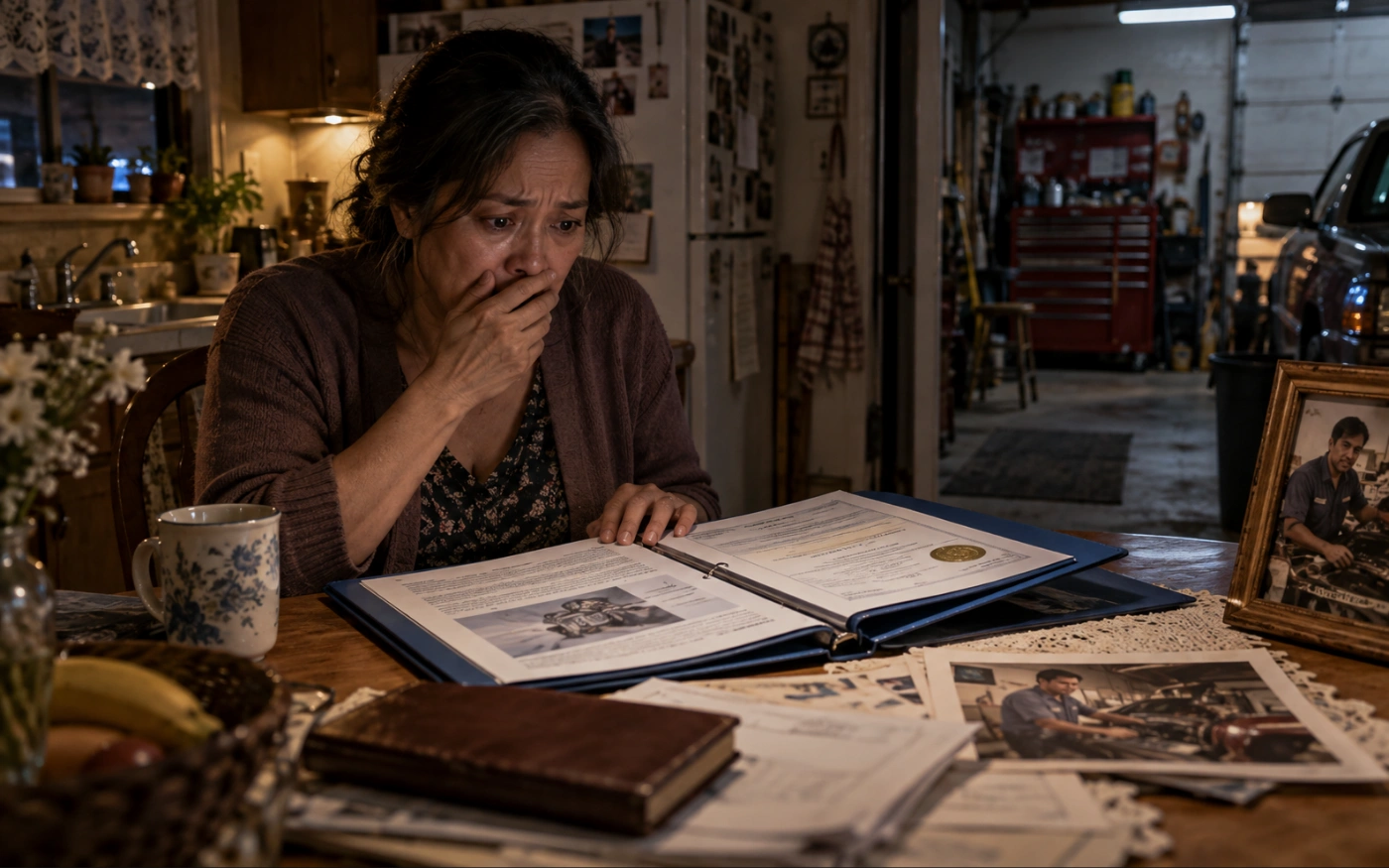
At home, I placed the folder on my kitchen table and made coffee I did not drink.
The house was too quiet. Dado’s old red tool chest still stood against the wall near the garage door.
He had been gone seventeen years, but sometimes I still expected to hear him call, “Bing, where are my glasses?” while the glasses sat on his head.
I should have thrown the report away.
Instead, anger made me read every page.
Page three: property records.
Page six: business income.
Page eight: Dado’s employment history.
Page ten: no criminal records, as if that were disappointing.
Then I turned to page eleven.
The heading read: Unclaimed Asset Search.
Below it was something I did not understand.
Patent No. 7,•••,•••. Inventor: Diosdado “Dado” Manalo. Automotive alignment apparatus. Possible licensing proceeds. Estate verification required.
That was all.
No dollar amount. No explanation.
I read it twice.
Then a third time.
“Dado,” I whispered into the empty kitchen. “Ano ’to?”
I thought it had to be some forgotten piece of paperwork.
My husband had fixed trucks.
He had never told me he owned a patent.
Then I remembered the metal device he used to carry between home and the shop in 2007. Two silver arms, a sliding gauge, and yellow marks painted by hand.
For months he had tested it beneath freight trucks. He called it his “crooked-wheel cure.”
Once, I found him at this same table, filling out forms.
“Secret love letter?” I had teased.
“If this works,” he said, tapping the papers, “maybe you can stop sewing until midnight.”
Two months later, a truck crossed the divider on Highway 101.
Dado never came home.
The forms disappeared beneath funeral bills, insurance papers, and the terrible work of surviving.
My phone rang. Emilio.
“Ma, okay ka lang? I’m coming over.”
“No,” I said, staring at page eleven. “I need you to do something first.”
“Anything.”
“Tell me if page eleven in your copy says what mine says.”
There was silence. Paper rustled.
Then my son stopped breathing.
PART 2: Was It Really His
At nine the next morning, I called the number listed beside the patent.
By eleven, a calm older voice said, “Mrs. Manalo? My name is Samuel Greene. I was your husband’s patent attorney.”
I gripped the phone with both hands.
“You knew Dado?”
“I knew a man who could look at a machine for thirty seconds and hear what was wrong with it.” His voice softened. “I have been hoping for this call for seventeen years.”
The next day, Emilio drove me to Samuel’s office in San Francisco.
Camille came too. She sat in the back holding the blue folder like it was a poisonous snake.
“Tita Divina, pasensya na,” she said. “I should have warned you.”
I watched the fog slide across the freeway. “Did you ask for the investigation?”
“No.”
“Did you know she had hired him?”
Her eyes filled. “I found his business card in her study. She said she was only checking Emilio, and I told her to stop. I should have warned you.”
Emilio’s jaw tightened.
I turned around. “Yes. You should have.”
Camille nodded. She did not defend herself. I respected that.
Samuel Greene was seventy-eight, with bushy eyebrows and a bow tie covered in tiny wrenches. On his desk sat a cardboard box marked D. MANALO.
He opened it in front of me.
There were drawings in Dado’s blocky handwriting. Photographs of the silver tool. A copy of the patent application, signed two months before he died.
And one yellow envelope addressed to me.
The seal had never been opened.
Samuel pushed it toward me. “He left this with the final paperwork. I sent letters after the patent was approved, but the shop had closed. I never had a good home address for you.”
“Why didn’t you find us?” Emilio asked.
Samuel took off his glasses. “I looked. The patent said Diosdado. The shop knew him as Dado. Your surname was wrong on one record.” He looked at me. “I failed your family.”
I opened the envelope.
Inside was one sheet of paper.
Bing,
If this tool earns nothing, please use this letter to wrap garlic. If it earns something, use it to rest. Emilio is smart, but you are the one who never stops. Let me be useful to you for once without getting grease on the curtains.
Love, Dado.
I laughed.
Then I cried so hard my forehead touched the desk.
Emilio knelt beside me. Camille held my shoulder. Samuel turned toward the window.
When I could finally breathe, Emilio picked up the letter.
“We’re framing this.”
I wiped my face. “Then what am I supposed to wrap garlic in?”
Camille laughed through her tears.
For seventeen years, I thought Dado had left us everything he had.
Apparently, he had left one more thing, and he had been very pleased with himself about it.
Samuel slid a statement across the desk.
The money was real.
A freight company had been using Dado’s tool for years. Samuel had the file. I had the certificates. That was enough to begin the claim.
The amount was a little over two million dollars.
“Ay, Diyos ko,” I whispered.
Emilio stared at the paper.
“Dad did this?”
I looked at Dado’s crooked handwriting.
“Yes,” I said. “Your father did this.”
By the time the next wedding meeting came around, the first distribution had cleared.
Camille called me the night before.
“My mother finalized the seating chart,” she said carefully.
I heard something in her voice.
“How many for Emilio’s side?”
“Forty.”
“Still?”
“Yes.”
Emilio took the phone from her. “Ma, huwag na. We’ll do City Hall and invite whoever we want.”
“No.”
“Ma.”
“How many people can that ballroom hold?”
There was a pause.
Camille said, “A lot more than forty.”
I looked at Dado’s framed letter on my kitchen table.
“Good,” I said. “Call Lola Rosa.”
Emilio laughed. “What are you doing?”
“Tell her to find her passport.”
PART 3: Who Filled the Ballroom
Victoria was already at the Fairmont when we arrived.
She stood beside a large seating chart with the coordinator and a florist, moving little white cards around like she was planning a military operation.
“Bride’s side is one hundred and sixty,” she said. “Groom’s side is forty. That keeps us at two hundred.”
Richard was sitting nearby with coffee.
He looked at the chart. “Balanced for whom?”
Victoria ignored him.
Then she saw me.
“Divina. Good. We saved two extra seats on Emilio’s side if you need them.”
“I remembered several.”
She smiled politely. “How many?”
“Forty-six.”
The coordinator looked up.
Victoria’s smile disappeared. “Diyos ko. Forty-six?”
“Lola Rosa. Three of Emilio’s aunts. Cousins from the Philippines. Two families from Daly City who knew Dado. Some people from my shop.”
“Divina, the additional cost—”
“I know.”
I placed a cashier’s check on the table.
“This covers the extra tables, meals, and the shuttle from Daly City.”
Nobody said anything for a moment.
Victoria looked at the check, then at me.
“Where did you get this?”
“Page eleven.”
Her eyes narrowed.
Camille stepped beside Emilio. “Mom, totoo pala. Your investigator found Dado’s patent.”
Victoria looked genuinely confused. “Anong patent?”
I almost laughed.
“Your investigator found something Dado filed before he died,” I said. “You were looking for debts. You missed what else was there.”
Richard lowered his coffee very slowly.
“Grabe,” he said. “How much was there?”
Emilio grinned. “Enough for more chairs.”
That was all I wanted to say about the number.
Victoria stared at me.
“I suppose this changes things.”
“Only the guest count.”
Richard barked out a laugh.
Even the coordinator smiled.
Camille picked up the seating chart.
“And while we’re changing things, Emilio and I want a DJ after the quartet.”
Victoria opened her mouth.
Emilio added, “The quartet can stay. We like the quartet.”
“I like the quartet,” Richard said quickly.
Camille pointed at another page. “And we want the late-night food station we asked about.”
Victoria looked at her daughter. “The sliders?”
“Lumpia and pancit.”
Richard raised his hand. “I vote yes.”
“This is not a board meeting,” Victoria said.
“Good,” Camille replied.
I expected another fight.
Instead, Victoria looked around the table and let out one long breath.
“Sige,” she said. “Keep the quartet. Add the DJ. Add the food. Add the forty-six people.”
“Forty-eight,” I said.
She stared at me.
“I remembered two more.”
Richard laughed so hard he had to put down his coffee.
The wedding took place three months later.
Lola Rosa arrived from Baras with two suitcases, three rosaries, and enough dried mango to feed a bus.
Emilio’s aunts arrived together and immediately began fixing things nobody had asked them to fix.
My old tailoring customers hugged me in the hotel lobby. Two mechanics who had worked beside Dado stood in front of his photograph for a long time without speaking.
Victoria’s business guests came too.
Nobody had to disappear so somebody else could belong.
The quartet played during cocktails exactly as Victoria wanted.
It was beautiful.
Then dinner ended.
The DJ started.
Within twenty minutes, Richard had lost his jacket.
Lola Rosa had pulled him onto the dance floor.
Three of Victoria’s friends were eating lumpia with their fingers because they had given up looking for forks.
“Kain muna,” one of Emilio’s aunts told them. “Dance later.”
Then she taught Camille’s cousins a line dance nobody performed correctly.
The ballroom got louder.
And happier.
I found Victoria standing near the edge of the dance floor with her pearls still perfectly straight.
She watched Richard attempt a turn with Lola Rosa and nearly lose a shoe.
“He is making a fool of himself,” she said.
“He looks happy.”
Victoria watched him for another second.
Then she looked at me.
“I owe you an apology.”
“Yes.”
“Not because of the patent.”
I waited.
“I was wrong before I knew about the money.” Her voice was quiet. “I’m sorry, Divina.”
I nodded toward the dance floor.
“Sige. Lola Rosa has been asking when she gets to meet you.”
Victoria looked alarmed. “Why?”
“She says Richard is more fun.”
For one second, Victoria looked offended.
Then she laughed.
A real laugh.
“Absolutely not.”
She took off her pearls, dropped them into Richard’s abandoned jacket pocket, and walked straight toward Lola Rosa.
“Halika, Victoria!” Lola Rosa called.
After dinner, Emilio took the microphone.
“My father could not be here tonight,” he said.
His voice broke, and he stopped.
I reached for Camille’s hand.
Emilio tried again.
“But apparently he still found a way to bring everybody.”
The room went quiet.
Then one of Dado’s old mechanic friends shouted, “And pay for the lumpia!”
Everybody laughed.
Emilio laughed too, wiping his eyes.
He touched the small silver wrench tie clip inside his jacket.
“To Dad,” he said.
Glasses lifted all over the ballroom.
“Para kay Dado!”
The following Monday, I opened my garage at eight like always.
I still liked sewing. I still liked the quiet hum of my machine and the little pile of chalk beside my scissors.
I just closed at five now when I felt like it.
Above my worktable, Dado’s letter sat in a frame.
Emilio had taped a small note underneath it.
DO NOT USE FOR GARLIC.
My phone buzzed.
Camille had sent me a wedding video.
In it, Lola Rosa had Victoria by both hands, spinning her beneath the ballroom lights while Richard clapped off-beat beside them.
I watched it twice.
Then I looked up at Dado’s letter.
“You would have loved this mess,” I told him.