
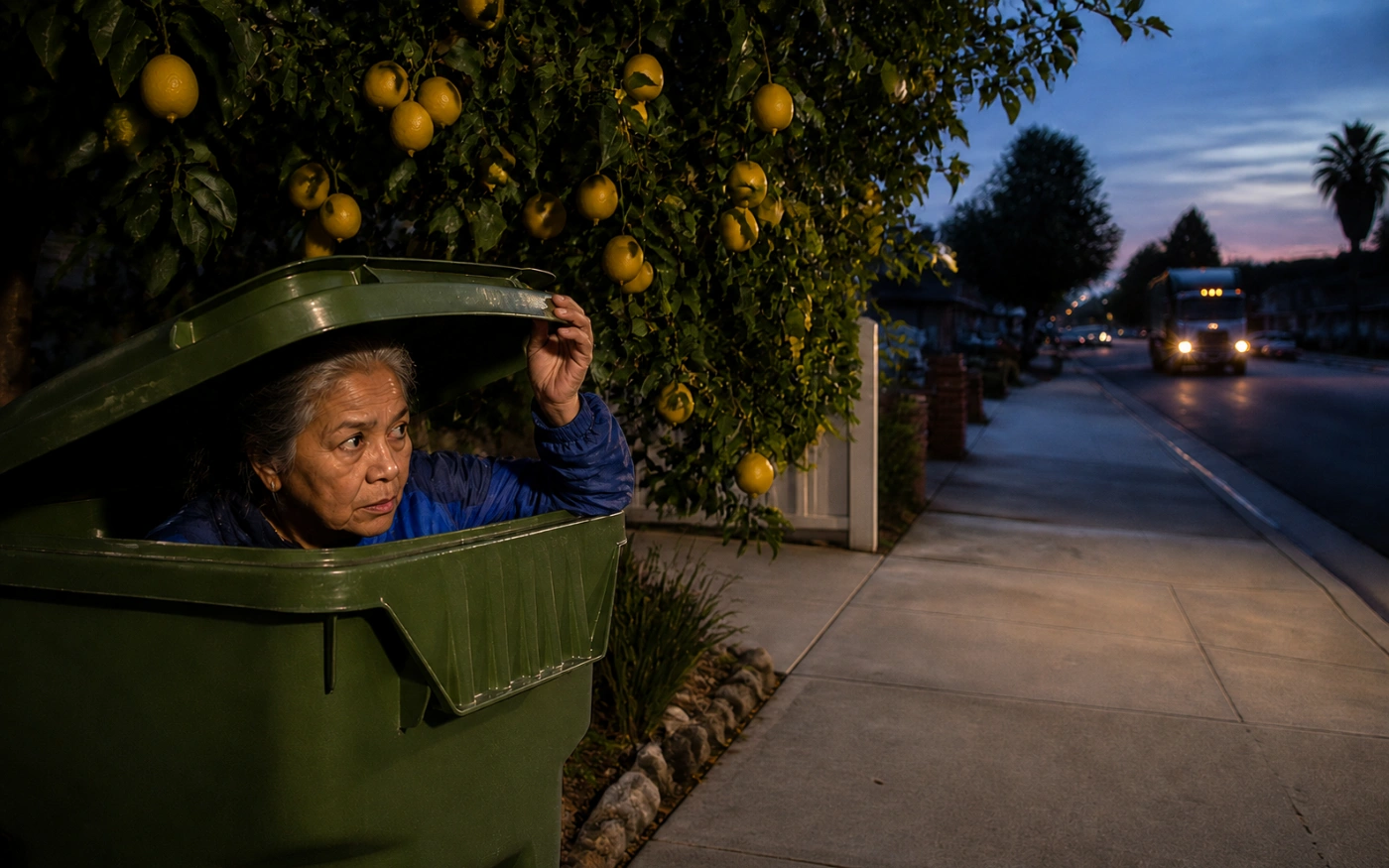
Somebody Was Stealing Lemons from My Tree. At 5:40 in the Morning I Got Inside My Green Trash Bin to Find Out Who. It Was Collection Day.
PART 1: The Friday Stakeout
Somebody was stealing lemons from my tree.
Not one lemon. Not two.
Every Friday morning, an entire low branch would be stripped naked.
I am seventy-two years old. I have arthritis in both knees, cataracts beginning in my left eye, and three daughters who believe I cannot operate a stepladder without calling them first.
But I know my own tree.
Ben planted it beside our driveway when our eldest, Maribel, was still in diapers. He used to leave a basket at the gate with a cardboard sign that said FREE—TAKE SOME, PLEASE.
After he died, I put the basket in the garage.
I still gave lemons away. Of course I did. If somebody knocked, I filled a bag until the handles stretched.
All I wanted was to see a face.
“Good morning, Elena. May I have three?”
“Yes, take six.”
That was how civilized people behaved.
But this thief came in darkness.
The first Friday, I blamed squirrels.
The second Friday, I found small muddy footprints beneath the tree.
The third Friday, I tied three red ribbons around the fattest lemons.
By sunrise, the ribbons were on the ground.
“Ma, please don’t turn this into a criminal investigation,” Maribel said when I called her.
“Who said criminal?”
“You said ‘suspect.’”
“I have suspects.”
“Who?”
“Everybody.”
She groaned. “Naku, Ma.”
My first suspect was Mr. Ramos from across the street because he made excellent calamansi pie and had once admired my lemons for too long.
My second was Lorna from the corner house because she borrowed my pruning shears in 2019 and never returned them.
My third was a young woman who jogged past every morning wearing sunglasses before sunrise.
“What is she hiding?” I asked my neighbor Cora.
“Her eyebags,” Cora said.
Cora thought the whole thing was hilarious.
She suggested a camera. I bought one, but all it recorded was darkness, my own elbow, and a cat showing me its backside.
So on Thursday night, I made my plan.
At 5:15 Friday morning, I put on black pants, Ben’s old navy windbreaker, gardening gloves, and a knitted cap.
Then I wheeled my empty green trash bin beneath the tree.
Yes.
I got inside it.
Before you judge me, understand that it seemed intelligent at the time. The lid had a small crack where I could see the lower branches. I brought a flashlight, a bottle of water, and half a cheese pandesal.
I forgot only one thing.
Friday was collection day.
At 5:31, my feet went numb.
At 5:36, I ate the pandesal.
At 5:39, I heard the gate creak.
A small shadow slipped into my yard.
Not Mr. Ramos.
Not Lorna.
Not the suspicious jogger.
A little boy wearing a red sweatshirt crept toward the lemon tree with a grocery bag. He couldn’t have been more than nine.
He reached for one of my lemons.
I exploded out of the bin.
“AHA!”
The boy screamed so loudly that Cora’s porch light came on.
His bag dropped. Lemons rolled everywhere.
“Bakit ka nagnanakaw?” I demanded.
“Hindi po! Sorry po!”
He ran.
“Come back! Hoy!”
I tried to climb out, but my right foot caught beneath me. The bin tipped backward, then slammed upright again.
And that was when I heard the garbage truck.
Its brakes hissed beside my driveway.
“Oh, no,” I whispered.
I pushed at the lid.
Before I could stand, two metal arms clamped around my green bin.
The whole world jerked upward.
“WAIT!” I screamed. “MAY TAO DITO!”
Across the street, Cora stepped onto her porch in a pink bathrobe, holding up her phone.
“Elena?” she yelled.
The bin rose higher.
The lid flew open.
And I looked straight down into the garbage truck.
PART 2: Why He Needed Lemons
I screamed Ben’s name.
Not Jesus.
Not help.
Ben.
The bin tilted, and I grabbed the rim with both hands while my legs slid toward two leaking black garbage bags.
The driver finally saw me.
His face turned white.
He hit a button, but instead of lowering me, the machine gave another horrible jerk.
“AYOKO!” I shrieked. “IBABA MO AKO!”
“Elena, hold on!” Cora shouted.
“What do you think I’m doing?”
Mr. Ramos came running in slippers. Lorna followed him carrying a broom, as if she planned to fight the truck.
The driver lowered the bin slowly. When it reached the ground, Mr. Ramos and Cora pulled me out by my arms.
My cap was gone.
My windbreaker was smeared with something I refused to identify.
And six neighbors were recording me.
“Delete that,” I ordered.
Cora lowered her phone.
“I mean it.”
“Of course,” she said.
She did not delete it.
By noon, the video had been viewed forty thousand times.
By dinner, it had reached Maribel in San Diego, Tess in Daly City, and Nina, who lived only twenty minutes away but behaved as if I had moved into a war zone.
All three called at once.
“Ma, what were you thinking?”
“You could have died!”
“Why were you inside a trash bin?”
“Because there was a thief!”
“A child, Ma!”
“I didn’t know that before I got in.”
Nina arrived with groceries I had not requested. She inspected my elbows, took my blood pressure, and tried to confiscate my green bin.
“Grabe ka talaga,” she muttered.
“I am fine.”
“You are famous.”
“I am humiliated.”
“That too.”
Cora’s video now had a caption: LEMON GRANDMA AMBUSH GOES WRONG.
People had added music.
One version froze on my face while I was ten feet in the air and played a dramatic choir.
Even Maribel laughed at that one.
I did not speak to Cora for two days.
But I kept thinking about the boy.
He had been thin. His red sweatshirt was too big. When he ran, one shoe flashed silver duct tape around the toe.
And he had left something behind.
A reused jam jar with a piece of masking tape on it.
PAOLO’S LEMONADE—$1.
On Monday afternoon, I saw that same jar on a folding table outside the laundromat three blocks away.
Paolo sat behind it.
A plastic pitcher beside him held pale yellow water with lemon seeds floating on top. His cardboard sign said HOMEMADE LEMONADE.
I marched over.
He saw me and froze.
Then he grabbed the money jar.
“Wait,” I said.
He bolted into the laundromat.
I followed.
He tried hiding behind a row of dryers, which would have worked better if his red hood had not been sticking out.
“Paolo.”
No answer.
“I only want to talk.”
“Are you calling police?”
“No.”
A woman folding towels stared at us. Paolo peeked around the dryer.
“Promise po?”
“Come out first.”
He stepped out slowly, clutching the jar against his chest.
“Why are you stealing my lemons?”
His mouth tightened.
“I wasn’t stealing all.”
“You left me four.”
“I needed twelve.”
“For this?” I pointed at the pitcher. “Nobody can drink that. There are seeds.”
“Some people drink.”
“Who?”
“Mr. Dale.”
The old laundromat attendant lifted his cup and said, “I pour it out when he isn’t looking.”
Paolo looked betrayed.
I sat on a plastic chair.
“Nasaan ang mama mo?”
“At home.”
“Why aren’t you in school?”
“No school today.”
It was Monday.
He stared at the floor.
Finally, he whispered, “May sakit si Mama.”
His mother, Liza, cleaned rooms at a motel near the freeway. She had collapsed at work two weeks earlier. The doctor told her she needed surgery, but she had no paid leave and had fallen behind on rent.
Paolo had heard her crying on the phone.
So he took sugar packets from the laundromat coffee counter, lemons from my tree, and plastic cups from the motel breakfast room.
“How much have you made?” I asked.
He opened the jar.
Seven dollars and thirty-eight cents.
My anger disappeared so quickly it almost embarrassed me.
Almost.
“You still should have knocked,” I said.
“I did once.”
That hit me.
“When?”
“Long time ago. Nobody answered.”
I remembered that day.
Someone had knocked while I was standing in the hallway with Ben’s old blue shirt pressed to my face.
I had stayed quiet until whoever it was went away.
Paolo rubbed his nose.
“Sorry po. Hindi na ako kukuha.”
I tasted his lemonade.
My whole mouth turned inside out.
“Diyos ko, Paolo.”
“Bad?”
“It tastes like furniture cleaner.”
His face fell.
I pushed the cup back toward him.
“Tomorrow. Four o’clock. My house.”
His eyes widened. “Why?”
“I’m teaching you.”
The next afternoon, he arrived carrying his jar and three dented cups.
I showed him how to roll the lemons first. How to strain the seeds. How to make syrup so the sugar didn’t sink like beach sand.
He squeezed too hard and sprayed juice into my eye.
I shouted.
He laughed.
I chased him around the table with a wet dish towel, and I caught myself laughing too.
By Saturday, we had a proper folding table beneath the lemon tree.
Nina made a new sign. Maribel sent a cash box. Tess ordered yellow paper cups printed with tiny smiling lemons.
Liza was furious when she learned what Paolo had been doing.
She came to my gate pale and breathless, wearing motel shoes and an expression that reminded me of myself whenever one of my daughters had frightened me.
“Pasensya na po,” she said. “I’ll pay for everything.”
“With what money?” I asked.
Her chin lifted. “Unti-unti. I will.”
“You can pay me by sitting down.”
“I can’t accept charity.”
“Good. This is lemonade.”
She looked at the table, then at Paolo.
He was wiping the same clean spot over and over.
“Ma,” he whispered, “I wanted to help.”
Liza covered her mouth.
That was when a car stopped in front of my house.
Then another.
Then six more.
People began walking toward us with phones in their hands.
Paolo stepped behind me.
A teenage girl pointed at my face and shouted, “That’s her! The lemon grandma!”
Within minutes, a crowd filled my driveway.
And the first man through the gate slapped a twenty-dollar bill on Paolo’s table.
“We came,” he said, “for the lemon thief.”
PART 3: What the Crowd Wanted
Paolo looked ready to run.
I put my hand on his shoulder.
“He is not a thief,” I said.
The man lifted both palms. “Sorry. I meant the famous lemonade partner.”
“Better.”
He bought one cup and handed it to his little girl. She tasted it, smiled, and asked for another.
Then everything became noise.
Cora had posted that we were selling lemonade beneath the tree. She included the address before asking me, so I stayed angry with her for almost three full minutes.
People came because of the video.
They stayed because Paolo’s lemonade was good.
A motorcycle group bought twenty cups.
Two nurses from the clinic arrived after their shift.
Mr. Ramos brought a tray of empanadas. Lorna returned my pruning shears and acted as if they had simply wandered into her garage seven years earlier.
My daughters took over the driveway.
“Two lines!” Maribel shouted. “Cash here, drinks there!”
“Ma, sit down,” Nina ordered.
“This is my house.”
“And those are your knees.”
Tess tied a yellow apron around Liza, who protested until Paolo said, “Please, Ma.”
Then she stood beside him, slicing lemons slowly while he stirred the pitcher.
Every time someone placed money in the jar, Paolo looked at her.
Every time, she tried not to cry.
By noon, we ran out of cups.
By twelve-ten, Cora returned from the market with four sleeves of them.
By one, there were folding chairs beneath the tree.
Nobody knew who brought the first chair. Soon there were twelve, then twenty. Someone opened a bag of chips. Someone else arrived with pancit in a foil tray.
Children chased each other around the trunk.
“Dahan-dahan!” I shouted.
They slowed down for perhaps four seconds.
A woman from the local news asked me to reenact climbing into the trash bin.
“No.”
“Could you stand beside it?”
“No.”
“Could you point at it?”
“Get off my driveway.”
Paolo laughed so hard he nearly dropped the sugar.
Late in the afternoon, when the crowd finally thinned, he carried the cash box to Liza.
It was full.
Not seven dollars.
Not thirty-eight cents.
Bills were packed to the top, along with folded notes and envelopes people had quietly slipped beneath them.
Liza opened one.
Her knees gave way.
Maribel caught her and guided her into a chair.
Inside the envelope was enough for the rent.
Another covered groceries.
The nurses had left a number for a patient advocate at their clinic.
Liza shook her head, tears falling onto her yellow apron.
“I can’t take all this.”
Paolo crouched beside her.
“Ma, please.”
She looked at her son’s sticky hands, his red sweatshirt, his taped shoe.
Then she pulled him against her so hard his face disappeared into her shoulder.
The next Saturday, they came back.
So did everyone else.
That was how it started.
Not as a business plan. Not as a fundraiser. Just Paolo at the table, Liza beside him, and my daughters arguing over who made the best syrup.
Mr. Ramos brought empanadas again.
Lorna brought lumpia.
Cora brought her phone, but now she asked before recording.
By sunset, every chair was taken.
People leaned against the fence. Children sat on the grass. Someone played old love songs from a speaker, and Nina danced badly enough to make Liza laugh until she had to hold her side.
I sat beneath the lemon tree with a cold cup in my hand.
Above me, the branches moved in the evening breeze.
Years ago, Ben had planted a skinny little tree beside an almost-empty driveway. Now its leaves held strings of yellow lights, and its roots were surrounded by shoes, spilled sugar, folding chairs, and people calling my name.
Paolo ran over and sat beside me.
“Too noisy?” he asked.
I leaned against the trunk and listened to all of them.
“No, anak,” I said, as another burst of laughter filled the yard. “Sakto lang.”