
My Braggart Husband Claimed His Cat-Bone Charm Gave Him Nine Lives — By Supper, I Counted Eight Very Public Accidents
PART 1: Eight Lives Before Supper
My husband bought nine lives at the Morong market.
By supper, he had only one left.
And our entire street had counted every disaster out loud.
Ernesto left our house at seven that morning with money for pork, garlic, and cooking oil.
He came back carrying none of them.
Instead, a red string hung from his fist. Tied to it was a crooked gray object the length of my little finger.
“Susan,” he said, breathing hard from excitement. “Tingnan mo. Cat bone.”
“Nasaan ang baboy?”
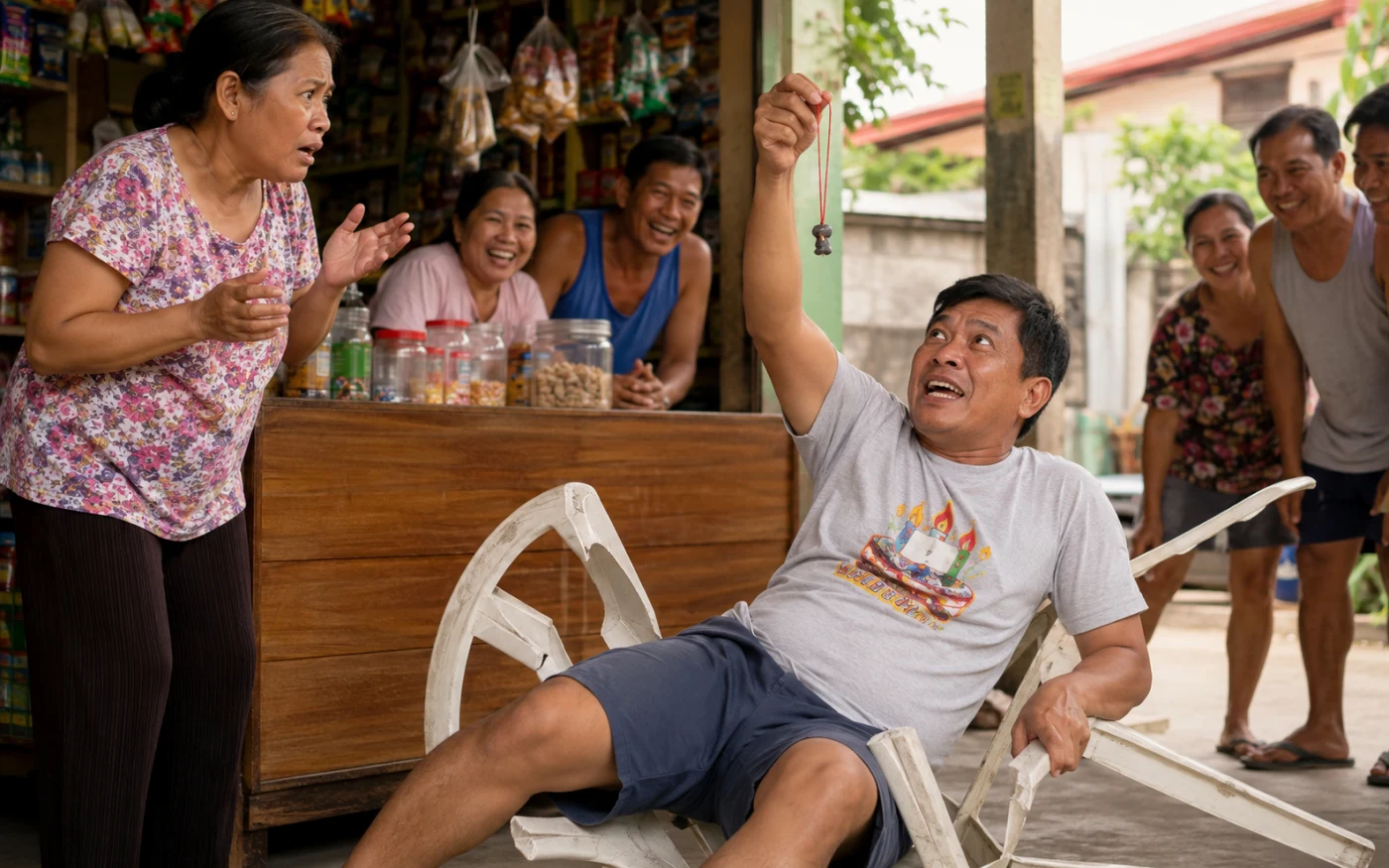
He walked past me and straight toward Aling Puring’s sari-sari store, where five neighbors were drinking coffee from plastic cups.
I followed because I knew that walk.
It was Ernesto’s parade walk. Chest out, chin high, as if a brass band should appear behind him.
“Nine lives,” he announced, raising the bone into the morning sun. “Anting-anting ito. Hindi ako mamamatay.”
Mang Boy stopped stirring his coffee.
Aling Puring leaned over her jars of candy. “Saan galing?”
“Sa palengke. From a man who knows old secrets.”
“How much?” I asked.
Ernesto looked hurt. “Sus, Susan. It is rude to ask the price of a miracle.”
That meant he had spent the grocery money.
I wanted to drag him home by the ear, but it was August 18, his forty-ninth birthday.
I had promised myself I would not fight with him before breakfast.
Then he sat on a white monobloc chair to explain how the charm had chosen him.
The back legs spread. The seat folded under him.
My husband vanished behind the counter with one arm still raised, the red string dangling above a sack of rice.
Nobody spoke.
Aling Puring peered down at him. “Isa.”
That was 8:40 in the morning.
Ernesto stood, rubbed his hip, and gave us a brave smile.
“See? Walang nangyari.”
“You broke Puring’s chair,” I said.
“The chair had one life. Ako, nine.”
By then three more neighbors had wandered over.
Ernesto saw his audience growing, and I saw common sense leave his body.
A tricycle came rattling down our road.
Ernesto stepped off the curb and opened both arms.
“Ernesto!” I screamed.
The driver swerved around him and shouted something I will not repeat. The tricycle never touched my husband.
The front wheel hit a deep puddle instead.
A brown wave rose higher than Ernesto’s chest.
Muddy water covered his birthday shirt, entered his mouth, and ran down into both slippers in front of six people waiting for pandesal.
Aling Puring lifted two fingers.
“Dalawa.”
“That was water,” Ernesto said, spitting. “Water cannot count.”
“The tricycle counts,” Mang Boy replied.
“It missed me.”
“Because the driver has eyes.”
I caught Ernesto’s arm. “Tama na. Come home.”
For one second, he looked at me. The boasting disappeared.
Under the mud, his face seemed tired and almost frightened.
Then a boy across the road called, “Tito Ernesto, can the charm save you from falling?”
My husband turned toward the mango tree.
“Huwag,” I said.
He was already climbing.
He chose a branch above our neighbor’s low wall, bounced on it twice, and called down, “A man with nine lives does not fear gravity!”
The branch cracked.
Ernesto dropped into a pile of dry leaves. The branch landed beside him. One green mango struck his shoulder and another rolled neatly to Aling Puring’s feet.
“Tatlo,” she said.
The boy ran to fetch a piece of plywood and chalk.
By nine-thirty, there was a board outside the sari-sari store.
Across the top, in large letters, someone had written: ERNESTO’S LIVES.
Under it were three white marks.
And when my husband saw that board, instead of going home, he wiped the mud from his face and asked everyone to follow him back to the market.
PART 2: Why He Needed Nine Lives
Twenty people followed us.
Some pretended they needed vegetables. Others did not pretend at all.
Mang Boy carried the chalkboard under his arm like an official record.
“Mga tsismoso,” I muttered.
“Witnesses,” Ernesto corrected me. He limped beside me, wet shirt clinging to his back. “When nothing else happens, they will know.”
“Something already happened three times.”
“Minor events.”
At the wet market, vendors called his name before we reached the fish tables.
News had traveled faster than we had.
Ernesto raised the charm. “Protected!”
Then his left foot landed on a galunggong that had fallen to the floor.
The fish shot forward. Ernesto’s arms spun.
He stayed upright for one amazing second, then sat hard in a shallow basin of crushed ice.
“Apat!” shouted half the market.
Mang Boy made the fourth mark.
Ernesto leaped up and backed away from the fish.
He backed into a stack of empty Coke crates.
The crates fell one after another.
A rack of shampoo sachets caught on his sleeve and followed him down, covering his head in pink, green, and blue packets.
“Lima!”
I pushed through the crowd and pulled the sachets from his face.
“Are you hurt?” I whispered.
“My dignity,” he said.
That answer broke my anger for a moment.
Ernesto had always been loud, but his pride was tender.
He could laugh at a bruise. He could not bear pity.
I saw the old vendor then, seated near the market exit under a faded umbrella.
On his cloth were strings, stones, tiny bottles, and several gray bones exactly like Ernesto’s.
He recognized me and looked away.
I marched over. “Ikaw ba? You sold him that?”
“He wanted it,” the man said.
“How much?”
“Two hundred.”
It was nearly all our food money.
“Why would you tell him it gives nine lives?”
The vendor glanced at Ernesto, who was bowing to the laughing crowd as if the fallen crates had been part of a show.
“I did not tell him,” he said softly. “He told me.”
My skin went cold.
The vendor said Ernesto had picked up the charm and asked whether it protected men at forty-nine.
When the vendor shrugged, my husband placed the money down anyway.
Forty-nine.
Ernesto’s father had died on his forty-ninth birthday.
He had collapsed beside a jeep in Pililla that afternoon. Ernesto was twenty-three then.
As this birthday came closer, he counted down without admitting it.
That morning, before leaving for the market, he had stood too long in front of our mirror.
I had asked what was wrong.
“Wala,” he had said. “I still look young.”
Now I understood the parade walk, the raised chin, the foolish challenges.
My husband was not trying to convince our neighbors.
He was trying to convince death.
I went to him and took his muddy hand.
“Uwi na tayo,” I said. “Please.”
His fingers closed around mine.
Then an askal darted from beneath a vegetable table, grabbed his loose right slipper, and ran.
Ernesto reacted before either of us could think.
“Hoy! Akin iyan!”
He chased the dog through the market, past the jeepney stop, and straight into the open canal beside the road.
The dog escaped with the slipper. Ernesto came out black to the knees.
“Anim,” Aling Puring called, but more gently this time.
We started home with Ernesto barefoot on one side. Nobody laughed as loudly now.
Maybe they saw his face.
Maybe public entertainment becomes something else when the proud man looks small.
We were passing the church road when a rooster stepped from a yard and stared at him.
Ernesto stared back.
“Do not,” I warned.
“I am doing nothing.”
The rooster charged.
Ernesto ran.
For two blocks, that rooster followed him past tricycles, laundry lines, and children pouring out of San Ildefonso College.
Ernesto tried hiding behind Mang Boy. The rooster went around Mang Boy.
He climbed a bench. The rooster waited below.
At last, the owner came running with a broom and carried the bird away.
Everyone agreed the rooster had won.
“Pito,” said Ernesto himself.
At home, I washed the canal mud from his legs. He sat quietly while I cleaned a scrape on his shin.
“Your papa was only one man,” I said. “His age is not waiting for you like a trap.”
Ernesto watched my hands. “You knew?”
“I know you.”
His eyes filled, but he blinked hard. “Do not tell Tala.”
“Why?”
“A daughter should think her papa is matibay.”
Before I could answer, twelve-year-old Tala came through the door carrying a paper lantern from school.
“Papa, hang this before supper, please.”
Ernesto looked at her, then at me.
He could have said his hip hurt. He could have asked me. Instead, he reached for the wobbly wooden stool.
“Ako na,” he said.
At five o’clock, with half the street still watching, he climbed up to tie Tala’s lantern under our awning.
The stool tilted.
Ernesto fell backward into the laundry basin—a full one, soapy, with my good sheets soaking inside.
“Walo!” the whole street shouted.
That night, bruised, damp, and wearing one slipper, my husband sat at our supper table with an ice pack on his hip.
Eight gone. One left.
He stared at the wall, doing the math.
Then Tala lifted the charm from his neck, scratched the gray bone with her fingernail, and gasped.
A curl of paint peeled away.
PART 3: What Tala Scratched Away
“Papa,” Tala said. “Plastic po.”
The three of us stared at the pale plastic showing beneath the gray paint.
Ernesto took the charm from her and scratched harder. More paint curled onto the table beside his rice.
There was no ancient bone. No secret from the mountains. No miracle.
Just cheap molded plastic on a red string.
I pressed my lips together.
I truly tried.
Then I remembered him vanishing inside the chair.
I saw the shampoo sachets over his head, the stolen slipper in the dog’s mouth, and that rooster waiting below the bench with terrible patience.
I laughed until I had to hold the table.
I laughed until tears ran down my face. Tala fell against my shoulder, laughing too.
Outside our open window, Aling Puring heard us and began laughing from her store.
Soon the whole street knew.
“Plastic!” somebody yelled.
Ernesto sat straight despite the ice pack on his hip.
He lifted his spoon and pointed it at me with all the dignity he had left.
“Ingat ka,” he said. “Ako, nine lives. Ikaw, isa lang.”
That made me laugh harder, but then I saw his mouth twitch.
He was fighting a smile.
Tala touched his bruised hand. “Papa, you don’t need nine.”
He looked away. “Easy for you. Bata ka pa.”
She took the plastic charm, looped it around his wrist, and held the knot there.
“You only need us to catch you.”
Ernesto’s face changed.
All day he had endured mud, fish, crates, canal water, a rooster, and an entire street shouting numbers.
That one sentence from his daughter was what finally broke him.
He covered his eyes with his free hand.
“Aray,” he whispered.
“Your eyes hurt?” Tala asked.
“No. My dignity again.”
I stood and went around the table.
I put my arms around both of them, wet birthday shirt, ice pack, red string, and all.
Outside, the neighbors were still calling, “Walo!”
Ernesto lowered his hand. “They think I have one life left.”
“Then stop climbing things,” I said.
“I had to hang her lantern.”
Tala looked toward the window. Her paper lantern hung crooked under the awning, but it was glowing now. Its yellow light moved across Ernesto’s face.
He had fallen into my laundry, but he had tied the knot before he fell.
I served the supper I had managed without pork.
Garlic rice, eggs, sliced tomatoes, and the two green mangoes that had dropped with him that morning.
Tala put one mango slice on his plate.
“For life number three,” she said.
Ernesto placed half his egg on hers. “For the person who caught number eight.”
He did not say he was afraid again. He did not have to.
At midnight, when his forty-ninth birthday was over,
I woke and found him standing beside the bed.
The plastic charm was still tied around his wrist.
“What are you doing?” I asked.
He looked at the clock.
12:01.
Then he smiled.
“I made it.”
He climbed back into bed and reached for my hand in the dark.
Twelve years have passed since that day.
The chalkboard is gone. The rooster is gone.
Aling Puring still tells the story to anyone who will listen, and Ernesto still insists the puddle should not count.
But in our family, whenever anyone stumbles, drops into a chair too hard, or catches a slipper on a step, somebody calls out a number.
Last Sunday, Tala came home from Baras with her little boy.
He was learning to walk and refused every hand offered to him.
Ernesto crouched two steps away, both arms open.
The baby took one step, then another. On the third, his knees folded.
Ernesto caught him before he touched the floor.
“Isa!” Tala shouted.
Her son blinked, startled. Ernesto lifted him high against his chest.
“Hindi,” my husband said, kissing the child’s hair. “That one does not count.”
He looked at me over our grandson’s head, sixty-one years old and still here.
“We caught him.”