
My Children Thought I Was Dying. I Let Them Fuss Over Me. Then They Ordered a Giant Memorial Portrait.
PART 1: What I Let Them Think
I want to be honest from the beginning.
My children thought I was dying, and I did not correct them.
In my defense, it got all three of them to stay for lunch.
For a few days, it worked beautifully.
Then my daughter asked which photograph I wanted beside the flowers.
That was my chance to confess.
Instead, I sent her the good one from my niece's wedding, where my hair was behaving.
That is the kind of judgment we are dealing with.
The trouble started the week before my seventieth birthday.
I had invited my children to Sunday lunch twice that month. Twice, I washed the good plates, set them out, and put them back in the cabinet clean.
Elaine had a deadline. Dennis was helping a friend move a couch. I have never met this friend. He moves more than anyone alive.
Mark came once. He ate standing next to my refrigerator like a man waiting for a bus.
He said the food was delicious. Then he left before the coffee finished dripping.
They were good children. They called me often. They reminded me about my vitamins.
They sent little hearts when I posted pictures of my orchids.
I did not want hearts.
I wanted them in chairs. Real chairs, at my table, eating off the good plates.
Then my friend Ruth lost her husband's insurance papers.
Ruth spent a week crying into cupboards.
I helped her empty every cabinet in her house.
When I got home, I was so frightened by the whole thing that I put all my own papers into one blue folder.
Insurance. The house. The bank. The phone number of the man who fixes the water heater.
Then I sent my children a message.
I'm putting my affairs in order. All three of you come Sunday. Please don't put this off again.
Please read that message the way my children read it.
I did not. I read it the way a woman with a new blue folder reads it.
It seemed very organized to me.
They arrived before noon. All three. Early.
Elaine brought arroz caldo. Dennis brought mangoes. Mark brought my favorite bread from the bakery across town, still warm in the bag.
Nobody had ever brought me warm bread for a folder.
"Ma," Elaine said. "What happened at your checkup?"
Here is something you should know.
I had a checkup that week. Everything was normal.
I promised to call my children afterward.
Instead, I called Ruth from the clinic parking lot and told her to stop worrying about me.
Then I went to buy fish, and I forgot my children completely.
Now I looked at Elaine's face.
I looked at Dennis putting his phone face down on the table, which he has never done in his life.
I looked at Mark pulling out my chair for me.
Oh, I thought.
Oh no.
I opened my mouth to explain everything.
"Let's eat first," I said.
That is not what I meant to say. My mouth had made a decision without me.
We ate all afternoon.
Afterward, Dennis washed the dishes. Elaine dried.
Mark fixed the wobbly kitchen chair I had been complaining about since his father was alive, and he did not once tell me to buy a new one.
When Elaine reached for the blue folder, I put a slice of cake in front of her.
"No doctor talk today," I said.
She squeezed my hand. I squeezed back.
I told myself I would explain tomorrow.
On Monday, Dennis came with soup and stayed for my whole teleserye and the news after.
On Tuesday, Mark brought groceries. I asked if he wanted coffee.
"Sige, Ma."
I made that coffee very slowly.
I have never made coffee so slowly. I measured the water like it was medicine.
He stayed until dark.
I told myself I would explain Wednesday.
On Wednesday, Elaine arrived with a foot bath.
It plugged into the wall and hummed like a little boat.
She filled it, knelt on my carpet, and put my feet in it herself.
"Too hot, Ma?"
"A little."
She added cold water with her own hands.
I sat back with my feet soaking and my daughter kneeling beside me, asking if I needed anything else.
I needed to tell the truth.
Instead I asked for a towel.
Then her phone rang.
"Hi, Tita Ruth," she said. "Yes. Thank you for calling back."
She took the phone into the kitchen and shut the door.
I did not think anything of it.
When she came back, she stood in the doorway for a long moment, just looking at me.
"Ma," she said. "Is there anything you want to tell me?"
This was it. God had opened the door for me personally.
I took a deep breath.
"Yes," I said. "About Saturday."
That was not what I meant to say either. My mouth had become a separate person.
"Your birthday," Elaine said.
Since I had already started, I kept going.
"All three of you. The whole afternoon. Lechon. The cousins. Dancing music. The good plates."
"Of course, Ma."
"And no sad faces. If people have nice things to say about me, they can say them while I'm here."
Elaine pressed her lips together very hard. Her eyes were wet.
I thought it was grief.
Then she took out her phone and started typing.
On Thursday, she sent me a picture and asked if she could print it big.
It was a terrible picture. My eyes were half closed. I looked like somebody was telling me about a parking ticket.
"Not that one," I wrote back.
I sent her the wedding one instead. Hair behaving.
She sent it back inside a gold border with white flowers all around it.
"Ang ganda," I said out loud to my phone.
Then I read the words under my face.
A CELEBRATION OF DORIS AGUILAR'S LIFE
PART 2: Why Nobody Was Eating
I called her immediately.
"Where does it say birthday?"
"We can add that, Ma."
"Why does it say life?"
"It is your life."
"I know it's my life! I'm the one living it!"
Behind her, somebody coughed. It sounded exactly like Dennis pretending not to be Dennis.
"Who is there?"
"We're doing the arrangements."
"What arrangements?"
"For your day."
I should have told her then. I know.
But the lechon was already ordered.
My children had cleared their whole Saturday.
Even my brother was coming, and my brother treats invitations as information, not requests.
I decided I would explain after lunch. Nobody gets upset after lechon.
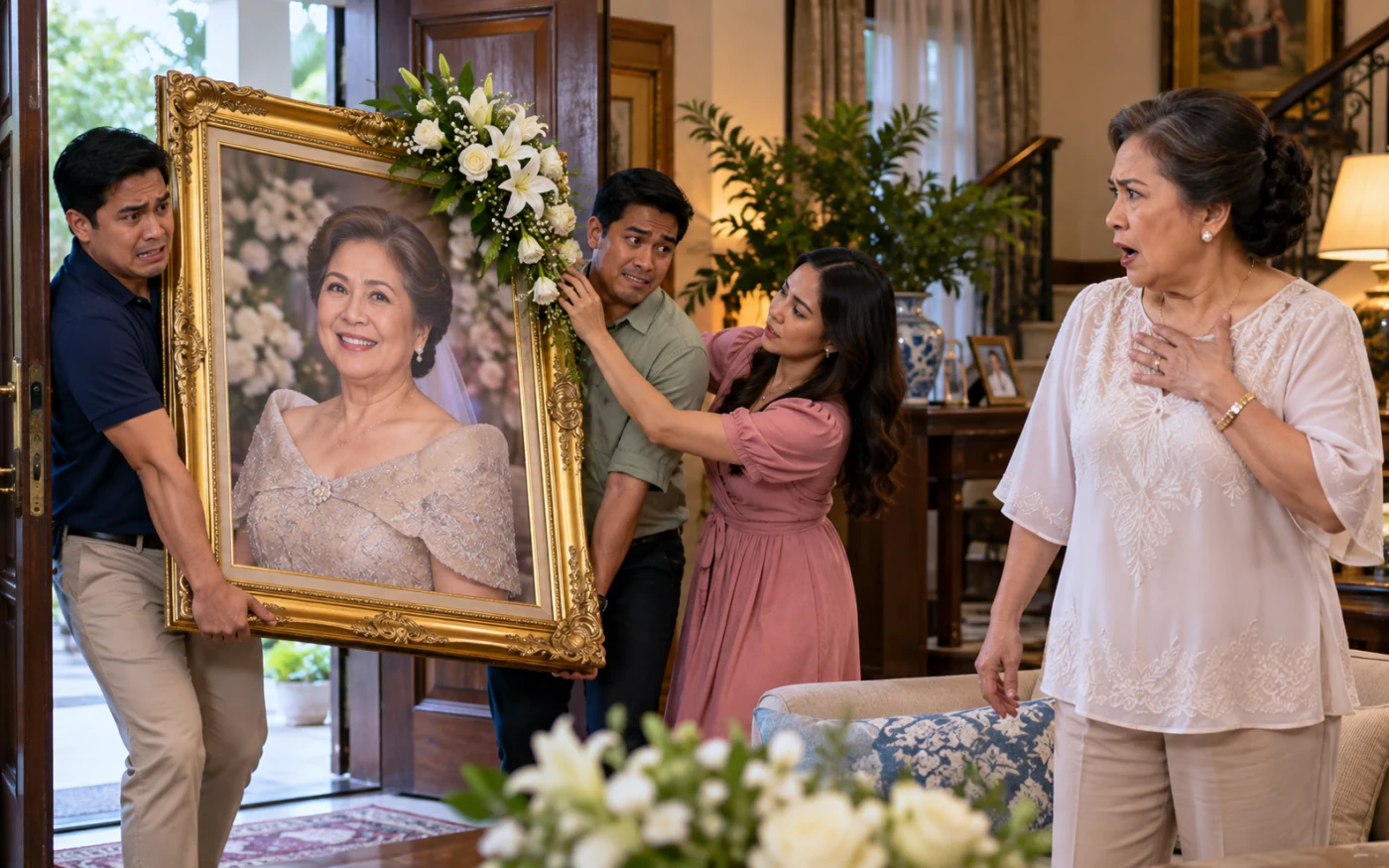
Saturday morning, Dennis and Mark carried my face through the front door sideways.
It was taller than I am. It needed its own easel.
It had a gold frame and a spray of white flowers, and it was smiling at me with my own teeth.
"I asked for yellow flowers," I said.
Elaine fixed a ribbon. "White looked more peaceful."
"I don't want peaceful. I want seventy."
Mark bent down to fix the legs of the easel.
He stayed down there a long time. His shoulders were shaking.
I thought he was crying.
Then Elaine brought out my armchair, a pile of cushions, and a blanket.
It was so hot that day Dennis had opened every window in the house. The blanket was wool.
"In case," Elaine said, tucking it over my knees.
"In case of what?"
"Baka ginawin ka, Ma."
I took the blanket off and folded it on the armrest.
Ruth arrived next with the cake in a big white box tied with string.
"Let me see," I said.
Elaine took the box out of Ruth's hands and carried it straight into the kitchen.
"Surprise," she said over her shoulder.
Ruth looked at me. Then she looked at my enormous face on the easel.
"You chose that picture?"
"It's better than the first one."
She nodded slowly. "Naku, Doris."
Then she sat down beside me and started peeling an orange, very calm, like a woman watching a movie after she already read the book.
"Anything you need to tell anyone, Doris?"
"Why does everybody keep asking me that?"
She handed me half the orange.
"No reason."
The cousins came in carrying presents. My brother brought a bottle.
Two aunties arrived in bright dresses, saw the portrait, and stopped in the doorway like it had asked them for money.
I waved them in before they could ask questions.
The house filled up. Every chair was taken.
People were standing in my kitchen. People were standing in my hallway.
I had wanted this for years.
I looked around. Mark was across the room, suddenly very busy with a napkin.
Elaine came over with a glass of water.
"Small sips, Ma."
I took the biggest sip of my life while looking straight into her eyes.
Dennis turned and faced the wall.
"What is wrong with him?" I asked Ruth.
"Ask your son."
I stood up to go look at the lechon. Both of my sons stood up with me, like bodyguards.
"Where are you going, Ma?" Mark asked.
"To the table."
"We'll bring you whatever you need."
"I want to see the pig."
So they helped me to the table.
Helped me.
One son holding each elbow, walking me across my own living room, which I have been crossing without assistance for most of my life.
My cousins stopped talking as we passed. My brother lowered his drink.
I have never felt so healthy and so carried at the same time.
I lifted the foil. The lechon was perfect. Brown and shining and crisp all over.
"Kain na tayo," I said.
"Tribute first, Ma," Elaine said.
"Food first. Then a small tribute."
"We'll be quick."
She walked me back to my chair. Mark put the blanket on my knees again. I let him, because I was running out of arms.
Dennis dimmed the lights.
Then he pressed play on his phone, and slow, sad piano music came out of the speaker.
The kind they play in movies when the doctor takes off his glasses.
"Ano ba? Not that," I said.
He stopped it immediately.
Elaine touched my shoulder. "Too much, Ma?"
"Not enough dancing."
She nodded like I had said something very brave.
Then Mark stood beside my portrait in the good shirt I bought him for Christmas and unfolded a stack of paper.
A thick stack.
He had never written that much for anything, including school.
Elaine called Dennis over. My three children stood together under my giant smiling face.
Mark cleared his throat.
"We always thought," he said, "there would be more time to say these things."
I gripped the arms of my chair.
This was everything I had asked for. Every eye in the room on me. All three of my children, in my house, on a Saturday.
And now they were going to say goodbye.
I stood up before he could read another word.
PART 3: What Was on the Cake
"Stop!" I said.
Mark jumped. I stepped toward him and bumped the easel.
My enormous face started falling.
I grabbed the frame with both arms.
The flowers slipped off. The room gasped.
And there I was, standing in my living room, hugging a picture of myself that was taller than me.
Nobody breathed.
"Put the paper down, Mark," I said, into my portrait's shoulder.
"Ma?"
"I'm not sick."
It was so quiet I could hear the lechon cooling.
I let go of myself carefully and turned around.
"My checkup was fine. Everything was normal. The folder is insurance papers. I just wanted you to know where they are."
My brother sat forward in his chair.
"But I knew what you thought," I went on.
"Since Sunday. I should have said it at the table. I kept trying. And every time I tried, somebody stayed a little longer, and I..."
I looked at the good plates on the table.
"I liked it," I said. "I'm sorry. I let you worry because I wanted you here."
Elaine walked over and took my hand in both of hers.
"We know, Ma."
I blinked at her.
"You know what?"
"That you're fine."
Behind her, Dennis made a small noise, like a balloon letting go.
"Since when?" I said.
"Wednesday."
I turned to Ruth.
Ruth put down her orange.
"You called me from the clinic parking lot," she said.
"You told me everything was normal. Then your daughter called me and asked what you weren't telling her. So I told her."
The phone call. The kitchen door. My feet in the warm water.
"You came back," I said to Elaine, "and asked if I had anything to tell you."
"I did."
"And I asked for lechon."
Dennis folded in half.
Then Mark went. He pressed his thick stack of paper against his face, but I could hear him laughing behind it.
Now I understood what he had been doing down by the easel all morning.
I looked at the blanket on my chair. The glass of water.
My two sons, who had walked me to the table like a queen being delivered.
"Small sips?" I said.
Elaine's face broke. She leaned against me, laughing so hard she had to hold on.
"You took such a big one, Ma."
"You monsters," I said.
Ruth went into the kitchen and came back with the white cake box.
Elaine untied the string and lifted the lid.
Yellow frosting flowers. And across the top, in thick blue letters:
NOT DYING. JUST SEVENTY.
I stared at it. Then at the portrait.
"You ordered all this after you knew?"
"Thursday," Mark said, wiping his eyes.
"And you let me change the picture?"
"We thought that was when you would tell us."
My cousins started laughing. Then the aunties. Then my brother, who has not laughed at a party since his own wedding.
"I approved my own memorial portrait," I said.
"Twice," said Dennis.
I covered my face with both hands.
Elaine gently pulled them down.
"Don't do that to us again, Ma."
"I won't, anak."
"And Ma." She looked at her brothers. They nodded.
"You were right. We weren't coming. We're sorry. Sundays are yours now. All three of us. Good plates."
I had to sit down for that.
I sat right down in my chair.
And all three of my children wrapped their arms around me.
When they finally let go, Mark was holding his stack of paper again.
"Ma," he said. "You said if people have nice things to say, let them say it while you're here."
"I did say that."
He smoothed the pages. "So it's still a tribute. Just not that kind."
Then my son read every page. Out loud. In front of everybody.
He did not skip one.
I cried through all of it, and this time nobody handed me water.
When he finished, Dennis put on the dancing music. Somebody uncovered the lechon.
Before we sat down, I picked up my enormous portrait and carried it to the empty chair beside mine.
Nobody helped me.
They were too busy laughing.
I sat with one arm around the gold frame while Elaine cut the cake and my sons passed out the slices.
Could I have handled things better?
Absolutely.
But nobody was rushing off.
My children. My whole family.
Right there at my table.
Eating off the good plates.