
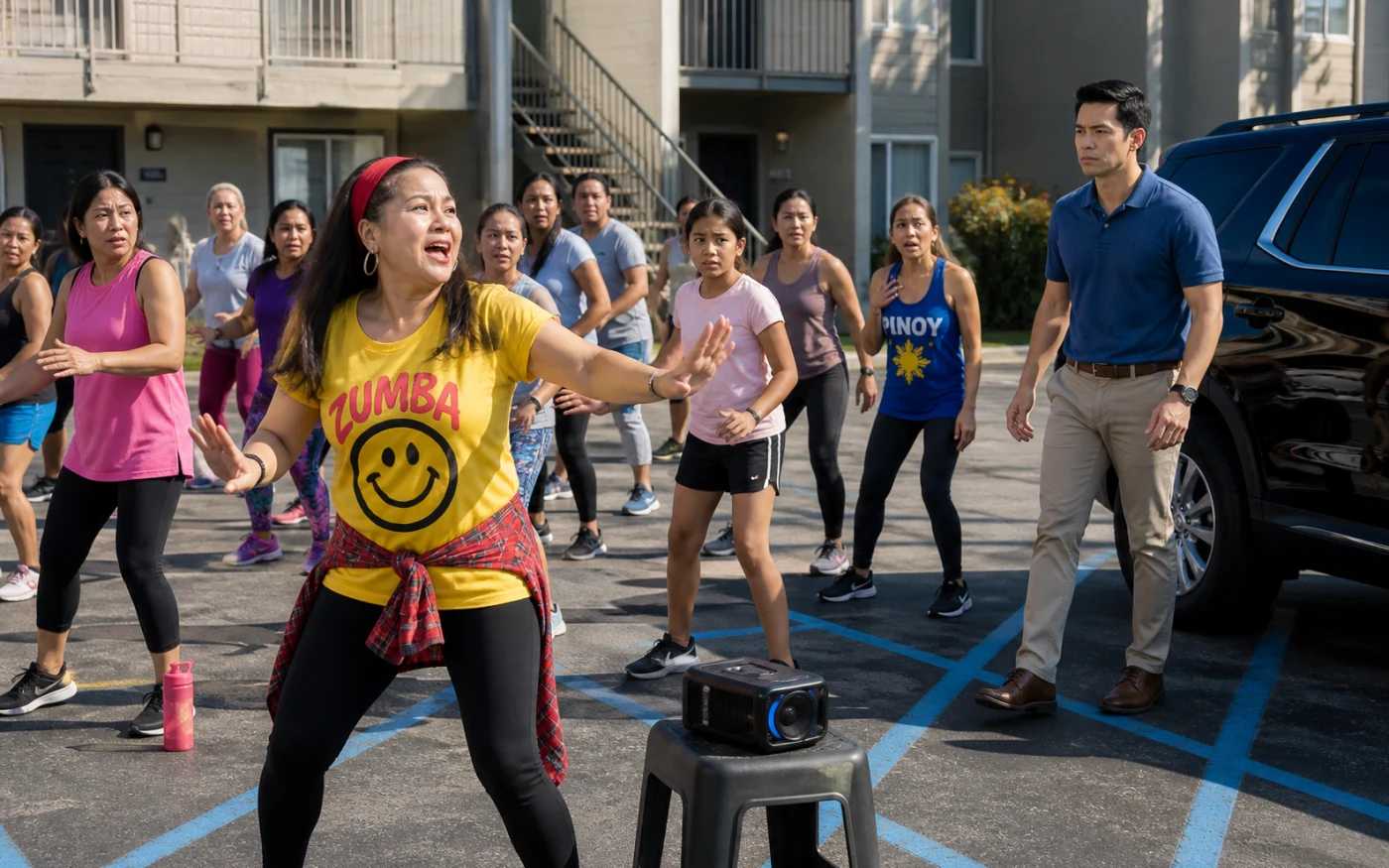
My Landlord Raised My Rent, So I Started a $5 Zumba Class in the Parking Lot. Four Weeks Later, Management Came to Shut Me Down...
PART 1: Five Dollars to Dance
The letter said my rent was going up four hundred dollars, so I carried my Bluetooth speaker into the parking lot and announced, “Zumba. Five dollars. Walang refund if pangit.”
That was my entire business plan.
I was sixty-one years old. I had one Zumba DVD from 2011, knees that made small clicking sounds on stairs, and absolutely no certification.
But I had lived at Pilar Arms for nineteen years. I knew exactly what I was working with: twenty-two apartments, two floors, one dying palm tree, and a parking lot full of people pretending not to be lonely.
The rent letter had arrived on a Tuesday.
Dear Valued Resident, it began.
Whenever somebody calls you “valued” before asking for money, hold your wallet.
I sat at my kitchen table with the letter beside my cold coffee. Four hundred dollars more, starting in six weeks. My paycheck from the school cafeteria already disappeared into rent, groceries, medicine, and the little envelopes I sent to my sister when I could.
No savings. No rich children. No secret gold bars inside the rice cooker.
I read the number six times, as if it might become ashamed and shrink.
Then somebody knocked.
It was Mr. Alvarez from unit 8, holding a package delivered to him by mistake.
“You okay, Fely?”
“Oo naman,” I said too quickly.
He looked at the letter. The same one was folded in his pocket.
“They got you too?”
Before I could answer, fourteen-year-old Jayla from unit 3 came downstairs, complaining that her mother had changed the Wi-Fi password. Then Mrs. Green from 17 appeared with laundry. Then little Noah chased a rubber ball between two parked cars while his father shouted from the balcony.
Everyone was home.
Nobody was together.
And suddenly I remembered the dusty DVD under my television—the one my cousin had given me after declaring that dancing would “bring back my waist.” It had not brought back my waist. But it had made me laugh.
By Thursday, I had taped a handwritten sign beside the mailboxes.
PARKING LOT ZUMBA WITH FELY
SATURDAY, 9 A.M.
$5 — BRING WATER AND COURAGE
Jayla took a picture.
“Tita Fely, are you even trained?”
“I trained in my sala.”
“For how long?”
“The DVD is fifty-two minutes.”
She stared at me, then laughed so hard she had to lean against the mailboxes.
Saturday morning, I woke at five.
At eight fifty-five, the parking lot was empty.
I had moved my own Toyota to the street and marked a crooked rectangle with blue painter’s tape. My speaker sat on a plastic stool. I wore black leggings, a yellow shirt, and the red headband I used when frying lumpia for Christmas.
At eight fifty-eight, I nearly went upstairs.
Then Mrs. Green arrived.
“Don’t expect jumping,” she warned.
Mr. Alvarez came next, wearing jeans.
“You cannot dance in those,” I told him.
“Watch me.”
Jayla and her two friends appeared with their phones already recording. They stood by the palm tree, giggling.
I pressed play.
The first song came out much louder than it had inside my apartment. A dog began barking on the second floor. Mrs. Green turned left when I turned right. Mr. Alvarez attempted one hip circle, lost his balance, and grabbed the dying palm tree.
“Isa, dalawa, tatlo, apat!” I yelled.
“Lima, anim—ay, mali!”
The teenagers shrieked with laughter.
“You think madali?” I shouted. “Halika! Join us!”
Jayla lowered her phone.
Five minutes later, all three girls were dancing.
By the end, we were sweaty, breathless, and completely out of step. Mrs. Green gave me five dollars. Mr. Alvarez gave me ten and refused change.
“Same time next week?” Jayla asked.
I looked around at five flushed faces.
“Next week,” I said.
Week two brought eleven people, including a woman around my age with silver-streaked hair and bright pink shoes.
“I’m Carol,” she said. “Saw the video online.”
Jayla lifted one guilty shoulder.
Week three brought twenty-one.
By week four, thirty bodies filled every space between the blue lines. A barber from across the street came. So did two nurses finishing a night shift, a mother with a baby strapped to her chest, and three delivery drivers who danced beside their van.
Mr. Bell from unit 12 came down too.
He had not left his apartment on a weekend in two years. Usually, I left soup outside his door and knocked twice. That Saturday, he stood at the edge in gray sweatpants, arms crossed.
“I’m only watching,” he said.
“Five dollars to watch.”
“That’s robbery.”
“Then dance. Libre ang embarrassment.”
He stayed for the whole hour.
After class, while everyone shared sliced oranges and pan de sal on the hood of my Toyota, Mr. Bell quietly asked whether the next class might include “something slower.”
That night, I counted one hundred forty-five dollars on my bed.
For the first time since the letter, I could breathe.
The following Monday, another envelope appeared under my door.
It said CEASE AND DESIST in bold letters.
Unpermitted commercial activity. Excessive noise. Liability exposure. Immediate termination.
At the bottom was the name of our new property manager: Dustin Cole.
And beneath his signature, one final sentence:
Management will conduct an enforcement visit Saturday at 9:00 a.m.
PART 2: Who Was in Third Row
“You have to cancel,” Jayla’s mother said Friday night.
We were gathered outside my apartment, passing the notice from hand to hand. Somebody had brought pancit. Somebody else brought folding chairs. Nobody knew whether we were having a crisis meeting or a birthday party.
“They can evict you,” Mrs. Green whispered.
“Can they?” Mr. Alvarez asked.
Everyone looked toward Arnel, somebody’s nephew who “knew about permits.”
Arnel adjusted his glasses. “Technically, Tita Fely is conducting commercial activity on private property.”
“Whose side are you on?” his aunt demanded.
“Sa atin, siyempre. But technically—”
“No more technically. Kain ka muna.”
I smiled, but my stomach felt hollow.
The management company was not inventing everything. I charged money. I played loud music. Mr. Alvarez had nearly injured himself on a tree. If somebody fell, my twenty-dollar speaker and cafeteria paycheck would not save anyone.
“Maybe we stop,” I said.
The hallway went quiet.
Mr. Bell looked down at his hands. Jayla stopped chewing. Even Noah, sitting on the floor with noodles hanging from his mouth, seemed offended.
Then Carol spoke from the stairwell.
“Or we have one last class.”
Everyone turned. She had driven forty minutes just to attend our meeting.
“If they’re coming Saturday,” she said, “let them see what they’re shutting down.”
“And if they call police?” I asked.
Carol shrugged. “Then I hope the police can keep tempo.”
Saturday morning, I wore my yellow shirt again.
At eight fifty, thirty people stood in the parking lot.
Nobody hid. Mrs. Green brought a first-aid kit. Arnel carried a folder of printed forms. Jayla had made a sign saying WE ACCEPT THE RISK OF BAD DANCING. Even Mr. Bell stood in the second row, stretching one leg against the curb.
“You don’t have to do this,” I told them.
“Start the music, Fely,” he said.
At exactly nine, a black SUV pulled in.
Dustin stepped out wearing khaki pants and a blue company polo. He was twenty-nine, maybe thirty, with clean white shoes and the tired expression of somebody already annoyed by a conversation that had not begun.
He walked toward my speaker.
“Ma’am, turn that off.”
The way he said ma’am made it sound like a warning label.
I kept my hand on the volume knob. “Good morning, Dustin.”
“You received the notice?”
“I received four hundred dollars also.”
Behind me, somebody coughed to hide a laugh.
His jaw tightened. “This gathering violates your lease. You’re operating a business in a common parking area and creating a serious liability.”
“We signed waivers,” Arnel announced, holding up his folder.
Dustin barely glanced at him. “Those don’t authorize the use.”
“We can lower the music,” Mrs. Green offered.
“That’s not the only issue.”
“We’ll move the cars.”
“Still not the issue.”
Every solution hit him and fell flat.
He reached toward the speaker.
Then a woman in the third row said, “Dustin, tama na.”
His hand froze.
I turned.
Carol stood between Jayla and Mr. Bell in her bright pink shoes, one hand on her hip.
All the impatience vanished from Dustin’s face.
“Mom?”
Nobody moved.
Dustin stared at her as if she had stepped out of the dying palm tree.
“What are you doing here?”
Carol’s cheeks reddened. “Zumba.”
“Here?”
“Obviously here.”
“Since when?”
“Week two.”
His voice dropped. “You drive forty minutes for this?”
“You told me about it after the first class,” Carol said. “So I looked it up.”
Dustin stared at her.
Carol looked at the pavement.
The bold woman who had challenged property management suddenly seemed smaller. She rubbed the toe of one pink shoe against a blue parking line.
“Why didn’t you tell me?” Dustin asked.
When Carol looked up, her eyes were shining.
“Because,” she said softly, “I didn’t want my son to know how lonely his mother had become.”
PART 3: Why She Kept It Secret
Dustin opened his mouth, but nothing came out.
Carol crossed her arms as if that could hold everything inside.
“After your dad died, people kept calling,” she said. “Then they stopped. You call every Sunday, anak, but you’re always rushing. I don’t blame you. May trabaho ka.”
Dustin looked around the parking lot.
At Mrs. Green holding the first-aid kit. At Mr. Bell in his sweatpants. At three teenagers who had come to make fun of me and now knew every song better than I did.
“Mom,” he said, quieter now.
“Here, nobody asks me to be okay.” Carol wiped one cheek. “They just say, ‘Move left, Carol.’ So I move left.”
For one moment, I thought that would change everything.
It did not.
Dustin inhaled, looked down at his company logo, and became the property manager again.
“The parking-lot class still has to stop.”
Groans rose behind me.
“Grabe ka,” Carol said.
“I can’t ignore the liability, Mom.”
“Then don’t ignore it,” Arnel said. “Give us another space.”
Dustin frowned. “There isn’t one.”
From the second-floor railing, Noah’s father called, “What about the common room?”
Everybody looked toward the far end of Pilar Arms.
Beside the laundry room was a brown door that had been locked since 2019. Behind it sat the old common room, abandoned after a pipe leak. Most newer residents thought it was storage.
“That room is closed,” Dustin said.
Arnel flipped through his papers. “Closed permanently or pending repair?”
“I don’t know.”
“May we inspect it?”
“No.”
Carol raised one eyebrow.
Dustin looked at her, then at thirty people waiting behind me.
Ten minutes later, he unlocked the door.
The room smelled like dust and wet cardboard. One ceiling tile sagged. Broken chairs were stacked against the wall, and a dead ficus leaned in the corner like it had given up years ago.
But there was a floor.
There were outlets.
And there was a door that closed.
“This is disgusting,” Jayla said.
“It’s perfect,” I answered.
What followed was the most chaotic week of my life.
Management agreed to reopen the room if we cleaned it, kept attendance below capacity, obtained a small activity permit, and signed proper waivers. Dustin did not apologize. He emailed the conditions in a document titled FINAL ACCOMMODATION, as if he had negotiated world peace.
Nobody cared.
Mrs. Green brought bleach. Mr. Alvarez patched the wall. The teenagers painted one side pale yellow and left handprints everywhere until Jayla’s mother made them repaint it. Arnel completed the permit forms, then discovered he had used an expired version and completed them again.
We hauled out six bags of trash.
Mr. Bell repaired the broken window latch. When I thanked him, he shrugged.
“I used to fix things,” he said.
On Friday afternoon, the permit arrived.
I taped it to the wall like a diploma.
Saturday’s class sold out before breakfast.
Thirty names. Thirty five-dollar bills. Enough over the month to meet the rent increase, with a little left for cleaning supplies and batteries.
At eight fifty-five, I stood at the front of our new room. The floor shone. A secondhand fan hummed by the window. Someone had placed a tray of bananas and puto beside the water cooler.
Carol took her usual place in the third row.
Then the door opened.
Dustin stepped inside.
He wore an old gray shirt, black gym shorts, and the expression of a man entering a dentist’s office.
“I’m just dropping off the capacity sign,” he said.
Carol pointed to the empty spot beside her.
“Dito ka.”
“Mom, I have work.”
“One hour.”
“I really can’t.”
She kept pointing.
Dustin looked at me for help.
I pressed play.
The room exploded with music.
“Warm-up!” I shouted.
Dustin lasted twelve seconds by the door before Carol walked over, grabbed his wrist, and pulled him into the back row. His first step went in the wrong direction. His second nearly collided with Mr. Alvarez.
Jayla laughed so hard she missed her own turn.
“No filming,” Carol warned her.
“I wasn’t!”
“Sinungaling.”
By the third song, Dustin’s face was red. By the fourth, he had stopped checking his phone. During the slow number, Carol reached for his hand, and this time he did not pull away.
I turned up the speaker.
Thirty people filled the yellow room—people who had spent years hearing one another through walls, passing in the stairwell, collecting each other’s packages, never knowing who needed soup or music or somebody to say their name.
I raised both arms.
“Ready?” I called.
“Ready!” they shouted.
“Isa, dalawa, tatlo, apat!”
Half the room stepped right. The other half stepped left. Dustin bumped into his mother, and Carol caught him, laughing against his shoulder.
“Lima, anim, pito, walo!”
They all got it wrong together.