
Lola's Goat Kept Escaping Into the Grumpy Widower's Vineyard Next Door. Then We Caught Lola Letting It Out.
PART 1: The Usual Suspect
I helped my grandmother break into a vineyard because she was too proud to ask a man to dinner.
To be fair, I did not know that was what I was doing at first.
I thought I was catching a goat.
Lola Felisa lived on a little piece of land outside Delano, with a vegetable garden, six chickens, and one white goat named Madam.
Madam had the face of a saint and the morals of a casino dealer.
Every few days she escaped through the fence and marched into the vineyard next door.
That vineyard belonged to Mang Tino, a widower with thick gray eyebrows and the permanent expression of a man who had just discovered somebody had parked in his space.
He always brought Madam home himself.
He would appear at our gate holding her rope and calling, “Felisa! Your criminal is back!”
Lola would come outside slowly, wiping perfectly clean hands on her apron.
“Ang drama mo. A goat cannot be a criminal, Tino.”
“She ate three vines.”
“She is one goat. Maybe your vines are weak.”
Then he would complain for ten minutes, and Lola would listen with her chin lifted.
After he left, she always made coffee.
Two cups.
She drank one and poured the other into the sink.
I noticed this because I was spending the summer with her, which mostly meant sleeping until ten, wearing old shirts, and becoming emotionally invested in a goat.
My cousins Dante and Issa came most weekends to repair the fence.
The first time, we replaced a loose board.
The second time, we added chicken wire.
The third time, Dante installed a latch meant for a horse stall.
He slapped it proudly and said, “If she opens this, she can have my car.”
The next morning, Madam was standing on the hood of his car.
She had not opened the latch.
She had climbed onto a feed bin, stepped onto the chicken coop roof, and dropped over the fence like a furry burglar.
Lola watched us chase her across the yard.
“Maybe she wants exercise,” she said.
“She is getting plenty,” I said, bent over and wheezing.
Madam chose that moment to pull a dish towel from the clothesline and run through the tomatoes with it streaming behind her like a parade banner.
Mang Tino arrived carrying a basket of grapes.
He did not smile.
His eyebrows did something complicated, though.
“I came to discuss damages,” he said.
“With grapes?” Lola asked.
“Evidence.”
She took the basket.
That evening she washed every grape and arranged them in her good blue bowl.
Lola had been alone for eleven years.
She never called herself lonely.
She just cooked enough sinigang for eight people and complained when only three of us came.
She kept Lolo’s chair at the table, but lately she had stopped setting a plate near it.
That seemed like progress until I noticed she now stood at the window whenever Mang Tino worked among the vines.
“I am checking if Madam escaped,” she told me.
Madam was asleep under the table.
The next escape was stranger.
At six in the morning, Mang Tino knocked with Madam beside him and mud on both knees.
“She got into my irrigation ditch.”
“Why were you in it?” Lola asked.
“Somebody had to lift her out.”
“You are limping.”
“I am not.”
He limped back to his vineyard.
Lola spent the afternoon making chicken arroz caldo “because we had too much ginger.”
She carried a covered pot next door.
She returned two hours later without it, wearing lipstick.
That was when I stopped blaming the goat.
Dante borrowed a motion camera from his friend who watched raccoons in his backyard.
We mounted it above the gate, aimed it at the latch, and said nothing to Lola.
At dawn the next morning, my phone chimed.
The camera had recorded movement.
I opened the video.
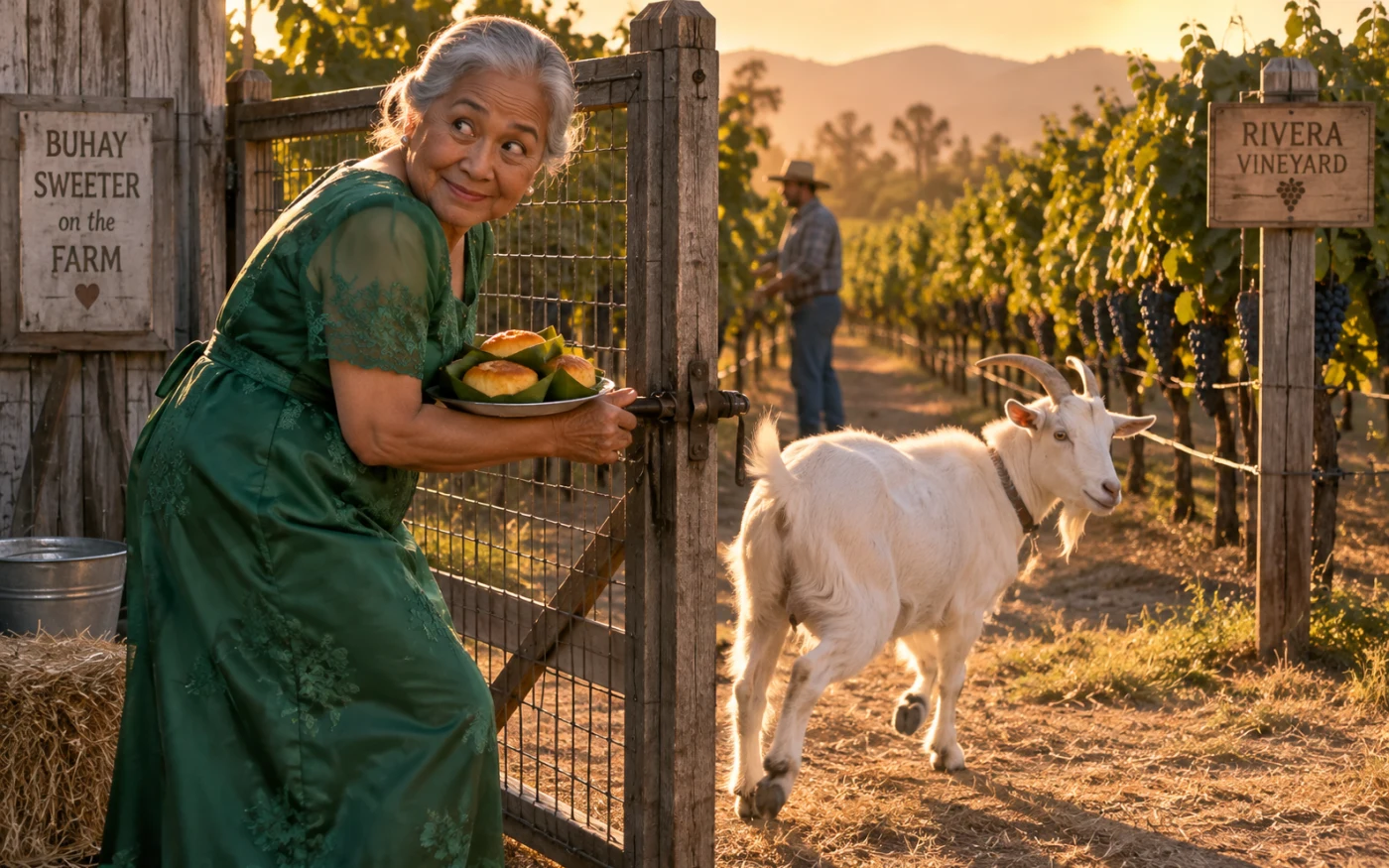
There was Lola in her best green dress, unlatching the gate with one hand and holding a plate of warm bibingka in the other.
She looked left.
She looked right.
Then she whispered, “Go, Madam. And do not embarrass me.”
Madam trotted straight toward Mang Tino’s vineyard.
Lola followed at a dignified distance.
She was also wearing perfume.
I called Dante and Issa.
“Emergency meeting,” I said.
“Is the goat alive?” Dante asked.
“The goat is running a dating service.”
Before breakfast, the three of us climbed through the vineyard fence to see how deep the conspiracy went.
We found a brand-new goat pen behind Mang Tino’s tool shed.
It had a roof, fresh straw, a water trough, and a shady bench wide enough for two stubborn people.
On the bench sat a bowl of sliced mangoes.
Then Mang Tino’s voice came from behind us.
“Would the three of you like to explain why you are eating my goat’s mangoes?”
PART 2: The Sign in the Yard
We turned around together.
Dante was holding a length of rope.
Issa had a mango slice halfway to her mouth.
I was sitting on the shady bench.
There are moments when honesty is the only sensible choice.
“We came to inspect your drainage,” I said.
Mang Tino stared at me.
“From my bench?”
“The view is better.”
He folded his arms.
Behind him, Madam was eating a paper seed packet.
We told him about the camera.
Not immediately, of course.
First Dante tried to claim we were testing the fence.
Then Issa said she had smelled mangoes.
Finally I showed Mang Tino the video of Lola opening the gate in her green dress.
He watched it twice.
His eyebrows relaxed.
“So,” I said, “you built all this to contain the problem?”
“Exactly.”
“The problem has a bench.”
“I get tired.”
“And sliced mangoes.”
“The goat likes mangoes.”
Madam spat out the seed packet and walked past the fruit.
Mang Tino took my phone and watched the video a third time.
His smile was so small it might have been a crack in the weather.
“Delete this,” he said.
“After you ask her out.”
The smile disappeared.
“I am too old for foolishness.”
“You built a furnished apartment for a goat.”
“It is a containment area.”
He took the bowl of mangoes inside.
We decided to help.
This was our first mistake as a group.
Our plan was simple.
We would invite Mang Tino to Sunday lunch, seat him beside Lola, and create one quiet moment for them to speak.
I cooked pancit.
Issa brought lumpia.
Dante was responsible for getting Mang Tino there without making the invitation sound romantic.
He told him we needed advice about termites.
“Why termites?” I asked.
“Men respect termites.”
Mang Tino arrived with a flashlight, a screwdriver, and two pamphlets from the county agriculture office.
Lola wore the green dress again.
She pretended this was because all her other clothes were drying.
There were no clothes on the line.
Lunch might still have worked if Madam had not found the open kitchen door.
She came inside silently and ate the center out of the pancit tray while we were on the porch.
When Lola carried the tray out, the noodles formed a perfect ring around an empty middle.
Nobody spoke.
Madam appeared behind her with one noodle hanging from her mouth.
Mang Tino laughed.
I had never heard him laugh before.
It came out in rusty bursts, and he had to hold the table.
Lola tried to stay offended.
Then the noodle slid off Madam’s face and landed on Dante’s shoe.
Lola laughed too.
For a few minutes, they looked young.
They sat side by side, eating lumpia and talking about the summer they had both worked at the same packing shed.
I began collecting plates very slowly.
Issa kicked Dante when he tried to ask about termites.
Then a white pickup stopped by Mang Tino’s property.
A woman in a blazer pushed a red-and-white sign into his front yard.
FOR SALE.
Lola’s laugh ended.
Mang Tino stood up.
“I was going to tell you,” he said.
“Tell me what?”
“My son wants me in Chicago. The vineyard is too much work now.”
Lola set down her fork.
“Then you should go.”
“Felisa.”
“Your family needs you.”
His face closed like a door.
He thanked us for lunch and went home.
Lola carried the ruined pancit into the kitchen.
I followed her.
“You could ask him to stay.”
“Why would he stay for me?”
“Because you have been releasing livestock at dawn.”
She froze.
I showed her the video.
She watched herself open the gate.
Then she handed back my phone.
“That dress looks better in person.”
“Lola.”
“He made his choice.”
For the next week, Madam did not escape.
Lola stopped standing at the window.
Mang Tino stopped coming to the gate.
The bowl of mangoes vanished from the bench.
On Friday, a moving truck backed into his driveway.
That night, we met beside Madam’s pen.
Dante held the gate key.
Issa held a ribbon.
I held a note that said, in Lola’s handwriting, PLEASE COME BACK.
She had not written it.
PART 3: What Madam Delivered
I know forging your grandmother’s handwriting is wrong.
I also know that by then Mang Tino’s dining chairs were wrapped in blankets.
We tied the note to Madam’s collar with the ribbon.
“This is not manipulation,” I said.
“Of course not,” Issa said. “It is goat-assisted communication.”
At five the next morning, we opened the gate.
Madam did not move.
We had spent all summer trying to keep her in.
Now she stared at freedom as if it were an unreasonable request.
Dante offered her lettuce.
She ate it without taking a step.
Issa pushed from behind.
Madam sat down.
I whispered, “Mang Tino has pancit.”
She stood so fast that Issa fell into the water trough.
Madam shot through the gate.
We followed at a run.
Lola came out onto the porch in her nightgown.
“What are you doing?”
“Morning exercise,” I called.
“With ribbon?”
We crossed the property line just as the moving men carried Mang Tino’s sofa through his front door.
Madam charged between them.
One man stepped left.
The other stepped right.
The sofa turned sideways and wedged in the doorway.
Mang Tino came around the truck carrying a box marked KITCHEN.
Madam saw him and leaped onto the shady bench.
The ribbon caught on a loose board.
The note tore free, flew over the fence, and landed in the open cab of the moving truck.
I climbed onto the bench.
Madam climbed onto the bowl stand.
Dante climbed onto the fence.
Issa, still dripping, tried the truck door.
The driver thought we were stealing his vehicle.
He leaned on the horn.
The horn startled Madam.
Madam jumped onto a stack of empty grape crates.
The crates toppled one after another.
She landed inside an open wardrobe box and kept running with the box around her middle.
All we could see were four white legs and a flowered ribbon.
She raced down the vineyard row like a small refrigerator with hooves.
The moving men dropped the sofa.
The driver kept honking.
Dante chased the wardrobe box.
Issa chased the note, which had blown out the other door.
I chased everybody while shouting, “Nobody panic!”
I was panicking enough for the whole county.
Then Lola appeared at the end of the row in her nightgown and rubber slippers.
“Madam! Halika rito!” she shouted.
The box stopped.
Madam’s head popped through the top.
Silence fell over the vineyard.
Even the driver took his hand off the horn.
The note drifted down and landed at Mang Tino’s feet.
He picked it up.
Lola saw her own handwriting.
Then she looked at me.
“I can explain,” I said.
“You cannot even copy my P.”
Mang Tino read the note.
He looked at Lola.
“Did you write this?”
Lola lifted her chin.
I was sure she would deny it.
Instead she said, “No. But I should have.”
Nobody moved.
Madam began eating the top of the wardrobe box.
Mang Tino walked to Lola.
“I waited for you to ask me to stay.”
“I waited for you to ask if I wanted you to.”
“Do you?”
“Yes.”
He nodded once.
“Then will you have dinner with me tonight?”
Lola looked down at her nightgown.
“Not dressed like this.”
“Seven o’clock.”
“Six-thirty. You eat too late.”
He turned to the moving men.
“Please put the sofa back.”
The man holding one end looked at the sofa wedged in the doorway.
“We have been trying.”
That afternoon, Mang Tino took down the FOR SALE sign.
His son was not angry.
He had wanted his father closer because he worried about him living alone.
When Mang Tino called and said he would not be alone anymore, his son went quiet, then asked when he could meet Lola.
Three months later, they married between the grapevines.
Lola wore the green dress until Issa convinced her that a bride was allowed one new outfit.
Mang Tino put the shady bench beneath an arch covered with white flowers.
There were folding chairs for family, long tables of food, and enough pancit for a hundred people.
This time, Dante guarded it.
Madam walked down the aisle in a flower crown.
She stopped halfway to eat one of the decorations, but nobody expected perfection from the matchmaker.
At dinner, Lola sat beside Mang Tino and slipped him the best slice of mango.
He put it on Madam’s plate.
Then he reached under the table and held Lola’s hand.
For once, she did not pretend she had somewhere else to be.